News
Rich project cases across industries, showing real implementation and proven technical strength.Selecting the right pneumatic conveying system for grain handling is a critical decision that directly impacts operational efficiency, product quality, and long-term profitability. As global grain trade volumes continue to expand—reaching an estimated 2.8 billion metric tons in 2026 according to industry projections—the demand for reliable, hygienic, and energy-efficient conveying solutions has never been higher. Grain processors, feed mills, breweries, and storage facilities alike face common challenges: minimizing breakage, preventing contamination, reducing dust emissions, and maintaining consistent flow rates across varying material characteristics. A systematic selection approach, grounded in material properties, system configuration, and lifecycle cost analysis, ensures that the chosen equipment aligns with both immediate production needs and future scalability. This guide draws on decades of practical engineering experience and current market data to help decision-makers navigate the complexities of grain pneumatic conveying system selection, from dilute phase to dense phase, from vacuum to pressure systems, and from component sizing to automation integration.
Understanding the fundamental differences between grain types is the first step in any selection process. Corn, wheat, barley, soybeans, rice, oats, and specialty grains each exhibit unique physical properties—particle size distribution, bulk density, moisture content, angle of repose, and friability—that influence pneumatic conveying behavior. For example, wheat with its narrow size range and moderate density typically flows well in dilute phase systems, while soybeans, with larger particles and higher oil content, require careful velocity control to avoid mechanical damage and oil smearing on pipe walls. Moisture content directly affects adhesive forces and material cohesion; grains stored at 14% moisture behave very differently from those at 18% moisture, especially in humid climates where condensation risks rise. The angle of repose dictates how material settles in hoppers and feeders, affecting discharge consistency. Heavyweight grain like corn (bulk density around 45–50 lb/ft³) demands more air power than lighter grains like oats (around 26–32 lb/ft³), but the trade-off must be balanced against particle degradation. Industry data from 2025–2026 shows that improper velocity settings account for up to 68% of grain breakage incidents in pneumatic systems, underscoring the need for accurate empirical testing or reference to established material classification standards such as the Ergun equation or the Carr classification system. Headpowder’s engineering team routinely characterizes client grain samples in their test lab, enabling precise determination of minimum conveying velocity, saltation velocity, and pressure drop across the pipeline, which forms the foundation of a reliable system design.
Once the grain properties are understood, the next decision involves selecting between dilute phase and dense phase conveying. Dilute phase systems suspend particles in a high-velocity airstream (typically 20–35 m/s) and are well-suited for low-density, free-flowing grains where throughput is moderate and distances are short to medium (under 200 meters). They are generally lower in capital cost and easier to maintain, but the high velocities increase wear on bends and elbows and cause higher particle attrition rates. In contrast, dense phase conveying moves grain at low velocities (3–8 m/s) using pressure differentials and air permeation through the material plug, drastically reducing friction and breakage. This is ideal for fragile, high-value grains such as malted barley or specialty rice, and for longer distances exceeding 150 meters. However, dense phase systems are more complex to design, require higher air pressure (up to 6–8 bar), and involve larger filter receivers and blow-off valves. Many modern grain facilities are adopting hybrid configurations—using dilute phase for short transfers from receiving pits to silos, and dense phase for long-distance transport to process areas or loading stations. A 2026 market analysis indicates that demand for dense phase systems in the grain sector has grown by 22% over the past three years, driven by stricter quality standards for food-grade grains and export specifications that penalize broken kernels. Headpowder has supplied over 120 grain-conveying systems globally, including a notable installation for a large Midwest U.S. grain terminal that switched from dilute phase to dense phase and reported a 40% reduction in kernel damage and a 15% decrease in energy consumption per ton conveyed.
Every grain pneumatic conveying system comprises several core elements: a motive air source (blower or compressor), a material feeding device (rotary airlock, venturi injector, or screw feeder), a conveying pipeline with bends and diverter valves, a separation device (cyclone, filter receiver, or baghouse), and a control system. Each component must be sized and configured to match the grain type and conveying phase. For motive air sources, positive displacement blowers are standard for dilute phase applications requiring moderate pressure (0.5–1 bar) and high volume, while screw compressors or reciprocating compressors are chosen for dense phase systems needing higher pressure. The airlock, often the most maintenance-intensive component, must be designed with abrasion-resistant materials (hardened steel or ceramic coatings) for grains with high silica content. The pipeline routing should minimize the number of bends, particularly tight-radius elbows, which cause the most severe wear and particle damage. Long-radius bends with at least 10 times the pipe diameter in radius, or even sandwich bends with replaceable wear liners, significantly extend service life. Diverter valves for multi-destination systems must be selected for dust-tight sealing to prevent cross-contamination, especially in facilities handling different grain types. Filter receivers should have sufficient cloth area to handle the system’s full air volume while meeting environmental emission standards (for example, the U.S. EPA’s grain mill standard of 0.01 gr/dscf). Headpowder’s modular component platform allows clients to mix and match standard parts—such as their patented anti-wear elbow series and airlock rotors with adjustable tip clearance—enabling customized solutions without extended lead times or excessive cost premiums.
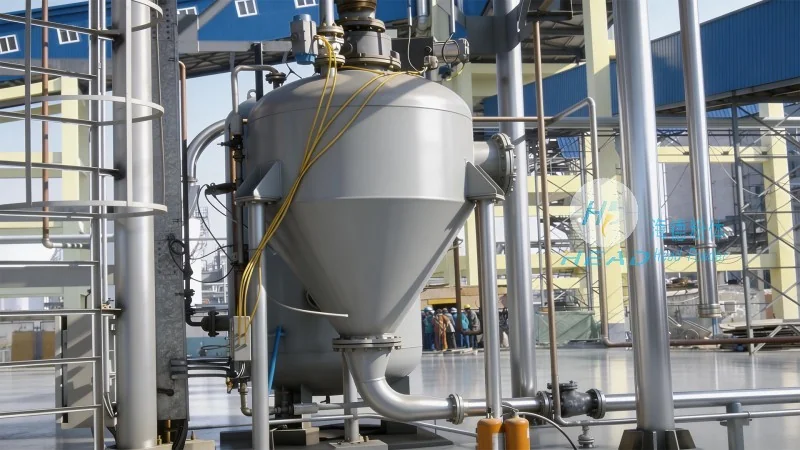
Velocity is the single most influential parameter in grain pneumatic conveying. Too low, and material drops out of suspension, causing blockages and surge flow; too high, and particle breakage and pipe wear accelerate exponentially. The “saltation velocity”—the airspeed at which particles begin to fall out of the airstream—must be calculated for each grain type and conveying condition. For wheat at typical loading ratios, saltation velocity is around 18–22 m/s; for corn, 20–25 m/s; for lighter grains like oats, 15–18 m/s. A safe conveying velocity is normally 1.5 to 2 times the saltation velocity, but this margin can be reduced in dense phase systems where material moves as a plug. The pipeline diameter directly affects velocity: a smaller diameter increases velocity for the same air volume, while a larger diameter reduces it. Proper sizing considers both the required throughput and the available pressure drop. Modern computational fluid dynamics (CFD) modeling, combined with empirical testing, allows engineers to simulate flow patterns and identify problem zones before installation. For example, a 2025 project in Brazil’s grain belt used CFD to optimize a 500-meter-long line conveying soybeans through a complex path with 27 bends, reducing projected wear points by 42% and ensuring consistent throughput of 150 tons per hour. Headpowder offers a free preliminary velocity analysis service, where clients submit grain samples and desired capacities, and the engineering team returns a pipeline diameter recommendation within three business days.
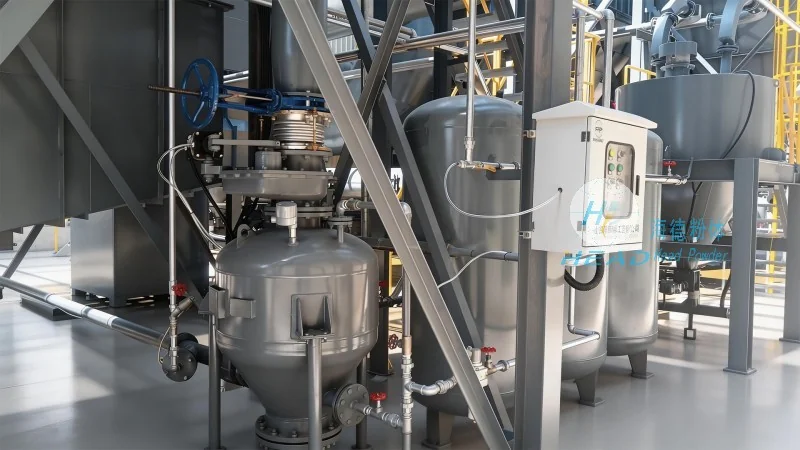
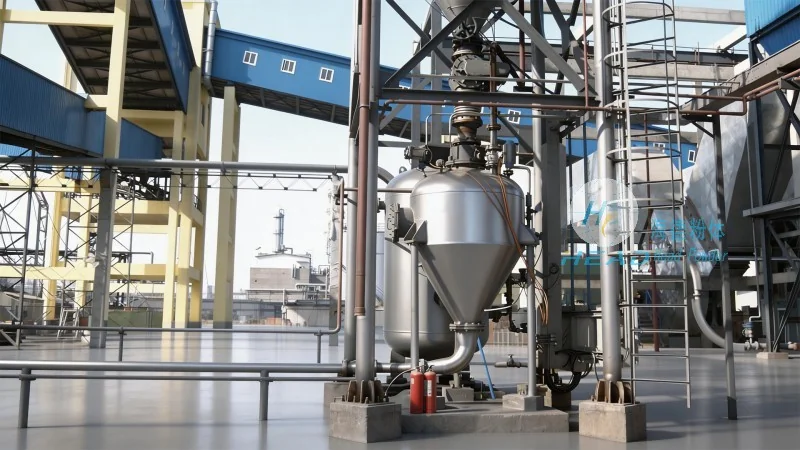
Energy costs represent 30–50% of the total operating expense of a pneumatic conveying system over its lifespan, making efficiency a top priority. In dilute phase systems, using variable frequency drives (VFDs) on blower motors can reduce energy consumption by 20–35% compared to fixed-speed operation when flow demand fluctuates. Dense phase systems inherently consume less air per ton conveyed because of the higher solids-to-air ratio—often 10:1 to 30:1 compared to 1:1 to 5:1 in dilute phase—but they require higher pressure, so the overall energy profile must be evaluated holistically. Heat recovery from compressor aftercoolers is an emerging trend; captured heat can preheat drying air or provide building heating, improving overall facility efficiency. Industry benchmarks from 2026 show that a best-in-class grain conveying system achieves an average specific energy of 0.8–1.2 kWh per ton per 100 meters of conveying distance. Regular maintenance—such as cleaning filter receivers, inspecting airlocks for seal wear, and checking pipe internal surface roughness—can prevent efficiency drift of up to 10% per year. Headpowder’s systems are designed with energy monitoring sensors that integrate into facility SCADA, providing real-time performance data and alerting operators when maintenance is due, helping customers maintain optimum efficiency throughout the equipment’s 15–20-year service life.
Modern grain processing plants are increasingly adopting Industry 4.0 principles, and pneumatic conveying systems must be compatible with centralized control architectures. Programmable logic controllers (PLCs) with touchscreen interfaces allow operators to set conveying parameters, monitor pressure and flow, and receive alarms for filter receiver cleaning cycles or airlock jams. Advanced systems incorporate automatic velocity correction: if a pressure spike indicates a developing plug, the control system can momentarily boost the blower speed to clear the line without manual intervention. Remote monitoring via cloud platforms enables plant managers to view system status from smartphones, facilitating predictive maintenance. For multi-ingredient blending operations, such as in feed mills, the conveying system must interface with upstream dosing scales and downstream mixing units to maintain proper sequencing and prevent material cross-over. Headpowder’s control packages are built on open-architecture platforms (Siemens, Rockwell, or Mitsubishi) and include pre-configured recipes for common grain types, reducing commissioning time by up to 30%. One installation at a high-capacity flour mill in the Netherlands integrated six pneumatic lines feeding 12 silos with automatic diverter valve switching based on production scheduling software, eliminating manual operator errors and achieving 99.7% on-time delivery to the mill’s grinding section.
A well-designed conveying system can underperform if installation details are overlooked. Pipeline supports must be spaced to prevent sagging, especially on long horizontal runs, and expansion joints should be included where temperature variations exceed 20°C. Leak testing with pressure decay methods ensures no air loss that could reduce velocity or introduce moisture. Commissioning should include a full load test using the actual grain at design throughput, measuring pressure drops at multiple points, and adjusting blower speed or airlock speed to achieve the target performance. Maintenance intervals depend on grain abrasiveness and conveying distance; typical schedules include weekly inspection of airlock rotors and bearings, monthly replacement of filter bags if differential pressure exceeds the manufacturer’s recommendation, and quarterly bore inspection of pipes using a borescope to detect wear patterns. Headpowder provides detailed installation manuals and on-site commissioning support for all systems, along with a remote diagnostics service that can identify 80% of emerging issues from sensor data before they cause downtime. Customers who enroll in the Headpowder Preventive Maintenance Program receive priority replacement parts and annual performance audits, ensuring their conveying system remains optimized for changing grain conditions over time.
Selecting the right grain pneumatic conveying equipment is not a one-time decision but a continuous process of aligning system design with evolving operational needs, material characteristics, and sustainability goals. A systematic evaluation—beginning with accurate material characterization, then moving through phase selection, component sizing, pipe routing, control integration, and lifecycle cost analysis—yields a system that delivers reliable performance, minimal product damage, and manageable energy expenses. The grain industry in 2026 is marked by tighter margins, higher quality demands from international buyers, and growing regulatory pressure to reduce dust emissions and energy use. Investing in a professionally designed pneumatic conveying system is a strategic move that pays dividends through higher throughput, lower waste, and enhanced product quality. Headpowder’s comprehensive approach, from laboratory testing to turnkey installation and post-sales support, has helped over 300 grain facilities worldwide achieve these outcomes. For tailored guidance on your next grain conveying project, contact our engineering consultation team for a preliminary feasibility analysis and system cost estimate. (咨询热线:156-6277-7102)

 Shandong headpowder Engineering Co., Ltd.
 156-6277-7102(Manager Zhang)
  0531-83386006
  Jinan City, Shandong Province, China
服务热线
微信咨询
回到顶部