News
Rich project cases across industries, showing real implementation and proven technical strength.The efficient handling and transfer of ceramic powders are critical to the success of modern manufacturing in industries ranging from advanced ceramics, electronics, and battery materials to refractory and construction products. As global demand for high-performance ceramic components continues to rise—driven by applications in semiconductor equipment, electric vehicle batteries, and medical devices—the need for reliable, contamination-free, and automated material transport systems has never been more pronounced. By 2026, the global market for pneumatic conveying systems in powder and bulk solids handling is projected to exceed USD 45 billion, with ceramic powder applications representing a significant growth segment due to increasing quality standards and production scales. Among the technologies available, pneumatic conveying systems have emerged as the preferred solution for moving ceramic powders because they offer closed-loop operation, minimal material degradation, and high flexibility in plant layout. This article provides a comprehensive overview of ceramic powder pneumatic conveying system equipment, examining core components, operating principles, selection criteria, and real-world implementation strategies. Designed for plant engineers, procurement specialists, and technical decision-makers, this guide aims to deliver actionable insights that support reliable system design and long-term operational efficiency.
Pneumatic conveying uses pressurized gas—typically compressed air or an inert gas like nitrogen—to transport bulk powders through a pipeline. For ceramic powders, which often have abrasive properties, irregular particle shapes, and high sensitivity to moisture, the choice of conveying mode is critical. Two primary configurations exist: dilute phase and dense phase. Dilute phase conveying suspends particles in a high-velocity airstream, while dense phase conveying moves material as a slug or plug at lower velocity, reducing wear and particle breakage. Ceramic powders such as alumina, zirconia, silicon carbide, and titanium dioxide typically benefit from dense phase systems when particle integrity is paramount, though dilute phase is still used for low-abrasion, free-flowing powders in shorter distances. Understanding the flow characteristics—including particle size distribution, bulk density, cohesion, and angle of repose—is the first step toward designing a system that prevents blockages, maintains consistent feed rates, and minimizes energy consumption.
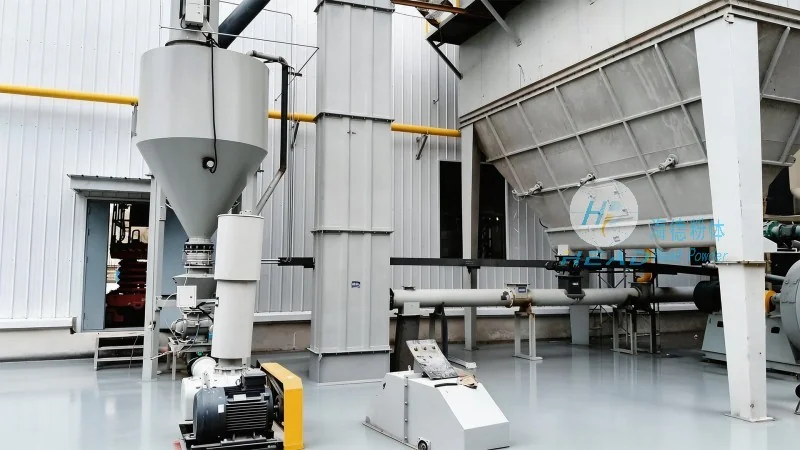
A complete ceramic powder pneumatic conveying system comprises several key pieces of equipment, each playing a specific role in the material journey from storage to process. The following components are essential for reliable operation:
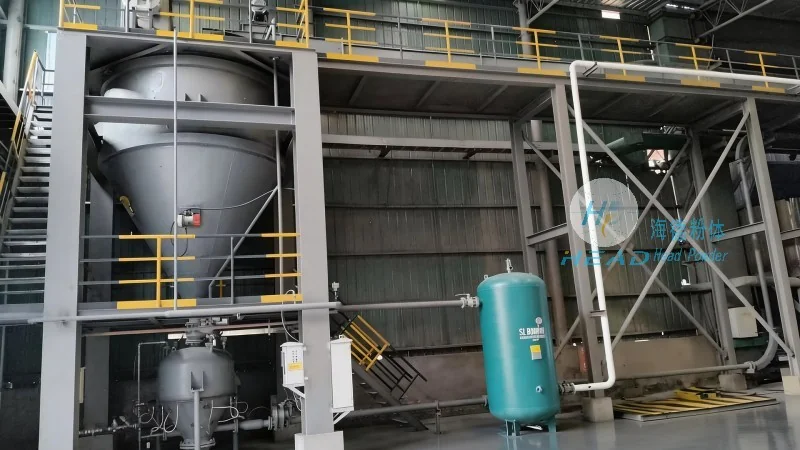
Each component must be selected with material properties in mind. For example, ceramic powders with high moisture affinity may require heated air or desiccant dryers to prevent caking in the feed hopper. Similarly, electrostatic discharge risks in fine ceramic dusts call for grounding and explosion-proof equipment designs in accordance with ATEX or NFPA standards.
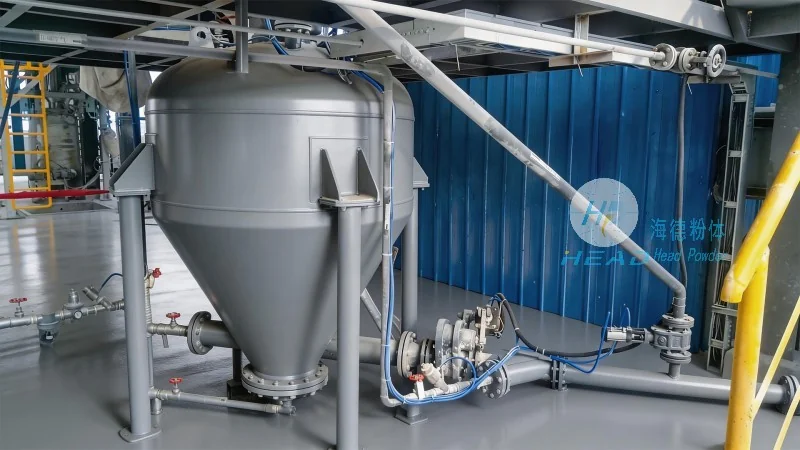
The typical operation of a ceramic powder pneumatic conveying system begins with material stored in a silo or big bag station. A rotary airlock below the discharge cone meters powder into the pipeline while maintaining a pressure seal. Compressed air from the blower enters the conveying line at a controlled velocity, entraining the powder and carrying it through the network of pipes. Along the route, diverter valves direct material to multiple destinations—such as batch mixers, pressing machines, or storage bins. At the receiving point, the cyclone reduces the air velocity, allowing powder to fall by gravity into the hopper while dust-laden air passes to the filter. The cleaned air is either exhausted or recirculated. System pressure is continuously monitored: a sudden rise indicates a blockage, while a drop suggests a leak or worn rotary valve. Advanced systems employ AI-driven algorithms that adjust the gas-to-solid ratio in real time, optimizing energy use by 15–25% compared to fixed-speed blower operation.
Choosing the right pneumatic conveying system for ceramic powders requires a thorough evaluation of operational parameters. The following technical factors are essential:
Industry standards such as ISO 10628 for piping design and EN 14462 for silo safety provide a framework for system compliance. Additionally, the latest 2026 market trend shows increasing adoption of modular, skid-mounted conveying units that reduce on-site installation time by up to 40% and allow factory testing before delivery.
Real-world implementations illustrate the value of properly engineered pneumatic conveying systems. One example involves a manufacturer of lithium-ion battery cathode active materials (CAM), where nano-sized ceramic powders like LFP and NCM must be transferred from synthesis reactors to coating machines. The client, a global battery producer, required a completely sealed system to prevent moisture absorption and maintain purity. headpowder designed a dense phase nitrogen conveying system with ceramic-lined venturi feeders and stainless steel piping. The system achieved a conveying rate of 2.5 t/h over a 180-meter route with a pressure drop of only 0.8 bar. Particle size distribution after conveying remained within specification, and the airtight design reduced oxygen exposure to below 100 ppm. The solution also integrated a nitrogen recovery unit, cutting gas consumption by 60%. Over five years of operation, the system demonstrated less than 2 mm wear on bends, significantly surpassing the expected lifespan.
In another case, a fine ceramics producer handling alumina and zirconia powders needed to supply multiple bagging stations from a central silo. The existing dilute phase system caused frequent pipe blockages and product attrition. headpowder conducted a material characterization study, including shear cell testing and permeability analysis, then retrofitted the line with a dense phase system using a pressure vessel feeder. The result was a 70% reduction in pipe wear, elimination of blockages, and a 12% improvement in bulk density consistency. Downtime for maintenance dropped from 8 hours per week to less than 1 hour per month. Both projects underscore the importance of custom engineering—no two ceramic powders behave identically, and off-the-shelf solutions often lead to costly inefficiencies.
To maintain peak performance over the system's lifecycle, a structured maintenance program is essential. Key practices include:
Predictive maintenance, enabled by continuous vibration and temperature sensors on blowers and rotary valves, can extend component life by 30% and reduce unplanned downtime. Many ceramic manufacturers now incorporate condition monitoring into their Industry 4.0 roadmaps, with data analytics platforms that alert operators before a failure occurs.
Looking ahead to 2026, several developments are shaping the ceramic powder pneumatic conveying landscape. First, the push for carbon-neutral operations is driving interest in low-pressure drop designs and energy recovery systems. For instance, variable frequency drives (VFDs) on blowers, combined with adaptive control logic, can cut energy use by up to 35%. Second, the expansion of electric vehicle battery production—which requires high-purity ceramic powders like lithium lanthanum zirconium oxide (LLZO) for solid-state batteries—is creating demand for ultra-clean, inert-gas conveying solutions. Third, digital twin simulation software is becoming mainstream, allowing engineers to virtually model powder flow, wear patterns, and blockage risks before a single pipe is installed. This approach reduces commissioning time and ensures first-time-right designs. Finally, modular, plug-and-play conveying units are increasingly preferred for brownfield retrofits, enabling fast deployment with minimal disruption to existing production lines. headpowder has been at the forefront of these innovations, delivering systems that meet the highest standards of reliability and efficiency for ceramic powder handling.
Selecting and implementing the right pneumatic conveying system for ceramic powders is a strategic decision that impacts product quality, operational costs, and environmental compliance. The overview provided in this article has highlighted the critical components, performance parameters, and real-world considerations that plant engineers must evaluate. From understanding powder behavior to selecting wear-resistant materials and leveraging advanced control systems, every detail contributes to a system that delivers consistent, safe, and efficient material transport. As the ceramic industry continues to evolve—with stricter purity requirements, higher throughput targets, and a greater emphasis on sustainability—partnering with an experienced equipment provider becomes invaluable. headpowder combines decades of engineering expertise with a deep understanding of ceramic material properties, offering custom-designed pneumatic conveying solutions that are built to last. Whether you are upgrading an existing line or constructing a new greenfield facility, our team can help you navigate the complexities of system design, from feasibility studies to commissioning and after-sales support. (咨询热线:156-6277-7102). By investing in a properly engineered system today, you ensure that your ceramic powder handling operations remain competitive, reliable, and ready for the challenges of 2026 and beyond.

 Shandong headpowder Engineering Co., Ltd.
 156-6277-7102(Manager Zhang)
  0531-83386006
  Jinan City, Shandong Province, China
服务热线
微信咨询
回到顶部