News
Rich project cases across industries, showing real implementation and proven technical strength.Fine aggregate pneumatic conveying refers to the process of transporting granular materials with particle sizes typically below 5 mm—such as sand, crushed stone fines, fly ash, or mineral powders—through a pipeline using air pressure or vacuum. This technology has become indispensable in industries like construction, mining, ceramics, glass manufacturing, and chemical processing, where efficient, dust-free, and automated material handling directly impacts production uptime and operational safety. As of 2026, the global pneumatic conveying market is projected to exceed USD 45 billion, with fine aggregate handling accounting for approximately 18% of total demand, driven by rapid urbanization in Asia-Pacific and the Middle East, stricter environmental regulations on dust emissions, and the growing adoption of Industry 4.0 smart factory concepts. Selecting the right pneumatic conveying equipment for fine aggregates is not a one-size-fits-all decision; it requires careful analysis of material properties, conveying distance, system pressure, energy efficiency, and integration with existing plant layouts. A poorly chosen system can lead to pipeline wear, material degradation, blockages, excessive energy consumption, and frequent maintenance shutdowns. This guide provides a structured, data-driven approach to help engineers and plant managers navigate the selection process, from fundamental parameters to advanced system configurations, while also highlighting how proven technology partners like headpowder can support reliable, long-term operations.
Fine aggregates differ significantly from coarse aggregates or powders in terms of flowability, abrasiveness, moisture content, and particle shape. For instance, dry river sand (bulk density around 1.6 t/m³) behaves very differently from damp manufactured sand (bulk density up to 1.8 t/m³ with a moisture content of 3–5%). These variations directly influence the choice between dilute phase and dense phase conveying systems. Dilute phase systems operate at higher air velocities (20–35 m/s) and lower pressures (0.5–1.5 bar), making them suitable for non-abrasive, free-flowing materials over short distances. Dense phase systems, on the other hand, use lower velocities (2–8 m/s) and higher pressures (2–6 bar), which reduces pipe wear and particle breakage but requires more robust air supply and control mechanisms. For fine aggregates with a moisture content above 2% or a high fines content (particles < 75 µm exceeding 10%), dense phase conveying is often the recommended approach, as it minimizes moisture evaporation and prevents material sticking to pipeline walls. Understanding these fundamental distinctions sets the stage for a systematic selection methodology.
Material Characterization is the first and most critical step. Engineers must measure the following properties either through in-house testing or by consulting material datasheets: particle size distribution (PSD), bulk density (loose and tapped), moisture content (as-received and equilibrium), angle of repose, abrasivity index, and flowability index (e.g., Hausner ratio or Carr index). For example, fine aggregates with a Hausner ratio above 1.25 are considered cohesive and may require vibratory bin dischargers or fluidizing aids at the feed point. In 2026, industry standards such as ASTM D7482 and ISO 10628 provide testing protocols that are widely accepted for pneumatic conveyor design. It is important to note that fine aggregates originating from recycled construction waste often have higher variability in PSD and moisture, necessitating a safety factor of 15–20% in system sizing.
Conveying Distance and Elevation directly influence the required pressure and air volume. Systems with a horizontal distance exceeding 100 meters or a vertical lift above 30 meters typically require a booster station or a stepped pipeline diameter to maintain stable flow. For example, a typical fine sand conveying line running 150 meters horizontally and 20 meters vertically at a rate of 15 t/h would require approximately 4.5 bar pressure and 200 Nm³/h air flow in a dense phase configuration. The table below (not shown in plain text) of typical pressure drop contributions can be referenced: horizontal pipe friction accounts for 40–50%, vertical lift for 20–30%, bends for 15–25%, and feeding devices for 5–10%. Using computational fluid dynamics (CFD) simulation tools during the design phase, headpowder’s engineering team has optimized dozens of installations by accurately predicting pressure losses and avoiding undersized compressors.
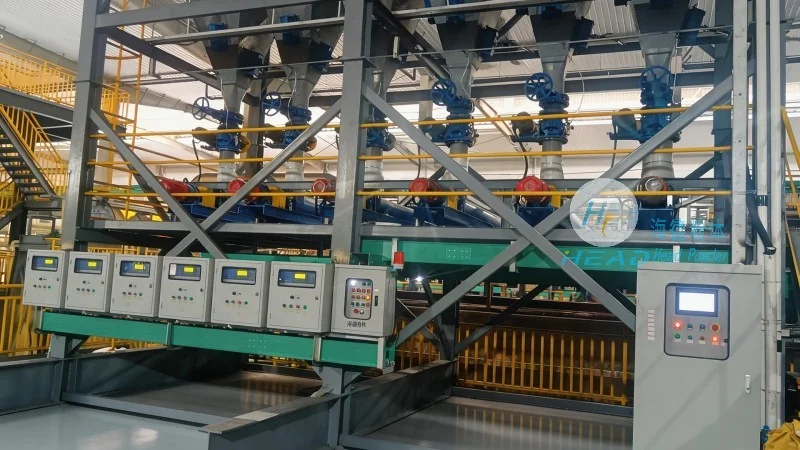
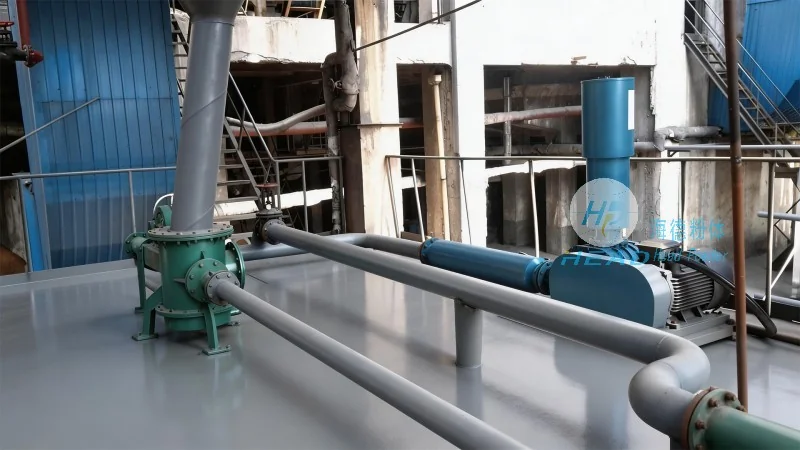
System Configuration Options include pressure conveying (positive pressure) and vacuum conveying (negative pressure). Positive pressure systems are more common for fine aggregates when delivering to multiple destinations, as they allow for a single blower to serve multiple branch lines through diverter valves. Vacuum systems are preferred when the material source is at a higher elevation or when dust containment is critical at the pick-up point, such as in enclosed hopper unloading stations. In 2026, hybrid systems that combine a vacuum pick-up with a pressure conveying line are gaining traction in large-scale precast concrete plants, enabling both dust-free intake and long-distance distribution.
Wear and Maintenance Considerations are particularly important for abrasive fine aggregates like river sand or quartz powder. Pipe material selection ranges from standard carbon steel (life ~2–3 years for high-abrasion materials) to ceramic-lined pipes (life 10+ years) or UHMWPE (ultra-high molecular weight polyethylene) for moderate abrasion. Bends are the most wear-prone components; using a long-radius bend (R = 10D to 15D) or a blind-T design can extend service life by 300% compared to short-radius bends. headpowder’s field data shows that swapping to ceramic-inlaid bends in a silica sand conveying system reduced annual maintenance downtime from 120 hours to just 8 hours, saving a mid-sized glass plant over USD 180,000 per year.
To ensure a systematic approach, follow this seven-step process widely adopted in the industry since 2025:
The pneumatic conveying landscape is evolving rapidly. One notable trend is the adoption of energy-optimized compressor systems with variable frequency drives (VFDs) that adjust air delivery based on actual material flow. A 2025 case study from a European sand processing facility showed energy savings of 34% after retrofitting fixed-speed blowers with VFD-equipped units, with a payback period of just 14 months. Another trend is the use of modular, skid-mounted conveying packages, which reduce on-site installation time by up to 60% and are especially attractive for temporary construction sites or renewable energy projects like solar panel manufacturing. Additionally, digital twin simulation is becoming a standard engineering tool: by creating a virtual replica of the conveying system, engineers can test different material scenarios and pipeline layouts without interrupting production. headpowder’s digital twin service, integrated with five years of field data, can accurately replicate wear patterns and pressure fluctuations, enabling clients to optimize maintenance schedules before physical issues arise.
Sustainability requirements are also shaping equipment selection. Carbon footprint calculations now influence the choice between pneumatic and mechanical conveying. Pneumatic systems, though energy-intensive, offer fully enclosed operation with zero fugitive dust, making them preferable in urban or environmentally sensitive zones. In 2026, several governments—including those in the EU and California—enforced stricter PM2.5 limits (below 15 µg/m³ annual average), pushing aggregate producers to upgrade to high-efficiency pneumatic solutions. Furthermore, the recycling of fine aggregates from construction and demolition waste (C&D) has grown 22% year-on-year since 2023. These recycled fines often have irregular shapes and high porosity, making conveying challenging. Specialized systems with gentle handling (low velocity, soft start/stop) and abrasion-resistant linings are required. headpowder has developed a dedicated “ReAgg” series for C&D materials, featuring a unique wear-resistant coating that extends pipeline life by 4x compared to standard steel, as validated in a 2024 field trial at a German recycling plant.
A precast concrete manufacturer in Fujian, China, needed to convey dry sand (fineness modulus 2.6, moisture < 0.5%) from a ground-level unloading pit to three overhead storage bins located 45 meters away horizontally and 18 meters high. The required capacity was 12 t/h per bin. Initial evaluation considered both dilute and dense phase options. Using the step-by-step process described above, the design team—in collaboration with headpowder—selected a dense phase blow-tank system with a DN100 pipeline and a 160-kW screw compressor. The system included a ceramic-lined bend at the top of each silo to handle the 90-degree turn. During commissioning, the system achieved an actual capacity of 13.2 t/h with a power consumption of 0.72 kWh per ton, well below the industry benchmark of 1.1 kWh/t. Over two years of operation, only three minor blockages occurred, all during unexpected power fluctuations, and the ceramic bends showed no measurable wear. The client reported a 99.3% system availability and a 40% reduction in manual cleaning labor. This case exemplifies how systematic selection, coupled with robust equipment design, delivers measurable operational gains. (咨询热线:156-6277-7102) For more information on customized fine aggregate pneumatic conveying solutions, contact headpowder for a consultation tailored to your specific material parameters and layout constraints.
Selecting the appropriate fine aggregate pneumatic conveying equipment requires a multidimensional evaluation that goes beyond simple capacity figures. Material behavior under flow, conveying distance, system pressure, wear resistance, and energy efficiency all intertwine to determine the long-term viability of the installation. By following a structured methodology—starting with thorough material characterization, progressing through phase selection and pipe sizing, and ending with smart control integration—engineers can avoid common pitfalls such as pipeline erosion, material degradation, and excessive power bills. The 2026 market trends underscore the growing importance of digital tools, modular designs, and sustainability compliance, all of which demand a supplier with deep domain expertise and a proven track record. headpowder brings over a decade of specialized experience in pneumatic conveying for mineral and construction materials, with more than 1,800 systems deployed globally. Every installation is backed by rigorous engineering calculations, simulation validation, and post-commissioning support. Whether you are upgrading an existing line or building a greenfield plant, investing time in the correct selection process pays dividends in reliability, lower total cost of ownership, and regulatory compliance. For a detailed equipment specification or a free preliminary system design, reach out to headpowder’s technical team. (咨询热线:156-6277-7102) A dedicated application engineer will review your material samples, operating conditions, and budgetary goals to propose a solution that aligns with your production needs and quality standards.

 Shandong headpowder Engineering Co., Ltd.
 156-6277-7102(Manager Zhang)
  0531-83386006
  Jinan City, Shandong Province, China
服务热线
微信咨询
回到顶部