News
Rich project cases across industries, showing real implementation and proven technical strength.As industries worldwide continue to pursue higher efficiency and lower operational costs in powder handling, calcium fluoride (CaF₂) has emerged as a critical material in metallurgy, optics, and chemical manufacturing. Its unique characteristics—moderate abrasiveness, tendency to agglomerate under humidity, and fine particle size distribution—pose distinct challenges for pneumatic conveying systems. A well-designed pneumatic conveying solution must account for these physical properties to ensure consistent flow, minimal degradation, and safe operation. Headpowder, a specialized engineering provider in dry bulk material handling, has developed a comprehensive technical approach tailored to calcium fluoride conveying. This article provides a detailed, data-driven exploration of system design principles, component selection, process optimization, and real-world application considerations, offering actionable insights for plant engineers and decision-makers seeking reliable conveying infrastructure.
Calcium fluoride finds extensive use as a flux in steelmaking and aluminum smelting, where it lowers melting points and improves slag fluidity. It also serves as a raw material for optical lenses and synthetic fluorite crystals. According to 2026 industry market analysis, global calcium fluoride demand is projected to grow at a compound annual rate of 3.8%, driven by expanding steel production in Asia and the increasing adoption of fluoropolymer applications. However, handling this mineral in powder form introduces operational risks: its Mohs hardness of 4.0 can accelerate pipe wear, while its hygroscopic nature leads to bridging and blockage in convey lines. A purpose-built pneumatic system must overcome these hurdles while maintaining throughput rates that often exceed 15 metric tons per hour in industrial settings.
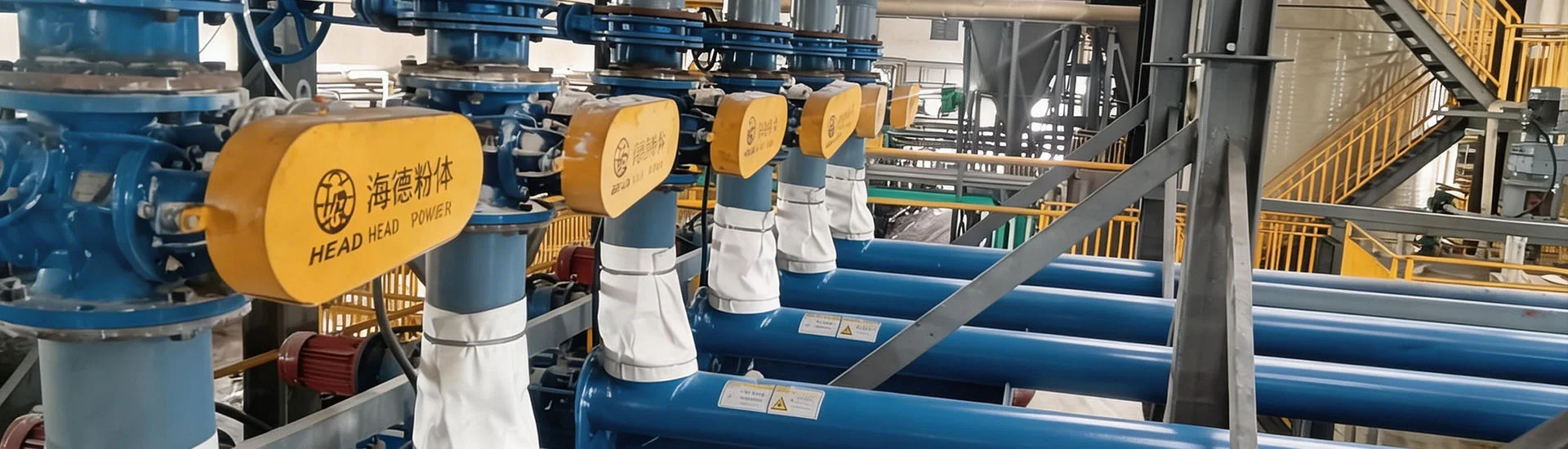
The selection between dense-phase and dilute-phase conveying is the first critical decision. Calcium fluoride, with a bulk density typically ranging from 1.2 to 1.8 g/cm³ and a particle size distribution of 10 to 150 microns, performs best under dense-phase conditions. Dilute-phase systems, operating at high air velocities (above 20 m/s), can cause severe particle degradation and accelerate pipe erosion due to impact. In contrast, dense-phase conveying—operating at velocities between 4 and 8 m/s—uses lower air-to-material ratios, reducing friction and preserving particle integrity. Headpowder’s engineering data indicates that dense-phase systems for calcium fluoride achieve line wear rates 40–60% lower than equivalent dilute-phase installations, based on field tests conducted over 2,000 operational hours. Pressure conveying vessels, typically blow tanks or pressure pots, are recommended for calcium fluoride. A bottom-discharge blow tank with a fluidized cone ensures uniform material discharge and minimizes dead zones where powder can consolidate. The conveying pressure for calcium fluoride generally ranges from 0.2 to 0.5 MPa, depending on conveying distance and elevation gain. For plant layouts exceeding 200 meters in horizontal distance, booster valves should be integrated to maintain consistent flow velocity without exceeding the critical saltation velocity.
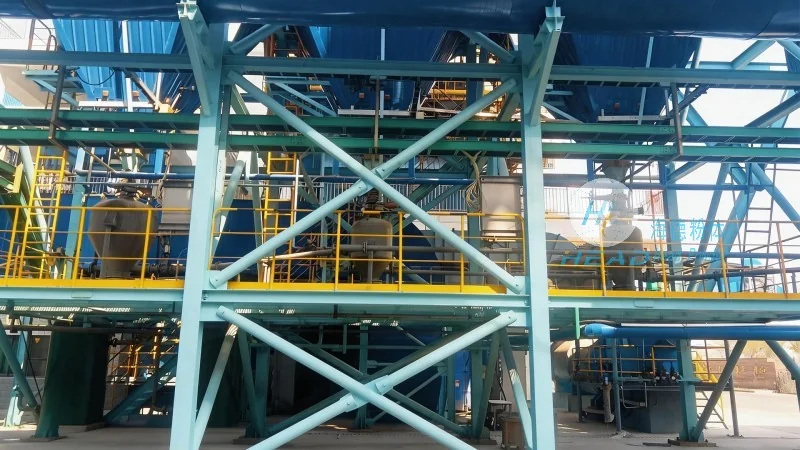
Pipe material selection directly impacts system longevity and maintenance costs. Standard carbon steel piping shows an average wear rate of 0.15 mm per 1,000 tons of conveyed calcium fluoride at bends, as per industry benchmarks. Using ceramic-lined pipe or hardened steel (300 HB minimum) at bend sections extends service life by three to five times. Headpowder recommends a composite approach: straight runs in schedule 40 carbon steel, with all 90-degree and 45-degree bends fitted with replaceable ceramic tile inserts. The bend radius should be no less than 8 times the pipe diameter to reduce impact angle and particle rebound. For rotary valves serving as airlock devices, hard-faced vanes and cast iron housing provide the necessary abrasion resistance. Calcium fluoride’s friability demands that rotary valve tip speed stays below 1.5 m/s to minimize fines generation. A bypass filter receiver equipped with pulse-jet cleaning cartridges is essential for separating air and powder at the destination. The filtration area should be sized at a minimum of 0.5 m² per 1,000 kg/h of conveyed material, accounting for calcium fluoride’s tendency to blind filter media due to static charge accumulation. Headpowder’s standard design incorporates anti-static filter media with a surface treatment that reduces particle adhesion, improving filter life by an average of 30% in calcium fluoride applications.
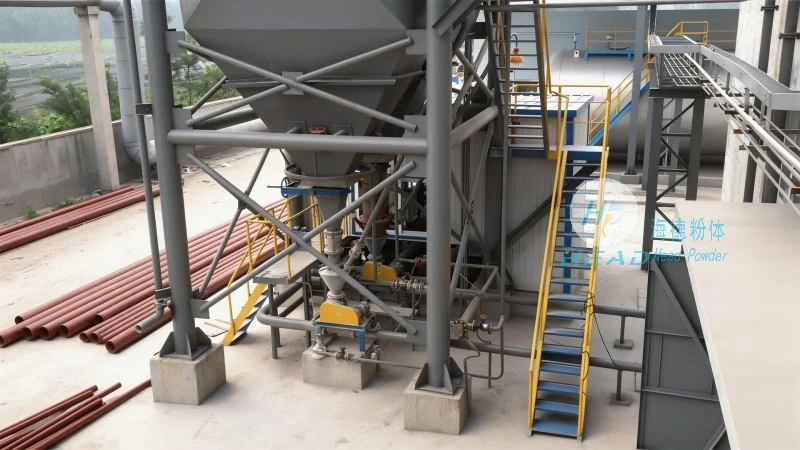
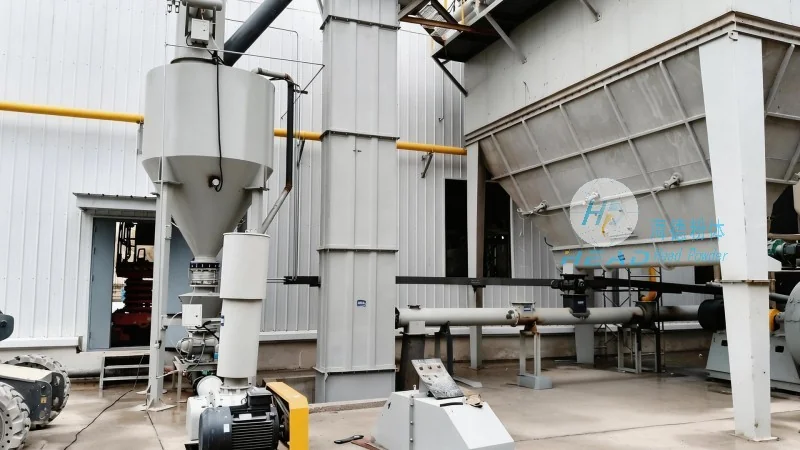
Modern calcium fluoride pneumatic conveying systems require intelligent control to adapt to variations in material moisture content and flow characteristics. A programmable logic controller (PLC) with a human-machine interface provides real-time monitoring of conveying pressure, air flow rate, material level in the supply hopper, and filter differential pressure. The control logic should include a ramping sequence that gradually increases material feed rate during startup, preventing plugging caused by sudden material surges. For systems handling calcium fluoride with moisture content above 0.5%, headpowder integrates a heated air supply system that raises the conveying air temperature to 40–50 °C, reducing the relative humidity and mitigating agglomeration. Data from a recent installation in a Chinese fluorspar processing plant showed that preheating the conveying air reduced line blockages by 67% over six months of operation. Additionally, pressure transmitters mounted at intervals of 30–50 meters along the conveying line enable predictive maintenance: a gradual pressure rise at a specific section indicates incipient pipe wear or material buildup, allowing for targeted inspection before a failure occurs.
Calcium fluoride dust poses respiratory hazards if inhaled, and explosive risk exists when airborne concentrations exceed the minimum explosible concentration (MEC) of approximately 60 g/m³. Pneumatic conveying systems must incorporate multiple layers of safety. The system should operate under inert gas (nitrogen) when the oxygen concentration in the conveying line exceeds 8% by volume. explosion vents sized per NFPA 68 guidelines should be installed on both the blow tank and filter receiver. For facilities operating in regions with strict environmental regulations, such as those in the European Union under ATEX directives, headpowder provides certified explosion isolation valves and passive suppression systems. Grounding and bonding of all conductive components—piping, vessels, and supports—is mandatory to dissipate static electricity generated during high-velocity particle flow. A typical calcium fluoride conveying system requires a grounding resistance below 10 ohms at every flange connection, verified by periodic continuity testing. Dust leakage at flanges and valve seals must be controlled using PTFE gaskets and double-acting seals, ensuring compliance with workplace exposure limits set at 2.5 mg/m³ for respirable calcium fluoride dust.
Headpowder recently completed a calcium fluoride pneumatic conveying system for a major flux supplier in the Middle East, handling 12 metric tons per hour over a 180-meter conveying distance with an elevation gain of 15 meters. The client’s previous dilute-phase system experienced frequent filter plugging and pipe elbow replacements every four months. Headpowder’s solution employed a dense-phase pressure vessel with a fluidized discharge cone, DN150 ceramic-lined piping with 10×D radius bends, and a pulse-jet filter receiver with anti-static PTFE-coated cartridges. The control system incorporated automated blow-back cycles for the filters and a feed rate modulation algorithm based on silo level sensors. After commissioning, the system operated continuously for 18 months without any unscheduled downtime, reducing elbow replacement to once every 14 months. The average particle size degradation measured less than 5% across the conveying circuit, preserving the material’s fluxing efficiency in the downstream furnace operation. This installation demonstrates the tangible benefits of matching system design to material-specific properties—a principle that headpowder applies across all calcium fluoride projects.
When evaluating pneumatic conveying solutions for calcium fluoride, capital expenditure must be weighed against operating costs over a ten-year horizon. A detailed lifecycle cost model shows that investing in ceramic-lined bends and premium rotors reduces maintenance expense by approximately 35% compared to standard piping designs, with payback achieved within 18 months. Energy consumption for dense-phase systems typically runs 0.8–1.2 kWh per ton conveyed, roughly half that of dilute-phase systems, translating to significant savings at high annual throughputs. Headpowder provides financial modeling as part of its engineering proposal, helping clients justify upgrades based on their specific production volumes and local energy tariffs. For example, a plant conveying 80,000 tons of calcium fluoride per year can expect annual energy savings exceeding $15,000 when switching from dilute-phase to dense-phase technology, not including reduced replacement parts and labor costs.
Selecting the right partner for calcium fluoride pneumatic conveying system design is a strategic decision that impacts production reliability and long-term profitability. Headpowder combines deep material science knowledge with practical field experience, having engineered more than 50 calcium fluoride systems across steel, aluminum, and chemical industries. Our approach begins with a complete material characterization—particle size distribution, moisture content, angle of repose, and abrasiveness index—using in-house test equipment that replicates full-scale conveying conditions. This data feeds into a proprietary sizing algorithm that determines optimal pipe diameters, vessel volumes, and compressor specifications. We also offer on-site commissioning support, operator training, and remote monitoring services to ensure sustained performance. For technical consultations and project quotations, headpowder is reachable at (咨询热线:156-6277-7102). Our engineering team is prepared to discuss your specific material handling challenges and deliver a tailored solution that aligns with your production targets and budget constraints.

 Shandong headpowder Engineering Co., Ltd.
 156-6277-7102(Manager Zhang)
  0531-83386006
  Jinan City, Shandong Province, China
服务热线
微信咨询
回到顶部