News
Rich project cases across industries, showing real implementation and proven technical strength.In the modern agricultural and grain processing industry, efficient material handling is a cornerstone of operational success. Rice, as one of the world's most vital staple crops, demands robust, sanitary, and high-capacity transportation solutions throughout its journey from paddy field to finished product. Pneumatic conveying technology has emerged as a transformative approach for moving rice and its by-products—whether it is paddy, brown rice, milled rice, bran, or husk—through processing facilities with minimal mechanical damage and maximum hygiene. This overview provides a comprehensive exploration of rice pneumatic conveying equipment solutions, addressing system design principles, key components, operational parameters, industry trends, and practical implementation strategies. The goal is to equip plant managers, process engineers, and decision-makers with actionable insights that can enhance productivity, reduce maintenance burdens, and align with modern safety and sustainability standards. By understanding the nuances of dilute-phase and dense-phase conveying, the role of airlock feeders, filtration units, and control systems, stakeholders can make informed choices that directly impact their bottom line. The following content draws on field-tested configurations, current market data as of 2026, and best practices proven across medium to large-scale rice mills. It reflects the technical depth expected from industry specialists like those at headpowder, a company with years of hands-on experience in designing and deploying pneumatic systems tailored to grain and powder handling. For personalized consultation, please reach out to the team at (咨询热线:156-6277-7102).
Rice processing involves multiple stages—cleaning, husking, whitening, polishing, grading, and packaging—each of which generates material flows that must be transferred between machines or storage bins. Traditional mechanical conveyors such as belt elevators, screw conveyors, and bucket elevators often present challenges: they occupy large floor space, require frequent lubrication, risk grain breakage, and create dust emission issues. Pneumatic conveying overcomes these limitations by using air pressure or vacuum to transport rice particles through enclosed pipelines. This method offers several distinct advantages. Firstly, it ensures gentle handling; properly designed pneumatic systems can achieve breakage rates below 0.5% even for delicate long-grain varieties. Secondly, the enclosed nature eliminates dust leakage, improving workplace air quality and complying with stringent occupational safety regulations. Thirdly, pipeline routing is flexible, allowing vertical, horizontal, and angled transfers without the need for multiple transfer points. In 2026, the global pneumatic conveying equipment market for grains is projected to grow at a compound annual growth rate of 6.2%, driven by increasing automation in food processing and stricter environmental standards. Rice millers are particularly drawn to these solutions because they enable continuous, automated processing lines that reduce manual intervention and human error.
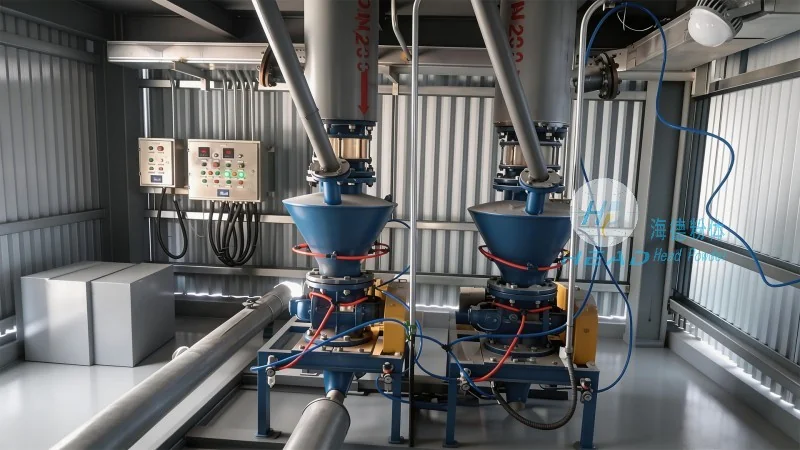
A complete rice pneumatic conveying solution comprises several interdependent components, each engineered to handle specific material characteristics. The primary elements include the feeder system, conveying pipeline, air moving device (blower or compressor), separation unit (cyclone or filter receiver), and control instrumentation. Below is a detailed breakdown of each component and its role in ensuring reliable operation.
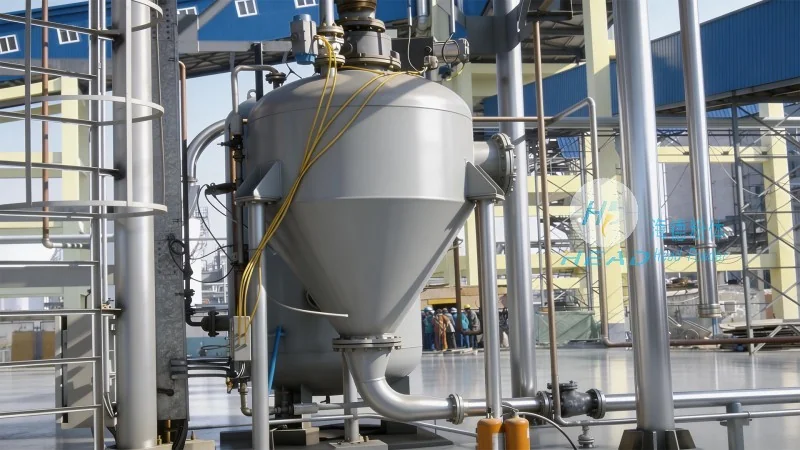
Selecting the appropriate conveying phase is critical to balancing capacity, product quality, and energy efficiency. In dilute-phase conveying, rice is suspended in a high-velocity airstream (typically 20–30 m/s) with a low material-to-air ratio (5–10 kg material per kg air). This method is suitable for short distances (under 100 meters) and high throughputs above 30 tons per hour. However, the high velocity can cause more abrasion on pipe elbows and slightly higher breakage for fragile rice grains. Dense-phase conveying, on the other hand, moves material at low velocity (2–8 m/s) with a high material-to-air ratio (over 30 kg/kg). It minimizes dust generation and grain damage, making it ideal for conveying finished white rice or parboiled rice where appearance is paramount. The capital cost for dense-phase systems is typically 20–30% higher due to the need for more robust compressors and specialized feeding mechanisms, but the reduced maintenance and product loss often justify the investment over five-year cycles. In 2026, many rice processing facilities in Asia and Africa are transitioning to hybrid systems that combine dilute-phase for bulk raw paddy transport and dense-phase for delicate final product handling, achieving an overall energy saving of 12–18% compared to pure dilute-phase designs.
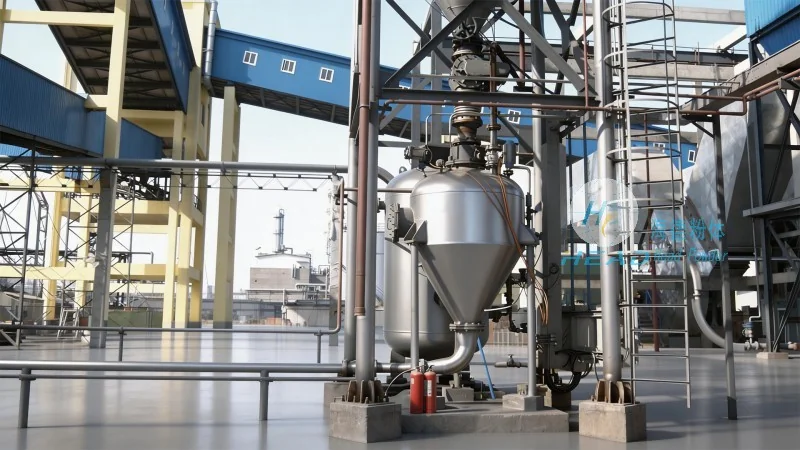
To design a rice pneumatic conveying system that delivers consistent performance, engineers must evaluate several parameters specific to the material. Rice has a bulk density of approximately 580–680 kg/m³ for paddy and 760–800 kg/m³ for milled rice, with an angle of repose around 30–35°. Moisture content (typically 12–14% for storage) influences flowability; higher moisture increases adhesion and risk of plugging. The system's conveying distance, vertical lift, and number of bends must be mapped precisely. A common rule of thumb is that each 90° bend adds the equivalent of 10–15 meters of straight pipe in pressure drop. The conveying air velocity should be maintained above the saltation velocity (the point at which particles begin to drop out of suspension), which for rice grains is around 16–18 m/s for horizontal runs and slightly higher for vertical lifts. Pressure drop calculations involve summing frictional losses through pipes, bends, feeders, and separators. For a typical 50-meter horizontal line with two 90° bends handling 10 tons per hour of milled rice, the required pressure is roughly 0.6–0.8 bar. System designers should also consider ambient temperature and humidity, as condensation within pipes can cause microbial growth. Stainless steel construction and proper insulation are recommended for facilities located in tropical climates.
Real-world installations provide the most reliable insight into system effectiveness. In a recent upgrade of a 150-ton-per-day rice mill in Southeast Asia, the replacement of bucket elevators with a centralized pneumatic conveying network resulted in a 40% reduction in daily maintenance time and a 23% decrease in energy cost per ton of processed rice. The system, designed with multiple intake points for paddy, bran, and husk streams, used a combination of dilute-phase for high-volume transfers and dense-phase for the final white rice silos. Over a 12-month operating period, the grain breakage rate remained below 0.3%, significantly lower than the 1.2% observed under the previous mechanical system. Another notable implementation involved a medium-scale rice parboiling plant where the conveying of soaked paddy (moisture content up to 32%) required careful handling to prevent agglomeration. By employing a positive displacement blower with moisture-resistant airlock valves and a slow-speed conveying velocity (12 m/s), the plant achieved a consistent throughput of 5 tons per hour with zero blockages during the six-month trial. These case studies underscore the importance of custom engineering. Companies like headpowder specialize in conducting on-site material testing and computational fluid dynamics (CFD) simulations to predict flow characteristics before fabrication, ensuring that the final system aligns with the client's specific layout and production targets.
Pneumatic conveying systems, while efficient, can represent a significant portion of a facility's electricity consumption—often 15–25% of total mill power. Optimizing energy usage begins with proper system sizing: an oversized blower wastes energy, while an undersized one leads to plugging. Variable frequency drives (VFDs) on the blower motor allow operators to match airflow to actual production rates, achieving 10–20% energy savings. Regular leak detection in pipelines and airlock valves is essential; a 5% air leak can increase power consumption by 12%. Filter bag replacement schedules should be based on differential pressure readings rather than fixed intervals—typically when the pressure drop across the filter exceeds 150 mmH₂O. For rotary airlocks, clearances between rotor tips and housing should be checked quarterly; excessive wear of 0.5 mm can double air leakage. Pneumatic conveying pipelines handling rice husk, which is highly abrasive, benefit from replaceable wear-back elbows or ceramic-lined bends that extend service life from six months to over two years. Implementing a predictive maintenance program using vibration sensors and thermal imaging can further reduce unscheduled downtime. According to 2025 industry surveys, mills that adopted such practices saw a 35% reduction in emergency maintenance costs.
Looking ahead, several technological developments are shaping the next generation of rice conveying solutions. The integration of IoT sensors enables real-time particle size analysis and moisture detection within the pipeline, allowing automatic adjustment of air velocity to preserve quality. Artificial intelligence algorithms are being trained to predict blockages based on pressure fluctuation patterns, granting operators proactive control. Another emerging trend is the use of modular skid-mounted systems that can be rapidly deployed and relocated, facilitating expansion or temporary setups. Sustainability is also driving innovation: low-energy conveying designs are incorporating regenerative blowers that recover energy during deceleration, and some manufacturers are exploring the use of compressed nitrogen as the conveying medium for premium organic rice to eliminate oxidation risks. Regulatory bodies in the European Union and North America are tightening permissible dust emission levels for grain facilities, pushing toward closed-loop air recirculation systems with HEPA filtration. For rice millers aiming to stay competitive, investing in advanced pneumatic conveying equipment is no longer optional—it is a strategic move that pays dividends in product quality, environmental compliance, and operational agility.
Selecting the right pneumatic conveying equipment for rice requires a holistic understanding of material properties, system dynamics, and operational goals. No single design fits all scenarios; each facility—whether a small rural mill processing 20 tons per day or a large industrial complex handling 500 tons per day—demands a tailored approach. The decision to adopt pneumatic conveying should be based on a thorough cost-benefit analysis that accounts for not only initial investment but also long-term energy costs, maintenance intervals, product damage rates, and employee safety. By partnering with an experienced engineering provider such as headpowder, rice processors gain access to decades of accumulated knowledge in grain handling, airflow modeling, and system integration. Their turnkey services, from feasibility study to commissioning, ensure that every component—from the feeding mechanism to the control panel—works in harmony. In a rapidly evolving market where quality and efficiency define success, a well-engineered rice pneumatic conveying solution is a decisive advantage. To discuss your specific requirements and explore how modern conveying technology can transform your mill's productivity, contact the specialists today at (咨询热线:156-6277-7102).

 Shandong headpowder Engineering Co., Ltd.
 156-6277-7102(Manager Zhang)
  0531-83386006
  Jinan City, Shandong Province, China
服务热线
微信咨询
回到顶部