News
Rich project cases across industries, showing real implementation and proven technical strength.Calcite, as a widely used industrial mineral in sectors such as construction, agriculture, plastics, paints, and environmental remediation, demands efficient and reliable material handling systems. Among the various transfer methods, pneumatic conveying stands out for its enclosed, dust-free, and flexible pipeline transport capabilities. However, the specific physical properties of calcite—including its moderate hardness, variable particle size distribution, and tendency to generate fine dust during transfer—pose unique engineering challenges. A well-designed calcite pneumatic conveying solution must carefully balance air velocity, pressure differential, material-to-air ratio, and system configuration to maintain flow stability while minimizing pipe wear and product degradation. With the global calcite market projected to exceed USD 18 billion by 2026, driven by rising demand in the construction and automotive sectors, the need for optimized, energy-efficient pneumatic conveying systems has never been more critical. This article provides a comprehensive technical overview of calcite pneumatic conveying, covering system types, key design parameters, component selection, operational considerations, and real-world application insights, all tailored to help engineering teams and plant managers make informed decisions for their specific process requirements.
Understanding the physical and chemical characteristics of calcite is essential before selecting any pneumatic conveying system. Calcite (calcium carbonate, CaCO₃) typically exhibits a Mohs hardness of around 3, meaning it is relatively soft compared to silica or alumina, but still abrasive enough to cause gradual wear in elbows and pipe bends over extended operation. Its bulk density commonly ranges from 1.0 to 1.6 t/m³ depending on particle shape and moisture content, while particle sizes can vary from fine powders (d50 around 10–50 microns) to granular forms (up to 3–5 mm). Importantly, calcite has a moderate cohesiveness; it can form agglomerates when exposed to humidity or static electricity, leading to blockages in dilute-phase systems if not properly managed. The material also tends to generate significant amounts of airborne dust during transfer, necessitating robust filtration and safety measures. For pneumatic conveying engineers, these properties translate into several critical design rules: recommended conveying velocities for calcite typically fall between 10 and 25 m/s for granular materials and 6–15 m/s for powders to avoid both saltation and excessive pipe wear; material-to-air ratios should be carefully selected based on system length and pressure capability; and moisture control (often below 1% by weight) is vital to maintain flowability. As of 2026, many calcite processing plants are adopting real-time particle size analyzers integrated with conveying controls to automatically adjust parameters based on feedstock variations, further improving system reliability and energy efficiency.
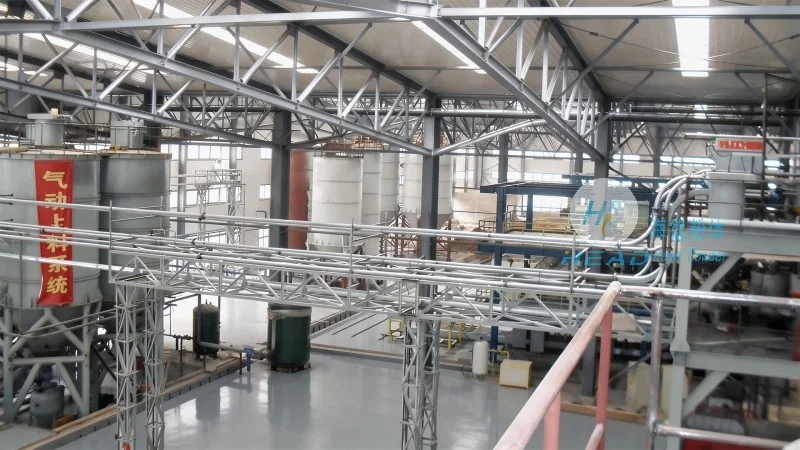
Two primary pneumatic conveying modes are employed for calcite: dilute-phase and dense-phase. Dilute-phase conveying operates at relatively high air velocities (typically 15–30 m/s) and low material-to-air ratios, suspending particles in a continuous air stream. This method is well-suited for short distances (under 100 meters) and moderate throughputs, such as transferring calcite powder from grinding mills to storage silos. However, dilute-phase systems experience higher pipe wear and particle attrition due to high-speed impacts against walls and bends. For calcite with a high fines content, dilute-phase may also generate excessive static electricity, leading to bridging and blockage unless anti-static hoses or grounding measures are implemented. In contrast, dense-phase conveying pushes calcite through pipelines at low velocities (2–8 m/s) using high-pressure air pulses, forming a moving bed or slug flow pattern. This mode drastically reduces wear, minimizes dust generation, and preserves particle integrity, making it ideal for fragile or high-value calcite products. Dense-phase systems can handle longer distances exceeding 200 meters and higher throughputs (up to 60 t/h or more) with lower specific energy consumption (typically 0.5–1.5 kWh per ton compared to 2–4 kWh per ton for dilute-phase). Recent advancements in pressure vessel design and control algorithms, such as adaptive pulse sequencing based on pressure feedback, have made dense-phase conveying increasingly cost-effective for calcite. Companies like Headpowder have deployed custom dense-phase solutions for calcite plants in Shandong and Guangxi, achieving over 98% equipment availability during continuous 24/7 operation. (咨询热线:156-6277-7102)
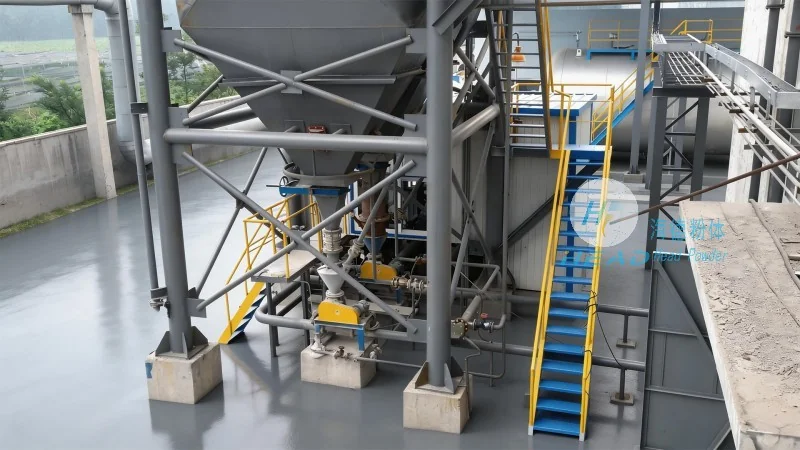
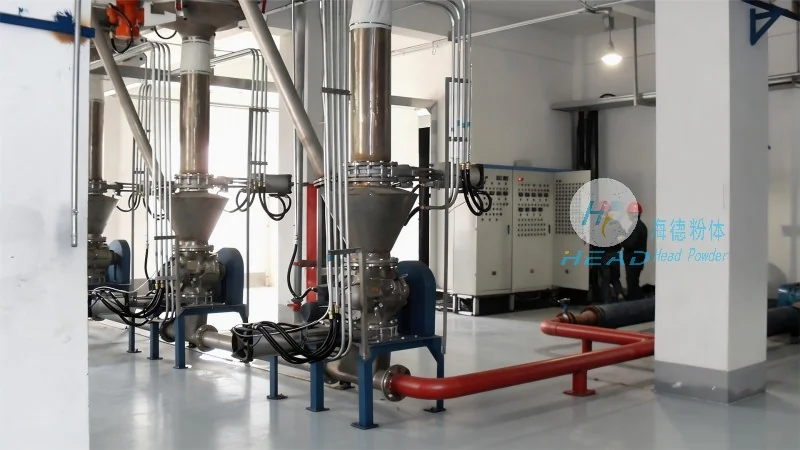
A robust calcite pneumatic conveying system comprises several critical components, each requiring careful specification to match the material's properties. The feed device is the first interface: rotary airlocks are the most common choice for dilute-phase, offering reliable metering at pressures up to 1.5 bar, but they suffer from leakage and wear when handling abrasive calcite dust. For dense-phase, pressure vessels (blow tanks) are preferred, featuring wear-resistant ceramic linings and hemispherical bottom geometries to prevent stagnant material build-up. The pipeline itself should be constructed from carbon steel with wall thicknesses of 6–10 mm for straight sections and at least 8–12 mm for elbows, where wear rates can be 3–5 times higher. Some operators now utilize aluminum oxide ceramic-lined bends or replaceable wear-back inserts to extend service life beyond 12 months. Air mover selection depends on pressure requirements: positive displacement (PD) blowers deliver 0.5–1.5 bar for dilute-phase; screw compressors or booster packages provide 2–6 bar for dense-phase systems. Filtration is equally important—pulse-jet baghouse filters with filter area ratios of 60–80 m² per ton/hour of conveying capacity ensure emissions below 10 mg/Nm³, meeting both regulatory standards and product recovery yield targets. Additionally, the integration of diverter valves, flow splitters, and silo venting systems must account for the cohesive nature of calcite fines to prevent plugging. Headpowder's engineering team routinely conducts computational fluid dynamics (CFD) modeling during the design phase, simulating particle trajectories and airflow distribution to optimize component geometry and minimize pressure drops across the entire system.
Modern calcite pneumatic conveying solutions incorporate advanced automation to maintain consistent material flow and reduce operator intervention. Programmable logic controllers (PLCs) with human-machine interfaces (HMIs) provide real-time monitoring of key variables: conveying pressure, air flow rate, material density, and differential pressure across the pipeline. For dense-phase systems, control algorithms adjust the blow tank pressurization sequence and air pulse intervals based on instantaneous feedback from pressure transmitters, ensuring stable slug formation and preventing line clearing cycles that waste compressed air. Many installations now include variable frequency drives (VFDs) on blowers or compressors, enabling energy savings of 20–40% during partial-load operation—a significant advantage given that 2026 electricity costs in many industrial regions have risen by 15% compared to 2023. Furthermore, predictive maintenance modules analyze wear trends using historical pressure drop data: an increase of 10% in baseline differential pressure often signals pipe wall thinning, prompting replacement before a rupture occurs. For calcite plants producing multiple grades (e.g., 200 mesh, 400 mesh, 600 mesh), automated recipe management allows rapid changeover between conveying parameters without manual recalculation. Headpowder has implemented such a system at a major calcium carbonate producer in Anhui Province, where the transition time between different calcite particle sizes was reduced from 45 minutes to under 12 minutes, increasing overall plant efficiency by 6% annually.
Despite careful design, several operational challenges frequently arise in calcite pneumatic conveying. One prevalent issue is pipe blockage due to material sagging when conveying velocity falls below the saltation velocity threshold. This is especially problematic after long straight runs where flow momentum dissipates. Mitigation includes installing booster air injectors at intervals of 30–50 meters or gradually tapering pipe diameter toward the receiving end to maintain velocity. Another challenge is static electricity generation during dilute-phase conveying of fine calcite powder (below 20 microns), which can cause agglomeration on filter bags and pipeline walls. Proper grounding of all conductive components, use of anti-static fabric filter media, and occasional introduction of moisture (below the material's hygroscopic limit) have proven effective. Material degradation—where larger calcite particles fracture into fines—can reach 5–10% in high-velocity dilute-phase systems over long distances, reducing product quality. Switching to dense-phase or installing impact-resistant elbow geometries (e.g., long-radius bends with R/D ratio of 8–10) reduces attrition rates to below 2%. Finally, dust emissions at transfer points and silo vents must be addressed through secondary filtration and negative pressure management. The adoption of enclosed transfer chutes and telescopic loading spouts further prevents fugitive dust release, aligning with 2026 environmental regulations in markets like the European Union and China, where permissible dust exposure limits have been tightened to 1 mg/m³ for calcium carbonate operations.
Correctly sizing a calcite pneumatic conveying system is paramount to achieving both operational reliability and economic viability. The primary design equation relates required air flow to material throughput: Q_air = (M_material × K) / (μ × ρ_air), where K is a factor accounting for particle characteristic length, μ is the material-to-air ratio, and ρ_air is the air density at operating conditions. For calcite powders in dilute-phase, typical μ values range from 5 to 15 kg-materia per kg-air, while dense-phase systems achieve μ of 30–80 kg/kg. The conveying pressure required increases logarithmically with line length: for a 100-meter dilute-phase system carrying calcite at 10 t/h, pressure demand is approximately 0.8–1.2 bar; a 200-meter dense-phase system at the same throughput would require 2.5–4 bar. Energy consumption can be estimated using specific energy (SE) in kWh/t: SE = (ΔP × Q_air × t) / (M × η), where t is total conveying time, η is overall efficiency (typically 60–75% for PD blowers and 55–65% for screw compressors). In practice, a well-designed dense-phase system for calcite can achieve SE below 1.2 kWh/t, while dilute-phase systems often exceed 2.5 kWh/t. With electricity costs averaging 0.08 USD/kWh globally, switching from dilute-phase to dense-phase can save over 100,000 USD annually for a plant conveying 200,000 tons per year. Headpowder's engineering reports indicate that their optimized dense-phase designs for calcite have reduced total cost of ownership (TCO) by 18–25% compared to traditional dilute-phase solutions, primarily through lower energy bills and reduced maintenance expenditure.
Calcite pneumatic conveying systems are deployed across diverse industrial contexts, each with distinct requirements. In the construction sector, where ground calcite is used as filler in cement and asphalt, high-throughput conveying (30–50 t/h) over distances of 150–300 meters from grinding mills to blending silos is common. Dense-phase rotary valves with ceramic linings have proven durable, with mean time between overhauls exceeding 8,000 hours. In the plastics industry, ultra-fine calcite (d50 = 2–5 microns) is often blended with polymer pellets in compounding lines requiring gentle transfer to avoid particle breakage. Here, low-velocity dense-phase conveying with nitrogen as the carrier gas is sometimes employed to prevent oxidation and moisture pickup. For agricultural applications, where calcite is used as a soil pH adjuster, conveying systems must handle high moisture content (up to 8%) without clogging; installing heated air injection or maintaining conveying velocities above 12 m/s has been successful. A notable implementation by Headpowder involved a calcite processing facility in Vietnam producing 150 t/day of ground calcium carbonate. The existing dilute-phase system suffered from frequent plugging and pipe changes every 6 months. After redesigning as a two-stage dense-phase system with dedicated blow tanks for fine and coarse fractions, the plant achieved uninterrupted operation for 18 months with zero unscheduled downtime, reducing annual maintenance costs by 62%. Such examples underscore the importance of tailoring system architecture to specific process characteristics rather than adopting a one-size-fits-all approach. (咨询热线:156-6277-7102)
Looking ahead to the 2026–2030 horizon, the calcite pneumatic conveying landscape is evolving along several technology vectors. One prominent trend is the incorporation of digital twin simulation, where a full virtual replica of the conveying system integrates with live sensor data to predict flow behavior under varying conditions. This allows engineers to test modifications (e.g., changing air velocity or pipe routing) without halting production, reducing trial-and-error time by 50–70%. Artificial intelligence-driven pressure control systems are also emerging, using machine learning models trained on historical operational data to anticipate blockage risks 20–30 seconds before occurrence and adjust blow tank cycles preemptively. Another development is the use of modular, skid-mounted conveying units that can be rapidly deployed and reconfigured for seasonal demand fluctuations—a growing need in the ag-lime market where application rates vary with planting seasons. Additionally, sustainability drivers are pushing for lower carbon footprints: regenerative blower technology recovers kinetic energy during deceleration, cutting electricity use by 12–18% in long-distance conveying. The integration of carbon capture-ready seal gas systems is also being explored, where CO₂-laden exhaust from calcite calcination kilns is repurposed as the conveying medium, simultaneously reducing emissions and operating costs. Headpowder is actively piloting a green conveying concept using renewable-energy-powered compressors at a calcite mine in Guizhou Province, targeting a 30% reduction in CO₂ equivalent per ton conveyed by 2027. These innovations point toward a future where calcite pneumatic conveying becomes not only more efficient but also more environmentally aligned with global decarbonization targets.
Implementing a successful calcite pneumatic conveying solution requires deep understanding of material behavior, precision engineering of system components, and a commitment to ongoing optimization. The technical choices—ranging from dilute-phase versus dense-phase to pipeline material selection and control strategy—directly impact plant uptime, product quality, energy consumption, and total operating costs. As the calcite market grows and regulatory pressures intensify, owners and operators cannot afford systems that compromise on reliability or efficiency. An experienced partner like Headpowder brings decades of domain expertise, proprietary design tools, and a proven track record of custom solutions across dozens of calcite facilities worldwide. Our engineering team offers turnkey support from feasibility studies and CFD simulations through commissioning and aftermarket service, ensuring that your conveying system performs at its best for the entire asset lifecycle. Whether you are upgrading an existing line or building a greenfield plant, we invite you to discuss your specific calcite conveying challenges and performance targets. (咨询热线:156-6277-7102) Let us help you achieve dust-free, energy-efficient, and maintenance-optimized material transfer that gives your operation a competitive edge in the evolving industrial landscape.

 Shandong headpowder Engineering Co., Ltd.
 156-6277-7102(Manager Zhang)
  0531-83386006
  Jinan City, Shandong Province, China
服务热线
微信咨询
回到顶部