News
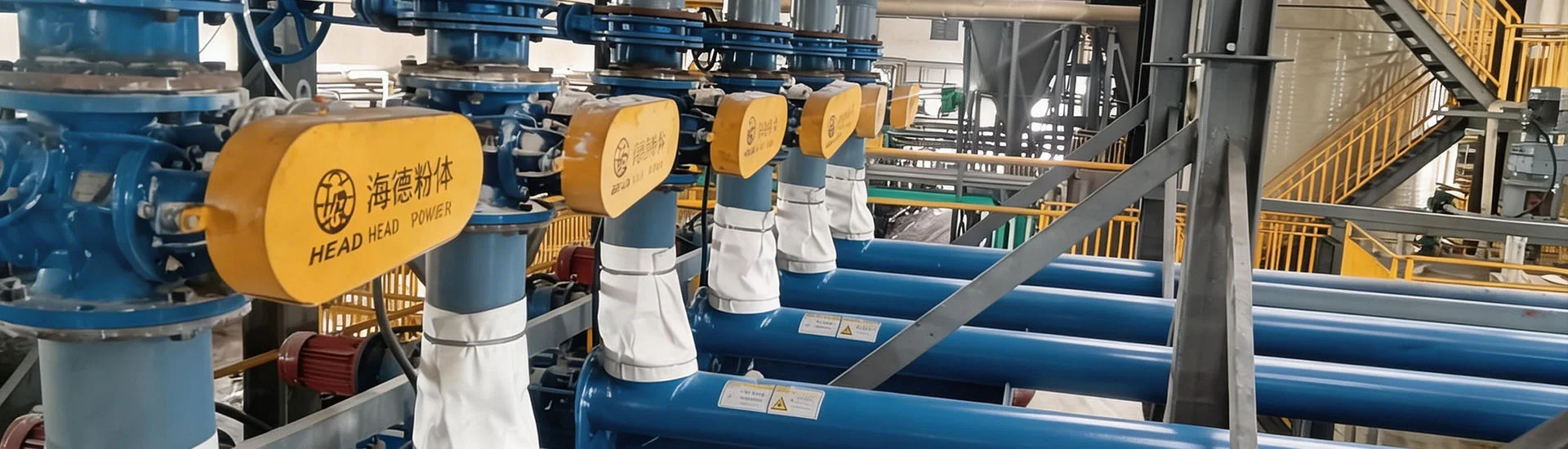
Rich project cases across industries, showing real implementation and proven technical strength.Calcium chloride is a hygroscopic and highly deliquescent material widely used in industries ranging from dust control and de-icing to food processing and chemical manufacturing. Its tendency to absorb moisture and form sticky agglomerates presents significant challenges for material handling, particularly in pneumatic conveying systems. Without careful engineering, calcium chloride can bridge, cling to pipe walls, or even degrade in quality due to excessive exposure to humidity. Headpowder, a specialized manufacturer of pneumatic conveying equipment, has developed robust solutions tailored specifically for calcium chloride handling. This article provides a comprehensive overview of calcium chloride pneumatic conveying system design, key equipment components, selection parameters, emerging industry trends, and practical operational considerations. Whether you are planning a new processing line or upgrading an existing system, understanding the unique properties of calcium chloride and how they interact with pneumatic transport is essential for achieving reliable, cost-effective, and low-maintenance operations. This deep dive is intended for plant engineers, operations managers, and procurement professionals who require technical clarity and actionable insights—not marketing fluff—to make informed decisions.
Before selecting any conveying equipment, it is critical to characterize the calcium chloride product you are handling. Commercial calcium chloride is available in several forms: flake, pellet, powder, and granular. Each form exhibits distinct bulk density, particle size distribution, and hygroscopic behavior. Typical bulk density ranges from 0.8 to 1.2 g/cm³ for flakes and 0.6 to 1.0 g/cm³ for powder. The critical property is its equilibrium relative humidity—calcium chloride begins to absorb moisture at a relative humidity above approximately 40% at typical ambient temperatures. This means that in most plant environments, the material will naturally attract moisture unless conveyed in a dry air or inert gas environment. Additionally, calcium chloride is corrosive to some metals, particularly aluminum and carbon steel under prolonged exposure. Therefore, material of construction (stainless steel 304 or 316L, or specialized coatings) is non-negotiable for long equipment life. Knowing these characteristics directly influences the type of pneumatic conveying system—dilute phase, dense phase, or vacuum—and the sizing of air movers, pipelines, and receivers.
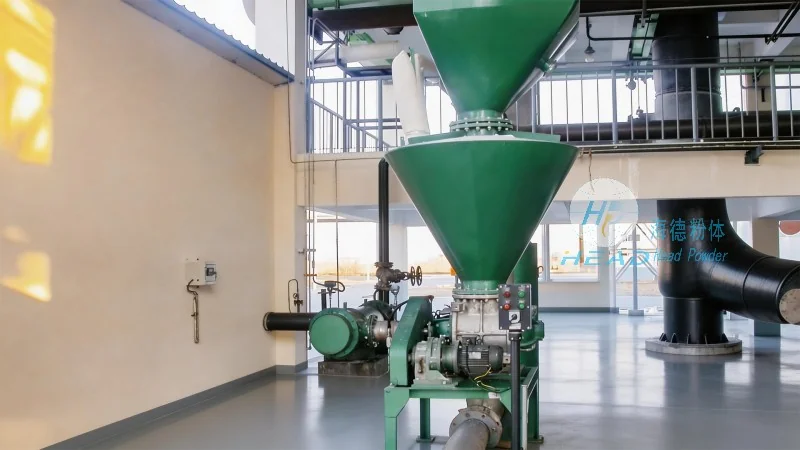
Three primary system configurations can be applied to calcium chloride handling: dilute phase pressure systems, dilute phase vacuum systems, and dense phase pressure systems. Each has its advantages and limitations depending on the required capacity, distance, and material sensitivity.
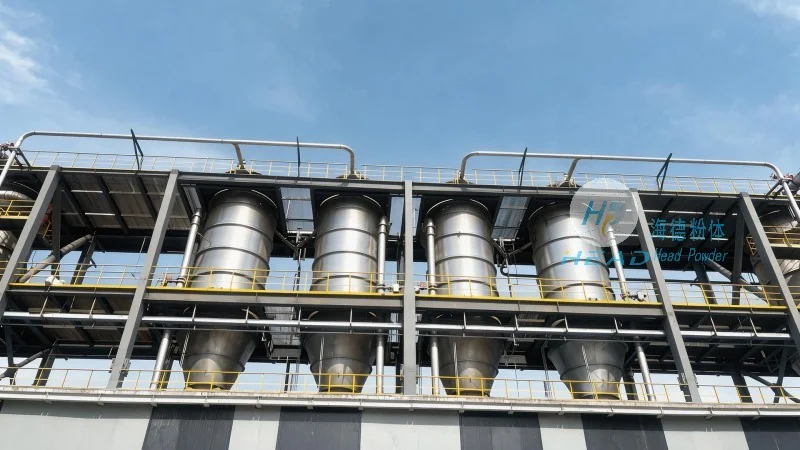
Headpowder engineers evaluate these options against the client’s specific material analysis and plant layout to recommend the most reliable architecture. In recent installations for calcium chloride processors, dense phase pressure systems have gained preference for their gentle handling and lower operational risks in humid climates.
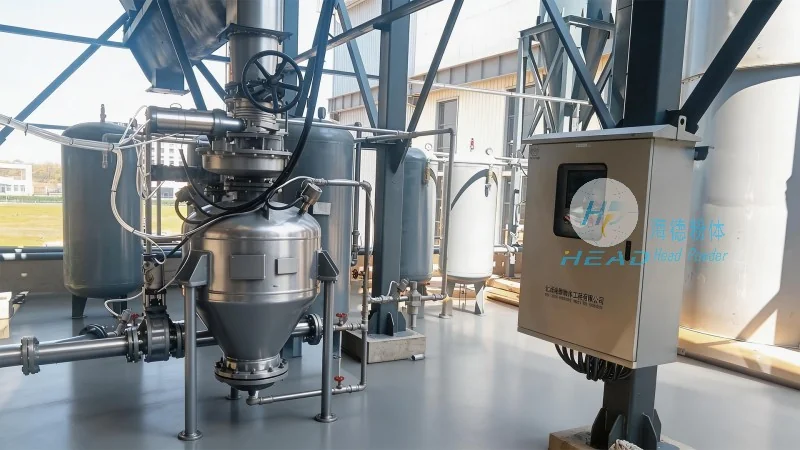
A complete system comprises several key components, each must be designed or selected to withstand the corrosive and hygroscopic nature of calcium chloride.
When designing a pneumatic conveying system for calcium chloride, several technical parameters must be calculated or estimated with high precision. Incorrect assumptions lead to plugging, excessive wear, or product quality issues.
Headpowder’s engineering team uses proprietary calculation software combined with years of field data to produce accurate designs. For example, in a recent project for a construction chemical manufacturer in Southeast Asia, we designed a dense phase system conveying 12 t/h of calcium chloride pellets over 180 meters with a loading ratio of 22 and a power consumption of only 9 kW, compared to 18 kW for a dilute phase alternative.
Even with a well-designed system, operators may encounter issues specific to calcium chloride. Understanding these beforehand helps in planning preventive measures.
The pneumatic conveying market is evolving rapidly, and calcium chloride handling is no exception. Several trends are reshaping system design and operation.
A leading manufacturer of industrial de-icers approached Headpowder to replace their existing screw conveyor system, which suffered from frequent clogs and high maintenance due to calcium chloride’s sticking behavior. The customer needed a system delivering 8 t/h of flake calcium chloride to a bagging station 120 meters away, with minimal dust and zero product contamination. After conducting a thorough material analysis and site survey, Headpowder proposed a dense phase pressure conveying system using a 5 m³ stainless steel blow tank with a 60° cone bottom and pneumatic fluidizing pads. The conveying line was 4-inch schedule 40 316L stainless steel with long-radius bends and a wear-back at the first bend. A compressed air system with a desiccant dryer provided -40°C dew point air. The PLC-based controller included humidity and differential pressure sensors that automatically adjusted air injection timing. The system was installed and commissioned in 14 days with zero start-up issues. Over the first 12 months of operation, the plant recorded a 97% uptime rate, a 35% reduction in energy cost compared to the previous screw conveyor, and virtually no product degradation. This case demonstrates that with proper engineering, calcium chloride pneumatic conveying can be highly reliable even in demanding environments.
Given the technical complexity and the specific material challenges, choosing an experienced equipment supplier is as important as the system design itself. Headpowder has specialized in pneumatic conveying for hygroscopic and corrosive bulk solids for over 15 years, with hundreds of installations globally. Our in-house testing lab can perform full-scale trials using your actual calcium chloride sample, verifying pressure loss, air velocity, and product quality before finalizing the design. We offer end-to-end support—from process optimization through fabrication, installation, commissioning, and training. Our systems comply with international standards including ASME, ISO, and CE. When you work with Headpowder, you get not only hardware but also technical know-how and a commitment to long-term performance.
Calcium chloride pneumatic conveying is a specialized field that demands careful attention to material characteristics, environmental conditions, and equipment robustness. Whether you opt for dilute phase or dense phase, the success of your system hinges on accurate sizing, proper material selection for components, and effective moisture control. With the 2026 industry shift toward smart, energy-efficient, and modular designs, now is an opportune time to evaluate your existing handling method or plan a new installation. Headpowder offers the expertise and proven track record to deliver systems that minimize downtime, reduce operating costs, and maintain product integrity. By focusing on real technical solutions rather than overblown claims, we help you achieve sustainable operations. For a personalized assessment of your calcium chloride conveying requirements, reach out to our engineering team. (咨询热线:156-6277-7102) Headpowder—engineering reliability into every particle.

 Shandong headpowder Engineering Co., Ltd.
 156-6277-7102(Manager Zhang)
  0531-83386006
  Jinan City, Shandong Province, China
服务热线
微信咨询
回到顶部