News
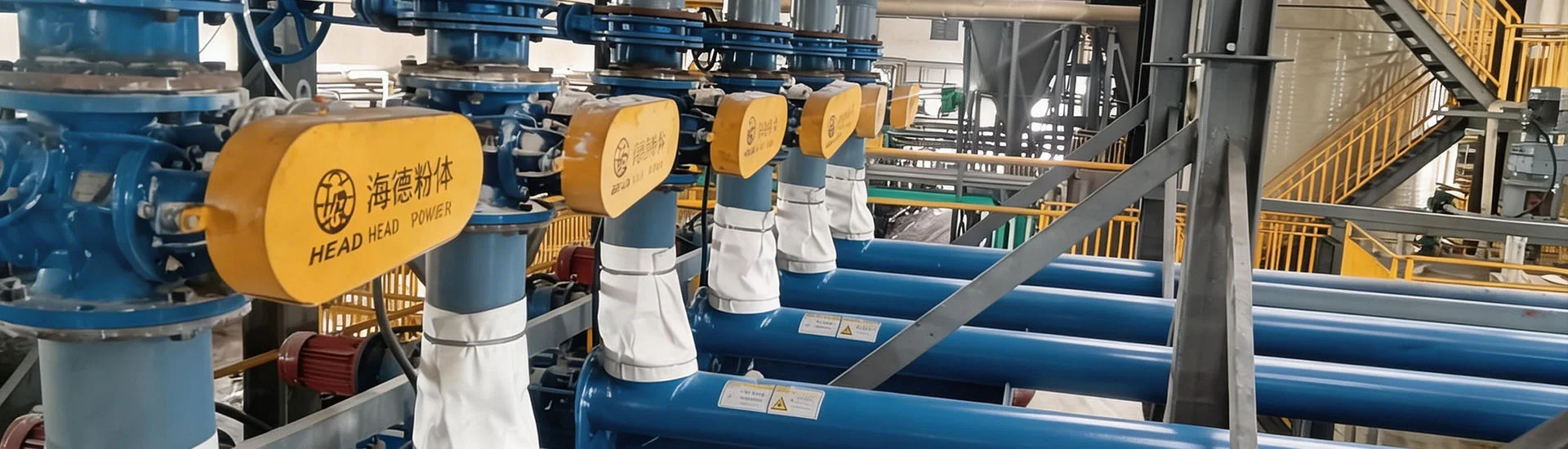
Rich project cases across industries, showing real implementation and proven technical strength.As global environmental regulations tighten, industries such as coal-fired power plants, steel smelting, cement production, and chemical processing face unprecedented pressure to manage industrial by-products responsibly. Among these, desulfurization dust ash – a fine, alkaline powder generated from flue gas desulfurization systems – poses unique handling challenges. Its low bulk density, high moisture sensitivity, and abrasive nature demand a conveying solution that is both reliable and environmentally sound. Pneumatic conveying technology has emerged as the preferred method for transporting desulfurization dust ash, offering sealed, dust-free, and automated material handling. This article provides a comprehensive examination of desulfurization dust ash pneumatic conveying equipment system solutions, covering working principles, system architecture, key selection parameters, real-world applications, and future trends – all with a focus on delivering actionable insights for facility managers and engineering decision-makers.
Pneumatic conveying relies on pressurized air to transport particulate materials through enclosed pipelines. For desulfurization dust ash, two primary conveying modes are employed: dilute-phase and dense-phase. In dilute-phase systems, high-velocity air suspends particles and carries them at relatively low concentrations, suitable for short distances (up to 100 meters) and lower capacities. Dense-phase conveying, by contrast, uses lower air velocities and higher material-to-air ratios, enabling longer transport distances (500 meters or more) with reduced pipeline wear and lower energy consumption. The choice between these modes depends on site-specific conditions such as material characteristics, layout constraints, and budget considerations. A well-designed system integrates components including a feeder (rotary valve or screw pump), a positive displacement blower or compressor, a receiving hopper with de-dusting filters, and a PLC-based control unit. The sealed nature of pneumatic conveying eliminates dust leakage, minimizes product degradation, and significantly reduces maintenance compared to mechanical conveyors like belt or screw systems. Furthermore, modern systems can incorporate automatic online cleaning and pressure stabilization features, ensuring continuous operation even in challenging environments.
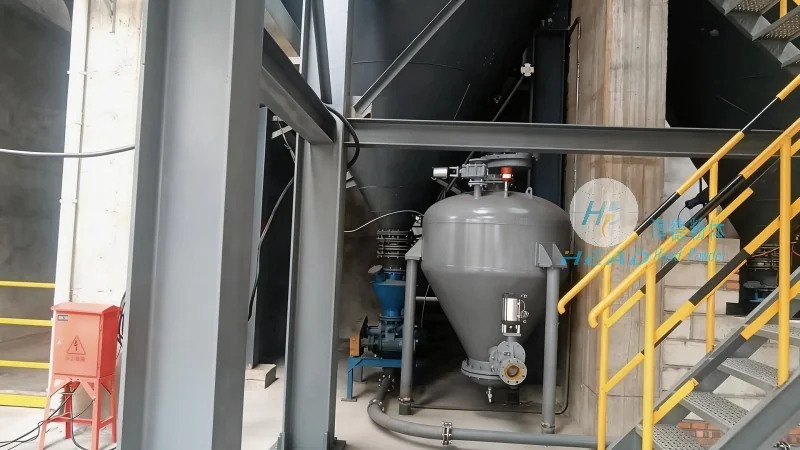
Every pneumatic conveying system for desulfurization dust ash must be carefully engineered around the material’s physical properties. The feeding device is the first critical interface: a rotary airlock valve prevents air backflow while allowing a controlled material feed rate. For cohesive or sticky ash, a vibrating hopper or fluidizing air injection system may be required to prevent bridging. The air mover – either a roots blower for dilute-phase or a screw compressor for dense-phase – must deliver consistent pressure and flow with adequate safety margins. Pipeline geometry is equally important: using wear-resistant steel or ceramic-lined bends at turning points can extend service life by a factor of three to five compared to standard carbon steel. At the receiving end, a baghouse filter or cartridge filter separates the ash from the conveying air, often equipped with pulse-jet cleaning to maintain differential pressure. Silo venting and level sensors complete the system, enabling automated start-stop cycles. Headpowder has developed a modular design philosophy for these components, allowing clients to scale from simple single-line systems to complex multi-point distribution networks. For instance, one 2025 installation at a 660 MW coal-fired plant integrated 12 conveying points into a single dense-phase network, achieving a material-to-air ratio of 30:1 while maintaining a 98% availability rate over 18 months of continuous operation.
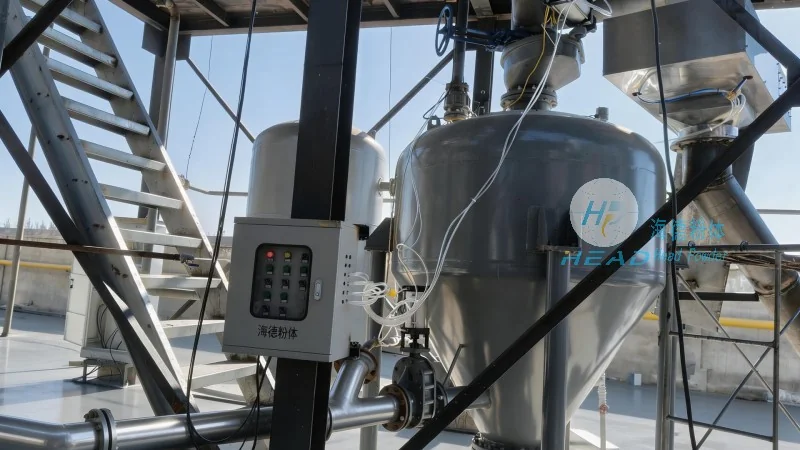
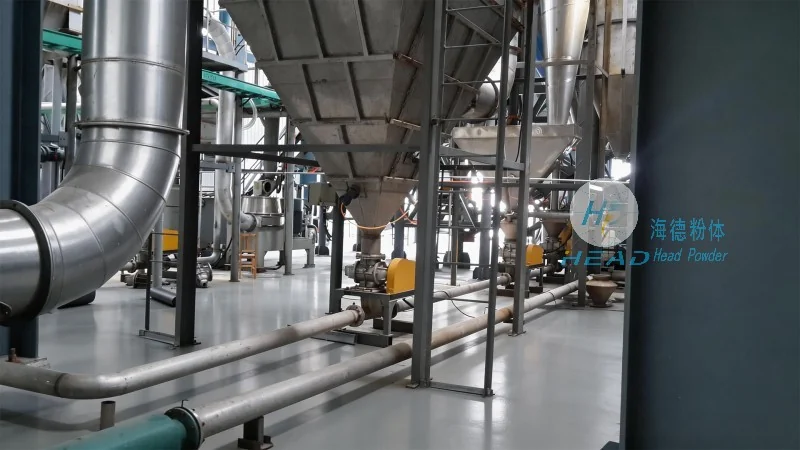
Selecting the appropriate pneumatic conveying system requires a thorough analysis of operating parameters. Particle size distribution typically ranges from 5 to 100 microns, with a median diameter around 20–30 microns, making the ash prone to agglomeration in moist environments. Bulk density varies between 0.6 and 1.2 g/cm³ depending on sulfur content and calcium-to-sulfur ratio. Conveying distance, elevation changes, and desired capacity (e.g., 10–50 tons per hour) directly influence pipeline diameter and air velocity. Industry guidelines recommend a minimum conveying velocity of 12–18 m/s for dilute-phase to avoid settling, while dense-phase operations can run at 4–8 m/s with careful control of pressure drop. An important but often overlooked factor is the ash’s angle of repose (typically 35–50°), which dictates hopper design and feeder selection. Economic analysis should also consider energy costs: dense-phase systems can reduce specific energy consumption by 30–50% compared to dilute-phase for distances above 200 meters. To simplify the decision process, headpowder provides a proprietary simulation tool that models pressure drop, wear rates, and power consumption based on client-specific input data. A case in point: a cement kiln client in Shandong Province reduced annual energy costs by RMB 180,000 after switching from dilute-phase to optimized dense-phase conveying, with system payback achieved within 14 months.
Real-world installations demonstrate the robustness of pneumatic conveying for desulfurization dust ash. In a 2×350 MW thermal power plant, the original mechanical conveyor frequently suffered from clogging and dust escape, failing to meet new local emission standards of 10 mg/Nm³. After retrofitting with a headpowder dense-phase system featuring ceramic-lined pipelines and automated purging, particulate emissions fell to below 5 mg/Nm³, and unscheduled downtime dropped by 85%. Another example involves a steel sintering plant handling 30 tons of ash per hour over a 480-meter routing with multiple elevation changes. The system achieved a conveying pressure of 2.8 bar with a material-to-air ratio of 28:1, resulting in pipeline wear limited to 0.3 mm per year compared to 2.5 mm in the preceding dilute-phase layout. These projects underline the importance of custom engineering: no two ash streams are identical, and a one-size-fits-all approach leads to premature wear or insufficient capacity. Headpowder’s engineers conduct on-site material sampling, particle analysis, and computational fluid dynamics modeling before proposing a final design, ensuring that the system matches the specific abrasiveness, moisture content, and temperature profile of each client’s ash.
Long-term reliability of a desulfurization dust ash conveying system depends on a structured maintenance program. Routine checks include monitoring air filter cleanliness, blower oil levels, rotary valve clearances, and pipeline thickness at bends. Dense-phase systems require additional attention to valve seat seals and blow tank venting cycles. A predictive maintenance approach, leveraging pressure sensors and vibration analyzers, can identify early signs of wear or blockages. For instance, a sudden increase in line pressure differential may indicate ash buildup at a low point, allowing operators to initiate a purge cycle before a full blockage occurs. Modern control systems offered by headpowder include remote monitoring dashboards that track real-time conveying rates, energy consumption, and alarm logs. Clients can access historical data trends and schedule maintenance windows based on actual usage rather than fixed intervals. One recent upgrade at a chemical plant reduced maintenance labor by 40% after implementing such a system. Additionally, periodic Performance Qualification (PQ) tests – comparing actual capacity to design specifications – help verify that the system continues to meet emissions and throughput targets as plant conditions evolve.
The pneumatic conveying industry is poised for significant transformation driven by automation, digitalization, and stricter environmental policies. By 2026, experts project that over 70% of new coal-fired units in China and Southeast Asia will adopt dense-phase conveying for desulfurization ash because of its lower carbon footprint and compliance with ultra-low emission mandates. Smart sensors integrated with Industrial Internet of Things (IIoT) platforms will enable autonomous adjustment of conveying parameters based on real-time ash quality fluctuations. Another emerging trend is the use of flexible, modular skid-mounted systems that reduce installation time by 50% and allow rapid reconfiguration when plant layouts change. Material recycling is also gaining attention: some facilities are exploring the injection of desulfurization ash back into the flue gas duct for supplementary desulfurization, a technique that demands highly controlled pneumatic feeding precision. In this evolving landscape, headpowder continues to invest in R&D for next-generation wear-resistant materials and adaptive control algorithms. The company’s latest Multi-Phase Adaptive Conveying (MPAC) technology, currently undergoing field trials, promises to automatically switch between dilute and dense modes to optimize energy use across variable load conditions – a breakthrough that could lower life-cycle costs by an additional 15–20%.
Investing in a desulfurization dust ash pneumatic conveying system represents a long-term commitment that directly impacts production efficiency, environmental compliance, and operating costs. Beyond hardware specifications, decision-makers should evaluate a supplier’s engineering capabilities, after-sales service network, and track record of successful installations in similar applications. A true system partner offers not only equipment but also turnkey project management – from site survey and process design to installation supervision and employee training. Headpowder has served over 120 industrial clients across thermal power, steel, and cement sectors since 2010, delivering tailored solutions that balance first-cost economics with total cost of ownership. The company’s engineering team provides lifetime technical support, including remote diagnostics and spare parts inventory management. For facilities preparing for upcoming emissions standards or seeking to retrofit aging conveying lines, a phased upgrade approach can minimize production interruption while progressively improving performance. A professional consultation begins with a no-obligation assessment of your current ash handling profile and preliminary system sizing. (咨询热线:156-6277-7102) – headpowder’s dedicated project advisors are ready to discuss your specific requirements and recommend an optimized solution that aligns with your operational goals and budget constraints.
In conclusion, a properly engineered desulfurization dust ash pneumatic conveying system is not simply a material transport mechanism; it is a critical component of modern industrial environmental management. By combining robust equipment design with intelligent controls and proactive maintenance, facilities can achieve reliable, low-emission ash handling that supports both regulatory compliance and operational excellence. As industry standards continue to evolve, partnering with an experienced provider who invests in continuous innovation becomes an increasingly strategic advantage. The information presented here provides a solid foundation for evaluating system options, but site-specific factors always demand a customized approach. For a detailed project feasibility study and budget estimate, reach out to headpowder’s technical team at the number above – the expertise behind decades of successful ash conveying installations is available to help you build a solution that works the first time and every time.

 Shandong headpowder Engineering Co., Ltd.
 156-6277-7102(Manager Zhang)
  0531-83386006
  Jinan City, Shandong Province, China
服务热线
微信咨询
回到顶部