News
Rich project cases across industries, showing real implementation and proven technical strength.In the rapidly evolving landscape of lithium-ion battery manufacturing, the efficiency and reliability of raw material handling directly impact production yield, energy consumption, and final product quality. Among the critical unit operations, pneumatic conveying of cathode and anode active materials has emerged as a specialized engineering discipline that demands a deep understanding of powder rheology, particle mechanics, and process safety. This technical introduction and overview aims to provide a comprehensive yet practical examination of pneumatic conveying systems designed specifically for electrode material powders, addressing both the fundamental principles and the nuanced challenges encountered in real-world production environments.
Lithium-ion battery electrodes are composed of active materials—such as lithium nickel cobalt manganese oxide (NCM) for cathodes and graphite or silicon-based compounds for anodes—along with conductive additives, binders, and solvents. These active materials are typically manufactured in powder form with particle sizes ranging from a few microns to several tens of microns. The handling of these fine, often cohesive, and sometimes abrasive powders presents unique engineering obstacles. Pneumatic conveying, which uses a gas stream (typically air or inert gas) to transport powder through pipes, has become the preferred method over mechanical conveyors due to its enclosed nature, flexibility in routing, and reduced risk of contamination. However, the specific properties of battery materials—high abrasiveness (e.g., NMC, LFP), friability (graphite), moisture sensitivity (many cathode precursors), and electrostatic charging tendencies—demand customized system designs that go far beyond generic pneumatic conveyor concepts.
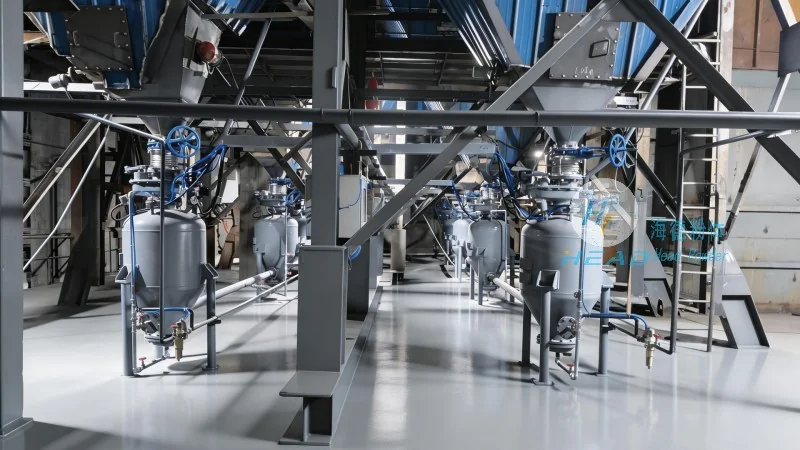
Pneumatic conveying systems operate based on the interaction between the gas flow and the dispersed solid particles. The two primary regimes are dilute phase (or lean phase) conveying, where particles are suspended in a high-velocity gas stream with a low solid-to-gas ratio, and dense phase conveying, where solids move as a moving bed or plug at lower gas velocities with a high solid loading. For cathode and anode materials, the choice between these regimes is not arbitrary; it is dictated by the powder’s flowability, particle hardness, and the acceptable level of degradation. Dilute phase conveying, while simple and well-understood, often leads to particle attrition, pipe wall erosion, and higher energy consumption due to the elevated gas velocities required (typically 15 to 30 m/s for fine powders). For friable anode materials like natural graphite or synthetic graphite flakes, such velocities can cause significant breakage, altering particle size distribution and affecting electrode slurry rheology. Conversely, dense phase conveying operates at velocities as low as 1 to 5 m/s, drastically reducing particle collisions and wear. However, dense phase systems require careful control of air injection and pressure to prevent pipeline blockage, especially with cohesive cathode materials like NCM or LCO which exhibit high internal friction and wall adhesion.
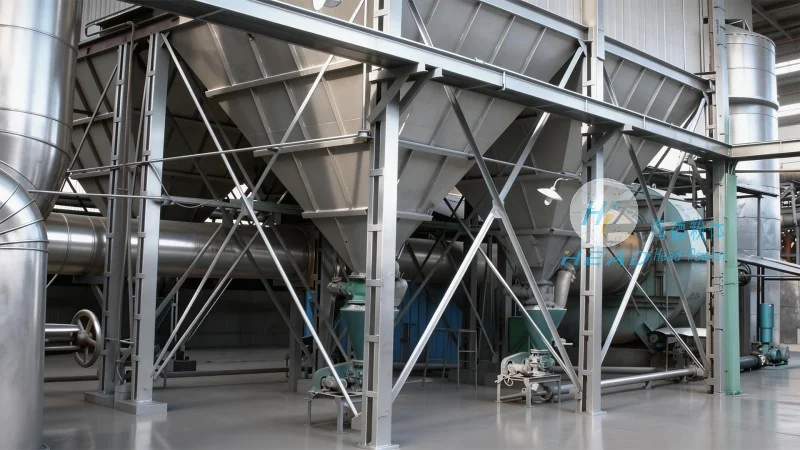
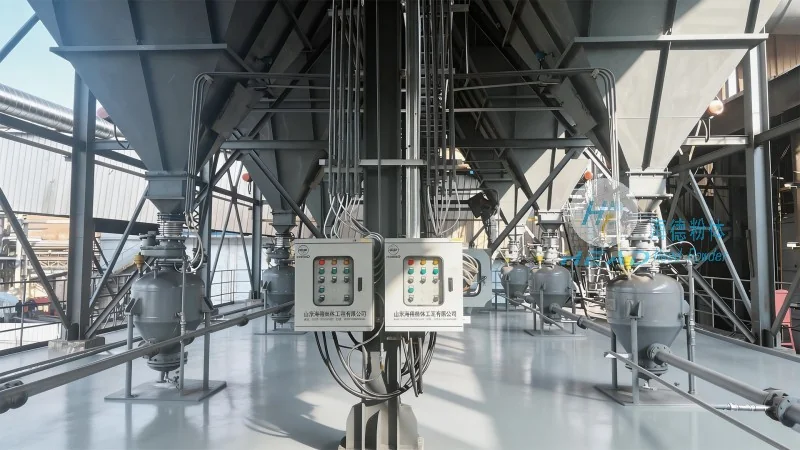
A complete pneumatic conveying system for electrode materials typically consists of a feed hopper or container, a conveying pipeline, a receiving vessel (cyclone or filter receiver), a dust collection unit, and a motive air supply (blower, compressor, or vacuum pump). The design must address several critical parameters: conveying distance, elevation change, batch size, and hourly throughput. For typical battery material factories, conveying distances may range from 30 meters to over 200 meters, often with multiple bends and vertical rises. Each bend introduces additional pressure drop and potential for particle accumulation or degradation. To mitigate this, headpowder incorporates long-radius elbows with wear-resistant liners (alumina ceramic or tungsten carbide) at all directional changes, reducing both erosion and product breakage. The pipe material itself is often stainless steel 304 or 316L with an internal surface roughness of Ra ≤ 0.8 μm to minimize powder sticking and facilitate cleaning during grade changes.
One of the most persistent issues in pneumatic conveying of battery materials is abrasion. Cathode materials like NMC and lithium iron phosphate (LFP) have hardness values of 4 to 6 on the Mohs scale, which can rapidly wear standard carbon steel pipes. Conversely, the abrasion effect also damages the particles themselves, leading to increased fines generation that can clog filters and degrade battery performance. Attrition is a primary concern for anode materials, particularly graphite and silicon-graphite composites. Even a 1% increase in fines below 5 μm can significantly reduce battery cycle life and capacity retention. headpowder’s approach to this problem includes using gentle acceleration zones, gradually expanding pipe diameters to reduce velocity before bends, and employing rotary valves with specially designed pocket geometries that minimize particle shearing. Electrostatic charge buildup is another often underestimated factor. High-resistivity powders like dry cathode materials can accumulate static charges exceeding 20 kV, posing risks of dust explosions and causing powder to adhere to pipe walls, leading to plugging or erratic flow. Effective grounding of all metallic components and the use of conductive hose linings are standard practices, and headpowder integrally bonds static dissipative materials into the conveying path to ensure charge dissipation below 2 kV.
For moisture-sensitive cathode materials (e.g., dry NMC, sodium-ion precursors) and hygroscopic anode materials (some synthetic graphites), the conveying gas must be conditioned to maintain a dew point typically below -40°C. Using dried compressed air or, in high-sensitivity applications, nitrogen in a closed-loop recirculation system prevents moisture pickup that could alter powder flow properties or trigger premature reactions. The inert gas system also eliminates the risk of oxidation for materials like natural graphite flakes. headpowder has delivered multiple projects where a nitrogen recirculation loop, combined with a regenerative blower and a membrane dryer, achieves oxygen levels below 1% throughout the conveying line, meeting the stringent safety and quality standards required in battery gigafactories.
Modern battery material production demands precise batching accuracy—often within ±0.5% of target weight—and seamless integration with upstream mixing or calcining processes. Pneumatic conveying systems must be equipped with loss-in-weight feeders, continuous level sensors, and programmable logic controllers (PLC) that modulate the motive air pressure and valve timing to maintain a consistent mass flow rate. headpowder’s control software incorporates algorithms that automatically adjust conveying parameters based on real-time powder properties, such as bulk density or flowability index measured from inline sensors. This adaptive control reduces the need for manual intervention and compensates for batch-to-batch variations in material characteristics, a common occurrence in the supply chain of cathode and anode powders.
As the global lithium-ion battery market expands at a compound annual growth rate exceeding 20% through 2026, driven by electric vehicle adoption and stationary energy storage, the demand for high-throughput, reliable pneumatic conveying systems has intensified. Several key trends are shaping the industry: first, the shift toward dry electrode coating processes, which eliminates solvents and increases the importance of dust-tight, dry pneumatic transport; second, the emergence of solid-state battery materials such as sulfides and oxides, which are highly moisture- and oxygen-sensitive, requiring fully sealed inert conveying loops; and third, the push for sustainability, with manufacturers seeking to reduce energy consumption per ton of material conveyed. Energy-efficient dense phase conveying methods, coupled with variable-speed drives on blowers, can lower system power consumption by 30% to 50% compared to traditional dilute phase systems. Additionally, predictive maintenance using vibration analysis, pipe wall thickness monitoring, and pressure trend analysis is becoming standard to prevent unplanned downtime. headpowder has been at the forefront of these innovations, integrating IoT sensors into its systems to provide real-time wear data and alert operators before breaches occur.
To illustrate the practical value of tailored design, consider a production line for synthetic graphite anode powder with a D50 particle size of 18 μm and a tapped density of 0.8 g/cm³. The material is highly cohesive and prone to bridging in standard hoppers. A conventional dilute phase system originally installed at a client site resulted in 2.5% particle breakage (increase in fines below 5 μm) and pipe wear requiring replacement every six months. After retrofitting with a headpowder-designed dense phase system using a bottom-discharge pressure vessel, a sintered metal filter for fine particle retention, and ceramic-lined bends, the particle breakage dropped to 0.3%, pipe service life extended beyond four years, and system energy consumption fell by 40%. The client achieved a consistent product quality that met the strict specifications for high-energy density battery grades, directly improving their cell yield by nearly 2%. (咨询热线:156-6277-7102)
When evaluating pneumatic conveying systems for cathode and anode materials, engineers should consider the following quantifiable metrics: pressure drop per unit length (typically 5–15 kPa per 100 meters for dilute phase, 20–50 kPa for dense phase), solid-to-gas ratio (10–20 kg/kg for dilute, 30–100 kg/kg for dense), and particle velocity at the pipe wall (should be below 10 m/s for fragile materials). The conveying capacity should be matched to the downstream process, with a safety factor of 15% to 20% to account for batch peaks. It is also essential to conduct a powder rheology assessment prior to system design, including measurement of cohesion index, wall friction angle, and compressive strength. These data, combined with computational fluid dynamics (CFD) simulations for gas-solid flow patterns, enable a predictive approach that minimizes trial and error. headpowder offers a mobile pilot testing trailer equipped with full instrumentation to run on-site trials with the customer’s actual material, ensuring the proposed design yields the required throughput and quality before any fabrication begins.
The handling of fine combustible powders, especially graphite and metal oxide materials with high surface area, imposes strict safety obligations. All pneumatic conveying systems must comply with ATEX or equivalent standards for dust explosion zones, typically requiring a maximum permissible oxygen concentration of 8% by volume when using inert gas. headpowder integrates passive safety devices such as explosion suppression canisters, venting panels, and flameless venting on filter receivers. Additionally, environmental regulations in Europe and North America are tightening permissible dust emissions to below 1 mg/Nm³. High-efficiency cartridge filters with pulse-jet cleaning and HEPA after-filters are now standard in headpowder’s designs, ensuring compliance and enabling closed-loop return of captured dust to the process for zero waste.
Pneumatic conveying technology for cathode and anode materials is far from a commodity; it is a specialized engineering solution that directly influences production consistency, cost, and safety. As battery chemistry evolves and production scales to multi-gigawatt-hour levels, the choice of conveying system becomes a strategic decision affecting plant profitability. By understanding the interplay between powder properties, conveying regimes, and system architecture, manufacturers can avoid costly pitfalls such as material degradation, pipe erosion, and batch variability. With decades of accumulated expertise in particle technology and hundreds of successful installations across the battery supply chain, headpowder remains committed to advancing this field through continuous innovation, rigorous testing, and a deep respect for the precision required in energy storage materials. Whether building a new facility or optimizing an existing line, engaging a partner with demonstrated technical depth in pneumatic conveying of fine battery powders is an investment in long-term operational excellence.

 Shandong headpowder Engineering Co., Ltd.
 156-6277-7102(Manager Zhang)
  0531-83386006
  Jinan City, Shandong Province, China
服务热线
微信咨询
回到顶部