News
Rich project cases across industries, showing real implementation and proven technical strength.Microsilica powder, also known as silica fume, is an ultra-fine pozzolanic material widely used in high-performance concrete, refractory materials, and ceramics. With particle sizes typically below 1 micron and bulk densities ranging from 150 to 300 kg/m³, this material presents significant handling challenges. Its low density, high angularity, and tendency to agglomerate or fluidize unpredictably demand specialized pneumatic conveying solutions. In industrial practice, the choice of conveying system directly influences operational efficiency, product quality, and maintenance costs. For facilities processing or distributing microsilica powder—from cement plants and ready-mix concrete producers to specialty chemical manufacturers—selecting the right pneumatic conveying technology is not merely a logistical decision but a critical factor in ensuring consistent output and meeting increasingly stringent environmental standards.
The global microsilica market is projected to maintain steady growth through 2026, driven by infrastructure modernization, demand for durable construction materials, and expansion of the renewable energy sector (where silica fume is used in wind turbine grouts). According to industry analyses, the annual production of microsilica exceeds 2.5 million metric tons, with major supply coming from silicon and ferrosilicon alloy smelters. As these producers seek to optimize downstream handling and reduce material losses, pneumatic conveying systems must evolve to balance energy efficiency with gentle material transport. This article provides a technical overview of microsilica powder pneumatic conveying solutions, covering system types, key design parameters, equipment selection considerations, and practical operational insights—all grounded in current industry practices and engineering standards.
Before examining specific conveying configurations, it is essential to understand the material characteristics that define system requirements. Microsilica powder exhibits several challenging properties that must be accounted for in any pneumatic conveying solution.
These properties directly influence the selection between dilute phase and dense phase conveying, the sizing of air movers, the choice of pipeline diameter and routing, and the type of feeding and separation equipment. For example, a dilute phase system operating at high air velocities (20–35 m/s) may effectively suspend the particles but risks significant pipe erosion and particle degradation. Conversely, dense phase conveying at lower velocities (2–8 m/s) reduces wear and energy consumption but requires careful pressure control to prevent plugging.
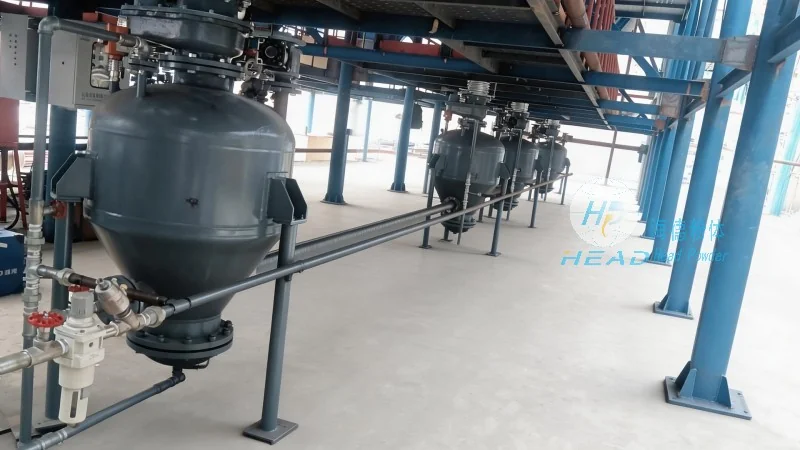
Based on industry experience and engineering practice, three primary system configurations are commonly employed for microsilica powder handling: dilute phase pressure systems, dense phase pressure systems, and vacuum (negative pressure) systems. Each has specific advantages and limitations that must be matched to the facility's throughput, distance, and layout constraints.
In dilute phase systems, the material is suspended in a high-velocity airstream (typically 20–35 m/s) and transported at a low solid-to-air ratio (typically 0.5–5 kg material per kg air). This is the most straightforward approach for microsilica powder when conveying distances are under 200 meters and throughputs are moderate. The system consists of a pressure vessel (blow tank) or rotary airlock feeding into a pipeline connected to a positive displacement blower or compressor. At the discharge end, a cyclone separator or baghouse filter collects the product.
For microsilica, dilute phase conveying offers the benefit of minimal upfront capital cost and simpler control logic. However, the high velocity causes significant pipe wear—even with mild steel, erosion rates can exceed 0.5 mm per month at bends. Furthermore, the high air volume requires larger filter bags and air treatment equipment. Many operators find that bent axis or long-radius bends with ceramic inserts extend service life considerably. Headpowder has engineered dilute phase systems with specially designed venturi feeders that reduce air velocity near the pickup point while maintaining suspension, achieving a 30% reduction in specific energy consumption compared to conventional rotary valve designs.
Dense phase systems operate at lower air velocities (2–8 m/s) with high solid-to-air ratios (10–40 kg/kg) and higher pressures (up to 6 bar). The material moves as a fluidized plug or slug through the pipeline, rather than being fully suspended. This mode is particularly suitable for microsilica powder because it minimizes particle degradation, reduces pipe wear dramatically, and requires less compressed air per ton of material.
Two common dense phase configurations are used:
Headpowder's dense phase systems incorporate proprietary flow sensors and PLC-based adaptive control algorithms that adjust booster activation based on real-time pressure differentials. In a recent installation at a major refractory manufacturer, this technology achieved consistent conveying of microsilica over a 350-meter route with 30% less compressed air consumption than conventional dense phase systems, while maintaining powder particle size distribution within specification limits.
For applications requiring multiple pickup points feeding a single destination, or where dust containment is critical, vacuum systems are often preferred. A vacuum pump or venturi creates negative pressure (typically –0.3 to –0.6 bar) in the pipeline, drawing material from hoppers or super sacks into the airstream. The collected product is separated in a cyclone and filter receiver before being discharged into a storage silo or process vessel.
Vacuum conveying is inherently safer for handling fine powders because any leakage is inward, preventing dust escape. However, the limited pressure differential restricts conveying distances to approximately 100–200 meters for microsilica, and throughputs are lower compared to pressure systems of similar pipeline diameter. For facilities operating multiple silo unloading points or requiring dust-free transfer from bulk bag stations to mixing equipment, vacuum systems remain a practical choice.
Regardless of the conveying mode chosen, several components require particular attention when handling microsilica powder. The following table summarizes key design parameters based on typical microsilica characteristics:
| Parameter | Recommended Range / Value | Remarks |
|---|---|---|
| Pipeline air velocity (dilute) | 20–28 m/s | Lower velocity reduces wear; 28 m/s max for long straight runs |
| Pipeline air velocity (dense) | 3–8 m/s | Dependent on material moisture content and particle morphology |
| Solid-to-air ratio (dilute) | 1–4 kg/kg | Lower ratio reduces risk of settling at bends |
| Solid-to-air ratio (dense) | 10–30 kg/kg | Requires adequate fluidization at pickup |
| Pipeline material | Carbon steel with ceramic lining (≥5 mm) at bends | Stainless steel 304/316 where moisture control is critical |
| Air drying requirement | Pressure dew point ≤ –40°C | Prevents moisture absorption and bridging in dense phase |
| Filter receiver filtration | HEPA H13 or cartridge with PTFE membrane | Ensure emissions ≤ 1 mg/Nm³ for compliance |
| Blow tank discharge valve | Full-port ball or pinch valve | Avoids dead zones where material can pack |
Compressed air quality directly impacts microsilica conveying reliability. Oil-free compressors (Class 0 per ISO 8573-1) are standard to prevent contamination. Aftercoolers and refrigerated dryers must maintain a pressure dew point below –40°C; for humid environments, desiccant dryers are recommended. In dense phase systems, the air receiver should be sized to provide stable pressure during blow tank cycles, typically 2–3 times the blow tank volume.
For microsilica, long-radius bends (R ≥ 10D, where D is pipe inner diameter) reduce wear and pressure drop. Using sweep bends with replaceable ceramic inserts at every change of direction—especially at the 45° and 90° turns—can extend pipeline life by 300–500% compared to standard steel bends. Headpowder incorporates such ceramic-lined bends as standard in all microsilica conveying packages, with documented service intervals exceeding 18 months in high-wear applications.
The conveying system does not operate in isolation. Proper integration with upstream feeding equipment and downstream storage or process vessels is essential for trouble-free operation. Microsilica storage silos should be designed with conical or fluidized discharge bottoms, equipped with aeration pads to maintain powder fluidity. Bin activators or screw feeders with variable speed drives can prevent bridging. For dense phase blow tank feeding, a rotary valve or metering screw that provides consistent, non-pulsating feed is critical to maintaining plug stability.
Many facilities also require dust collection at the conveying discharge point. Baghouse filters with pulse-jet cleaning and high-efficiency PTFE media achieve emission levels below 1 mg/Nm³, complying with stringent environmental regulations. The filter housing should be electrically grounded to dissipate static charges that accumulate during microsilica handling.
Several developments are shaping the pneumatic conveying landscape for fine powders like microsilica. First, the push toward Industry 4.0 and digitalization is driving adoption of smart sensors and predictive maintenance. Real-time monitoring of pipeline pressure, air velocity, and temperature allows operators to detect incipient blockages or filter clogging before they cause downtime. Headpowder offers a cloud-based monitoring platform that aggregates data from multiple conveying lines, providing operators with dashboards and alerts that improve overall equipment effectiveness (OEE).
Second, energy efficiency is becoming a competitive differentiator. With electricity costs rising, dense phase conveying—which can reduce energy consumption by 40–60% compared to dilute phase for the same throughput—is gaining traction. Variable frequency drives on blowers and compressors further optimize energy use by matching air supply to actual demand.
Third, sustainability and circular economy principles are influencing system design. Closed-loop conveying systems that recirculate conveying air, combined with high-efficiency filtration, minimize both energy waste and dust emissions. Some advanced systems now integrate carbon capture or use low-carbon compressed air generation methods, aligning with corporate net-zero commitments.
Finally, the microsilica market itself is evolving. The global push for green building materials and high-durability infrastructure (bridges, tunnels, offshore structures) is increasing demand for high-reactivity silica fume. This drives requirements for larger conveying capacities and longer distances, pushing engineers to develop multi-phase conveying solutions that combine dense phase for long hauls with dilute phase for fine metering.
Successful deployment of a microsilica pneumatic conveying system hinges on thorough site evaluation and commissioning. Before installation, the following steps are essential:
Headpowder's commissioning team follows a standardized protocol that includes shear cell testing of the actual material, computational fluid dynamics (CFD) modeling of critical pipeline sections, and a 72-hour continuous performance test before final handover. This approach has resulted in less than 2% deviation between predicted and actual conveying rates across more than 60 installations worldwide.
Microsilica powder pneumatic conveying presents unique engineering challenges that demand careful system selection, component specification, and operational discipline. Whether opting for dilute phase simplicity, dense phase efficiency, or vacuum-based containment, the key to reliable performance lies in understanding the material's physical behavior and matching the system design accordingly. With global microsilica production expected to exceed 3 million metric tons by 2026, and end-user requirements for consistent product quality and low emissions becoming more stringent, investment in well-engineered conveying solutions pays dividends through reduced downtime, lower maintenance costs, and improved product integrity.
Companies that partner with experienced system integrators gain access to proven designs, proprietary control strategies, and ongoing support that ensures their conveying systems remain efficient and compliant for years to come. Headpowder's track record in delivering customized pneumatic conveying solutions for microsilica and other hard-to-handle powders spans over a decade, with installations serving the construction, refractory, ceramics, and specialty chemical sectors worldwide. By combining deep material science knowledge with practical field experience, Headpowder helps facility engineers achieve reliable, energy-efficient, and dust-free material handling from source to process. For an in-depth consultation on your specific microsilica conveying requirements, reach out to the Headpowder engineering team (咨询热线:156-6277-7102) to discuss your project goals and site conditions.

 Shandong headpowder Engineering Co., Ltd.
 156-6277-7102(Manager Zhang)
  0531-83386006
  Jinan City, Shandong Province, China
服务热线
微信咨询
回到顶部