News
Rich project cases across industries, showing real implementation and proven technical strength.Caustic soda, also known as sodium hydroxide (NaOH), is one of the most widely used industrial chemicals in sectors such as pulp and paper, alumina refining, chemical processing, water treatment, and soap manufacturing. Handling caustic soda—whether in flake, pearl, or microbead form—presents significant challenges due to its hygroscopic nature, corrosiveness, and potential for caking. A well-engineered pneumatic conveying system is critical for safe, efficient, and dust-free transport of caustic soda from storage to process points. This article provides a comprehensive overview of the equipment used in caustic soda pneumatic conveying systems, focusing on design principles, component selection, system configurations, and operational best practices. Headpowder, as a specialized supplier in this field, brings years of field experience and engineering expertise to ensure reliable and cost-effective solutions for handling this demanding material.
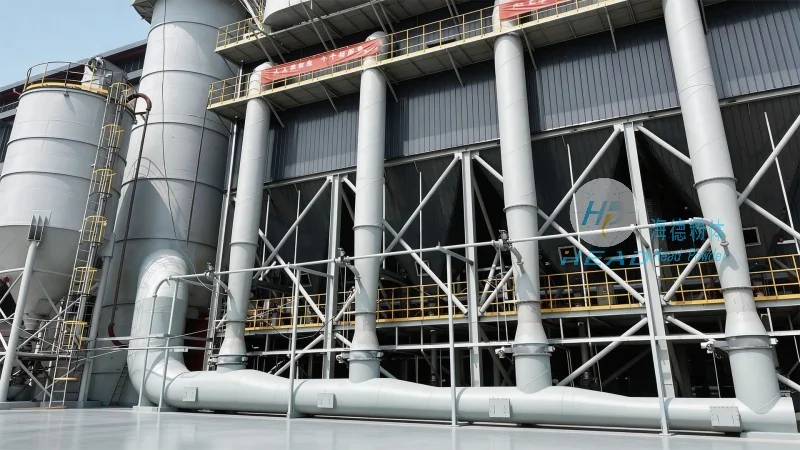
Pneumatic conveying systems for caustic soda fall into two main categories: dilute phase and dense phase. Dilute phase systems operate at high air velocity and low pressure, suspending particles in the air stream. Dense phase systems use lower velocities and higher pressure, pushing material in a plug-like flow. For caustic soda, dense phase conveying is often preferred because it minimizes particle attrition, reduces moisture absorption, and lowers energy consumption. However, the choice depends on particle size distribution, moisture content, conveying distance, and throughput requirements. Headpowder engineers evaluate these parameters carefully during the design phase, tailoring each system to the specific material characteristics and site constraints.
A typical caustic soda pneumatic conveying system consists of several key equipment modules: material feeding device, air source, conveying pipeline, separation and filtration unit, and control system. Each component must be constructed from corrosion-resistant materials, typically stainless steel 304 or 316L, with appropriate surface finish to prevent caustic soda from sticking and to facilitate cleaning. PTFE or UHMWPE linings may be used in certain sections to reduce friction and prevent chemical attack. Headpowder’s standard design incorporates modular construction, allowing for easy installation, maintenance, and future expansion.
The feeding mechanism is the starting point of any pneumatic conveying system. For caustic soda, rotary airlock valves are commonly used to introduce material into the conveying line while maintaining pressure differential. The rotor housing and blades must be made of stainless steel with hardened wear surfaces, and the clearances should be tight to prevent air leakage. In some applications, screw feeders or venturi eductors are used, especially when handling fine powders. Headpowder offers a range of rotary valves with optional ceramic coatings to extend service life in abrasive caustic soda environments.
The air source is typically a positive displacement blower or a screw compressor, depending on the required pressure and flow rate. For dilute phase systems, centrifugal fans may suffice for short distances, but dense phase systems demand higher pressure (up to 4-6 bar) provided by screw compressors. Air drying is essential because moisture reacts with caustic soda to form a sticky, corrosive paste. Headpowder integrates refrigerated or desiccant dryers into the air preparation unit, along with particulate and coalescing filters to ensure clean, dry compressed air. This step alone can reduce system downtime and maintenance costs significantly, as moisture-related clogs and corrosion are among the most common failure modes.
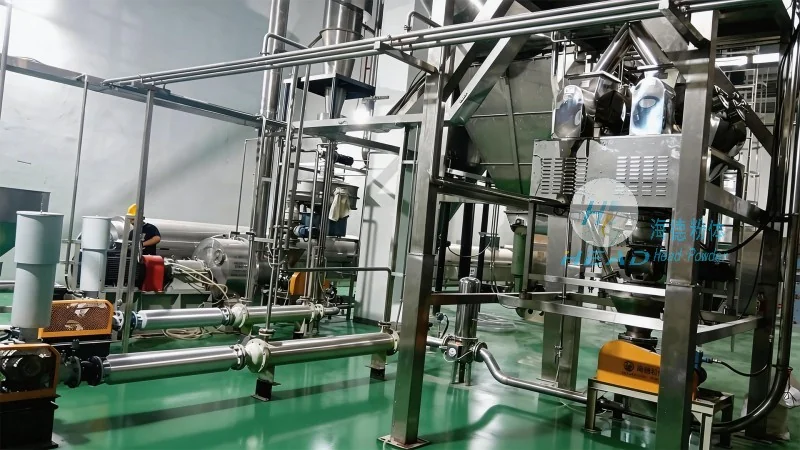
Conveying pipelines for caustic soda must be designed with smooth internal surfaces, gradual bends (large radius elbows), and minimal straight sections to reduce pressure drop and material buildup. Standard carbon steel pipes are unsuitable due to rapid corrosion; stainless steel 304L or 316L with a surface roughness of Ra ≤ 0.8 μm is recommended. High-density polyethylene (HDPE) pipes may be used for lower pressure applications, but they require proper grounding to avoid static electricity accumulation. Headpowder’s pipeline systems feature a combination of butt-welded joints and flanged connections for critical sections, facilitating inspection and cleaning.
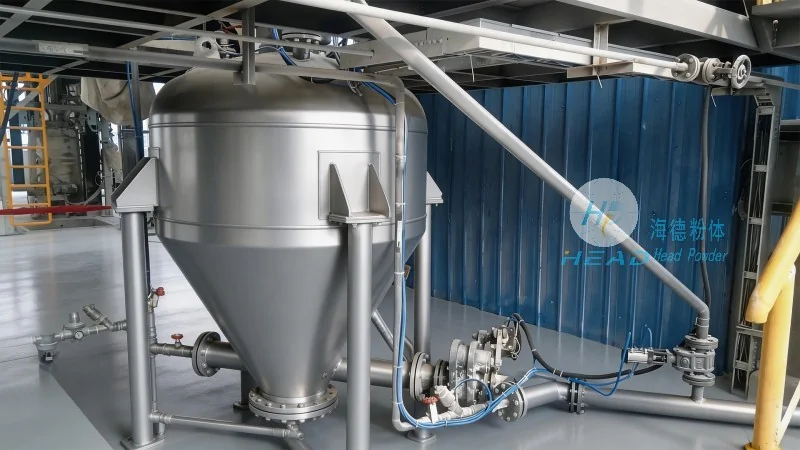
Bend radii should be at least 10 times the pipe diameter for dense phase systems and 15 times for dilute phase to minimize material degradation. Blow tanks or pressure vessels are used to batch feed material into dense phase systems, with discharge controlled by pinch valves or diverter valves. Headpowder has developed a proprietary blow tank design with a fluidizing bottom that improves material flow consistency and reduces bridging. In one installation for a major alumina refinery, this design reduced system cycle time by 22% while lowering compressed air consumption by 18%.
When the conveyed material reaches its destination, the air must be separated from the solid particles. Cyclone separators are often used as the primary stage, followed by a baghouse filter or cartridge dust collector to achieve near-zero emissions. For caustic soda, the filter media must be anti-static and resistant to alkaline attack—often polyester felt with PTFE membrane coating is employed. The collected dust can be recirculated back into the process, improving yield and reducing waste. Headpowder’s filtration units are designed with pulse-jet cleaning systems that maintain low pressure drop and high filtration efficiency, meeting stringent environmental standards such as EPA MACT and EU BREF.
In applications where the conveyed material is directly fed into a mixing tank or reactor, a simple vent filter may suffice. However, for long-distance conveying or when multiple destinations are involved, a full separation and conveying system with diverter valves, silo top filters, and level indicators is necessary. Headpowder supplies integrated control panels that manage the entire sequence from feeder to destination, with alarms for filter pressure, material level, and air quality. These panels can be connected to plant DCS via Modbus or Profibus protocols.
Modern caustic soda pneumatic conveying systems rely on PLC-based controls for precise material metering, automatic purging, and fault detection. Sensors monitoring air pressure, flow rate, motor current, and temperature provide real-time data for optimization. Headpowder’s control software includes algorithms that adjust conveying velocity dynamically based on material moisture content, preventing line blockages. Remote monitoring via SCADA allows operators to diagnose issues from a central control room, reducing the need for field intervention. For example, in a chemical plant processing 10 tons per hour of caustic soda pearls, the automated system improved throughput consistency by 16% and reduced unplanned downtime by 30% over a one-year period.
Regular maintenance of a caustic soda pneumatic conveying system is essential to avoid unscheduled stoppages and safety hazards. Key maintenance tasks include checking wear on rotary valves, cleaning filter bags, inspecting pipe integrity for pitting, and verifying air dryer performance. Headpowder provides detailed maintenance manuals and training sessions for site personnel. Safety considerations are paramount: caustic soda dust is corrosive to skin and eyes, and fine particles can create explosive atmospheres if mixed with air in certain concentrations. Therefore, all system components must be grounded, and ex-proof electrical equipment rated for Zone 22 (dust) should be installed. Headpowder conducts HAZOP reviews during the design stage and offers options for inert gas blanketing (e.g., nitrogen purging) for systems handling very fine caustic soda powders.
Compliance with international standards such as ISO 12100, ATEX, and IECEx is built into every system. Headpowder’s quality management system is ISO 9001 certified, and all pressure vessels are designed and tested in accordance with ASME VIII Div. 1 or PED 2014/68/EU. The company also stays updated on evolving industry regulations, including the European Seveso III directive for major accident hazards involving dangerous substances.
The global caustic soda market is projected to grow at a compound annual growth rate (CAGR) of 3.8% from 2024 to 2030, driven by demand from alumina production, water treatment, and green chemical manufacturing. As environmental regulations tighten, end-users are increasingly shifting from manual handling to enclosed pneumatic conveying systems to reduce fugitive dust and operator exposure. The trend toward Industry 4.0 and digital twins is also influencing equipment design. Headpowder has already integrated IoT sensors into its systems, enabling predictive maintenance based on vibration analysis and wear monitoring. By 2026, it is expected that most new installations will require remote monitoring capabilities and compatibility with factory automation platforms.
Another emerging trend is the use of vacuum conveying for short-distance transfers in confined spaces, especially in pharmaceutical and specialty chemical plants where contamination control is critical. Headpowder’s modular vacuum conveyors, combined with stainless steel inline filters, offer a compact solution for feeding reactors and mixers without exposing operators to caustic dust. Field data from a recent project in Southeast Asia demonstrated a 40% reduction in chemical waste compared to manual dumping methods.
In a recent project for a midsize chlor-alkali producer, Headpowder designed and installed a complete dense phase pneumatic conveying system for transferring caustic soda flakes from a storage silo to three separate dissolution tanks located 80 meters away. The system included a 5 m³ blow tank, a 316L stainless steel pipeline with 90° sweep bends, a cyclones-baghouse separation unit, and a PLC with HMI touchscreen. The existing manual forklift-and-bucket method was replaced, resulting in a 70% reduction in labor costs, a 95% reduction in airborne dust, and a 12-month payback period. The customer reported zero line blockages during the first year of operation. This installation highlights how tailored engineering, combined with reliable equipment, can deliver measurable operational improvements.
For clients exploring new plant designs or retrofitting existing systems, Headpowder offers free on-site assessments and feasibility studies. The company’s engineers analyze material samples, measure flow characteristics, and simulate system performance using CFD software. This ensures that every component—from the air compressor to the final discharge valve—is optimally sized and matched to the specific caustic soda grade. Headpowder has built a strong reputation for after-sales support, with a global service network capable of responding within 48 hours.
Selecting a pneumatic conveying system supplier for caustic soda is a strategic decision that impacts safety, efficiency, and long-term operating costs. Key factors to evaluate include the supplier’s experience with similar materials, the availability of customized solutions, and the quality of post-installation support. Headpowder brings over two decades of focused experience in handling hygroscopic and corrosive powders. The company’s design library contains more than 500 successful installations worldwide, with specific expertise in caustic soda. Headpowder’s systems are built with future expandability in mind, allowing customers to add additional conveying points or increase capacity without replacing major equipment.
Headpowder also offers leasing and financing options for capital-sensitive projects, along with extended warranties on critical components. For more information about custom caustic soda pneumatic conveying equipment, system design, and pricing, industry professionals are encouraged to contact the company directly. (咨询热线:156-6277-7102). Headpowder’s technical team is available for video consultations and site visits to discuss project requirements in detail.
In summary, a well-designed pneumatic conveying system for caustic soda is not just a material handling solution—it is a strategic asset that enhances workplace safety, improves product quality, and reduces environmental impact. With the right equipment and engineering expertise, companies can achieve reliable, low-maintenance operation even in the most demanding conditions. Headpowder continues to lead the industry by combining robust equipment with innovative automation, ensuring that every system delivers measurable value for years to come.

 Shandong headpowder Engineering Co., Ltd.
 156-6277-7102(Manager Zhang)
  0531-83386006
  Jinan City, Shandong Province, China
服务热线
微信咨询
回到顶部