News
Rich project cases across industries, showing real implementation and proven technical strength.In the evolving landscape of industrial material handling, the efficient and safe transport of metallurgical coal powder stands as a critical challenge for steelmaking, coke production, and energy sectors worldwide. Metallurgical coal, also known as coking coal, is a key raw material in blast furnace ironmaking, and its processing into fine powder demands specialized pneumatic conveying systems that can maintain product integrity, minimize dust emissions, and ensure continuous operation under harsh conditions. As global steel production continues to rise with infrastructure development and urbanization, the demand for reliable coal powder conveying solutions has never been greater. Engineers and plant operators face the dual pressure of meeting stringent environmental regulations while optimizing operational cost-efficiency. This article provides an in-depth overview of pneumatic conveying equipment systems designed specifically for metallurgical coal powder, covering system architecture, key components, selection parameters, industry trends, and practical considerations for system integration. By exploring the technical nuances and real-world applications, we aim to help decision-makers choose the right conveying solution that balances performance, safety, and long-term reliability.
Metallurgical coal powder differs significantly from thermal coal or other bulk solids in its physical and chemical characteristics. It typically has a low ash content, high carbon content, and specific particle size distribution ranging from 0 to 3 mm, with a significant portion below 200 mesh. The material is prone to moisture absorption, which can lead to agglomeration and flowability issues. Additionally, coal dust is combustible, requiring explosion-proof system design. These properties directly influence the choice of pneumatic conveying method — dilute phase, dense phase, or a hybrid approach. Dilute phase conveying, where particles are suspended in high-velocity air, is suitable for short distances and lower throughput, but it may cause particle attrition and pipe erosion. Dense phase conveying, operating at lower velocities with higher material-to-air ratios, preserves particle integrity and reduces wear, making it more appropriate for fragile or abrasive coal powders. The selection must also account for the conveying distance, system pressure drop, and the need for inert gas purging to mitigate explosion risks.
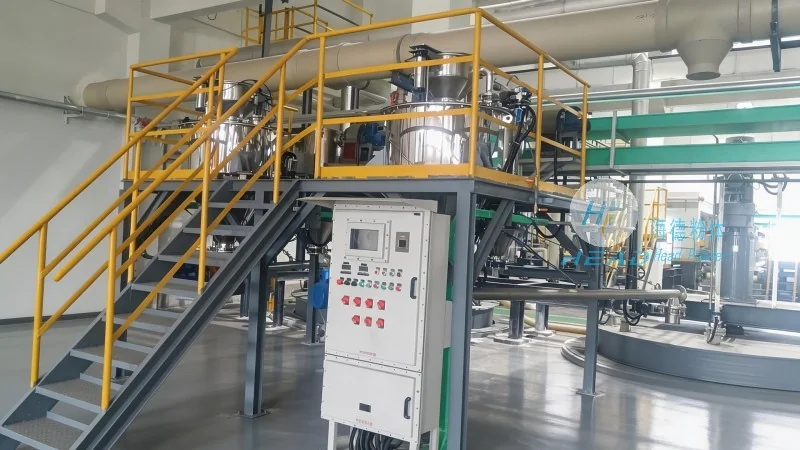
An integrated metallurgical coal powder conveying system comprises several essential modules, each engineered for durability and precision. The feeding system, often using rotary valves or screw feeders, ensures uniform material introduction into the pipeline while preventing air leakage. The conveying pipeline itself must be designed with wear-resistant materials — such as ceramic-lined or hardened steel pipes — to withstand the abrasive nature of coal particles. Air supply units, including positive displacement blowers or compressors, provide the necessary pressure differential to move the material. On the receiving end, a separation system (typically a cyclone separator and baghouse filter) captures the coal powder from the conveying air stream. To meet environmental standards, the exhaust air is filtered to achieve particulate emissions below 10 mg/Nm³. Control systems with PLC and SCADA integration allow real-time monitoring of pressure, flow rate, and temperature, enabling automatic adjustments to prevent blockages or pressure spikes. Each component must be selected with careful consideration of the specific site conditions, including ambient temperature, humidity, and available space.
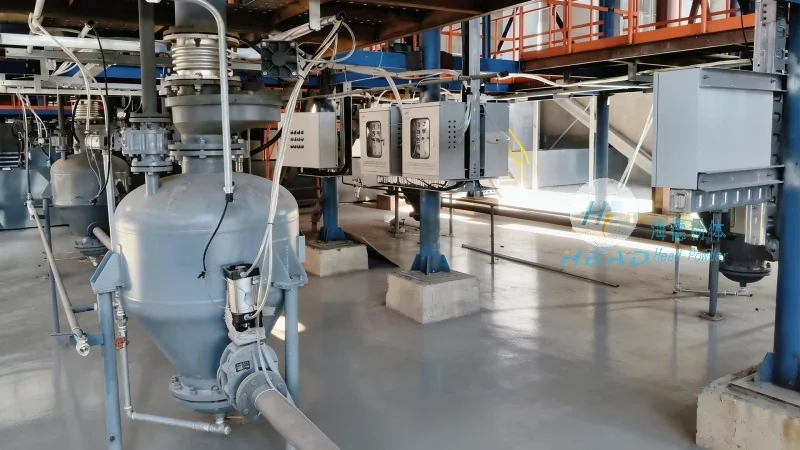
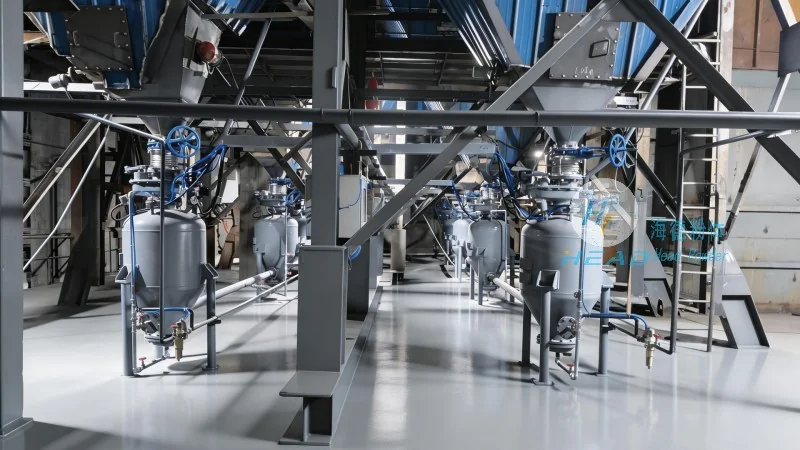
Designing a pneumatic conveying system for metallurgical coal powder requires meticulous calculation of several key parameters. The conveying velocity must be optimized: too high causes excessive wear and energy consumption; too low leads to blockages or saltation. For dense phase systems, typical conveying velocities range from 3 to 8 m/s, while dilute phase systems operate at 15 to 25 m/s. The solid-to-air ratio is another critical factor, typically between 5 and 15 for dense phase, and below 5 for dilute phase. The differential pressure across the system must be accurately estimated based on pipeline length, elevation changes, and number of bends — each bend can add 10 to 20 equivalent meters of straight pipe. Material characteristics such as particle shape, moisture content, and bulk density (typically 0.6–0.8 t/m³ for metallurgical coal powder) directly affect these calculations. Safety considerations include grounding to prevent static discharge, installation of rupture discs and explosion vents, and use of oxygen analyzers to maintain inert atmospheres. Industry standards like ISO 14122 and ATEX directives provide guidelines for safe design, and compliance is non-negotiable for systems operating in explosive environments.
As of 2026, the metallurgical coal powder pneumatic conveying market is witnessing several transformative trends driven by digitalization and sustainability goals. One major advance is the adoption of intelligent control systems equipped with machine learning algorithms that predict pipe wear and potential failures before they occur. This predictive maintenance approach reduces unplanned downtime by up to 30%. Another trend is the integration of energy recovery systems — for example, using variable frequency drives on blowers that adjust air flow based on real-time demand, achieving 15–25% energy savings. Modular and skid-mounted conveying units are gaining popularity, especially in retrofit projects where space constraints exist. These pre-engineered packages simplify installation and commissioning. Additionally, there is a growing emphasis on closed-loop conveying systems that minimize fugitive dust, fully complying with evolving emission standards such as the EU Industrial Emissions Directive (IED) and China's ultra-low emission policies. For clients seeking reliable solutions, headpowder has developed advanced dense-phase conveying technology specifically for metallurgical coal powder, with proven systems achieving material-to-air ratios above 12 and conveying distances exceeding 500 meters without degradation. (咨询热线:156-6277-7102)
When evaluating pneumatic conveying equipment suppliers for coal powder applications, plant managers should prioritize several performance indicators. First, assess the system's track record with similar materials: demand references from installations handling metallurgical coal with comparable moisture and abrasiveness. Second, evaluate the supplier's ability to provide a complete turnkey solution, including feeding, conveying, filtration, and control integration, rather than sourcing individual components separately. Third, consider the ease of maintenance — systems with quick-disconnect couplings, self-cleaning filters, and accessible inspection ports significantly reduce labor costs. Fourth, verify the supplier's compliance certifications, including ISO 9001, ATEX, and any local safety regulations. Fifth, analyze the total cost of ownership over a 10-year lifecycle, including energy consumption, spare parts replacement, and maintenance labor. A high-quality system may have a higher upfront cost but yields lower operating expenses through reduced wear and higher uptime. For example, headpowder's coal powder conveying solutions incorporate proprietary wear-resistant linings and optimized pipeline routing, achieving service intervals twice as long as conventional designs, as validated in multiple steel plant installations.
To illustrate the practical benefits of well-engineered pneumatic conveying systems, consider a typical large-scale coking plant that processes 1,200 tons of metallurgical coal per day. The facility replaced its old mechanical conveying system (belt conveyors and bucket elevators) with a dense-phase pneumatic system from headpowder. The new system eliminated dust leakage completely, reducing environmental fines and improving worker safety. The PLC-controlled system allowed precise feeding to multiple coke oven charging points, reducing coal spillage by 95%. The conveying distance was 350 meters with eight 90-degree bends, yet the system maintained a stable pressure drop of 0.8 bar and operated at a solid-to-air ratio of 11.5. Over two years of operation, maintenance costs dropped by 40%, and energy consumption per ton of coal conveyed decreased by 18% compared to the previous dilute phase system. Another example involves a steel mill that required mobile coal powder feeding for its pulverized coal injection (PCI) process. headpowder designed a compact, trailer-mounted system that could be relocated between furnace lines, featuring a 15-ton-per-hour capacity with integrated dust control. These examples demonstrate how tailored design and robust equipment can deliver tangible operational improvements.
A successful pneumatic conveying system implementation extends beyond equipment delivery. Proper installation includes precise pipe alignment, support structure design, and electrical integration. During commissioning, system tuning is critical: adjusting blower speed, air pressure, and feeder rotation to match actual material flow characteristics. headpowder provides on-site technical support throughout this phase, including performance tests at full load to verify throughput and dust emission levels. After commissioning, a comprehensive training program for operators covers normal operation, emergency shutdown procedures, and routine maintenance tasks such as filter cleaning and lubrication schedules. To maximize system life, preventive maintenance contracts are available that include regular inspections, wear part replacement, and remote monitoring via cloud-based platforms. With the right lifecycle support, a metallurgical coal powder conveying system can reliably operate for 15 to 20 years, even under continuous heavy-duty service.
Looking ahead, the metallurgical coal powder handling industry will continue to evolve toward greater automation and environmental responsibility. The push for net-zero emissions in steelmaking is driving the adoption of hydrogen-based direct reduction processes, but metallurgical coal will remain vital for decades, especially in regions where alternatives are not yet economical. Pneumatic conveying systems will become more intelligent, with self-optimizing algorithms that adjust parameters in real-time to changing material properties. Additionally, the use of recycled inert gases (such as nitrogen or carbon dioxide) for explosion protection will become more common, reducing operating costs. Companies like headpowder are investing in R&D to develop next-generation conveying equipment that integrates IoT sensors for continuous health monitoring and uses sustainable materials for construction. For end users, partnering with an experienced system integrator that understands both the material science and the operational realities ensures that their investment delivers maximum return, today and in the future.
In summary, pneumatic conveying for metallurgical coal powder is a specialized engineering discipline that demands careful analysis of material properties, system dynamics, and safety requirements. By choosing a robust, well-designed system from a competent provider like headpowder, plant operators can achieve high efficiency, low emissions, and dependable operation. Whether for a greenfield project or a retrofit, the right equipment and support make a measurable difference in productivity and environmental compliance. For further technical consultation and tailored system proposals, industry professionals are welcome to contact the team directly.

 Shandong headpowder Engineering Co., Ltd.
 156-6277-7102(Manager Zhang)
  0531-83386006
  Jinan City, Shandong Province, China
服务热线
微信咨询
回到顶部