News
Rich project cases across industries, showing real implementation and proven technical strength.In the evolving landscape of bulk material handling, potassium sulfate (K₂SO₄) has emerged as a critical input for high-value agricultural fertilizers, industrial chemicals, and specialty manufacturing processes. As global demand for sulfate-based potash continues to rise—market analysts project a compound annual growth rate of approximately 4.8% between 2024 and 2026—the need for efficient, safe, and dust-free conveying systems becomes paramount. Traditional mechanical conveyors often struggle with potassium sulfate's abrasive nature, hygroscopic tendencies, and fine particulate generation. This is where pneumatic conveying systems have proven to be the most reliable and cost-effective solution. With decades of engineering expertise, headpowder has developed a comprehensive range of potassium sulfate pneumatic conveying equipment that addresses material degradation, energy consumption, and environmental compliance. This article provides a deep technical overview of the key equipment components, system configurations, design considerations, and operational best practices, drawing on real-world installations and 2026 market trends.
Potassium sulfate is a crystalline salt with a Mohs hardness of about 2.5 to 3, making it moderately abrasive. Its bulk density typically ranges from 1,200 to 1,500 kg/m³ depending on particle size distribution, and it is classified as a free-flowing but slightly hygroscopic material. When exposed to humidity above 60%, potassium sulfate can form agglomerates and cause bridging in hoppers. Additionally, the fine dust fraction (below 50 microns) presents respiratory hazards and explosion risks if not properly managed. In 2026, stricter occupational exposure limits (OELs) for respirable crystalline silica and sulfate dust are being enforced across North America, Europe, and Asia-Pacific regions. These regulatory pressures, combined with rising energy costs, have driven many potassium sulfate producers to upgrade from dilute-phase pneumatic systems to dense-phase or medium-phase conveying solutions. headpowder's equipment is engineered to handle these challenges through precise airflow control, abrasion-resistant materials, and intelligent filtration systems.
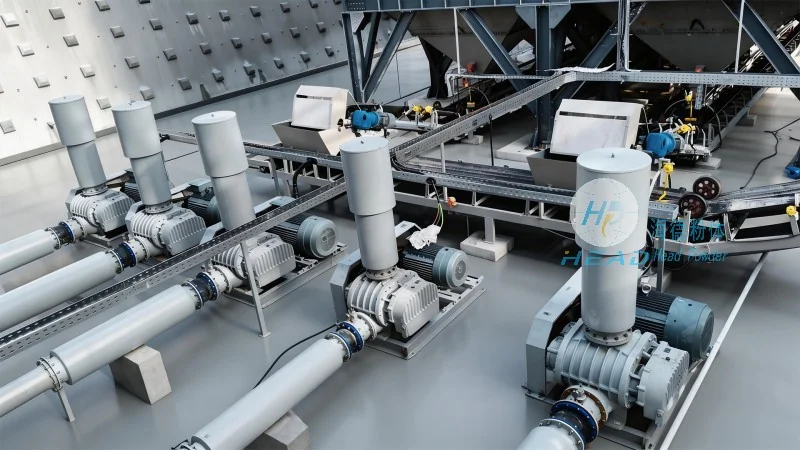
A typical pneumatic conveying system for potassium sulfate comprises several integrated modules, each optimized for the material's unique properties. Below is a breakdown of the essential equipment:
The conveying process begins with a feed hopper equipped with a vibratory discharge or a screw feeder to ensure consistent material flow into the airlock. For potassium sulfate, headpowder recommends a drop-through rotary airlock valve with hardened rotor tips and a blow-through design to minimize material shearing and dust leakage. The rotor-to-housing clearance is typically maintained at 0.1 mm to prevent both air loss and product degradation. In high-throughput applications exceeding 20 tons per hour, a double-flap valve or rotary valve with a pre-aeration system is used to stabilize material entry.
The prime mover for the conveying air is a positive displacement (PD) blower, which delivers a constant volume of air against varying system pressures. For dense-phase conveying of potassium sulfate, headpowder selects PD blowers with a pressure rating between 0.5 and 2.5 bar(g), coupled with variable frequency drives (VFDs) for precise velocity control. Energy optimization is critical: in 2026, typical installations achieve a specific energy consumption of 0.08–0.15 kWh per ton-meter, compared to 0.25–0.40 kWh for conventional dilute-phase systems. The blower package includes a silencer, inlet filter, pressure relief valve, and aftercooler to reduce air temperature before entering the conveying line.
Potassium sulfate's abrasive particles cause significant erosion in standard carbon steel pipes. To extend service life, headpowder utilizes schedule 40 or schedule 80 seamless steel pipes with a minimum wall thickness of 6 mm for the straight sections, and ceramic-lined bends or induction-hardened elbows at turning points. The bend radius should exceed 10 times the pipe diameter to reduce impact wear. In systems conveying over 500 meters, a combination of stainless steel 304L and alumina ceramic tiles is used at high-velocity zones. Field data from a 2025 installation in a Canadian sulfate plant showed that ceramic-lined bends lasted over 12,000 operating hours before requiring replacement, compared to 2,500 hours for unlined carbon steel.
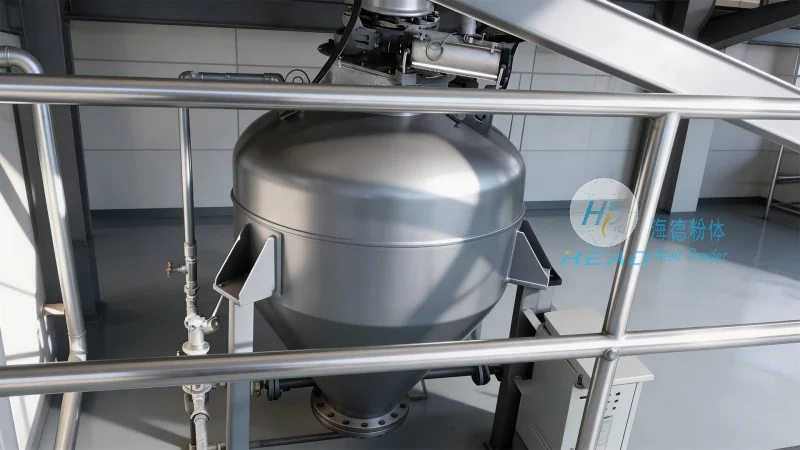
For long-distance or high-capacity applications, headpowder's standard design employs a dense-phase pressure vessel (also called a blow tank) with a bottom discharge and a fluidizing cone. The vessel is constructed of carbon steel with an internal epoxy coating to resist corrosion from trace moisture. A typical blow tank has a geometric volume of 3 to 15 m³ and operates at a working pressure of 1.5 to 3.0 bar(g). The conveying cycle includes batch filling, pressurization, and controlled release of material through a venturi nozzle or a tube feeder. The system achieves a solids-to-air ratio between 15:1 and 35:1, drastically reducing air requirement and dust generation compared to lean-phase systems.
At the destination point, a primary cyclone separator recovers the bulk of the potassium sulfate particles. headpowder's cyclones are designed with an optimized inlet velocity (around 18–22 m/s) and a high-efficiency vortex finder to achieve collection efficiencies above 99% for particles larger than 10 microns. The remaining fine dust is captured by a pulse-jet baghouse filter, typically housing polyester or aramid filter bags with a PTFE membrane for low pressure drop and easy cleaning. In 2026, regulations require outlet emissions below 5 mg/Nm³ in most jurisdictions. headpowder's baghouse design includes an integrated fan, compressed air manifold, and differential pressure monitoring for automatic pulse cleaning every 60 to 120 seconds.
Modern pneumatic systems rely on programmable logic controllers (PLCs) with human-machine interfaces (HMIs) to manage pressure, flow, temperature, and material level. headpowder integrates Siemens or Allen-Bradley controllers with Modbus or Profibus communication for seamless plant integration. Key instrumentation includes radar level transmitters on the blow tank, mass flow meters on the conveying line, and pressure transducers at critical points. An advanced algorithm adjusts the blow tank discharge rate based on real-time line pressure feedback, preventing plugging and minimizing air consumption. Remote monitoring via IoT gateways is now standard, allowing operators to access system diagnostics from mobile devices.
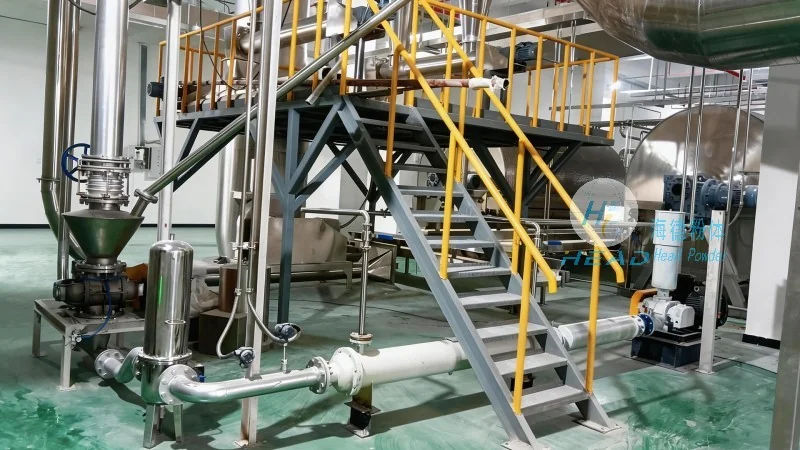
Selecting the right conveying regime depends on distance, capacity, and material characteristics. For potassium sulfate, three common configurations exist:
When designing a pneumatic system for potassium sulfate, engineers must address several critical factors. First, moisture control: Potassium sulfate absorbs moisture from compressed air, leading to caking in lines and filters. headpowder installs a refrigerated air dryer plus a desiccant dryer to achieve a dew point of -40°C at the blower discharge. Second, electrostatic discharge: Dry, fine dust can generate static charges that cause explosions. All equipment is grounded per IEC 60079-14 standards, and conductive filter bags are used. Third, plugging prevention: In long horizontal runs, the conveying line should have a slight downward slope (1–2°) or incorporate blow-through fittings at regular intervals. headpowder's proprietary "Anti-Plug" software uses pressure profiles to detect incipient blockages and automatically initiate a purging cycle.
headpowder has executed multiple projects in the potassium sulfate sector. One notable installation at a large fertilizer complex in the Middle East replaced a fleet of bucket elevators and screw conveyors with a single dense-phase pneumatic line spanning 280 meters. The system handles 18 t/h of granulated potassium sulfate (0–4 mm particle size) from the dryer discharge to the storage warehouse. The customer reported a 40% reduction in maintenance cost, a 60% drop in fugitive dust emissions, and a 30% decrease in energy consumption per ton. Another project for a specialty chemical producer in Germany used a headpowder medium-phase system to convey fine potassium sulfate (d50 = 120 microns) to a mixing unit, achieving a conveying velocity of just 12 m/s and reducing particle breakage from 8% to under 2%. These results demonstrate the practical value of advanced system design.
A well-designed pneumatic conveying system for potassium sulfate can operate for 15–20 years with proper maintenance. headpowder recommends a preventive maintenance schedule that includes weekly inspection of rotary airlock tip clearance, monthly replacement of filter bags in high-wear zones, and quarterly pipe wall thickness measurements using ultrasonic gauges. The typical annual maintenance cost for a 30 t/h dense-phase system is estimated at 2.5–3.5% of the initial capital investment. In contrast, mechanical conveyors for the same duty often require annual expenditures of 5–7% of initial capital due to belt replacement, bearing failures, and chute wear. Additionally, pneumatic systems offer superior flexibility for future capacity expansion by simply adding a larger blower or a second blow tank.
The global potassium sulfate market is projected to exceed 8 million metric tons by 2026, driven by growing demand for potassium-free chloride-sensitive crops and high-efficiency fertilizers. In response, manufacturers are seeking conveying systems that reduce product degradation and permit gentle handling. The latest trend involves the adoption of smart pneumatic systems with adaptive controls that learn flow patterns and optimize energy use in real time. headpowder is at the forefront of this technology, integrating artificial intelligence models that predict line blockages based on historical pressure data and material humidity readings. Furthermore, new emission standards in the European Union (IED 2.0) and the U.S. EPA's revised NESHAP for mineral processing are compelling end users to specify enclosed pneumatic systems with HEPA filtration. headpowder's baghouse filters now meet MERV 16 and HEPA H13 standards, ensuring compliance without additional cost.
Choosing the right equipment partner is as important as selecting the conveying technology. headpowder brings over two decades of hands-on experience in designing, fabricating, and commissioning pneumatic systems for challenging bulk solids. Our engineering team conducts a detailed material characterization for every project, including particle size analysis, angle of repose, moisture sensitivity, and abrasion index testing. We then simulate the conveying process using computational fluid dynamics (CFD) software to optimize pipe routing, bend placement, and air consumption. Every headpowder system comes with a comprehensive documentation package, including P&IDs, installation manuals, and a two-year warranty on all mechanical components. For inquiries about your potassium sulfate pneumatic conveying project, please reach out to our sales team. (咨询热线:156-6277-7102) We look forward to helping you achieve higher efficiency, lower emissions, and reduced operating costs.
As industries around the world tighten environmental regulations and pursue operational excellence, the role of advanced pneumatic conveying systems becomes increasingly central. Potassium sulfate, with its unique combination of abrasiveness, hygroscopicity, and fine dust hazards, demands a tailored approach that generic equipment cannot provide. headpowder's specialized potassium sulfate pneumatic conveying system equipment—from wear-resistant pipelines and dense-phase vessels to smart control systems—delivers measurable improvements in reliability, energy efficiency, and safety. By integrating the latest 2026 market insights, material handling innovations, and regulatory compliance features, headpowder enables producers to stay competitive while reducing their environmental footprint. Whether you are upgrading an existing plant or designing a greenfield facility, investing in a well-engineered pneumatic solution will yield returns for decades. Contact headpowder today to discuss your specific requirements and receive a preliminary system design proposal.

 Shandong headpowder Engineering Co., Ltd.
 156-6277-7102(Manager Zhang)
  0531-83386006
  Jinan City, Shandong Province, China
服务热线
微信咨询
回到顶部