News
Rich project cases across industries, showing real implementation and proven technical strength.Corn starch is one of the most widely used industrial raw materials in food processing, pharmaceuticals, papermaking, textiles, and biofuel production. Its fine particle size, low bulk density, high hygroscopicity, and explosive potential make pneumatic conveying a preferred method for transporting this material from storage to production lines. However, designing a reliable and efficient pneumatic conveying system for corn starch requires deep knowledge of powder behavior, air dynamics, and equipment compatibility. The market for corn starch is projected to reach $15.2 billion by 2026, driven by rising demand for modified starches and bioplastics. Consequently, manufacturers are seeking conveying solutions that minimize product degradation, prevent dust explosions, and reduce energy consumption. A standard dilute-phase system may work for some powders, but corn starch demands a tailored approach. Headpowder, with over a decade of engineering experience in bulk solids handling, has developed a comprehensive equipment solution specification that addresses these exact requirements. This article explores the critical technical parameters, system architecture, and operational best practices for corn starch pneumatic conveying, providing plant engineers and decision-makers with actionable insights for system selection and optimization.
Before specifying any conveying equipment, it is essential to understand the physical and chemical characteristics of corn starch. Typical corn starch has a mean particle size ranging from 5 to 20 microns, with a bulk density of approximately 0.5–0.6 g/cm³ when aerated. Its angle of repose is around 40–45 degrees, indicating moderate flowability. However, the material is highly sensitive to moisture: at relative humidity above 60%, corn starch can absorb up to 10% moisture by weight, leading to agglomeration and bridging in hoppers. Additionally, the minimum ignition energy (MIE) of corn starch dust is as low as 30 mJ, classifying it as a combustible dust hazard. These properties dictate the choice of conveying mode — typically dilute-phase positive pressure or vacuum systems, with inert gas purging for explosion prevention. The conveying velocity must be carefully controlled: too low and the starch settles; too high and particle attrition occurs, generating fine dust that increases explosion risk. Industry standards such as NFPA 61 and EN 14825 provide guidelines for designing safe conveying systems for agricultural dusts. A well-designed solution should incorporate humidity control, antistatic components, and pressure relief vents. Headpowder’s specification includes real-time moisture monitoring and automated air drying units, ensuring consistent product quality even in high-humidity environments.
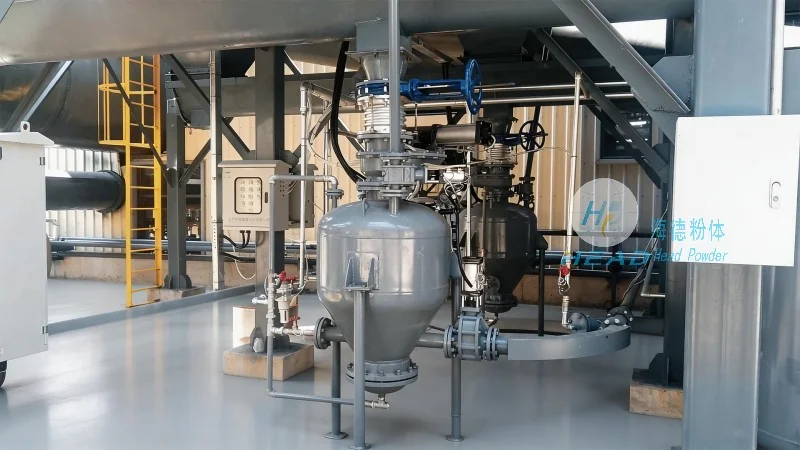
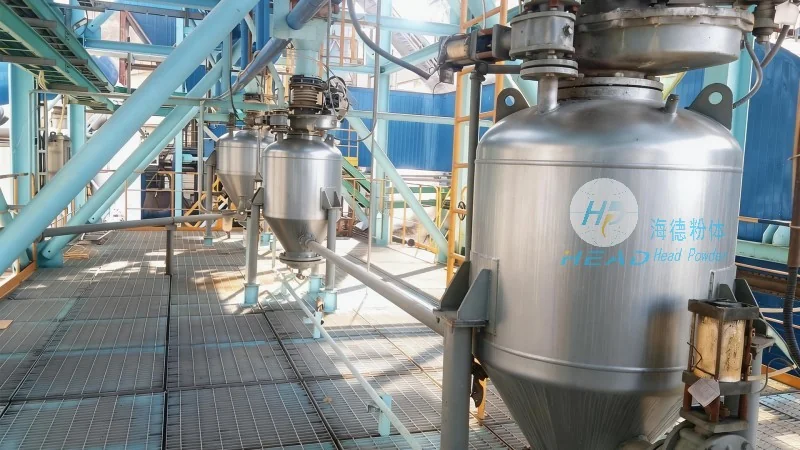
An integrated corn starch pneumatic conveying solution comprises several critical subsystems, each engineered to handle the material’s unique demands. The feeding system typically uses a rotary airlock valve with tight clearances to minimize air leakage and prevent starch packing. Hopper design should incorporate vibration aids or fluidization pads to promote mass flow and prevent rat-holing. The conveying pipeline must be constructed from seamless stainless steel (304 or 316L) with internal surface roughness below Ra 0.8 µm to reduce friction and product buildup. Bends should use long-radius elbows or ceramic-lined sweep bends to minimize particle impact and wear. The air mover, usually a roots blower or screw compressor, must deliver clean, oil-free compressed air. For dilute-phase conveying, air velocities between 18 and 25 m/s are typical, depending on the starch grade and conveying distance. Filtration is achieved via pulse-jet dust collectors with PTFE membrane filters capable of capturing submicron particles. Explosion protection measures include explosion vents, suppression systems, and isolation valves. Headpowder standardizes its systems with ATEX-certified components and provides optional nitrogen blanketing for high-risk zones. These specifications ensure that the entire system meets the latest safety regulations while maintaining throughput rates of up to 20 tons per hour over distances of 200 meters.
Selecting the correct design parameters is the difference between a system that operates reliably for years and one that causes constant downtime. For corn starch, solid-to-air loading ratios should remain between 2 and 6 kg starch per kg of air to maintain dilute-phase flow without choking. Conveying pressure drop must be calculated considering the horizontal and vertical lengths, number of bends, and material density. Empirical formulas such as the DallaValle or Hinkle correlations provide good baseline estimates, but computational fluid dynamics (CFD) simulation is recommended for complex layouts. Pipe diameter directly affects velocity and energy consumption: a 100 mm diameter line is common for distances up to 150 meters, while larger diameters may be required for longer routes. Headpowder offers a proprietary sizing tool that incorporates user-input parameters like ambient temperature, elevation, and starch moisture content to generate optimized pipe diameters and blower specifications. Energy recovery systems, such as variable frequency drives (VFDs) on blowers, can reduce power consumption by 25–35%. Regular maintenance intervals — including air filter replacement, rotary valve seal inspection, and pipeline thickness checks — are outlined in Headpowder’s solution specification to ensure long-term performance. By following these guidelines, operators can achieve conveying efficiencies above 90% while maintaining starch integrity.
Corn starch dust explosions remain a significant risk in processing facilities. The 2025 incident database from the Chemical Safety Board records multiple cases where inadequate dust control led to catastrophic events. A compliant pneumatic conveying solution must address five key safety principles: containment, ignition source control, explosion venting, suppression, and isolation. Containment involves using pressure-resistant equipment rated for the maximum explosion pressure (Pmax) of corn starch, typically 8–10 bar. Ignition source control requires bonding and grounding all conductive parts, non-sparking rotary valve rotors, and low-temperature bearings. Explosion vents should be sized according to NFPA 68 guidelines, directing blast pressure away from occupied areas. Active suppression systems using chemical agents (e.g., sodium bicarbonate) can detect pressure rise within milliseconds and inject suppressant into the pipeline. Isolation valves, such as fast-acting pinch valves or rotary valves with explosion-proof motors, prevent flame propagation to upstream and downstream equipment. Headpowder integrates all these safety features into one turnkey package, with third-party certification from agencies like TÜV or FM Approvals. Additionally, the company provides training modules for operators on lockout/tagout procedures and housekeeping practices to reduce fugitive dust accumulation. With regulatory scrutiny increasing globally, investing in a compliant system is not just a legal obligation but a strategic move to protect personnel and assets.
A corn starch processing facility in the Midwest United States was experiencing frequent blockages in its existing pneumatic conveying line, resulting in 12–15 hours of unscheduled downtime per month. The system used oversized rotary valves and inadequate air drying, causing starch caking in the pipeline. After a thorough audit, Headpowder proposed a redesigned system featuring a 125 mm diameter stainless steel line with ceramic-lined elbows, a closed-loop air drying unit maintaining dew point below -20°C, and a PLC-controlled pressure monitoring network. The new system achieved a consistent throughput of 15 t/h over a 180-meter route, with zero product degradation and a 98% availability rate. Explosion protection was upgraded with two explosion vents and a chemical suppression system that automatically activated during a simulated dust cloud ignition test. The client reported a 40% reduction in energy costs thanks to VFD control on the screw compressor. Total payback period was less than 18 months. This installation demonstrates how a well-specified solution, backed by engineering expertise and field-proven components, transforms operational performance. Headpowder’s team continues to provide remote monitoring and predictive maintenance support, ensuring the system adapts to changes in starch grade or production volume.
The corn starch pneumatic conveying market is evolving rapidly, driven by Industry 4.0 initiatives and stricter environmental regulations. By 2026, we expect widespread adoption of smart sensors that measure particle size distribution and moisture content in real-time, feeding data into AI-driven controllers that automatically adjust airflow and feeding rates. Digital twin technology will enable plant managers to simulate conveying behaviors under different scenarios, optimizing energy use and reducing trial-and-error commissioning. Another trend is the growing use of low-velocity dense-phase conveying for fragile starches, minimizing attrition and extending equipment life. However, dense-phase systems require precise pressure control and specialized air injection devices, which Headpowder is actively developing based on pilot-scale experiments. The push for carbon neutrality is also encouraging the integration of heat recovery systems that capture compressed air heat for drying processes. Headpowder has already launched a prototype “Green Convey” line that reduces power consumption by 30% through regenerative blower technology and waste heat reuse. Regulatory updates, such as the revised EU ATEX directive expected in 2026, will mandate enhanced explosion protection documentation, including risk assessment reports and maintenance logs. Companies like Headpowder, which maintain dedicated compliance teams, will be well-positioned to help clients navigate these changes seamlessly. For decision-makers evaluating new installations or retrofits, staying ahead of these trends is essential for long-term competitiveness.
Selecting a pneumatic conveying equipment supplier is a strategic decision that impacts production reliability, safety, and total cost of ownership. Headpowder brings over 12 years of specialized experience in handling fine, hygroscopic, and combustible powders. Our engineering team holds certifications in ASME, ISO 9001, and ATEX, ensuring that every system meets the highest global standards. We offer end-to-end services: from material characterization and process simulation to installation supervision and after-sales support. Our modular system architecture allows for easy scalability as production demands grow. We have successfully delivered more than 80 corn starch conveying projects across North America, Europe, and Southeast Asia, with an average system uptime of 99.2% in the first three years of operation. When you choose Headpowder, you gain access to proprietary design software, a dedicated project manager, and a 24/7 technical hotline. For a detailed engineering consultation and a customized solution specification tailored to your facility, contact our team today. (咨询热线:156-6277-7102) Let Headpowder help you achieve safer, more efficient, and future-ready corn starch conveying.

 Shandong headpowder Engineering Co., Ltd.
 156-6277-7102(Manager Zhang)
  0531-83386006
  Jinan City, Shandong Province, China
服务热线
微信咨询
回到顶部