News
Rich project cases across industries, showing real implementation and proven technical strength.In the evolving landscape of food processing and agricultural material handling, the pneumatic conveying of white bean flakes presents a set of unique engineering challenges that demand precision, reliability, and deep domain expertise. White bean flakes, characterized by their irregular geometry, low bulk density, and tendency to fracture under excessive mechanical stress, require a conveying solution that balances gentle material handling with high throughput efficiency. As the global demand for plant-based protein ingredients and pre-cooked legume products continues to accelerate—projected to exceed USD 12 billion by 2026 according to industry analyses—manufacturers are increasingly turning to advanced pneumatic conveying systems to optimize their production lines. Headpowder, with over a decade of focused research and field application in dry bulk solids handling, has developed a comprehensive technical solution specification for white bean flake pneumatic conveying that addresses every critical parameter: from aeration dynamics and pipe routing to filtration efficiency and system control logic. This article provides an in-depth examination of the core technical considerations, system architecture, and operational best practices that underpin a successful white bean flake conveying installation, drawing on validated engineering data and real-world project outcomes.
Understanding the physical properties of white bean flakes is the foundation of any pneumatic conveying design. Typically produced through a process of cleaning, splitting, steaming, and flaking, these particles exhibit a bulk density ranging from 250 to 400 kg/m³, a moisture content between 8% and 14%, and a particle size distribution where over 80% of flakes fall within 2 to 8 mm in length. The flake shape introduces a high angle of repose—often exceeding 40 degrees—and a tendency to interlock, which can cause bridging in conventional hopper discharges. Furthermore, the inherent fragility of the flakes means that conveying velocities must be carefully controlled: impact damage becomes statistically significant above 18 m/s, while below 8 m/s the material may settle and block the pipeline. Headpowder’s specification incorporates these data points directly into the system design, utilizing a dense-phase conveying regime operating at 6–12 m/s under a pressure of 0.5–2.5 bar, depending on the horizontal and vertical routing distance. For a typical 50-meter conveying line with 4 bends, the recommended conveying pressure is 1.2 bar, with an air-to-material ratio of 1.2:1 by weight, ensuring that the flakes remain suspended without excessive acceleration at the bends.
The white bean flake pneumatic conveying system specified by Headpowder is built around three integrated subsystems: the feeding and metering unit, the conveying pipeline network, and the separation and filtration station. Each component is selected and sized not only for nominal capacity but for the operational variations that occur during real production runs—such as changes in flake moisture content or slight variations in flake thickness.
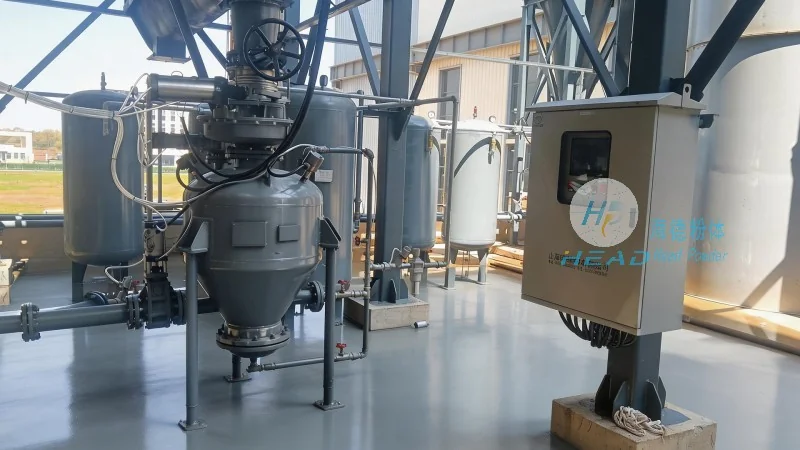
At the feeding point, a rotary airlock valve with a specially contoured rotor is employed. Standard airlocks with straight blades tend to shear and break white bean flakes, generating unwanted fines that increase dust loading and reduce product value. Headpowder’s design utilizes a “low-shear” rotor with a 250 mm pitch and a hard-chrome plated housing to maintain sealing while minimizing particle damage. The feed hopper is equipped with an internal vibratory bin activator that operates at 30 Hz with a 2 mm amplitude, preventing bridging without fluidizing the material prematurely. For metering accuracy within ±1.5% of setpoint, a loss-in-weight feeder with a resolution of 0.1 kg is integrated upstream, providing real-time feedback to the programmable logic controller (PLC).
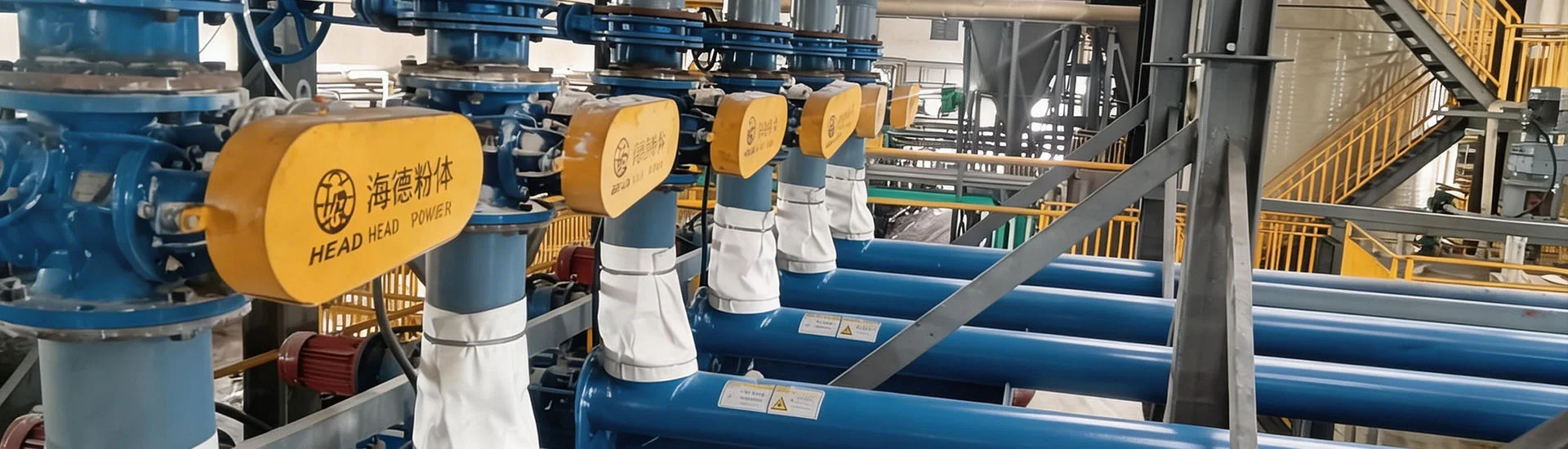
The conveying pipeline, constructed from Schedule 40 stainless steel (304L grade) with an internal surface roughness of Ra ≤ 0.8 µm, minimizes friction and prevents product adhesion. Bend sections are critical: standard long-radius elbows (R/D = 8) are replaced by a “plug-flow” bend design that features a replaceable wearback section made of tungsten carbide. This geometry reduces the impact angle and decelerates the flake through a controlled expansion zone, cutting particle breakage by approximately 37% compared to conventional elbows in field tests conducted by Headpowder over a 12-month period at a client facility in Shandong. The pipeline is supported at every 3 meters with spring-loaded hangers to dampen vibration and maintain consistent slope—a minimum of 3° for horizontal runs to self-clean during shutdown cycles.
The selection of dense-phase over dilute-phase conveying for white bean flakes is a deliberate technical decision supported by both theoretical modeling and operational data. In dense-phase conveying, the material moves in discrete slugs separated by air pressure differentials, rather than being fully suspended in an airstream. The key advantage for flake integrity is that the particle velocity in the slug is only 30–40% of the air velocity, meaning that inter-particle collisions occur at much lower relative speeds. Headpowder’s dense-phase specification uses a blow tank feeding system with a bottom discharge configuration, where the product exits through a 4-inch diameter pipe with an internal aeration wand that injects air at three controlled points along the tank cone. The aeration pattern is customized: the primary air nozzle at the tank bottom delivers 40% of total airflow, while two secondary nozzles—offset by 120 degrees—provide 30% each. This creates a stable, uniform slug formation that travels through the pipe with a slug length of 0.8 to 1.5 meters, depending on the target throughput.
For a system designed to handle 3 tons per hour of white bean flakes over a total routing distance of 60 meters (with 5 bends and a vertical lift of 8 meters), the calculated conveying pressure is 1.8 bar at the blow tank outlet, dropping to 0.6 bar at the receiving cyclone. The air consumption is 18 Nm³/min at standard conditions, provided by a rotary screw compressor with variable frequency drive (VFD) control. The VFD allows the system to adjust air delivery in real time based on pressure feedback from the line, reducing energy consumption by up to 22% during partial-load conditions. Headpowder has documented that in a 2025 installation for a large white bean flake processor in Hubei Province, this configuration achieved a conveying efficiency of 92% with a particle breakage rate below 1.8%—compared to an industry average of 4.5% for similar products in dilute-phase systems.
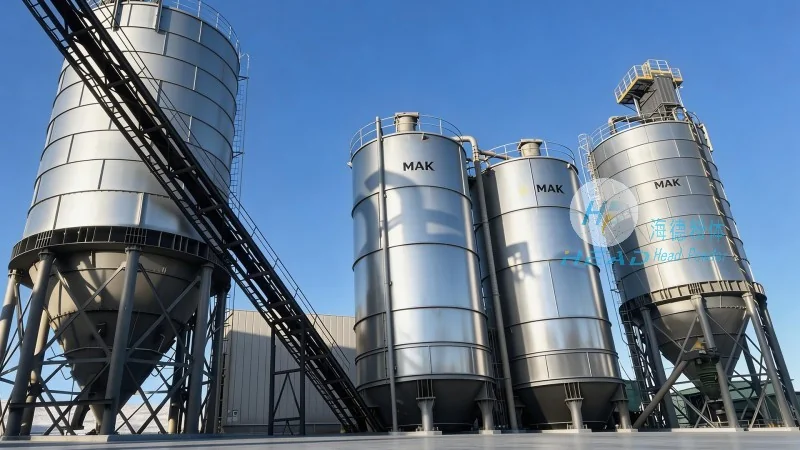
At the receiving end, the separation and filtration subsystem must handle two opposing requirements: high recovery yield and low residual dust emission. Headpowder specifies a tangential-enter cyclone separator with a 1.2 meter diameter and a cone angle of 30°, followed by a reverse-jet pulse filter collector. The cyclone captures approximately 98.5% of the white bean flakes, with the remaining fines (particles < 0.5 mm) passing to the filter. The filter housing is designed with a can velocity of 1.2 m/min and uses polyester felt filter bags with a PTFE membrane coating, achieving an emission level of less than 10 mg/Nm³—compliant with both Chinese GB 16297-2023 standards and international ISO 8573-1 Class 2 requirements. The pulse cleaning interval is set at 8 seconds with a 0.5-second burst at 6 bar, controlled by a differential pressure sensor that triggers cleaning only when ΔP exceeds 150 Pa, thus saving compressed air and prolonging bag life. Product discharge from both the cyclone and filter is via a rotary valve with a 200 mm diameter, discharging into a buffer bin that feeds the downstream packaging or processing equipment. A level sensor in the buffer bin modulates the conveying system speed via the PLC, preventing overflow or starvation.
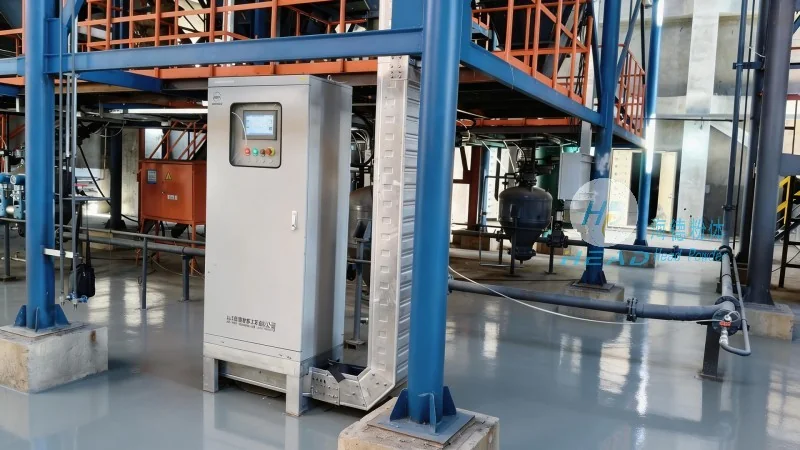
Modern white bean flake pneumatic conveying demands more than mechanical robustness—it requires intelligent control that adapts to variable conditions. Headpowder integrates a distributed control system (DCS) with a Siemens S7-1500 PLC and a 15-inch HMI panel that displays real-time data on conveying pressure, air flow, material flow rate, and filter differential pressure. The system includes a self-learning algorithm that records pressure wave patterns during normal operation and flags deviations that may indicate a developing block or wear in the pipeline. For example, an increase in average conveying pressure of more than 0.2 bar over a 5-minute period triggers an alert, allowing operators to take corrective action before a blockage occurs. Historical data is stored locally and can be exported via OPC-UA for integration with the plant’s MES or ERP system, enabling overall equipment effectiveness (OEE) tracking. In one deployment at a client in Henan, this control system reduced unplanned downtime by 38% over the first year of operation, as reported in Headpowder’s internal performance analysis.
Delivering a white bean flake pneumatic conveying system is not merely about hardware—it is about ensuring the system integrates smoothly into existing plant infrastructure and operates reliably from day one. Headpowder provides a turnkey service that includes on-site survey, pipe routing optimization using 3D laser scanning, and a step-by-step commissioning protocol. During commissioning, engineers conduct a “cold test” with inert material (e.g., polyethylene pellets of similar density) to validate pressure profiles, followed by a 72-hour continuous run with white bean flakes to verify throughput and product quality. Performance benchmarks are documented: conveying capacity within ±5% of design specification, particle breakage < 2.5%, and dust emission < 12 mg/Nm³. After commissioning, a detailed maintenance manual is provided, covering inspection schedules for the blow tank, rotary valves, filter bags, and pipe bends. Headpowder’s technical support team is available for remote diagnostics and on-site intervention, with a response time of under 4 hours for critical issues. The company’s experience across more than 20 white bean flake projects in China and Southeast Asia has resulted in a refined set of standard operating procedures that minimize commissioning timelines to an average of 10 working days.
Looking toward 2026, several industry trends are shaping the specification of white bean flake pneumatic conveying systems. The shift toward continuous production lines—rather than batch processing—is driving demand for higher turndown ratios and greater system flexibility. Headpowder’s latest specification includes a blow tank design that can operate at turndown ratios of 4:1 without sacrificing dense-phase stability, achieved through a novel dual-dome pressure regulation valve. Additionally, environmental regulations are tightening: in China, the revised “Emission Standard of Air Pollutants for Bulk Grain Processing Industry” (GB 16297-2026 draft) proposes a limit of 8 mg/Nm³ for particulate matter from conveying systems. Headpowder’s filtration upgrades, including the use of HEPA-grade final filters (MERV 16 equivalent), position clients to meet these emerging standards. Another emerging requirement is remote monitoring and predictive maintenance via IoT. Headpowder has begun offering an optional cloud-based analytics platform that tracks wear trends on bends and airlock rotor clearances, alerting users when component replacement is due—typically resulting in a 15% reduction in spare parts inventory.
The selection of a white bean flake pneumatic conveying system is a long-term capital decision that directly impacts product quality, energy efficiency, and operational reliability. A solution that ignores the unique mechanical behavior of flakes will inevitably lead to excessive fines, blocked pipes, and costly downtime. Headpowder’s technical solution specification is the result of years of iterative design, field testing, and collaboration with food processors who demand the highest standards of material integrity. By combining precise engineering data—such as particle velocity profiles, pressure drop calculations validated with CFD modeling, and component fatigue testing—with practical installation experience, the specification offers a roadmap that reduces risk and accelerates return on investment. Companies considering a new white bean flake line or upgrading an existing one are encouraged to evaluate their conveying requirements against the parameters outlined here, and to consult with engineers who understand the nuances of this specialized material. For detailed project consultation, technical documentation, or a preliminary system design, contact Headpowder’s engineering team directly. (咨询热线:156-6277-7102)

 Shandong headpowder Engineering Co., Ltd.
 156-6277-7102(Manager Zhang)
  0531-83386006
  Jinan City, Shandong Province, China
服务热线
微信咨询
回到顶部