News
Rich project cases across industries, showing real implementation and proven technical strength.The global polyethylene (PE) market is projected to exceed 130 million metric tons by 2026, driven by rising demand in packaging, construction, and automotive sectors. As PE pellets remain the primary feedstock for injection molding, blow molding, and extrusion lines, the efficiency of material handling directly impacts production uptime and product quality. Pneumatic conveying has emerged as the preferred method for transporting PE pellets—offering enclosed transfer, minimal degradation, and flexible routing. However, designing a reliable system for these low-density, hygroscopic, and abrasive-sensitive pellets requires a deep understanding of material properties, airflow dynamics, and equipment durability. Headpowder has specialized in bulk solids handling for over a decade, delivering pneumatic conveying solutions that address the unique challenges of PE pellet transport: eliminating dust generation, preventing angel hair formation, and maintaining consistent throughput across variable process conditions. This article presents a comprehensive technical examination of PE pellets pneumatic conveying equipment, covering system architecture, key component selection, process parameters, energy optimization, and real-world validation. Whether you are upgrading an existing line or building a new polymer facility, these insights will help you evaluate vendor proposals and specify a solution that balances capital efficiency with long-term operational reliability.
Before selecting any pneumatic conveying equipment, engineers must characterize the bulk solid. PE pellets are non-friable, free-flowing, and have a bulk density typically ranging from 500 to 600 kg/m³, depending on the grade (LDPE, LLDPE, HDPE). Their particle size distribution—usually 3–5 mm diameter with a length of 3–6 mm—makes them moderately cohesive under certain humidity conditions. One critical property is the moisture absorption behavior: while PE is hydrophobic, surface moisture can condense during storage, leading to flowability issues and potential clogging in conveying lines. Additionally, the pellets have a low angle of repose (approximately 25–30°), which facilitates gravity discharge from silos but demands careful air velocity control to avoid saltation in horizontal pipes. The abrasiveness is relatively low compared to minerals or glass beads, yet high-velocity impacts can still generate fine dust—known as "angel hair" or streamers—that degrades product quality and fouls downstream filters. For 2026 industry standards, the allowable dust generation rate in pneumatic conveying of food-grade PE pellets is below 0.01% by weight, per updated FDA and EU directives. Therefore, a technical solution must incorporate low-velocity dilute-phase or dense-phase conveying strategies, depending on the throughput and distance. Headpowder recommends conducting a full material analysis before engineering the system, including particle shape (spherical vs. cylindrical), coefficient of sliding friction, and electrostatic charge tendency—factors that directly impact pipe wear, filter loading, and conveying stability.
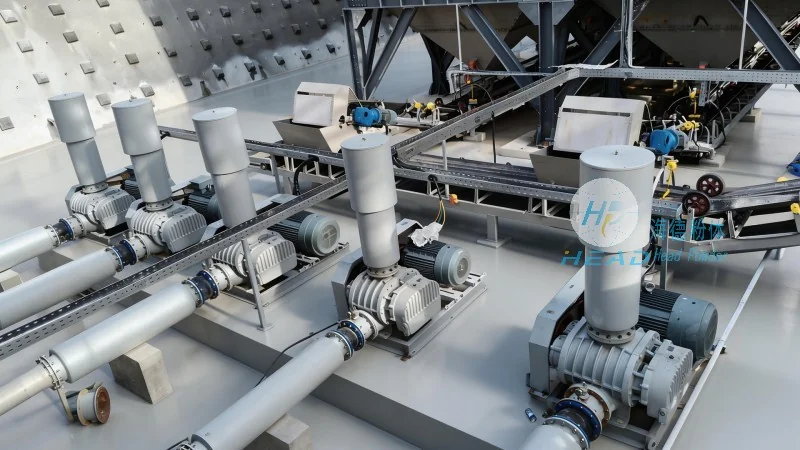
Pneumatic conveying systems for PE pellets generally fall into two categories: dilute-phase (also called suspension flow) and dense-phase (plug or slug flow). Each has distinct advantages and constraints based on conveying distance, throughput, and product sensitivity.
In dilute-phase systems, pellets are suspended in a high-velocity airstream (typically 20–30 m/s for PE) through the pipeline. This method is simple, cost-effective for short distances (under 100 meters), and allows high flexibility in routing. However, the high velocity increases particle-to-pipe wall impacts, which can generate streamers and fines. For PE pellets, dilute-phase is acceptable when product quality requirements are moderate and the conveying distance is less than 80 meters. Headpowder has implemented dilute-phase systems for masterbatch production lines, achieving throughputs up to 10 tons per hour with proper venturi injectors and rotary valve metering. The key design parameters for dilute-phase conveying of PE pellets include: air-to-material ratio (typically 1.5–2.5 kg air per kg material), pressure drop calculations using the Darcy-Weisbach equation with particulate load correction factors, and pipe diameter selection to maintain velocity above the saltation velocity (around 15 m/s for horizontal runs).
For longer distances (over 100 meters) or higher product quality requirements, dense-phase conveying is the recommended technical solution. Here, pellets are transported as compacted plugs at lower air velocities (4–10 m/s), significantly reducing product degradation. The material moves in pulsating slugs, propelled by pressurized air from a blow tank or pressure vessel. This method is particularly advantageous for PE pellets used in rotational molding or extrusion where surface defects from fines are unacceptable. Dense-phase systems consume less energy per ton conveyed—typically 30–40% lower than dilute-phase for the same capacity—but require higher initial capital investment in pressure vessels, control valves, and air compressors. Headpowder’s dense-phase solutions incorporate proprietary plug-detection technology that maintains consistent slug length and prevents line blockage. In a recent project for a high-density polyethylene (HDPE) pipe manufacturer, a dense-phase system conveying pellets 250 meters with a 15-meter elevation gain achieved 12 tons per hour with less than 0.005% fines generation, verified by sieve analysis. The blow tank design uses a bottom cone with fluidization nozzles and a blow-through valve, ensuring reliable discharge even with moisture-laden pellets during monsoon seasons.
Building a robust PE pellets pneumatic conveying system requires careful specification of each component. Below is a technical breakdown of the critical elements.
For dilute-phase systems, rotary valves (airlocks) are the most common feeder. They meter pellets from a hopper into the conveying line while preventing air loss. For PE pellets, a drop-through design with enclosed rotor pockets minimizes shearing. The rotor-to-housing clearance should be maintained between 0.1–0.3 mm to reduce blow-by air without risking jamming from pellet fragments. Headpowder’s standard rotary valves feature hardened stainless steel blades and wear-resistant housing liners, rated for pressure differentials up to 0.5 bar. For dense-phase systems, a pressure vessel (blow tank) with a discharge cone and bottom fluidization is used. The volume of the blow tank should be sized to hold at least 2–3 minutes of material flow to ensure steady-state operation. In both cases, a vent filter on the feed hopper is essential to handle displaced air during filling.
The conveying pipe for PE pellets should have an inner surface roughness of less than 1.6 μm to minimize friction and particle damage. Stainless steel 304L is the standard for food-contact applications, while carbon steel with internal ceramic lining offers better wear resistance for abrasive regrinds. Pipe bends are critical: long-radius bends (R/D ratio of 8:1 or higher) should be used to reduce impact and prevent angel hair formation. For systems handling 3–5 mm PE pellets, a minimum bend radius of 600 mm for 80 mm diameter pipes is recommended. Straight pipe sections should be joined with flanged connections for easier cleaning and inspection. In 2026, many polymer processors are adopting vacuum-tight couplings to meet low-emission standards for volatile organic compounds (VOCs) that may be present in off-spec pellets.
Compressed air quality directly affects system performance. For PE pellets, the air must be oil-free and dried to at least a pressure dew point of –40°C to avoid moisture condensation and microbial growth. Scroll compressors or oil-free screw compressors paired with refrigerated air dryers are typical. At the conveying line discharge, a receiver tank with a reverse-jet bag filter (filter area per air flow rate: 0.5–0.8 m² per m³/min) captures dust and returns it to the product stream. Headpowder employs PTFE-coated filter cartridges with surface treatment to prevent pellet blinding, maintaining a differential pressure below 50 mbar during normal operation.
Optimizing a PE pellets pneumatic conveying system involves balancing velocity, pressure, and product degradation. Industry data from 2025 shows that energy consumption in pneumatic conveying accounts for 15–25% of total plant power in plastics processing facilities. By fine-tuning the following parameters, operators can reduce energy costs by up to 20% while maintaining throughput.
In a 2026 benchmark study comparing conventional vs. optimized conveying for a PE injection molding plant, the optimized system using dense-phase technology and variable-speed screw compressors achieved a specific energy consumption of 2.8 kWh per ton, compared to 4.1 kWh per ton for a fixed-speed dilute-phase system—a 32% reduction. Additionally, the fines content in the final product dropped from 0.03% to below 0.01%, meeting the stricter quality standards for thin-wall containers.
Successful deployment of pneumatic conveying equipment for PE pellets requires rigorous installation procedures. The pipeline must be supported every 2–3 meters to prevent sagging, and all flanges should be grounded to avoid electrostatic discharge—especially critical when conveying in dry climates where static charges can exceed 25 kV. During commissioning, the system should be run with a slightly increased air flow (10% above design) to verify that no material accumulates at low points. Headpowder’s commissioning team uses high-speed cameras to inspect pellet trajectories at bends and tie-in points, adjusting air velocity on-site to eliminate recirculation zones. A formal acceptance test includes measuring throughput at three different pressure settings, recording filter differential over an 8-hour run, and performing a sieve analysis of the material at the receiver to ensure degradation is below client specifications.
PE pellets conveying equipment faces ongoing operational challenges: filter bag wear, rotary valve blade erosion, and pipeline abrasion. A preventive maintenance schedule should include monthly inspection of the filter cartridges for pin-holes, quarterly replacement of blow tank seal rings, and annual pipe wear measurements using ultrasonic thickness gauging. For systems with high fines generation, adding an aspiration line or a cyclone separator before the main filter can extend filter life by 40%. Headpowder offers condition monitoring optionality—including vibration sensors on blow tanks and pressure transducers at key points—that integrates with plant SCADA to predict failures before they cause downtime. In the event of a blockage (common with moisture-laden PE pellets during rainy seasons), the system should include purge valves at low points and a bypass line for reverse blowing. Many clients have adopted Headpowder’s quick-release flanges on critical sections, reducing clearing time from hours to minutes.
A large manufacturer of HDPE corrugated pipes in Southeast Asia needed to replace an aging positive-pressure dilute-phase system that was producing excessive streamers and causing frequent filter clogging. The facility required conveying PE pellets from a truck unloading station to 12 extrusion lines distributed over a 200-meter long building. Throughput demand was 9 tons per hour with a product purity requirement of less than 0.02% fines. Headpowder designed a dense-phase system using a 2.0 m³ blow tank, 80 mm diameter stainless steel pipe with 1D long-radius bends, and a central vacuum-assisted receiver. The system incorporated a pressure-based sequence control that automatically adjusted blow cycles based on the level sensors in each line. After installation, the fines content measured 0.008%, well below the threshold, and the specific energy consumption was 3.1 kWh/ton—a 25% improvement over the previous system. The client reported zero unplanned downtime in the first 15 months of operation, with filter replacement intervals extended from 6 to 14 months. This project demonstrates that a technically sound pneumatic conveying solution not only improves product quality but also reduces total cost of ownership.
The pneumatic conveying industry for PE pellets is evolving along three axes: digitalization, sustainability, and modularization. By 2026, over 60% of new polymer handling systems are expected to include Industrial Internet of Things (IIoT) capabilities, allowing real-time tracking of wear, energy consumption, and air quality. Headpowder is already offering edge-based analytics that calculate the optimal air-to-material ratio based on live pellet moisture data from NIR sensors. On the sustainability front, closed-loop air recirculation systems that reuse conveying air after filtration are gaining traction, reducing compressed air consumption by up to 50% for low-toxicity materials like PE. Modular skid-mounted conveying units are becoming popular for brownfield retrofits, as they reduce installation time by 40% compared to traditional field-erected systems. For processors seeking to comply with ISO 14001 and carbon footprint reduction initiatives, combining dense-phase conveying with solar-powered air compressors is a viable path forward—Headpowder has completed two such installations in 2025, each cutting Scope 2 emissions by 30%.
Selecting the right pneumatic conveying equipment for PE pellets is not a one-size-fits-all decision. It requires analyzing the specific polymer grade, the plant layout, the quality thresholds, and the long-term operational budget. A poorly designed system can lead to product loss, high energy bills, and costly downtime. Headpowder brings over a decade of focused experience in bulk solids handling, with a team of mechanical engineers and material scientists who understand the nuances of pellet transport. From initial material characterization to commissioning and remote monitoring, we deliver solutions that are engineered for performance and built to last. For a detailed discussion of your PE pellets conveying requirements, or to request a technical consultation with system performance projections, please reach out to our team directly.
(咨询热线:156-6277-7102)

 Shandong headpowder Engineering Co., Ltd.
 156-6277-7102(Manager Zhang)
  0531-83386006
  Jinan City, Shandong Province, China
服务热线
微信咨询
回到顶部