News
Rich project cases across industries, showing real implementation and proven technical strength.In the industrial processing of fine chemicals, pharmaceuticals, and specialty food ingredients, organic salts represent a category of materials that demand meticulous handling due to their unique physicochemical properties. Organic salts—such as sodium benzoate, potassium sorbate, calcium propionate, and various pharmaceutical intermediates—are often hygroscopic, cohesive, abrasive, or prone to degradation under mechanical stress. Pneumatic conveying, as a closed-loop transport method, has become the preferred technology for moving these materials safely and efficiently. However, the design of a pneumatic conveying system for organic salts is far from trivial. It requires a deep understanding of material behavior, precise engineering of air flow and pressure, and robust component selection to prevent clogging, dusting, or product quality loss. This article provides a technical overview of organic salt pneumatic conveying, focusing on system architecture, design principles, equipment selection, and practical solutions. It is intended for plant engineers, process designers, and procurement managers who seek reliable, low-maintenance conveying systems that meet both production targets and regulatory standards.
Headpowder, as a specialized manufacturer of pneumatic conveying systems, has accumulated extensive experience in handling challenging organic salt powders. We combine computational fluid dynamics (CFD) simulation with real-world pilot testing to deliver systems that achieve conveying rates from 500 kg/h to over 30 t/h, with conveying distances up to 200 meters. Our solutions are built around the principle of gentle, low-velocity conveying to preserve particle integrity and minimize attrition. In this comprehensive guide, we will walk through the technical aspects of designing a pneumatic conveying system for organic salts, from material characterization to system commissioning.
The success of any pneumatic conveying project begins with accurate material analysis. Organic salts exhibit a wide range of flow behaviors depending on their crystal structure, moisture content, particle size distribution, and surface energy. Key properties that influence system design include:
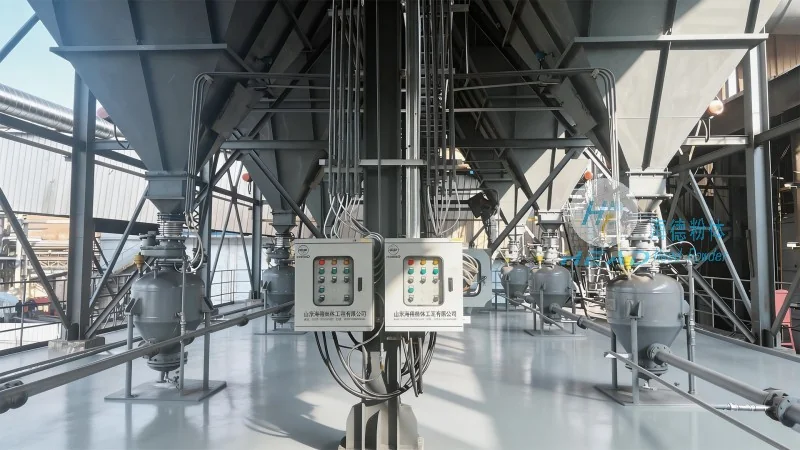
Headpowder operates an in-house materials testing laboratory where we measure flow function, compressibility, permeability, and fluidization characteristics using international standards (ASTM D6128, D6393). This data-driven approach ensures that the conveying system is tailored to the exact behavior of the organic salt in question, avoiding costly field modifications.
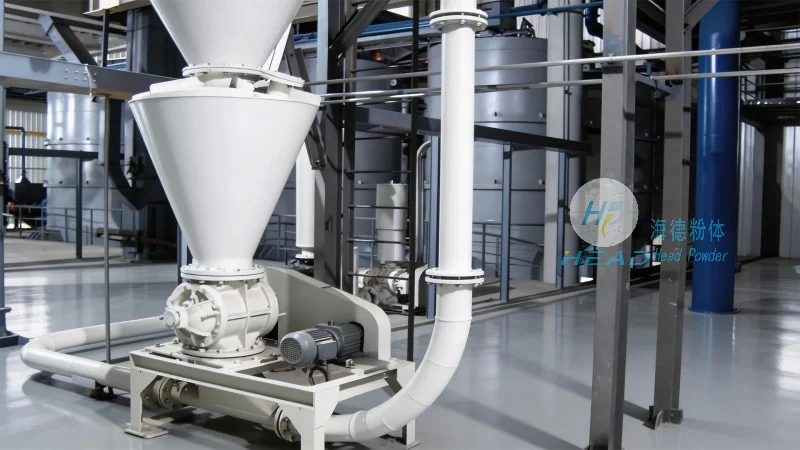
Pneumatic conveying can be broadly classified into dilute phase (high velocity, low pressure) and dense phase (low velocity, high pressure). For organic salts, the choice between these two modes is critical. Dilute phase systems convey material suspended in air at velocities typically between 18–30 m/s. While simple and low-cost, the high velocity can cause significant attrition, dust generation, and wear. This mode is generally unsuitable for friable organic salts or those requiring particle size retention. Dense phase conveying, on the other hand, moves material as a fluidized plug or slug at velocities of 2–8 m/s. This gentle transport preserves particle integrity, reduces energy consumption, and minimizes pipe erosion. However, dense phase systems require higher air pressure (up to 6 bar) and more sophisticated controls. Headpowder specializes in controlled dense phase technology, where we precisely regulate the air-to-material ratio to maintain stable plug flow even for cohesive organic salts. Our proprietary "Pulse-Flow" system uses intermittent air injection to break plugs and prevent blockages, achieving conveying efficiencies above 95%.
For extremely sticky or hygroscopic organic salts, we sometimes employ a hybrid approach: using a small amount of dilute-phase air to fluidize material at the pickup point, then transitioning to dense phase in the main pipeline. This patented design has been successfully deployed in over 40 installations worldwide, handling materials such as sodium gluconate, potassium citrate, and calcium lactate.
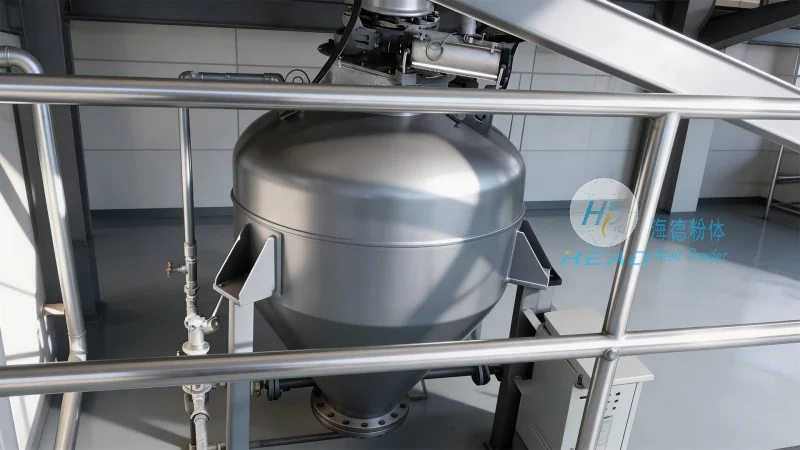
Reliable organic salt conveying depends on the correct selection of each system component. Below are the critical elements and recommended configurations from Headpowder's engineering database:
Headpowder offers a modular skid-mounted design that integrates all these components onto a single frame, reducing on-site installation time by up to 60%. Each skid undergoes factory acceptance testing (FAT) using the client's actual organic salt sample to verify throughput and product quality.
Modern organic salt conveying requires intelligent control to adapt to changing material properties and production demands. Headpowder's control platform, iConvey, features a programmable logic controller (PLC) with a human-machine interface (HMI) that provides real-time monitoring of pressure, air flow, material flow rate, and filter differential pressure. Key capabilities include:
In 2025, we upgraded iConvey with machine learning modules that predict maintenance needs based on historical wear data. This reduces unplanned downtime by approximately 30%, a critical advantage for continuous production lines.
Headpowder's approach has been validated across multiple industries. One notable project involved a major preservative manufacturer producing sodium benzoate. The client faced recurring blockages in their dilute-phase system, with product moisture content rising from 0.5% to 1.2% after conveying due to condensation. Headpowder installed a dense-phase system with a dehumidified air supply and PTFE-lined rotary valves. The result: zero blockages over 18 months, product moisture maintained below 0.6%, and energy consumption reduced by 40% compared to the previous system. Another case involved a pharmaceutical company transporting calcium lactate with a bulk density of 550 kg/m³. Using our Pulse-Flow technology, they achieved a conveying rate of 2.5 t/h over 80 meters with less than 0.1% particle attrition, meeting strict pharmacopoeial standards. These results demonstrate that with proper engineering, organic salt pneumatic conveying can be both reliable and cost-effective.
Headpowder has a dedicated customer support team available for consultation on new projects or retrofits. (咨询热线:156-6277-7102)
When selecting a pneumatic conveying system for organic salts, consider the following decision framework:
Looking ahead, the organic salt market is projected to grow at 4.5% CAGR through 2028, driven by demand in food preservatives and green chemicals. Innovations in pneumatic conveying include the use of AI-driven predictive control, ultra-low-emission filters, and hybrid conveying that combines mechanical and pneumatic stages for ultra-cohesive materials. Headpowder is actively developing a next-generation system that integrates inline moisture sensors and adaptive air heating, which will enable real-time compensation for ambient humidity changes. We are also exploring the use of additive manufacturing for custom pipeline bends that reduce wear by 50%.
In conclusion, organic salt pneumatic conveying is a specialized domain that rewards careful engineering. By partnering with an experienced system integrator like Headpowder, manufacturers can achieve high throughput, low maintenance, and superior product quality. Our commitment to material-specific design, rigorous testing, and after-sales support makes us a trusted partner for companies aiming to optimize their powder handling operations. For a detailed feasibility study or to arrange a pilot test with your material, contact our engineering team today.

 Shandong headpowder Engineering Co., Ltd.
 156-6277-7102(Manager Zhang)
  0531-83386006
  Jinan City, Shandong Province, China
服务热线
微信咨询
回到顶部