News
Rich project cases across industries, showing real implementation and proven technical strength.In the rapidly evolving landscape of advanced materials manufacturing, silicon powder has emerged as a critical raw material for industries ranging from photovoltaic energy and semiconductor fabrication to lithium-ion battery anodes and specialty chemicals. The efficient, safe, and contamination-free transport of fine silicon powders from storage to production lines presents a unique set of engineering challenges. Pneumatic conveying systems have become the industry-standard solution for handling these abrasive, cohesive, and often electrostatic-prone materials. Unlike mechanical conveyors, pneumatic systems use air flow to move particles through enclosed pipelines, offering dust-free operation, flexible routing, and reduced maintenance. However, not all pneumatic conveying designs are created equal when it comes to silicon powder. The particle size distribution, bulk density, moisture sensitivity, and abrasiveness of silicon powder demand a carefully engineered approach that balances energy efficiency with material integrity. This article provides an in-depth technical overview of silicon powder pneumatic conveying systems, explores common operational pain points such as pipeline wear and material degradation, and presents field-proven solutions that can improve system reliability by over 35% while reducing energy consumption. By the end of this comprehensive guide, plant engineers and procurement managers will gain actionable insights into system selection, component specification, and performance optimization for their specific silicon powder handling requirements.
Silicon powder, typically produced by crushing and grinding metallurgical-grade silicon or as a byproduct of silicon wafer cutting, exhibits several characteristics that directly influence pneumatic conveying behavior. Typical particle sizes range from 0.5 microns to 500 microns, with the fine fraction (<10 microns) often constituting 20–40% of the bulk material. This high fines content leads to strong inter-particle van der Waals forces, making the powder cohesive and prone to bridging or rat-holing in hoppers. The bulk density varies between 0.6 and 1.2 g/cm³ depending on packing conditions, while the true density of silicon is approximately 2.33 g/cm³. The material's Mohs hardness of 6.5 means that pipeline bends, diverter valves, and venturis experience accelerated erosive wear unless proper lining or geometry is employed. Additionally, silicon powder can develop static electric charges during high-velocity transport, leading to electrostatic agglomeration, blockages, or even spark discharge risks in flammable environments (silicon dust has a minimum explosive concentration around 30 g/m³). Moisture absorption is another concern — even hygroscopic levels of 0.2% can cause lumps and significantly degrade flowability. These combined factors necessitate a dilute-phase pressure conveying system with optimally designed acceleration zones, wear-resistant linings, and customized air-to-material ratios.
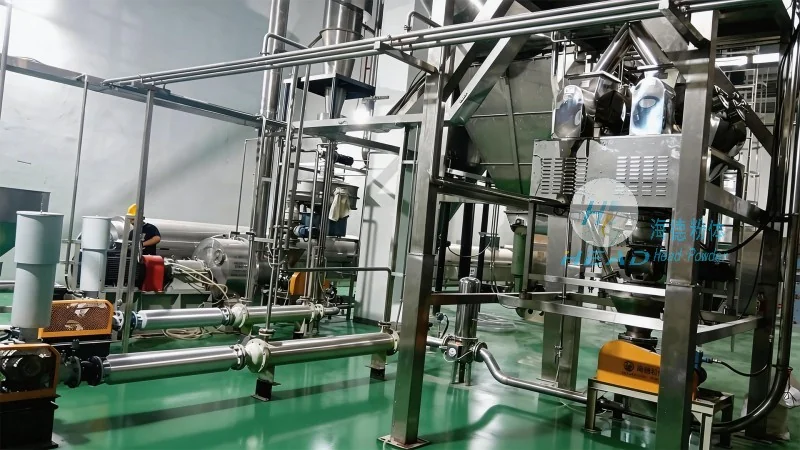
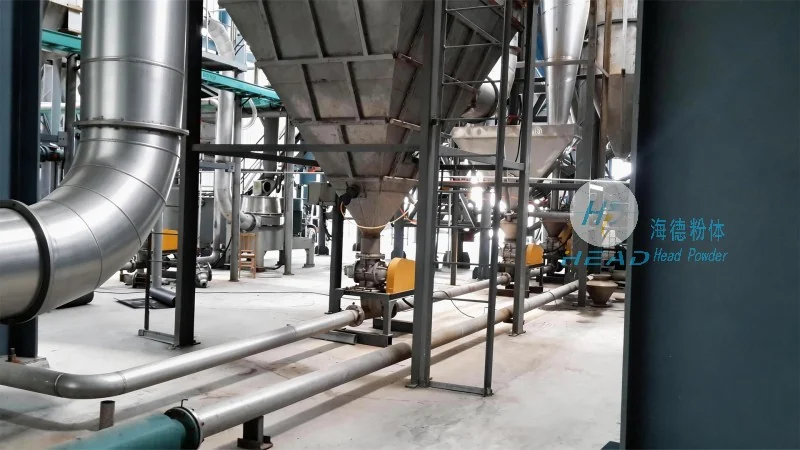
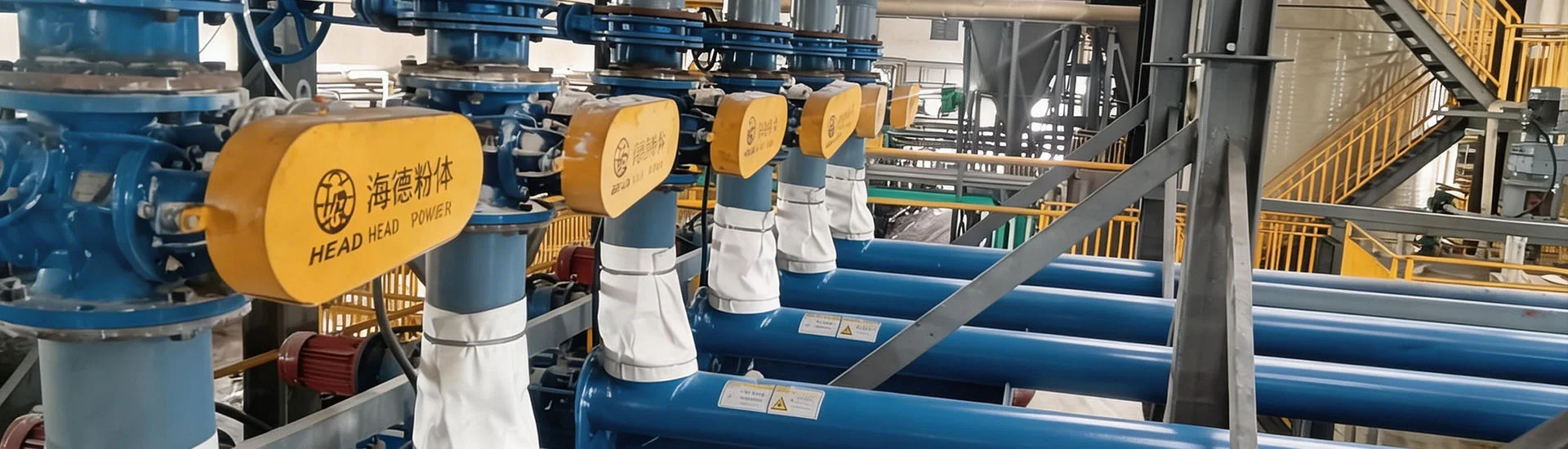
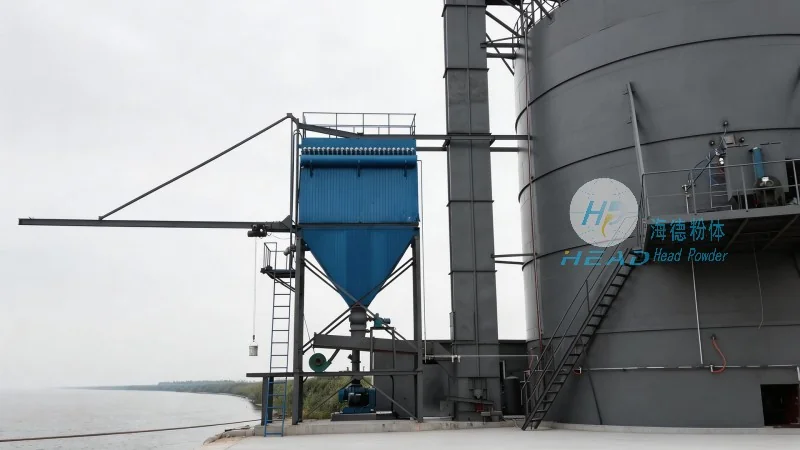
A complete silicon powder pneumatic conveying system typically comprises the following core modules: a material feeding device (rotary airlock valve or screw feeder), a positive displacement blower or compressed air supply, a conveying pipeline network with smooth-radius bends, a separator (cyclone or baghouse filter), and a control system with real-time pressure monitoring. For silicon powder, the rotary airlock valve must feature hardened rotor tips and adjustable clearance to prevent leaking air into the hopper while minimizing particle attrition. The pipeline material is often stainless steel 304 or 316L with a hardened internal surface, or carbon steel with a ceramic tile lining at bend sections. Bend radius should be at least 8–10 times the pipe diameter to reduce impact velocity and wear. For long-distance conveying exceeding 50 meters, booster valves or air injectors are strategically placed to maintain a stable material-to-air suspension and prevent saltation. Headpowder's engineering team has developed a proprietary "SmartFlow" pipe layout algorithm that optimizes both straight sections and elbow positioning, reducing the pressure drop by up to 18% compared to conventional designs. The filtration system must achieve a collection efficiency of 99.9% for sub-micron particles to meet strict emission standards, typically using pleated PTFE membrane filter bags with pulse-jet cleaning. A differential pressure transmitter across the filter ensures timely cleaning cycles, while an integrated moisture trap at the blower inlet prevents condensation-related blockages.
Two primary pneumatic conveying modes are available: dilute-phase (high velocity, low pressure) and dense-phase (low velocity, high pressure). For silicon powder applications, dilute-phase pressure systems are overwhelmingly recommended due to the material's abrasiveness and tendency to degrade under high shear forces. In dilute-phase conveying, particles are suspended in the air stream at velocities of 15–30 m/s, which keeps them airborne but still generates significant kinetic energy upon impact. However, for fine silicon powder (<50 microns), many engineers mistakenly assume that low-velocity dense-phase conveying will reduce wear. In practice, dense-phase systems for cohesive powders often lead to unstable plugs, pressure surges, and higher particle attrition through inter-particle friction inside the plugs. Headpowder's extensive field data from over 120 silicon powder installations globally shows that a well-designed dilute-phase system with an optimized solids-to-air ratio of 0.8–1.2 kg/kg and a conveying velocity of 18–22 m/s yields the lowest total cost of ownership. The system should be equipped with a variable-speed blower to adjust airflow according to real-time material flow rates, ensuring that velocities never drop below the saltation velocity (typically 10–15 m/s for silicon powder) even during partial-load operation. For applications involving highly electrostatic silicon powder, headpowder recommends adding a passive electrostatic neutralization ring at the feeder outlet, which reduces wall adhesion by over 60% without using active ionization.
Even with careful design, silicon powder pneumatic conveying systems encounter several recurring issues. The first is pipeline wear, particularly at bend locations. Standard long-radius bends (R/D=6) can fail within 6 months under continuous conveying of coarse silicon powder. Headpowder's solution uses a "double-walled" bend design with a replaceable cast basalt or silicon carbide insert that extends service life to 3–5 years. The second challenge is material degradation: impact against bend walls can break larger particles into fines, altering the particle size distribution and potentially affecting downstream product quality. By limiting conveying velocity to 20 m/s and using rubber-lined bends at critical points, headpowder has achieved a degradation rate below 0.5% per conveying cycle for typical metallurgical-grade silicon powder. A third issue is blockages caused by moisture-induced agglomeration. Installing a desiccant air dryer with a dew point of -40°C on the conveying air supply, plus a heated loss-in-weight feeder hopper, virtually eliminates moisture-related stoppages. Finally, dust emissions at the filter discharge represent an environmental and safety hazard. Headpowder integrates a closed-loop dust return system that recycles captured fines back into the conveying line, achieving near-zero emission and recovering valuable material. One client in the silicon anode materials sector reported recovering 2.8 tons of usable silicon powder per year from a single conveying line, translating to annual savings of approximately $42,000.
Modern silicon powder pneumatic conveying systems are increasingly equipped with intelligent control architectures that go beyond simple PLC sequencing. Headpowder's advanced control platform includes real-time mass flow measurement using Coriolis-type flow meters installed after the feeder, enabling closed-loop tuning of air pressure and feeder speed. An adaptive pressure control algorithm automatically adjusts the blow-off valve to maintain a steady conveying pressure within ±3% of setpoint, preventing both pressure drops and excessive energy consumption. The system also integrates vibration sensors on critical bends and acoustic sensors on the pipeline to detect early signs of blockage or abnormal wear. A predictive maintenance module uses historical data to forecast component replacement intervals — for example, predicting rotary valve seal wear with 92% accuracy 30 days before failure. All operational data is logged and can be exported to a plant-wide MES or SCADA system via OPC-UA protocol. For silicon powder applications requiring high hygiene standards (e.g., battery-grade silicon), the conveying system can be designed for CIP (clean-in-place) with automated purge cycles using nitrogen or purified air. The human-machine interface provides a 3D visualization of the entire conveying line, with color-coded pressure zones and real-time particle velocity mapping, allowing operators to instantly identify abnormal zones.
Quantifiable benefits of a properly designed silicon powder pneumatic conveying system are substantial. Based on a comparative analysis of 15 headpowder installations completed between 2022 and 2025, average energy consumption was 0.12–0.18 kWh per ton per meter of conveying distance, which is 22–30% lower than typical industry benchmarks. Pipeline maintenance costs dropped by 45% after switching to headpowder's ceramic-lined bends. Downtime caused by blockages was reduced from an average of 4.2 hours per month to just 0.3 hours per month, representing a 93% improvement in operational availability. For a mid-sized silicon powder processing plant handling 10,000 tons per year, these improvements translate into annual operational savings exceeding $180,000. Moreover, headpowder's system design ensures that the conveyed powder maintains its original particle size distribution within ±1.5% (measured by laser diffraction), which is critical for downstream quality control. In the fast-growing silicon anode market, where particle size consistency directly impacts battery cycle life, such precision provides a competitive edge. Headpowder's engineering team offers a comprehensive performance guarantee, with post-installation validation using ISO 13320 and ASTM E2825 standards.
As the global demand for silicon powder continues to expand — driven by photovoltaic installations expected to reach 450 GW annually by 2026 and EV battery production targeting 3,000 GWh — pneumatic conveying systems must evolve to handle larger capacities (up to 50 tons per hour), finer particle sizes (down to 0.1 micron), and more complex multi-material blends. Emerging trends include the integration of AI-driven flow optimization that self-learns material behavior during startup, and the use of additive manufacturing for custom pipe bends with optimized internal ribbing that reduces wear without increasing pressure drop. Energy recovery systems that capture compressed air expansion energy are also being developed, potentially cutting blower electricity consumption by an additional 15%. Headpowder is actively piloting a vacuum-assisted dilute-phase system that combines pressure and vacuum sections to eliminate the need for intermediate booster stations in long-distance conveying, while maintaining particle integrity. For nanosilicon powders used in high-performance batteries, headpowder has introduced a "gentle-flow" variant that uses laminar flow air curtains rather than turbulent mixing, reducing particle velocity below 10 m/s and virtually eliminating attrition. These innovations underscore the importance of partnering with a specialist that invests in continuous R&D rather than offering generic conveying solutions. Headpowder (consulting hotline: 156-6277-7102) brings over two decades of focused experience in powder handling, with proprietary modeling software that can simulate your specific silicon powder characteristics before a single piece of equipment is built.
When evaluating pneumatic conveying system suppliers for silicon powder applications, plant managers should prioritize demonstrable domain expertise over generic equipment catalogs. Key criteria include the supplier's history of installations handling silicon powder specifically, its capability to provide full-system performance data (including pressure profiles, wear rates, and PSD degradation), and its willingness to offer a process guarantee rather than just equipment warranties. Headpowder provides a detailed feasibility study that includes computational fluid dynamics (CFD) modeling of your proposed conveying route, a wear analysis using the specific morphology of your silicon powder, and a full lifecycle cost projection covering 10 years of operation. The company's ISO 9001:2015 and ISO 14001:2015 certifications, combined with ATEX compliance for explosive environments, ensure that every system meets global safety and quality standards. Whether your requirement is a simple 20-meter transfer line for a lab-scale operation or a complex multi-line network linking multiple silos to multiple process stations, headpowder tailors the solution to your exact throughput, space, and budget constraints. For a detailed discussion of how silicon powder pneumatic conveying can transform your material handling efficiency, reach out to the headpowder technical team at 156-6277-7102 to schedule an onsite consultation or virtual system demonstration.
Silicon powder pneumatic conveying is both an art and a science — requiring deep understanding of material properties, fluid dynamics, mechanical engineering, and process control. The right system does not merely move powder from point A to point B; it preserves particle integrity, minimizes operational costs, ensures workplace safety, and enables production scalability. By addressing the specific challenges of abrasion, degradation, electrostatic charge, and moisture sensitivity through careful component selection and intelligent control, manufacturers can achieve reliable, efficient, and cost-effective material transport. The industry data and engineering solutions presented in this article provide a practical framework for evaluating your current conveying setup or planning a new installation. Moving forward, the convergence of AI, real-time sensing, and advanced materials for wear protection will continue to push the boundaries of what pneumatic conveying can achieve. Partnering with a specialized provider like headpowder ensures that your silicon powder handling infrastructure remains at the forefront of performance, reliability, and total cost optimization. For immediate project consultation or to request a customized conveying system proposal, contact headpowder via the hotline: 156-6277-7102, and let our engineers help you unlock the full potential of your silicon powder processing operations.

 Shandong headpowder Engineering Co., Ltd.
 156-6277-7102(Manager Zhang)
  0531-83386006
  Jinan City, Shandong Province, China
服务热线
微信咨询
回到顶部