News
Rich project cases across industries, showing real implementation and proven technical strength.Hydrated lime powder, also known as calcium hydroxide (Ca(OH)₂), is a fine, dry, and highly reactive material widely used in water treatment, flue gas desulfurization, soil stabilization, and chemical processing. The efficient and reliable transfer of hydrated lime powder from storage to point-of-use is critical for maintaining process consistency, minimizing material waste, and ensuring operator safety. Pneumatic conveying systems have become the preferred solution for handling hydrated lime powder due to their enclosed nature, flexibility in routing, and ability to transport material over long distances. As industries increasingly prioritize environmental compliance and operational efficiency in 2026, selecting the right pneumatic conveying design and specifications for hydrated lime powder has never been more important. This article provides a detailed technical introduction to pneumatic conveying for hydrated lime powder, covering system types, key design parameters, material properties, component specifications, and practical considerations for installation and maintenance. By understanding these fundamentals, engineers and plant managers can make informed decisions that align with both current operational needs and future scalability.
The global market for pneumatic conveying systems in the powder handling sector is projected to grow steadily through 2026, driven by expansions in wastewater treatment infrastructure and stricter emissions regulations in power generation and cement industries. Hydrated lime powder, with its bulk density typically ranging from 400 to 600 kg/m³ and a particle size distribution of 1–50 microns, presents unique handling challenges. Its tendency to aerate, form arches, and generate dust requires a carefully engineered conveying approach. At headpowder, we have extensive experience designing pneumatic conveying systems tailored to the specific rheological behavior of hydrated lime powder, ensuring consistent transfer rates and minimal degradation. Below, we explore the technical specifications and best practices that form the backbone of a reliable system. (咨询热线:156-6277-7102)
Before selecting a pneumatic conveying method, it is essential to characterize the material properties of hydrated lime powder. The most critical parameters include particle size distribution, bulk density, angle of repose, moisture content, and abrasiveness. Hydrated lime powder is typically produced by the hydration of quicklime (calcium oxide) and results in a fine, free-flowing powder under ideal conditions, but it can become cohesive when exposed to moisture or static electricity. The median particle size (D50) ranges from 5 to 20 microns, which classifies it as a fine powder prone to dusting and fluidization. The bulk density after aeration can drop significantly, affecting the required conveying air velocity and pressure.
Another important characteristic is the material's tendency to absorb carbon dioxide from ambient air, forming calcium carbonate scale on equipment surfaces. This can lead to blockages in conveying lines if proper material handling precautions are not taken. In terms of abrasiveness, hydrated lime powder is moderately abrasive, so wear-resistant materials such as hardened steel or ceramic-lined bends are recommended for long-term reliability. The moisture content should be maintained below 0.5% by weight to prevent agglomeration. Understanding these properties allows engineers to calculate the minimum conveying velocity—typically between 10 and 20 m/s for dilute phase—and to design appropriate air filtration and dust collection systems. headpowder incorporates these material-specific factors into every system design to ensure consistent performance across varying operating conditions.
Pneumatic conveying systems are broadly categorized into dilute phase, dense phase, and semi-dense phase systems. Each type offers distinct advantages depending on the conveying distance, capacity, and material characteristics. For hydrated lime powder, both dilute phase and dense phase systems are commonly employed, but the selection must be validated through material testing and computational modeling.
Dilute Phase Conveying: In dilute phase systems, the material is suspended in a high-velocity airstream (typically 12–25 m/s) and conveyed through pipelines at a low material-to-air ratio. This method is suitable for short to medium distances (up to 100 meters) and moderate capacities. Dilute phase is often used for unloading tankers or feeding small batches. The primary advantage is simplicity and lower capital cost, but the high velocity can cause particle attrition and increased pipe wear. For hydrated lime powder, dilute phase is acceptable when the particle size distribution is uniform and the conveying distance is limited. However, proper filtration is mandatory to capture fines.
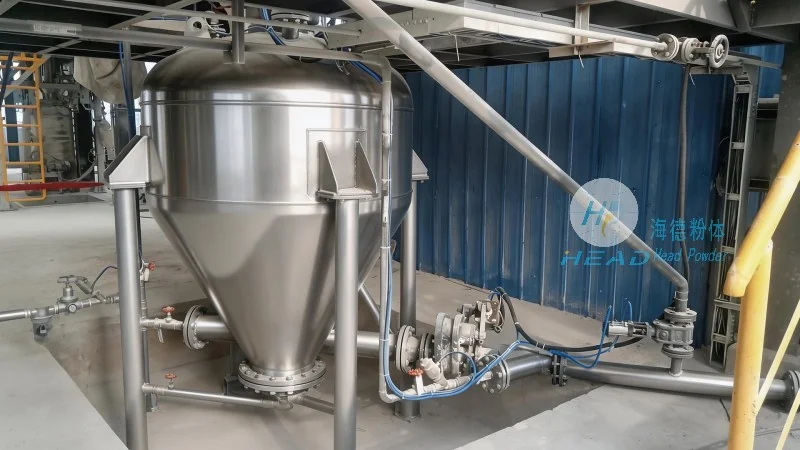
Dense Phase Conveying: Dense phase systems operate at low air velocities (1–8 m/s) with a high material-to-air ratio, moving the powder as a fluidized plug or slug through the pipeline. This method significantly reduces particle degradation, energy consumption, and pipe wear. Dense phase is ideal for long distances (up to 500 meters) and for materials that are fragile or cohesive. For hydrated lime powder, dense phase conveying minimizes dust generation and prevents segregation of fines. The system requires a higher initial capital investment due to the need for a pressure vessel and specialized control valves, but the long-term operational savings often justify the cost. headpowder has deployed numerous dense phase systems for hydrated lime in industries such as steelmaking and flue gas desulfurization, achieving consistent throughput with minimal maintenance.
Vacuum vs. Pressure Systems: Pneumatic conveying can also be classified by the driving force—positive pressure or vacuum (negative pressure). Pressure systems are typical for long-distance transport from a single source to multiple destinations, while vacuum systems are suited for multiple pick-up points feeding a single receiver. For hydrated lime powder, pressure systems are more common due to the need to convey against back pressure in silos. However, vacuum systems are occasionally used for dust-free unloading of bulk bags or small containers. The choice between pressure and vacuum should consider the overall plant layout, available compressed air capacity, and safety requirements regarding dust explosions.
A robust pneumatic conveying system for hydrated lime powder consists of several critical components, each requiring careful specification to ensure reliable operation. The major components include the air source (blower or compressor), feeding device (rotary valve, screw feeder, or pressure vessel), conveying pipeline, bends, diverter valves, receiving hopper, and dust collection equipment. Below are key technical specifications for each component based on industry standards and headpowder's field experience.
Air Source: For dilute phase systems, positive displacement blowers are typically used to provide air volumes ranging from 10 to 100 m³/min at pressures of 0.5–1.5 bar. For dense phase systems, screw compressors supplying air at 2–6 bar are more common. The air must be dry and oil-free to prevent contamination of hydrated lime powder. In 2026, energy-efficient blower packages with variable frequency drives are becoming standard, reducing power consumption by up to 30% compared to fixed-speed units. headpowder recommends specifying a safety margin of 15–20% on air volume to accommodate variations in material flow.
Feeding Device: The rotary valve is the most widely used feeder for dilute phase pneumatic conveying of hydrated lime powder. Selection criteria include rotor diameter (typically 200–500 mm), housing material (cast iron or stainless steel), and tip clearance (0.2–0.5 mm). For dense phase systems, pressure vessels with pinch valves or cone valves are employed to introduce material into the airstream in batches. The feeding rate must be accurately controlled to maintain the desired material-to-air ratio. headpowder integrates load cells or loss-in-weight feeders for precise dosing applications such as water treatment chemical injection.
Pipeline and Bends: Conveying pipelines are usually made of carbon steel or stainless steel, with a wall thickness of 4–8 mm depending on pressure rating. For hydrated lime powder, horizontal sections should be kept to a minimum to avoid settling, and vertical lifts should be designed with adequate velocity. Bends are the most wear-prone components; long-radius bends (R = 6–10D) or hammer-type bends with replaceable wear backs are recommended. In high-wear applications, ceramic-lined bends can extend service life to over 10,000 operating hours. headpowder provides detailed pipe routing diagrams that minimize the number of bends and ensure smooth material transitions.
Dust Collection: The receiving hopper must be equipped with a pulse-jet bag filter or cartridge filter to separate the conveyed air from the hydrated lime powder. Filter media should be PTFE-coated to handle fine dust and prevent blinding. The air-to-cloth ratio is typically 1.5–2.5 m³/m²/min for hydrated lime. Proper bin vent sizing and filter cleaning cycles are essential to maintain system pressure balance. headpowder's dust collection designs comply with OSHA and EU dust explosion prevention directives, including proper grounding and explosion venting.
Designing a pneumatic conveying system for hydrated lime powder requires a systematic approach based on material testing and hydraulic modeling. The first step is to determine the required conveying capacity, usually expressed in tons per hour (t/h). Typical capacities for hydrated lime range from 1 to 50 t/h depending on the application. The conveying distance, including horizontal length, vertical lift, and number of bends, directly affects the pressure drop and air consumption. Industry data from 2026 indicate that for a dilute phase system conveying hydrated lime over 100 meters with five 90-degree bends, the pressure drop is approximately 0.5–0.8 bar. For a dense phase system over the same distance, the pressure drop can be as low as 0.2–0.4 bar, but the required air volume is significantly reduced.
Material-to-air ratio is another critical parameter. For dilute phase conveying of hydrated lime, typical ratios are 5–15 kg material per kg of air. For dense phase, ratios of 20–50 kg/kg are achievable. The lower limit of conveying velocity must be maintained above the saltation velocity to prevent blockages. For hydrated lime powder, saltation velocity in horizontal pipes is typically 8–12 m/s for dilute phase. headpowder uses computational fluid dynamics (CFD) simulations to optimize pipe diameter and air flow for each project, ensuring reliable startup and shut-down procedures.
Furthermore, the system must account for the material's hygroscopic nature. In humid environments, hydrated lime can absorb moisture, increasing cohesion and causing plugging. headpowder incorporates moisture-proof silo designs and heated air systems for regions with high ambient humidity. Additionally, the conveying air should be pre-dried using desiccant dryers to maintain dew point below -20°C. These measures not only improve flowability but also prevent chemical reactions that can alter the lime's reactivity.
Proper installation and ongoing maintenance are essential to maximize the lifespan and efficiency of a hydrated lime pneumatic conveying system. During installation, all flanged connections must be aligned and gasketed to prevent air leaks. Pipelines should be supported every 3–5 meters to avoid sagging. Electrical grounding of all components, including the pipeline, is mandatory to dissipate static electricity that can ignite dust. headpowder provides detailed installation manuals and on-site supervision to ensure compliance with international standards such as ATEX or NFPA 654.
Routine maintenance includes inspecting rotary valve tips for wear, checking filter bag integrity, and verifying blower oil levels. For dense phase systems, the pinch valves or cone valves should be examined for material buildup. Preventive maintenance schedules should be established based on operating hours, with a typical inspection interval of 500–1,000 hours. headpowder offers remote monitoring solutions that track pressure, temperature, and flow rate in real time, alerting operators to potential issues before they cause downtime.
Safety considerations are paramount when handling hydrated lime powder. The material is classified as a nuisance dust but can cause respiratory irritation at high concentrations. Enclosed conveying systems minimize worker exposure. Additionally, hydrated lime powder can generate carbon dioxide when in contact with water or moisture, so confined space entry procedures must be followed during maintenance. headpowder includes purge ports and pressure relief valves as standard in system designs, along with lockout/tagout provisions. Fire and explosion risks are low due to the high calcium content, but proper bonding and grounding are still required for all dust-handling equipment.
To illustrate the practical application of these principles, consider a recent project delivered by headpowder for a municipal water treatment plant in Southeast Asia. The facility required reliable conveyance of hydrated lime powder from a 200-ton silo to multiple dosing points 150 meters away. The daily consumption was 12 tons, and the lime was used for pH adjustment and softening. After material testing, headpowder selected a dense phase pressure system operating at 2.5 bar with a conveying line diameter of 4 inches. The system included a stainless steel pressure vessel, ceramic-lined bends, and a pulse-jet filter with PTFE cartridges. Since commissioning in early 2025, the system has operated continuously with over 98% availability and no blockages, even during the monsoon season. The customer reported a 40% reduction in energy consumption compared to their previous dilute phase system, and dust emissions were virtually eliminated. This case demonstrates how proper specification and design can deliver measurable operational and environmental benefits.
Looking ahead, several technological developments are shaping the next generation of pneumatic conveying systems for hydrated lime powder. The adoption of Industry 4.0 principles, including IoT sensors and predictive analytics, allows operators to monitor system health and optimize air consumption dynamically. Smart rotary valves with integrated condition monitoring can predict wear patterns and schedule maintenance proactively. Furthermore, advances in pipe lining materials, such as ultra-high molecular weight polyethylene (UHMW-PE), are reducing friction and extending component life in abrasive applications.
From a regulatory perspective, stricter emission standards for particulate matter in many regions are driving demand for enclosed conveying with high-efficiency filtration. The European Union's Industrial Emissions Directive (IED) and similar regulations in North America require dust emissions below 10 mg/Nm³, which is achievable with proper filter design. headpowder continuously invests in R&D to improve filtration efficiency and reduce pressure drop, keeping pace with evolving environmental requirements. Additionally, the trend toward modular and skid-mounted systems is accelerating, allowing faster installation and easier relocation as production needs change.
Finally, there is growing interest in using renewable energy sources to power pneumatic conveying systems. Solar-powered blowers combined with energy storage are being piloted in remote locations. While not yet mainstream, these solutions align with the broader industrial sustainability goals. headpowder is actively exploring hybrid systems that combine conventional compressed air with on-site renewable generation to lower carbon footprints.
In summary, the successful pneumatic conveying of hydrated lime powder requires a deep understanding of material properties, careful selection of system type and components, and adherence to design best practices. By partnering with a knowledgeable supplier like headpowder, plant operators can achieve reliable, efficient, and safe material handling that supports their production goals. Whether you are designing a new facility or upgrading an existing system, the technical insights provided here should serve as a solid foundation for evaluation and decision-making. (咨询热线:156-6277-7102)

 Shandong headpowder Engineering Co., Ltd.
 156-6277-7102(Manager Zhang)
  0531-83386006
  Jinan City, Shandong Province, China
服务热线
微信咨询
回到顶部