News
Rich project cases across industries, showing real implementation and proven technical strength.In the rapidly evolving landscape of modern agriculture and bio-waste recycling, the demand for efficient, hygienic, and scalable material handling solutions has never been more critical. Organic fertilizer pellets, as a high-value end product of composting and granulation processes, require specialized conveying systems that preserve their integrity, prevent cross-contamination, and optimize overall production throughput. Among the various conveying technologies available today, pneumatic conveying systems have emerged as the preferred choice for many medium-to-large-scale fertilizer production facilities. This article provides a comprehensive, technically grounded introduction to organic fertilizer pellets pneumatic conveying system equipment, covering core principles, system architecture, key selection parameters, industry trends through 2026, and practical implementation considerations. Whether you are a plant manager evaluating a new line or an engineer seeking to upgrade existing infrastructure, this deep dive will equip you with actionable insights to make informed decisions.
Pneumatic conveying, at its fundamental level, harnesses the energy of a gas stream—typically air—to transport bulk solid materials through enclosed pipelines. For organic fertilizer pellets, which are often friable, hygroscopic, and prone to degradation under mechanical impact, a well-designed pneumatic system offers distinct advantages over mechanical conveyors such as belt or screw conveyors. It eliminates dust emissions, reduces maintenance associated with moving parts, and enables flexible routing across multiple production zones. However, not all pneumatic systems are created equal. The specific characteristics of organic fertilizer pellets—including particle size distribution (typically 2–8 mm), bulk density (ranging from 0.6 to 1.0 g/cm³ depending on moisture and formulation), and moisture content (often 8–15% after drying)—demand careful engineering to avoid system blockage, excessive breakage, or energy inefficiency. As the global organic fertilizer market continues to expand—projected to surpass USD 20 billion by 2026 according to industry benchmarks—the need for robust, reliable conveying equipment becomes a strategic priority for producers aiming to scale up while maintaining product quality.
Understanding the two primary modes of pneumatic conveying is essential for selecting the right equipment. Dilute phase conveying, also known as suspension flow, operates at high air velocities (typically 20–35 m/s) with a relatively low solid-to-air ratio. The pellets are suspended in the airstream and transported at high speed. This method is simple in design and suitable for short distances (under 200 meters) and moderate capacities. However, the high velocity can cause significant pellet attrition, dust generation, and wear on pipeline bends. For organic fertilizer pellets that require gentle handling to preserve their spherical shape and nutrient uniformity, dilute phase should be applied cautiously, often with wear-resistant elbows and velocity control devices.
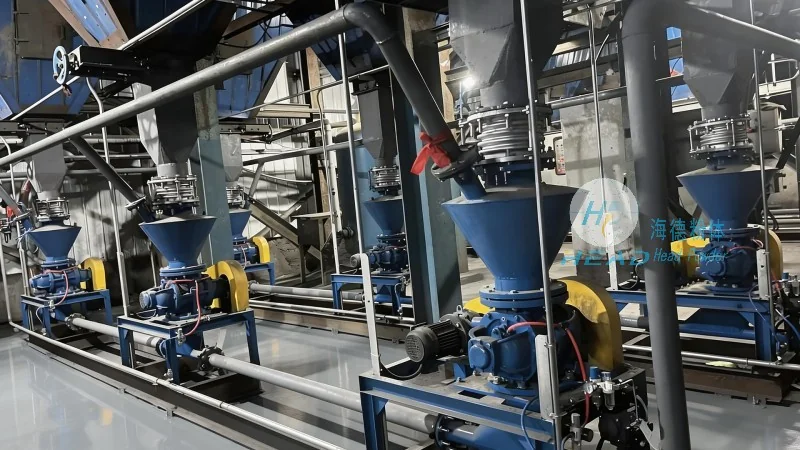
Dense phase conveying, in contrast, moves pellets at much lower air velocities (2–10 m/s) using a higher solid-to-air ratio. The material flows as a compact plug or slug, pushed or pulled by compressed air pulses. This mode dramatically reduces particle degradation and energy consumption per ton of material moved. It is ideal for longer distances (up to 500 meters or more) and for fragile or abrasive products like organic fertilizer pellets. The capital investment for dense phase systems is higher due to the need for air compressors, boosters, and sophisticated control valves, but the total cost of ownership often proves lower when factoring in reduced maintenance and product loss. Many leading producers in Europe and North America have already shifted toward dense phase conveying for premium organic pellet lines, a trend expected to accelerate through 2026 as quality standards tighten.
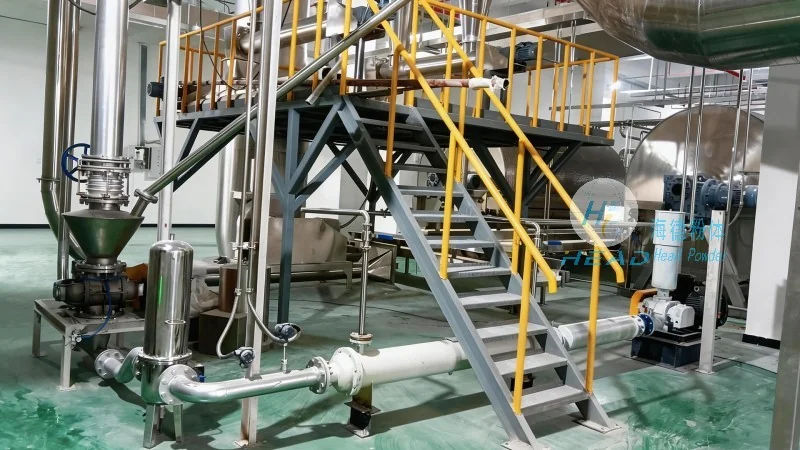
A complete pneumatic conveying system for organic fertilizer pellets integrates several critical sub-systems, each requiring careful specification. The feeding device, typically a rotary airlock or a screw feeder, meters pellets from a hopper into the conveying line while maintaining pressure differential. For sticky or high-moisture pellets, a drop-through rotary valve with hard-faced tips and adjustable clearance prevents binding. The conveying pipeline itself is usually constructed from stainless steel (SS304 or SS316) to resist corrosion from residual moisture and acidic components in organic fertilizers. Pipe diameters typically range from 80 mm to 200 mm, depending on throughput (e.g., 5–50 tons per hour). Bends must be long-radius (minimum 6× pipe diameter) and equipped with replaceable wear-back plates to extend service life.
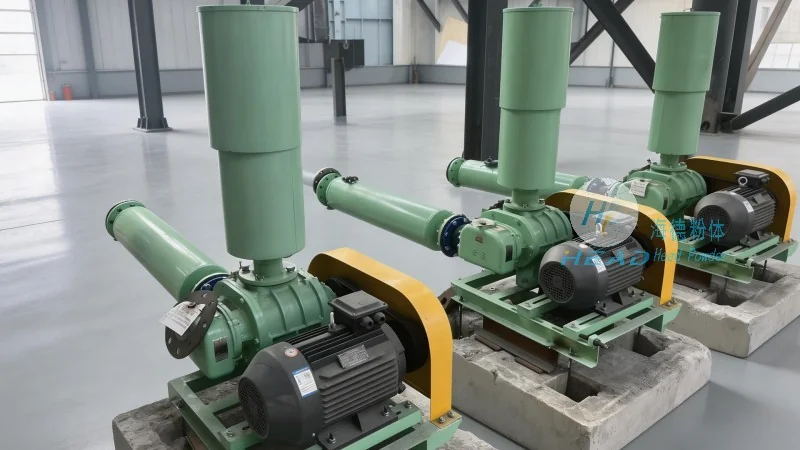
Air supply equipment is the heart of the system. Positive displacement blowers (roots-type) are standard for dilute phase, while screw compressors or high-pressure blowers are used for dense phase. Filtration at the receiving end is equally important: pulse-jet baghouse filters or cartridge collectors capture fines and return them to the process, ensuring compliance with environmental regulations and minimizing product loss. Additionally, pressure sensors, flow meters, and programmable logic controllers (PLCs) enable real-time monitoring and automatic adjustment of conveying parameters. A well-designed control system can reduce air consumption by 15–30% through adaptive velocity control, directly lowering operational costs. For plants processing organic fertilizers with variable moisture or particle size—common when using manure, crop residues, or municipal biosolids as feedstocks—such intelligent control is not a luxury but a necessity.
When evaluating pneumatic conveying equipment for organic fertilizer pellets, several technical parameters must be aligned with the specific production scenario. Throughput capacity, often expressed in tons per hour (t/h), determines the scale of blower, pipeline diameter, and feeding mechanism. A typical medium-scale plant handling 10 t/h of pellets with a bulk density of 0.8 g/cm³ would require a line velocity around 18 m/s in dilute phase or 4 m/s in dense phase. The conveying distance and number of bends dramatically affect pressure drop—each 90-degree bend can add the equivalent of 10–15 meters of straight pipe resistance. For layouts exceeding 100 meters with multiple directional changes, dense phase is strongly recommended to avoid excessive breakage.
Pellet characteristics dictate material compatibility. The angle of repose, internal friction coefficient, and compressibility influence how pellets behave in the feeder and pipeline. Organic fertilizers often contain fibers or irregular particles that can interlock, causing bridging. Therefore, hopper design should include steep angles (at least 60 degrees) and optional bin activators. Moisture content above 12% can lead to adhesion on pipe walls; in such cases, gentle aeration or heated conveying air may be required. Furthermore, the system must accommodate seasonal variations—for instance, wet-season pellets may have 18% moisture, while dry-season pellets are around 8%. An experienced supplier like headpowder customizes every system by conducting actual material testing in a pilot facility before delivery, ensuring that the design matches real-world conditions. (咨询热线:156-6277-7102)
The global organic fertilizer industry is undergoing significant transformation driven by regulatory pressure to reduce synthetic chemical inputs, growing consumer demand for organic food, and circular economy initiatives. By 2026, the adoption of automated, closed-loop material handling systems is predicted to increase by over 35% among mid-to-large organic fertilizer producers, according to recent agricultural technology reports. Pneumatic conveying fits perfectly into this trend because it enables full containment—no dust escape, no manual intervention, and seamless integration with upstream granulators and downstream bagging or bulk loading stations.
Energy efficiency is another critical driver. New-generation pneumatic systems incorporate variable frequency drives (VFDs) on blowers and compressors, reducing energy consumption by up to 40% compared to fixed-speed units. Additionally, heat recovery from compressor cooling can be used to pre-heat drying air or warm plant interiors, aligning with sustainability goals. Smart monitoring using IoT sensors and predictive maintenance algorithms further reduces downtime. For example, pressure drop trends can warn of impending blockages before they occur, allowing proactive cleaning. These technological advancements are making pneumatic systems increasingly cost-competitive with traditional mechanical conveyors, especially when total lifecycle costs are considered.
Despite their benefits, pneumatic conveying systems for organic fertilizer pellets are not immune to challenges. Pellet degradation, while lower in dense phase, can still occur if air velocity spikes during startup or shutdown. Proper ramp-up/ramp-down sequences in the PLC logic mitigate this. Pipeline wear at bends is inevitable; using ceramic-lined or self-replacing wear sections extends maintenance intervals to 12–18 months in typical operations. Another common issue is condensation in cold climates—moisture in warm conveying air can cool and condense inside pipes, causing pellet agglomeration. Insulating pipes and installing moisture separators on air intakes address this.
Headpowder has accumulated extensive field experience across multiple continents, helping clients overcome these hurdles. For instance, a poultry manure-to-organic fertilizer plant in Southeast Asia processing 20 t/h of pellets originally faced 8% breakage with a dilute-phase system. After redesigning to dense phase with controlled plug formation, breakage dropped below 1.5%, and energy costs fell by 25%. Such results underscore the importance of working with a partner who understands both the science of pneumatic conveying and the unique behavior of organic materials.
A modern organic fertilizer production line is not an isolated conveyor but an integrated network linking dryers, coolers, screens, coating drums, and storage silos. Pneumatic systems can be designed as "plug-and-play" modules that interface with existing equipment via flexible hoses and quick-couplers, allowing future expansions without major downtime. When planning a new facility, it is advisable to allocate space for potential capacity increases of 30–50%—oversizing the pipeline and air supply slightly at the outset is far more economical than replacing components later. Additionally, selecting components with industry-standard flanges and electrical protocols (e.g., Profibus, Modbus) ensures compatibility with various automation platforms.
Looking ahead, the integration of artificial intelligence for real-time optimization is on the horizon. Systems that learn the optimal air-to-material ratio based on live moisture and particle size data could further reduce energy use and product damage. For now, the most reliable approach remains a robust mechanical design combined with competent process control. Companies investing in well-engineered pneumatic conveying equipment today will be well-positioned to meet the stricter quality and sustainability requirements that the market will demand in 2026 and beyond.
Selecting the right equipment supplier is as important as selecting the right technology. A reputable provider offers not only hardware but also process engineering expertise, installation supervision, commissioning, and ongoing technical support. Headpowder, with over a decade of specialization in bulk material handling for the fertilizer industry, has developed a comprehensive service portfolio. From material characterization in its ISO-certified lab to on-site performance validation, every project benefits from a systematic approach. The company’s engineers provide detailed piping layouts, pressure drop calculations, and electrical schematics tailored to each client’s site constraints. After installation, remote monitoring and annual maintenance checks help sustain optimal performance. Whether the goal is to reduce pellet breakage by 50% or lower energy costs by 20%, the team works collaboratively to achieve measurable results.
In conclusion, organic fertilizer pellets pneumatic conveying system equipment represents a strategic investment for any producer aiming for growth, efficiency, and quality consistency. By understanding the fundamental differences between dilute and dense phase conveying, carefully selecting components based on pellet properties and plant layout, and staying abreast of technological advancements, manufacturers can build a conveying system that delivers reliable, low-cost operation for years. As the organic fertilizer market continues its robust expansion toward 2026, the role of advanced material handling will only become more pivotal. Partnering with experienced specialists ensures that your production line not only meets today’s demands but is also ready for tomorrow’s challenges.

 Shandong headpowder Engineering Co., Ltd.
 156-6277-7102(Manager Zhang)
  0531-83386006
  Jinan City, Shandong Province, China
服务热线
微信咨询
回到顶部