News
Rich project cases across industries, showing real implementation and proven technical strength.Selecting the right pneumatic conveying equipment system for rare earth powder is a critical decision that directly impacts production efficiency, product quality, and operational safety in the downstream processing of rare earth materials. Rare earth powders are unique in their physical and chemical properties—they are often fine, abrasive, hygroscopic, and prone to electrostatic agglomeration—which makes conventional conveying methods inadequate. As the global demand for rare earth elements continues to rise, driven by applications in electric vehicles, wind turbines, and advanced electronics, the need for reliable, closed-loop, and precisely controlled pneumatic conveying systems has become more pronounced. By 2026, the rare earth powder processing industry is expected to see a compound annual growth rate of over 8%, with stricter environmental regulations pushing manufacturers toward cleaner, more automated material handling solutions. This article provides a comprehensive technical guide to selecting a rare earth powder pneumatic conveying equipment system, covering key equipment parameters, material characteristics, system configurations, and practical considerations that ensure long-term operational stability and cost efficiency.
Understanding the fundamental behavior of rare earth powder during pneumatic transport is the first step toward correct system selection. Rare earth powders typically have particle sizes ranging from sub-micron to several hundred microns, with bulk densities between 0.8 and 2.5 g/cm³ depending on the specific oxide, carbonate, or metal form. Their high hardness (Mohs scale 5–7) causes severe wear on piping bends and conveying components. Additionally, many rare earth powders are highly hygroscopic, absorbing moisture from ambient air that leads to caking, bridging, and flow obstructions. The fine particle fraction—often below 10 microns—presents both an inhalation hazard and a risk of dust explosion if not properly managed. Therefore, any pneumatic conveying system for rare earth powder must incorporate advanced filtration, explosion mitigation features, and moisture control capabilities. headpowder has developed specialized dense-phase conveying solutions that address these challenges through low-velocity transport, customized pipe lining materials, and integrated dehumidification units (咨询热线:156-6277-7102).
The selection of a pneumatic conveying system begins with a thorough characterization of the rare earth powder being handled. Parameters such as particle size distribution, angle of repose, cohesion, moisture content, and abrasivity directly determine whether a dilute-phase or dense-phase approach is appropriate. For example, a free-flowing neodymium oxide powder with a median particle size of 20 microns and low moisture content can be conveyed in dilute phase at relatively high velocities using a positive displacement blower. In contrast, a sticky samarium-cobalt alloy powder with irregular particle shapes and a high angle of repose requires dense-phase conveying at low velocity to prevent line blockage and degradation. The Geldart classification of the powder—whether it behaves as Group A (aeratable), Group B (bubbling), or Group C (cohesive)—provides a useful starting point. Most rare earth powders fall into Group A or C, with Group C powders demanding special attention to aeration, fluidization uniformity, and anti-clogging design. Machine learning models based on historical conveying data can now predict optimal velocity, pressure drop, and solid loading ratio for a given rare earth powder, but empirical testing remains indispensable.
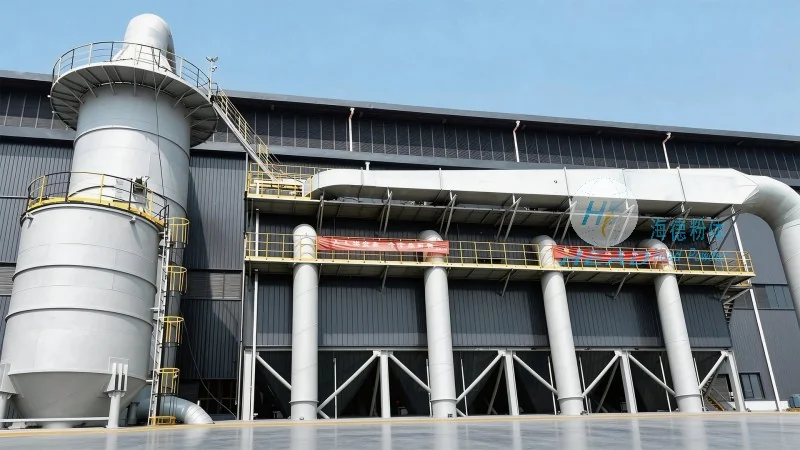
The primary distinction in pneumatic conveying systems is between dilute-phase (high velocity, low pressure) and dense-phase (low velocity, high pressure) configurations. For rare earth powders, dense-phase conveying is generally preferred for several reasons. First, the lower velocity (typically 2–8 m/s) dramatically reduces particle attrition, preserving the integrity of fragile rare earth particles and minimizing fines generation that could compromise downstream sintering or separation processes. Second, dense-phase systems create less abrasion on pipe walls, which extends equipment life and reduces maintenance costs—a significant advantage given the high capital investment in rare earth processing plants. Third, the lower air consumption means smaller filtration and dust collection systems, lowering both energy costs and carbon footprint. headpowder's dense-phase conveying equipment has been deployed in multiple rare earth oxide production lines in China and Southeast Asia, achieving powder degradation rates below 0.5% over a 200-meter conveying distance. However, dilute-phase remains viable for non-friable powders that require high throughput rates, especially when the conveying distance exceeds 300 meters. A hybrid system that combines dense-phase feeding with dilute-phase final transfer can also be engineered to balance efficiency and product quality.
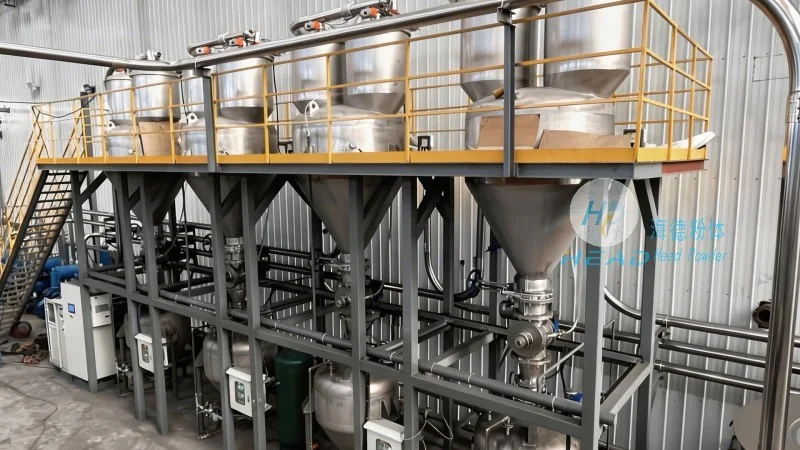
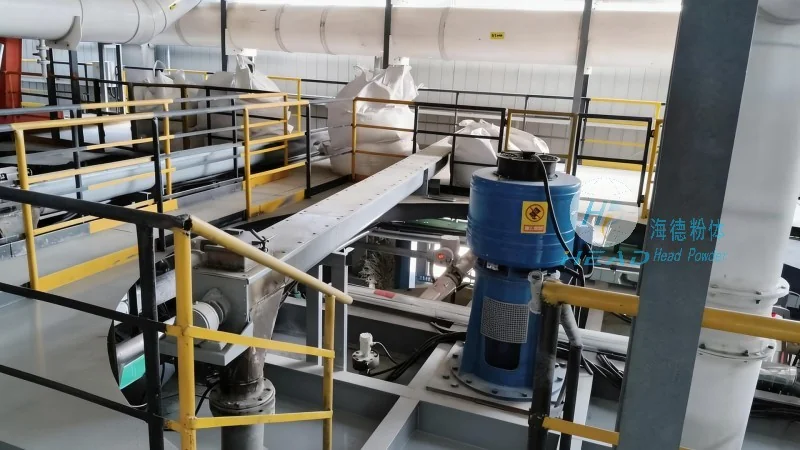
Every pneumatic conveying system comprises four core subsystems: the feeding device, the conveying pipeline, the gas-solid separation unit, and the control system. For rare earth powder, each component must be selected with careful attention to material compatibility and process requirements.
The feeding device—typically a rotary airlock, screw feeder, or venturi ejector—must handle the cohesive nature of rare earth powders without bridging or flooding. Rotary airlocks with hardened rotors and adjustable blowback ports are common, but for fine powders below 10 microns, a screw feeder with variable-pitch flights and a nitrogen purge can provide more consistent metering. The conveying pipeline requires abrasion-resistant lining materials such as alumina ceramic, basalt, or polyurethane, especially at bends where wear is most aggressive. A 90-degree bend can experience up to 20 times the erosion rate of a straight section; therefore, long-radius bends or vortex elbows are recommended to extend service life. The filtration system, usually a pulse-jet baghouse or cartridge filter, must achieve emission levels below 1 mg/Nm³ to comply with global environmental standards. The filter media should be anti-static and hydrophobic to handle electrostatic charges and moisture. Finally, the control system must integrate real-time monitoring of pressure, velocity, temperature, and moisture, with automated adjustments to conveying parameters based on powder condition changes. A programmable logic controller (PLC) with a human-machine interface (HMI) allows operators to visualize system performance and receive predictive maintenance alerts.
Pipeline layout significantly influences both conveying efficiency and wear distribution. A straight-line, minimal-bend layout reduces pressure drop and abrasion, but site constraints often require multiple direction changes. For rare earth powder systems, the maximum conveying velocity should be kept below 12 m/s in straight sections and below 8 m/s through bends to limit impact erosion. Each bend should have a radius-to-diameter ratio (R/D) of at least 10 for dense-phase systems, and the inside of the bend should be lined with a replaceable wear plate. Tee-type bends or blind tee designs can also be used, where the powder impacts a bed of accumulated material rather than the pipe wall. The number of bends should be minimized; every additional 90-degree bend increases total system pressure drop by approximately 0.2–0.5 bar depending on velocity and powder characteristics. Vertical risers present another challenge, as the powder must overcome gravity without salting out. A minimum air velocity of 3 m/s in the vertical section is typically required for dense-phase conveying of rare earth powders. headpowder's engineering team uses computational fluid dynamics (CFD) simulations to optimize pipeline routing before installation, ensuring that the pressure drop does not exceed the blower capacity while maintaining stable slug flow in dense-phase mode.
Rare earth powders, particularly those with particle sizes below 75 microns, can form explosive dust clouds when suspended in air. The minimum explosive concentration (MEC) for many rare earth oxides is between 50 and 200 g/m³, and the minimum ignition energy (MIE) can be as low as 10 mJ for some metallic rare earth powders. Therefore, any pneumatic conveying system must be designed in accordance with international standards such as ATEX (Directive 2014/34/EU) or NFPA 652 (Standard for Combustible Dusts). Key safety measures include: using inert gas (nitrogen or argon) as the conveying medium instead of air; installing explosion relief vents on the conveying line and dust collector; implementing suppression systems that detect pressure rise and deploy chemical suppressants within milliseconds; and grounding all equipment components to prevent electrostatic discharge. The conveying velocity should be kept below the minimum ignition energy threshold through proper sizing of the conveying line. For extremely sensitive powders, a vacuum-based dense-phase system (negative pressure) can reduce the risk of dust leakage and provide inherent safety advantages. headpowder integrates explosion-proof rotary valves, spark detection, and automatic isolation gate valves into its standard rare earth powder conveying packages, and all systems are third-party certified for use in Zone 20/21 environments.
Moisture control is perhaps the most overlooked yet impactful factor in rare earth powder pneumatic conveying. Even a small amount of moisture (0.5–2% by weight) can cause dramatic changes in powder flowability, leading to bridging in feed hoppers, caking in filter bags, and increased pressure drop across the system. The hygroscopic nature of many rare earth compounds means that the conveying gas must be dried to a dew point below -40°C to prevent moisture absorption during transport. This is typically achieved by installing a refrigerated air dryer or a desiccant dryer on the compressed air supply, coupled with inline humidity sensors that trigger alarms if the dew point rises. In regions with high ambient humidity, a nitrogen generator that supplies dry nitrogen as the conveying gas can be a cost-effective alternative to oversized drying equipment. Temperature also plays a role: some rare earth powders, such as cerium oxide, can undergo phase changes at elevated temperatures, so the conveying gas temperature should be kept below 60°C. Heat exchangers or cooling coils can be integrated into the system if the compression process raises the gas temperature significantly. headpowder offers pre-configured moisture management modules that include a desiccant dryer, a nitrogen boost system, and a closed-loop humidity controller, tailored to the specific hygroscopicity of the customer's rare earth powder.
A well-designed pneumatic conveying system must not only transport rare earth powder reliably but also integrate seamlessly with upstream milling, calcination, or blending equipment and downstream pressing, sintering, or packaging machinery. Scalability is critical because rare earth processing plants often expand capacity in phases. The conveying system should be modular, allowing additional feeding points or discharge stations to be added without major reengineering. For example, a centralized dense-phase system that serves multiple receiving hoppers can use a common pipeline manifold with diverter valves, enabling one blower and one filter to support several process lines. The conveying control system should interface with the plant's distributed control system (DCS) via standard protocols such as Modbus TCP or Profibus, enabling synchronized operation with upstream and downstream equipment. When conveying to a batch mixer or a continuous kiln, the system must provide accurate mass flow control, often using loss-in-weight feeders at the discharge end. headpowder's customers have reported a 15–20% improvement in overall equipment effectiveness (OEE) after upgrading from manual material handling to an integrated pneumatic conveying system, thanks to reduced downtime from blockages and faster changeovers between different rare earth grades.
While the initial capital expenditure (CAPEX) for a rare earth powder pneumatic conveying system can be substantial—ranging from $150,000 for a small dense-phase unit to over $1.5 million for a large, multi-line installation—the total cost of ownership (TCO) over a 10-year period is often significantly lower than alternative methods such as mechanical conveyors or manual transport. Key TCO factors include energy consumption (blower and dryer power), maintenance costs (replaceable wear parts and filter bags), downtime losses, and product losses due to degradation or spillage. A dense-phase system for rare earth powder typically consumes 0.5–1.5 kWh per ton of material conveyed, compared to 2–4 kWh per ton for dilute-phase. Using energy-efficient blowers with variable frequency drives (VFDs) can further reduce electricity costs by 20–30%. Maintenance intervals for ceramic-lined pipes can exceed 5 years with proper velocity control, while filter bag replacement is typically required every 2–3 years. Many processors find that the payback period for a well-engineered system is between 18 and 36 months, based on reduced labor costs, higher throughput, and lower product rejection rates. headpowder provides a detailed TCO analysis for each project, factoring in local electricity tariffs, labor rates, and production targets, helping customers make informed investment decisions.
A mid-sized rare earth separation facility in southern China was struggling with frequent blockages in its dilute-phase pneumatic conveying system when handling neodymium oxide powder with a median particle size of 8 microns and a moisture content of 1.2%. The system required weekly manual cleaning of the filter bags and experienced pipe erosion every three months, leading to 10% downtime and annual maintenance costs exceeding $80,000. headpowder conducted a site audit and recommended a conversion to dense-phase conveying using nitrogen as the carrier gas, with a ceramic-lined pipeline and a pulse-jet cartridge filter equipped with hydrophobic membrane media. After installation, the system operated continuously for 12 months without a single blockage incident. The filter bag replacement cycle extended to 3.5 years, and pipe wear was negligible after 18 months of operation. Product degradation measured by particle size analysis showed no change between the feed and discharge material, whereas the previous system had increased the fines fraction by 3.2%. The customer reported a 12% increase in overall throughput and a 40% reduction in maintenance labor. This real-world example illustrates how proper system selection, tailored to the specific properties of rare earth powder, directly translates into operational and financial benefits.
The selection of a rare earth powder pneumatic conveying equipment system is a multifaceted engineering decision that requires balancing material science, fluid dynamics, safety regulations, and economic constraints. As the industry moves toward higher automation and stricter environmental compliance, the trend is clearly toward dense-phase pneumatic conveying with inert gas support, smart sensor integration, and modular, scalable design. Processors who invest in a system that accounts for the unique abrasiveness, hygroscopicity, and explosivity of rare earth powders will gain a significant competitive advantage through lower operating costs, higher product quality, and greater process reliability. Partnering with an experienced equipment supplier like headpowder, who offers not only standardized systems but also custom engineering based on powder characterization and site-specific conditions, ensures that the system will perform as intended over its entire lifecycle. By following the selection guidelines outlined in this article—carefully evaluating material properties, choosing the appropriate conveying phase, specifying wear-resistant components, implementing robust safety measures, and planning for scalability—rare earth producers can build a material handling solution that supports growth and innovation in this critical industry.

 Shandong headpowder Engineering Co., Ltd.
 156-6277-7102(Manager Zhang)
  0531-83386006
  Jinan City, Shandong Province, China
服务热线
微信咨询
回到顶部