News
Rich project cases across industries, showing real implementation and proven technical strength.In the rapidly evolving landscape of lithium-ion battery manufacturing, the efficiency and reliability of material handling systems have become critical determinants of production quality and cost control. Among these systems, pneumatic conveying stands out as a preferred method for transporting battery materials due to its closed-loop, dust-free, and automated nature. However, the unique physical and chemical properties of battery materials—such as high abrasiveness, moisture sensitivity, electrostatic tendency, and particle friability—pose significant challenges that require a carefully engineered technical solution. This article provides a comprehensive technical specification for pneumatic conveying systems designed specifically for battery materials, offering an in-depth analysis of system architecture, component selection, process parameters, safety considerations, and industry best practices. Whether you are scaling up from pilot to mass production or retrofitting an existing facility, understanding these technical nuances is essential for achieving consistent material flow, minimal degradation, and optimal energy efficiency.
The global battery materials market is projected to exceed USD 120 billion by 2026, driven by the accelerating demand for electric vehicles and energy storage systems. As production capacities increase, manufacturers are turning to pneumatic conveying to replace manual or mechanical handling methods, which often suffer from contamination risks, high labor costs, and limited throughput. Yet, the successful deployment of such systems hinges on a deep understanding of material behavior and system design parameters. This article will systematically cover the key aspects of battery material pneumatic conveying, including material characterization, system types (dilute phase vs. dense phase), component specifications (blowers, rotary valves, filters, pipelines), control strategies, and maintenance protocols. By the end, readers will have a clear roadmap for evaluating, designing, or commissioning a pneumatic conveying solution that meets the stringent requirements of battery material processing.
Battery materials—such as lithium iron phosphate (LFP), nickel manganese cobalt oxide (NMC), graphite, silicon anode powders, and solid electrolytes—exhibit highly variable properties that directly influence pneumatic conveying design. Key parameters include particle size distribution (typically 1–50 microns for active materials), bulk density (ranging from 0.3 to 1.5 g/cm³), moisture content (must be kept below 500 ppm for most cathode powders), and angle of repose. Additionally, many battery powders are cohesive and hygroscopic, meaning they tend to agglomerate or absorb moisture from ambient air, leading to flow blockages or chemical degradation. Electrostatic charge generation during conveying is another critical concern, as fine particles can accumulate static electricity, causing clinging to pipe walls, spark discharge risks in explosive environments, and inconsistent batch weights. To address these challenges, a comprehensive material analysis should be conducted prior to system design. This includes shear cell testing for flowability, moisture sorption isotherms, and electrostatic dissipation measurements. Based on these data, engineers can select the appropriate conveying phase and component materials. For example, for highly abrasive materials like lithium carbonate, pipeline wear resistance must be enhanced using ceramic-lined pipes or wear-resistant elbows. Headpowder, with over a decade of experience in powder handling for advanced materials, has developed proprietary material characterization protocols that enable precise system customization (咨询热线:156-6277-7102).
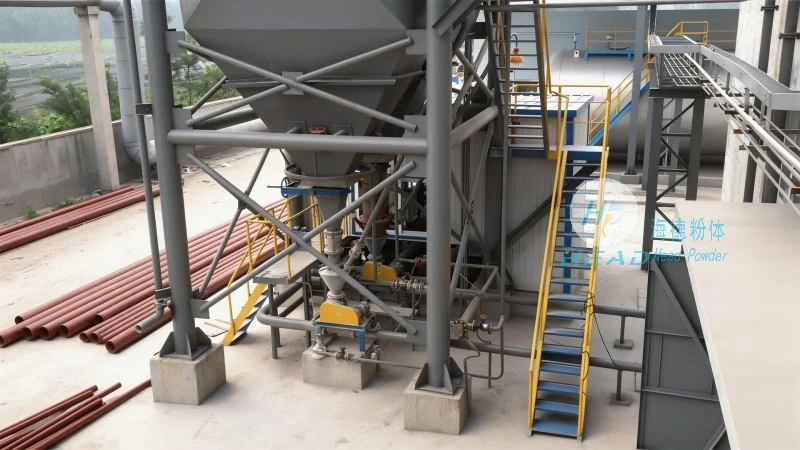
The choice between dilute phase and dense phase pneumatic conveying is fundamental to system performance. In dilute phase conveying, materials are suspended in a high-velocity air stream (typically 20–35 m/s) and transported at low product-to-air ratios. This method is suitable for free-flowing, non-friable materials and offers higher throughput in shorter distances. However, for battery materials, the high velocity can cause particle attrition, leading to fines generation and loss of active material integrity. Moreover, high air consumption increases energy costs and filter loading. In contrast, dense phase conveying operates at lower velocities (2–10 m/s) with higher material concentrations, utilizing pressure differentials to push material plugs through the pipeline. This mode significantly reduces particle degradation, minimizes erosion, and lowers energy consumption by 30–50% compared to dilute phase. For battery materials, dense phase is generally recommended, especially for cathode powders that are sensitive to mechanical stress. Yet, dense phase systems require more careful design to prevent plugging, particularly for cohesive or very fine powders. Modern dense phase systems incorporate bypass lines, sonic nozzles, and advanced PLC-based control to maintain stable flow. A comparative analysis at a leading Chinese battery-grade material plant showed that switching from dilute to dense phase reduced particle breakdown by 60% and achieved 15% higher yield in downstream electrode coating. Headpowder’s engineering team applies computational fluid dynamics (CFD) simulations to model material behavior under different conveying regimes, ensuring the selected solution aligns with specific material fragility and production requirements.
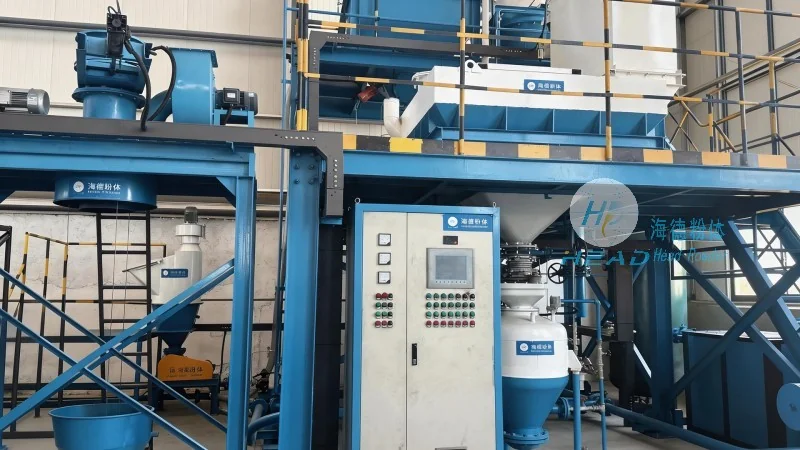
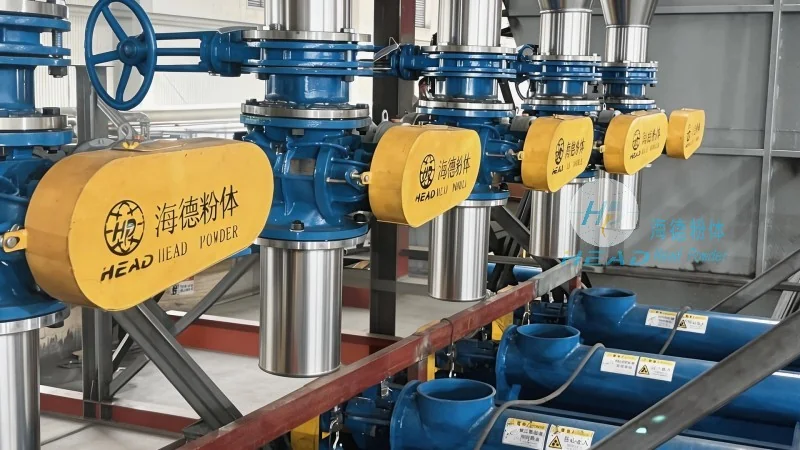
A robust pneumatic conveying system for battery materials relies on precisely specified components. The blower or compressor must deliver consistent pressure and flow while being energy-efficient. For dense phase systems, screw compressors or dry-running rotary lobe blowers are preferred, with pressure ratings typically between 0.5 and 3.0 bar. The rotary airlock valve, acting as the material feeder, must handle abrasive powders without leakage; design considerations include wear-resistant rotor tips, adjustable clearance, and explosion-proof certification. For battery materials, rotary valves with hardened steel or carbide-tipped rotors are common. The conveying pipeline should be constructed from 304 or 316L stainless steel with smooth internal surfaces to reduce friction and contamination. Elbows require attention—long-radius or plug-type elbows are recommended to minimize impact degradation. Filtration systems, including bag filters or cartridge filters, must achieve emission levels below 1 mg/m³ to comply with environmental regulations and prevent material loss. Additionally, dampening systems for pressure fluctuations and moisture control devices (e.g., desiccant dryers or heated air) are essential when handling hygroscopic powders. A leading industry standard, the NFPA 654, provides guidelines for explosion protection in powder handling, which often mandates the installation of rupture disks, suppression systems, or inert gas blanketing for combustible battery materials like graphite. Headpowder integrates these safety features as standard in all its battery material conveying solutions, backed by CE and ATEX certifications where applicable. For a mid-scale cathode production line handling 5 tons per hour of NMC powder, a typical dense phase system from Headpowder includes a 75 kW screw compressor, six rotary valves with ceramic liners, over 200 meters of DN100 pipe with 90-degree long-radius bends, and a 24-cartridge filter with reverse-pulse cleaning. This configuration has demonstrated 99.7% material integrity after conveying, as verified by laser particle size analysis.
Modern battery material pneumatic conveying systems are increasingly integrated into Industry 4.0 frameworks. The control system should monitor and adjust key parameters in real time, including material flow rate, air velocity, pressure drop, temperature, humidity, and filter differential pressure. Using a PLC with SCADA interface, operators can optimize conveying cycles based on material batch properties. For example, when conveying a cohesive graphite powder, the system can automatically reduce conveying velocity by 10% to prevent plugging while increasing injection pressure to maintain throughput. Advanced systems incorporate predictive maintenance algorithms that analyze vibration and torque data from blowers and rotary valves to forecast wear. Furthermore, batch weighing and totalizing functions enable precise inventory management and recipe control. The communication protocol should support OPC-UA for seamless integration with MES or ERP systems. In a recent deployment for a solid-state battery electrolyte manufacturer, Headpowder implemented a fully automated dense phase conveying line that reduced manual intervention by 80% and achieved ±0.5% batch weight accuracy. The control logic included soft-start sequencing, emergency stop interlocks, and auto-purge cycles to prevent material caking during idle periods. Such automation not only improves consistency but also reduces the risk of human error—a critical factor in high-value battery material processing where a single batch deviation can cost tens of thousands of dollars.
The successful operation of a battery material pneumatic conveying system depends heavily on proper installation and ongoing maintenance. During installation, pipe alignment must be checked to avoid bends that increase pressure loss or material stagnation. Supports should allow for thermal expansion, and grounding straps are mandatory to dissipate static electricity. Commissioning involves a phased approach: first, verify the blower performance and air logic; second, run with an inert material to check for leaks and pressure drops; third, introduce actual battery powder at low rates, gradually increasing to design capacity while monitoring particle degradation. Maintenance schedules should be based on operating hours. Key tasks include weekly inspection of filter bags for dust accumulation, monthly calibration of pressure sensors, and quarterly replacement of rotary valve seals. Pipeline wear can be monitored using ultrasonic thickness gauging; elbows typically require replacement after 6–12 months for abrasive materials. Additionally, moisture traps and air dryers need regular regeneration or replacement of desiccant. By following these protocols, equipment lifespan can exceed 10 years with consistent performance. Headpowder offers a comprehensive maintenance package that includes remote diagnostics, spare parts consignment, and on-site training for plant technicians. One case study involves a lithium iron phosphate producer that adopted Headpowder’s predictive maintenance plan, reducing unplanned downtime by 70% over two years and saving approximately USD 150,000 per year in lost production.
As battery technology evolves toward higher energy densities and new chemistries, pneumatic conveying systems must adapt. Solid-state batteries, for instance, require handling of sulfide-based electrolytes that are highly moisture-sensitive and can generate toxic hydrogen sulfide gas if exposed to humidity. This demands hermetically sealed conveying loops with dry nitrogen purge and real-time gas monitoring. Similarly, silicon-dominant anodes, with their extremely fine particles (sub-micron), pose challenges in electrostatic control and filter efficiency. Emerging trends include the use of artificial intelligence for adaptive conveying control, based on online particle size analysis using laser diffraction sensors. Another development is the adoption of modular, skid-mounted conveying units that can be deployed quickly and reconfigured for different materials. By 2026, it is estimated that over 35% of new battery material plants will incorporate some form of smart pneumatic conveying with self-optimizing parameters. Companies that invest in these technologies now will gain a competitive edge in quality consistency and operational cost. Headpowder continuously invests in R&D, having filed 12 patents related to dense phase conveying of advanced battery powders, including a novel anti-clogging nozzle design and a low-shear rotary valve.
In summary, the technical specification for battery material pneumatic conveying is a multi-dimensional discipline that balances material science, mechanical engineering, process control, and safety compliance. From understanding the flow behavior of cathode and anode powders to selecting the right conveying phase, component materials, and automation level, every decision impacts final product quality and production economics. The best solution is not one-size-fits-all but rather a tailored system designed through close collaboration between the manufacturer and the equipment provider. Headpowder, with its specialized expertise in battery materials handling, offers end-to-end services from material testing and system design to installation and after-sales support. For battery material producers aiming to achieve high purity, low degradation, and scalable production, investing in a technically sound pneumatic conveying system is not optional—it is a strategic imperative. To discuss your specific material conveying requirements or request a detailed feasibility study, contact Headpowder directly (咨询热线:156-6277-7102) to speak with our application engineers who have successfully completed projects for leading battery manufacturers across Asia and Europe.

 Shandong headpowder Engineering Co., Ltd.
 156-6277-7102(Manager Zhang)
  0531-83386006
  Jinan City, Shandong Province, China
服务热线
微信咨询
回到顶部