News
Rich project cases across industries, showing real implementation and proven technical strength.Graphite powder, with its unique properties such as high thermal conductivity, chemical inertness, and lubricating characteristics, has become an indispensable raw material in industries ranging from lithium-ion battery production to advanced metallurgy and semiconductor manufacturing. However, handling graphite powder presents distinct challenges due to its fine particle size, low bulk density, high abrasiveness, and tendency to generate dust clouds that pose both explosion risks and environmental concerns. Pneumatic conveying systems have emerged as the preferred solution for transporting graphite powder safely, efficiently, and with minimal degradation. These systems utilize air or inert gas to move material through enclosed pipelines, eliminating dust escape, reducing manual handling, and enabling automated continuous feeding. As global demand for graphite powder is projected to exceed 3 million metric tons by 2026, driven by the rapid expansion of electric vehicle batteries and energy storage systems, the need for reliable, high-performance pneumatic conveying equipment becomes increasingly critical. This article provides a comprehensive overview of graphite powder pneumatic conveying equipment systems, covering working principles, key components, design considerations, industry standards, and emerging trends, offering practical insights for engineers and plant managers seeking to optimize their material handling operations.
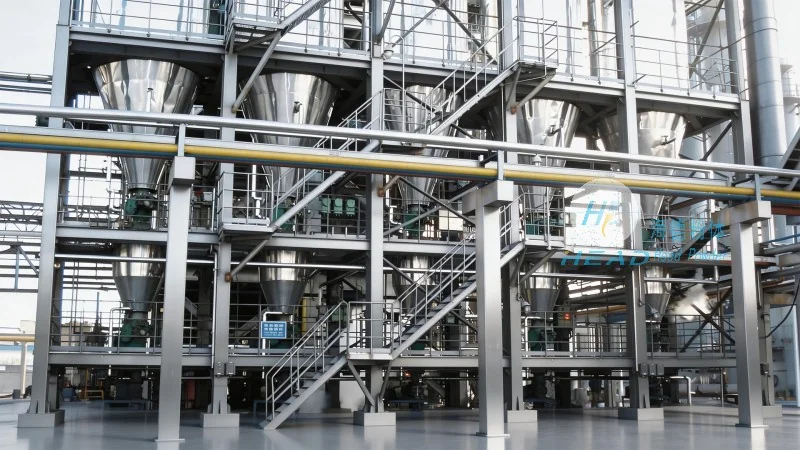
Pneumatic conveying transports graphite powder by suspending particles in a gas stream, typically air, nitrogen, or argon, depending on the material's sensitivity to oxidation or moisture. The system relies on a pressure differential created by a blower, compressor, or vacuum pump to move the powder-gas mixture through a pipeline. For graphite powder, two primary modes are commonly employed: dilute phase conveying and dense phase conveying. In dilute phase conveying, particles are fully suspended at high velocities (typically 15–30 m/s), which suits short-distance transport and low-capacity requirements but may cause higher wear on pipes and fittings due to abrasive graphite. Dense phase conveying operates at lower velocities (3–8 m/s) and higher material-to-air ratios, pushing the powder in slug or plug flow. This method significantly reduces erosion, lowers energy consumption, and minimizes particle breakage, making it ideal for brittle or high-value graphite grades. The selection between these modes depends on factors such as particle size distribution, moisture content, conveying distance, and required throughput. Modern systems often incorporate PLC controls and variable frequency drives to adjust air flow dynamically, ensuring consistent performance even when material properties fluctuate.
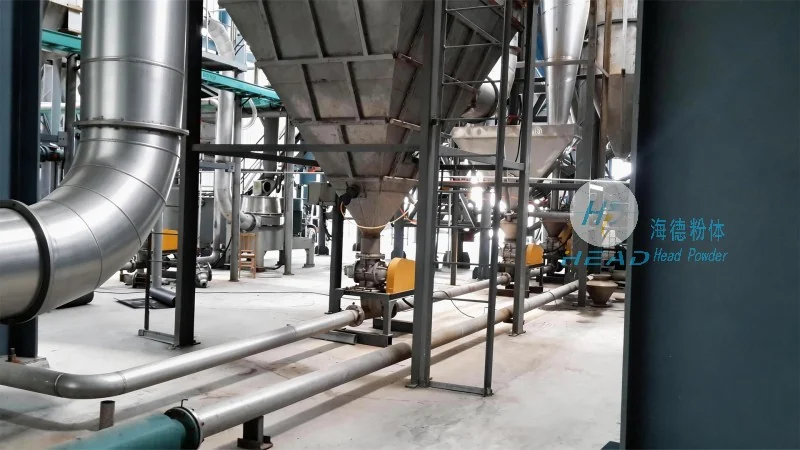
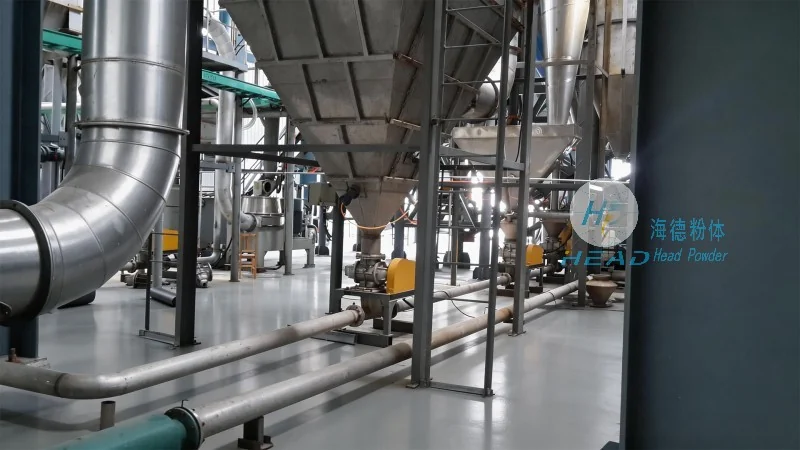
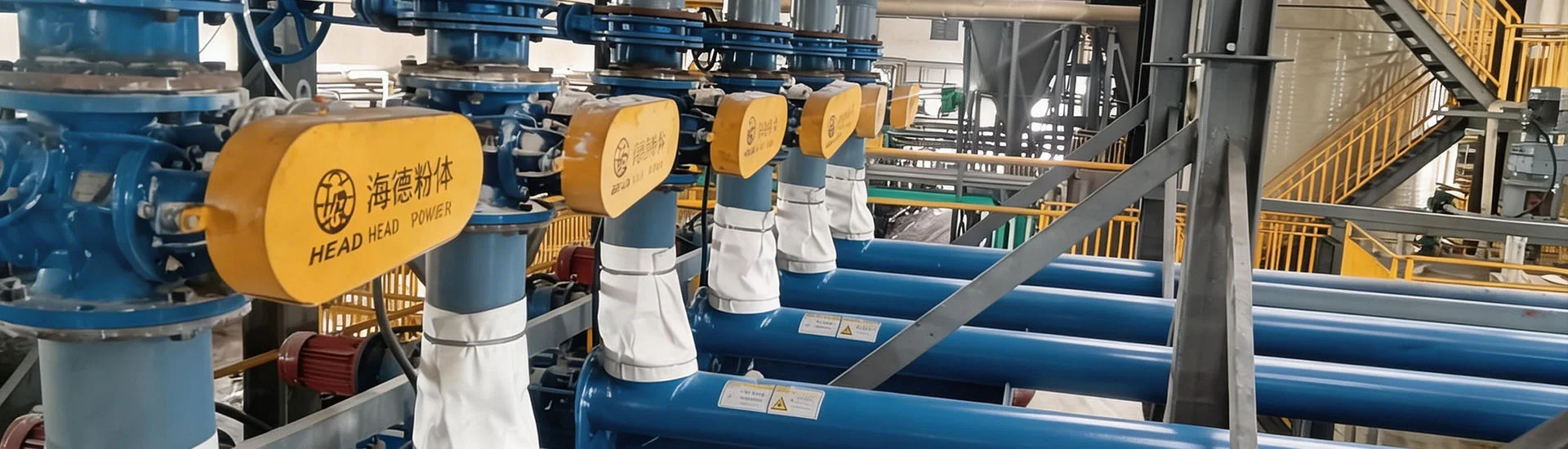
A well-designed pneumatic conveying system for graphite powder comprises several critical components, each engineered to withstand the abrasive and cohesive nature of the material. The material feeding device, often a rotary valve or a screw feeder, meters graphite powder into the conveying line at a controlled rate. For fine graphite powders, rotary valves with hardened rotor tips and adjustable clearance prevent leakage and maintain seal integrity. The conveying pipeline is typically constructed from wear-resistant materials such as stainless steel with ceramic liners or hardened alloy steel, as standard steel can erode quickly under high-velocity graphite flow. Bend sections are particularly vulnerable; long-radius bends with replaceable wear inserts extend service life. Filtration equipment, including baghouse filters or cartridge dust collectors, separates graphite powder from the conveying air at the destination. Given graphite's fine particle size (often below 10 microns), high-efficiency HEPA filters may be required to meet emission standards below 1 mg/m³. Other essential components include airlocks to maintain pressure differentials, diverter valves for multiple discharge points, and dehumidification units when moisture-sensitive graphite grades are handled. Sensors for pressure, flow, and temperature feed data to a central control system, enabling real-time monitoring and predictive maintenance.
Selecting the appropriate pneumatic conveying equipment for graphite powder demands careful evaluation of several technical parameters. Bulk density of graphite powder typically ranges from 0.3 to 0.8 g/cm³ depending on grade and particle size, influencing the sizing of blowers and pipelines. The angle of repose, which can exceed 45 degrees for fine graphite, affects hopper design and feeder selection to prevent bridging. Particle shape—whether flaky, spherical, or irregular—determines flowability and abrasiveness. For example, flake graphite tends to orient itself in the conveying stream, creating higher friction and requiring higher air velocities. Conveying distance and elevation change directly impact pressure loss: a 100-meter horizontal line with 20-meter lift may require 0.5–0.8 bar of positive pressure for dilute phase systems, while dense phase systems often operate below 0.3 bar. Volume flow rate of air must be calculated to maintain the desired solids loading ratio, typically between 10 to 30 kg of graphite per kg of air for dense phase. Industry standards such as ISO 12407 (pneumatic conveying of particulate materials) and ATEX directives for explosive dust atmospheres provide guidance on safety margins and equipment certification. Headpowder's engineering team routinely conducts material characterization tests, including shear cell analysis and minimum conveying velocity trials, to tailor each system to specific graphite powder properties.
Graphite powder, while not inherently explosive in bulk, can form combustible dust clouds when finely divided and suspended in air. According to the U.S. Chemical Safety Board, more than 500 dust explosions occurred in industrial facilities between 2008 and 2023, with carbon-based materials being a significant contributor. For pneumatic conveying systems handling graphite powder, explosion prevention and mitigation are mandatory. Key safety measures include inert gas blanketing (using nitrogen or argon to keep oxygen levels below the limiting oxygen concentration, typically 8–10% for graphite), explosion venting panels on vessels and filters, and suppression systems that detect pressure spikes within milliseconds. The conveying line should be electrically grounded to dissipate static charges that can accumulate as graphite particles rub against pipe walls. Additionally, magnetic separators or metal detectors at the feeding point prevent tramp metal from entering the system and causing sparks. All equipment must comply with ATEX 2014/34/EU or NEC Article 500 classifications. Headpowder integrates these safety features as standard in its graphite powder conveying systems, offering optional monitoring of oxygen concentration and grounding continuity via IoT-enabled sensors, which helps customers meet regulatory requirements and reduce insurance premiums.
The global graphite market is undergoing transformative growth, with the battery sector alone accounting for over 40% of total demand in 2025 and projected to reach 55% by 2028. This shift drives increasing requirements for automated, low-degradation pneumatic conveying systems. In 2026, three key trends are reshaping the industry: first, the adoption of smart conveying systems equipped with AI-driven predictive analytics that reduce unplanned downtime by 35–50% compared to traditional systems. Second, modular and compact system designs that allow faster installation and easier retrofitting into existing plants, particularly important for battery material manufacturers scaling up production. Third, the integration of closed-loop conveying with carbon capture technology, as many producers seek to minimize their environmental footprint. Additionally, the growing focus on recycled graphite from spent batteries creates new challenges—conveying systems must handle variable particle sizes and agglomerates typical of recycled material. Headpowder has already deployed several such systems in European and Asian battery recycling facilities, demonstrating reliable handling of graphite with up to 12% moisture content without clogging. With global investments in graphite processing exceeding $2.5 billion annually from 2024 to 2026, the demand for specialized pneumatic conveying solutions will continue to rise.
Successful deployment of graphite powder pneumatic conveying equipment requires collaboration between the system supplier and the end-user from the design stage. A thorough site survey should assess ambient temperature variations (graphite can absorb moisture above 60% relative humidity, causing sticking), available space for rotary feeders and filter receivers, and existing compressed air infrastructure. For a recent project supplying a graphite anode material producer in Shandong, China, Headpowder designed a dense phase conveying system capable of moving 8 tons per hour of spherical graphite powder over 150 meters with a conveying air velocity of 6.5 m/s. The system used wear-resistant ceramic-lined bends that showed less than 0.5 mm wall thickness loss after 6 months of continuous operation. Another case involved a specialty graphite processor in Germany requiring sterile conveying conditions. Headpowder implemented a fully stainless steel system with CIP (clean-in-place) nozzles and food-grade seals, meeting the customer's ISO 14644 Class 7 cleanroom standards. These examples illustrate how customized engineering, rigorous testing, and attention to ancillary equipment (like dehumidifiers and pneumatic gates) lead to reliable, long-lasting installations. Regular maintenance—checking rotary valve clearances, replacing filter bags every 12–18 months, and monitoring pipe wear with ultrasonic thickness gauges—extends system life beyond 10 years.
With over two decades of specialized experience in powder handling, Headpowder has developed a deep understanding of graphite's unique behavior under pneumatic transport. Our engineering team holds multiple patents related to low-velocity dense phase conveying for abrasive materials and offers a comprehensive pre-sales service: we analyze your graphite sample in our in-house laboratory for flowability, compressibility, and attrition characteristics before proposing a design. Each system is fabricated in our ISO 9001-certified facility using precision welding and laser cutting, with on-site performance testing before shipment. Post-installation, we provide remote monitoring via our proprietary cloud platform, which alerts operators to deviations in conveying pressure or filter differential pressure. This proactive approach has reduced emergency breakdowns for our clients by 62% on average. Whether you are handling natural flake graphite for refractories, synthetic graphite for electrodes, or recycled graphite for batteries, Headpowder delivers a system that balances efficiency, safety, and total cost of ownership. Our references include tier-1 battery material manufacturers and specialty chemical companies across 15 countries. For a detailed consultation on your graphite powder conveying requirements, contact our technical team directly.
(咨询热线:156-6277-7102)
As the graphite industry moves toward higher purity standards (99.95% and above for battery-grade material), pneumatic conveying must evolve to minimize metal contamination. Headpowder is actively researching ceramic composite pipeline materials that reduce wear debris generation to below 1 ppm. Simultaneously, the integration of Industry 4.0 technologies—digital twins, automated valve diagnostics, and energy optimization algorithms—promises to further lower operating costs. In the next three years, we anticipate that fully autonomous conveying systems, capable of self-adjusting parameters based on real-time particle size analysis, will become commercially viable. These advancements will help clients achieve not only higher efficiency but also compliance with increasingly stringent environmental regulations. By partnering with Headpowder, you gain access to a dedicated team that stays at the forefront of pneumatic conveying science, ensuring your graphite powder handling infrastructure remains competitive into the next decade.

 Shandong headpowder Engineering Co., Ltd.
 156-6277-7102(Manager Zhang)
  0531-83386006
  Jinan City, Shandong Province, China
服务热线
微信咨询
回到顶部