News
Rich project cases across industries, showing real implementation and proven technical strength.In the mineral processing and industrial powder handling sectors, talc powder stands out for its unique softness, high brightness, and chemical inertness. Yet, precisely because of these very properties—its platy particle shape, low bulk density, and tendency to generate dust—conveying talc powder efficiently, safely, and without degradation poses significant engineering challenges. For decades, pneumatic conveying has been the preferred method for moving talc powder across diverse stages of production, from grinding and classification to storage, blending, and final packaging. However, selecting and designing the right pneumatic conveying system for talc powder is not a one-size-fits-all proposition. It requires a deep understanding of material characteristics, system pressure regimes, pipeline geometry, and automation control. This article provides a comprehensive, technically grounded overview of talc powder pneumatic conveying equipment system solutions, tailored for industry professionals seeking reliable, cost-effective, and energy-efficient approaches.
The market for talc powder continues to expand, driven by demand in plastics, ceramics, paints, paper, cosmetics, and pharmaceuticals. According to industry data projected for 2026, the global talc market is expected to exceed 8.5 million metric tons annually, with increasing emphasis on ultra-fine grades (d97 < 10 μm) and high-purity specifications. As talc producers scale up operations and tighten quality standards, the pneumatic conveying system becomes a critical link in the value chain. An inadequately designed system can lead to particle attrition, pipeline wear, segregation, blockages, and excessive energy consumption. Conversely, a well-engineered solution not only ensures gentle handling and consistent throughput but also reduces maintenance downtime and operational costs. In this context, headpowder has developed a series of tailored talc powder pneumatic conveying equipment system solutions that integrate decades of field experience with the latest advances in dense-phase conveying, filtration, and intelligent control.
Before diving into equipment selection, it is essential to characterize the flow properties of talc powder. Talc typically has a particle size distribution ranging from a few microns to several hundred microns, with a median diameter often between 5 μm and 50 μm for industrial grades. Its bulk density varies from approximately 0.3 g/cm³ to 0.8 g/cm³ depending on compaction and particle shape. The platy morphology—flat, layered particles—gives talc a high angle of repose and poor flowability under gravity alone. Additionally, talc is inherently cohesive and aeratable, meaning it can fluidize easily but also tends to deaerate rapidly when subjected to pressure changes. These characteristics make it prone to "ratholing" in hoppers and "salting out" in pipelines if the conveying velocity is not properly controlled.
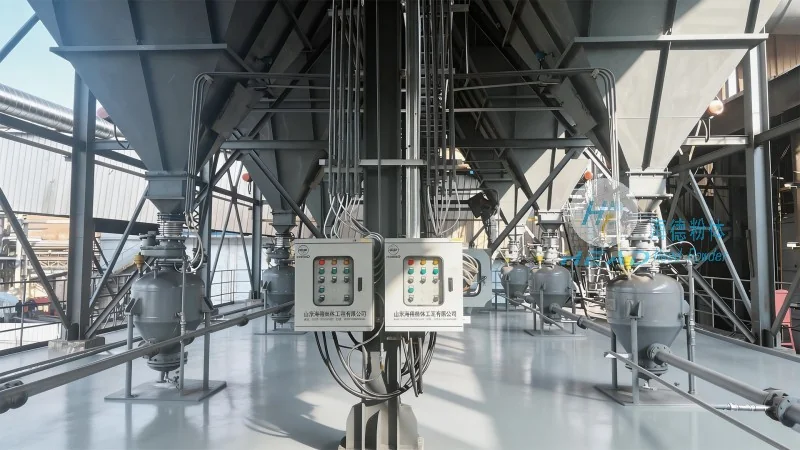
For pneumatic conveying, the two primary regimes are dilute-phase (high velocity, low pressure) and dense-phase (low velocity, high pressure). Dilute-phase systems, using positive pressure blowers at 0.5–1.5 bar, are common for shorter distances and lower capacities. However, for talc powder, dilute-phase conveying often leads to excessive particle breakage, pipeline erosion, and higher energy consumption per ton conveyed. Dense-phase conveying, on the other hand, operates at velocities typically 3–8 m/s compared to dilute-phase velocities of 15–25 m/s. In dense-phase systems, the material moves as a fluidized plug or a continuous strand, significantly reducing wear, attrition, and air consumption. Given the intrinsic value of fine talc—where particle integrity directly impacts brightness and application performance—dense-phase pneumatic conveying has become the industry benchmark for premium talc handling.
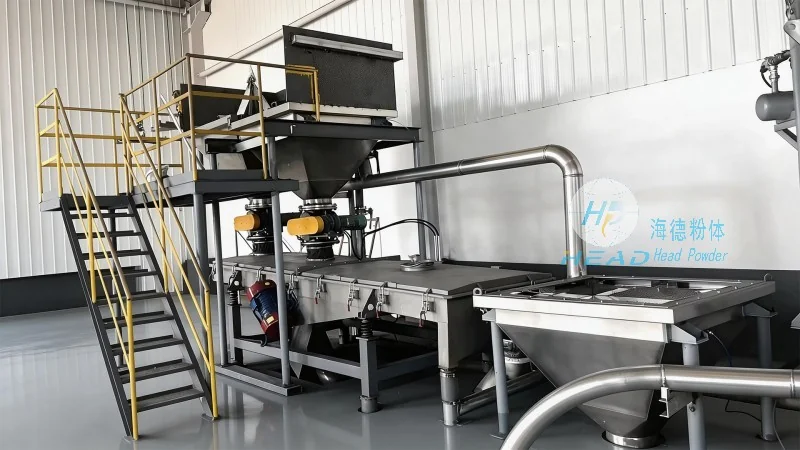
A complete talc powder pneumatic conveying equipment system consists of several integrated modules, each engineered to address specific operational demands. The following components form the core of headpowder's standard solution:
Not all talc applications are identical. A cosmetic-grade talc requiring d97 < 10 μm and strict metal contamination limits will impose different demands than a coarse talc used in ceramic tile bodies. Below are three representative configurations that headpowder frequently engineers:
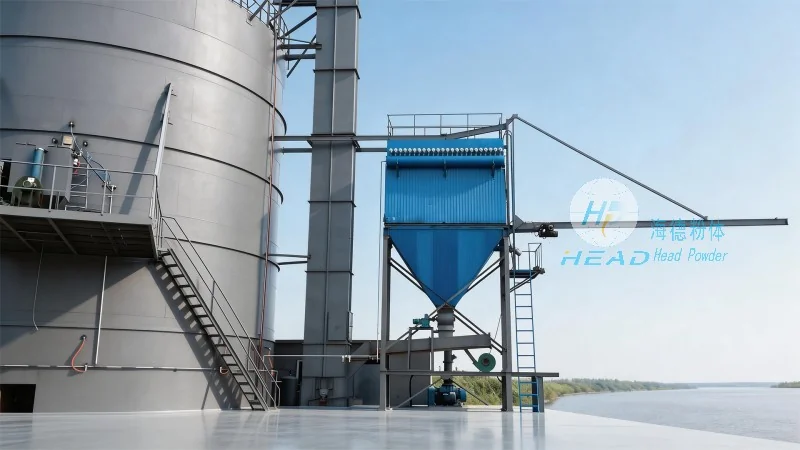
Scenario 1: Ultra-Fine Talc from Multiple Grinding Mills to Blending Silos In this setup, several pin mills or jet mills produce separate streams of ultra-fine talc (d97 < 15 μm). Each mill discharges into a dedicated surge hopper, from which dense-phase pneumatic conveying transports the powder to a central blending silo. The conveying distance is typically 50–150 m, with a capacity of 5–10 t/h per line. To prevent particle attrition, conveying velocity is kept below 6 m/s. headpowder's solution uses a patented "soft-start" air injection sequence that gradually pressurizes the line, reducing shock and potential particle degradation. A typical installation at a major Asian talc processor achieved a 30% reduction in energy consumption compared to their previous dilute-phase system, while maintaining identical throughput and particle size distribution.
Scenario 2: Coarse Talc (200–400 mesh) from Dry Grinding to Packaging For coarser grades, dilute-phase conveying can be economically viable over short distances (under 80 m). However, headpowder still recommends a hybrid low-velocity mode to minimize dust generation. In this configuration, a positive displacement blower delivers air at 0.8–1.2 bar, and the pipeline is fitted with gradual expansions to control velocity. The bag filter is sized with a higher can velocity (2–3 m/min) to handle the larger particle carryover. One client in the rubber industry replaced their screw conveyor system with headpowder's pneumatic solution and reported a 40% drop in spillage and a 25% increase in packing speed due to smoother material flow.
Scenario 3: Talc Slurry or Wet-Caking Material Handling Although rare, some talc operations involve moisture content above 1.5%, leading to caking and flow problems. For such cases, headpowder integrates a heated air drying unit into the pneumatic conveying line. The air is preheated to 60–80°C to reduce residual moisture to below 0.3% during transport. Additionally, a special blow-tank design with a fluidized bottom ensures that even cohesive talc is entrained into the airstream without bridging. This solution has been deployed in European talc processing plants handling damp tailings, with consistent uptime exceeding 97%.
When evaluating a talc powder pneumatic conveying equipment system solution, key performance indicators include:
From an economic standpoint, the total cost of ownership includes initial capital expenditure (CAPEX), operating expenses (OPEX), and maintenance. While dense-phase systems have higher upfront costs due to the air compressor and specialized valves, the savings in energy, reduced filter replacement frequency, and lower product loss often yield a payback period of less than 18 months for capacities above 5 t/h. Additionally, automation reduces labor requirements—many headpowder systems operate with one part-time attendant per shift.
A successful talc pneumatic conveying project extends beyond hardware delivery. headpowder follows a systematic installation and commissioning protocol:
After commissioning, headpowder offers a remote monitoring service subscription. Data from pressure transmitters, motor current, and filter differential pressure are continuously analyzed. When anomalies are detected—such as gradual rise in pipeline backpressure indicating an incipient blockage—the system automatically adjusts air injection or alerts the operator via SMS or email. This predictive maintenance approach has been shown to reduce unscheduled downtime by 60% among existing clients.
Talc powder pneumatic conveying is a specialized field where generic solutions often fail to deliver acceptable performance. The subtle interplay between particle morphology, moisture sensitivity, and process requirements demands a deep level of engineering customization. By focusing on dense-phase technology, proper component selection, and intelligent control, headpowder has built a portfolio of reference installations that span from small-scale cosmetic talc processors to large mining operations with throughputs exceeding 50 t/h. Each system is designed with the end-user's total cost of ownership in mind, balancing capital efficiency with operational reliability. Whether you are modernizing an existing plant or building a greenfield facility, engaging an experienced partner early in the design phase can make the difference between a system that merely conveys and one that adds competitive advantage. For more information or to discuss your specific talc handling challenge, contact headpowder today (咨询热线:156-6277-7102) and request a preliminary feasibility study—your powder deserves a system that respects its unique nature.

 Shandong headpowder Engineering Co., Ltd.
 156-6277-7102(Manager Zhang)
  0531-83386006
  Jinan City, Shandong Province, China
服务热线
微信咨询
回到顶部