News
Rich project cases across industries, showing real implementation and proven technical strength.Calcium hydroxide powder, commonly known as hydrated lime, is a fine, dry, and highly reactive material widely used in water treatment, flue gas desulfurization, construction, chemical processing, and soil stabilization. Its unique physical properties—low bulk density, high surface area, and tendency to fluidize unpredictably—make pneumatic conveying the preferred method for efficient, dust-free, and reliable material transport. This guide provides a comprehensive, technically rigorous overview of calcium hydroxide powder pneumatic conveying systems, covering system architecture, component selection, operational parameters, common challenges, and forward-looking trends through 2026. Designed for engineers, plant managers, and procurement professionals, the content emphasizes real-world applicability, regulatory compliance, and measurable performance improvements. The goal is to equip decision-makers with actionable knowledge to optimize their conveying operations, reduce downtime, and maintain product quality—all while aligning with evolving environmental standards. As a specialized pneumatic conveying system provider, headpowder (consultation hotline: 156-6277-7102) has accumulated extensive field experience in handling calcium hydroxide powder across multiple industries. The insights shared here draw from that expertise, offering a balance of theoretical foundations and practical solutions.
Before designing any pneumatic conveying system, a deep understanding of the conveyed material is essential. Calcium hydroxide powder typically exhibits a bulk density ranging from 0.4 to 0.7 g/cm³, a particle size distribution of 1–50 microns, and a moisture content below 1% in commercial grades. Its hygroscopic nature means it readily absorbs atmospheric moisture, leading to caking, agglomeration, and flowability issues if not handled under controlled conditions. The powder also has a moderately abrasive character due to the crystalline structure of calcium hydroxide, which can cause wear on pipe bends and conveying components over time. Additionally, the material's electrostatic charging tendency during pneumatic transport can lead to blockages or inconsistent flow. These characteristics dictate key design decisions: dense-phase or dilute-phase conveying, air velocity ranges, pipeline material selection, and filter media specifications. For example, excessive air velocity in dilute-phase systems can cause particle attrition, generating fines that compromise downstream processes. Conversely, too low a velocity in dense-phase systems may result in plugging. Understanding these nuances allows engineers to tailor a system that balances energy efficiency, capacity, and product integrity.
Two primary pneumatic conveying modes are employed for calcium hydroxide powder: dilute-phase (suspension flow) and dense-phase (plug flow). Each has distinct advantages and limitations depending on the application.
In dilute-phase systems, the powder is suspended in a high-velocity airstream (typically 15–25 m/s) and transported through pipelines at low pressure (up to 1 bar). This method is simple, low-cost, and suitable for short distances (under 100 meters) and moderate capacities (up to 10 tons per hour). However, the high velocity accelerates pipe wear and can degrade the calcium hydroxide particles, leading to dust generation and reduced reactivity. For applications where particle preservation is critical—such as in pharmaceutical or fine chemical processes—dilute-phase may not be ideal. Nevertheless, for bulk storage-to-process feeding in water treatment plants, it remains a common choice due to its straightforward control and lower capital investment.
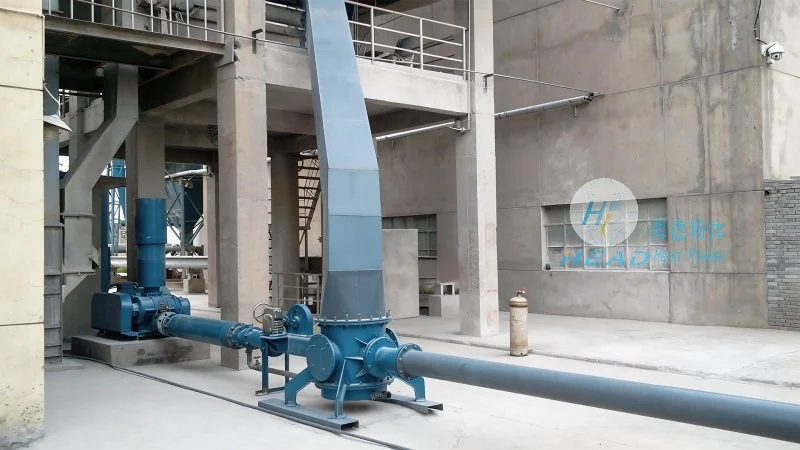
Dense-phase systems operate at higher air pressures (2–6 bar) and lower velocities (3–8 m/s), pushing the material as discrete plugs or slugs through the pipeline. This approach dramatically reduces particle attrition and pipeline erosion, making it preferable for fragile, abrasive, or hygroscopic powders like calcium hydroxide. Dense-phase conveying can handle longer distances (up to 500 meters or more) and higher capacities (exceeding 20 tons per hour). It also consumes less air per ton of material, lowering energy costs and filter loading. The trade-off includes more complex control systems, higher initial investment, and the need for specialized airlock feeders (e.g., rotary valves or screw feeders) capable of maintaining pressure differentials. For most industrial calcium hydroxide applications—especially those requiring consistent product quality and low maintenance—dense-phase conveying is the recommended architecture.
A reliable pneumatic conveying system for calcium hydroxide powder integrates several critical components, each requiring careful specification based on material properties and operational demands.
The air compressor or blower must deliver clean, dry, and oil-free compressed air. Moisture in the air accelerates caking and corrosion, while oil contamination can alter the chemical reactivity of calcium hydroxide. Desiccant dryers and coalescing filters are standard. For dense-phase systems, a pressure vessel or blow tank is used to batch the powder and inject it into the pipeline with controlled air pulses. The air velocity must be precisely regulated—typically via pressure sensors and variable frequency drives—to maintain stable plug flow without surging.
Rotary airlock valves are the most common feeding devices for calcium hydroxide powder. They provide a continuous, metered feed while minimizing air leakage. However, the fine particle size and abrasive nature of calcium hydroxide require valve designs with hardened rotor tips, close clearances, and venting ports to prevent air blowback. Screw feeders with variable speed control are an alternative for high-accuracy feeding, especially in dense-phase systems. The feed system must also include aeration pads or fluidizing nozzles in the hopper discharge to prevent bridging and rat-holing.
Pipeline routing should minimize bends, especially 90-degree elbows, which are primary wear points. Long-radius bends (at least 5–10 times the pipe diameter) or wear-resistant ceramic-lined bends extend service life significantly. The pipe material itself is typically carbon steel for economic reasons, but stainless steel (304 or 316L) is recommended when product purity or moisture sensitivity is critical. Pipe diameter is calculated to maintain the appropriate conveying velocity: for dilute-phase, the diameter is smaller to sustain high velocities; for dense-phase, larger diameters lower the velocity and reduce back pressure. Typical diameters range from DN50 to DN150 for medium-scale systems.
At the destination, the calcium hydroxide powder must be separated from the conveying air. Cyclone separators are used for bulk collection, achieving 95–99% separation efficiency, followed by baghouse filters or cartridge filters for fine dust capture. The filter media should be selected with a surface treatment (e.g., PTFE membrane) to prevent blinding caused by the hygroscopic and adhesive nature of calcium hydroxide dust. Pulse-jet cleaning systems with adjustable intervals keep the filter bags operational. The exhaust air must meet local environmental regulations, typically limiting particulate emissions to below 10 mg/Nm³.
Field experience with calcium hydroxide pneumatic conveying reveals several recurring issues that can disrupt production and escalate costs.
Plugging often occurs when moisture enters the system, causing the powder to cake and stick to pipe walls. Solutions include upstream drying of compressed air, maintaining a slight positive pressure in hoppers to prevent humid air ingress, and installing pipe tracing or insulation in humid climates. Additionally, using a dense-phase control algorithm with adaptive pulse timing can clear incipient plugs before they become solid.
Despite calcium hydroxide being moderately abrasive, continuous high-velocity conveying can erode carbon steel pipes, especially at bends. Implementing replaceable wear backs at critical points, using ceramic-lined elbows, and scheduling routine thickness inspections can extend system life. In dense-phase systems, wear is naturally lower due to reduced velocity, but the receiving vessel and cyclones still require abrasion-resistant linings.
Variations in powder bulk density caused by changes in production batch or moisture content can lead to fluctuating conveying rates. Employing a loss-in-weight feeder or a mass flow meter downstream provides real-time feedback for automatic air pressure adjustment. Headpowder’s proprietary control system integrates these sensors into a closed-loop algorithm that stabilizes flow regardless of material variability, ensuring consistent delivery to downstream processes.
As environmental regulations tighten globally, pneumatic conveying systems for calcium hydroxide must comply with standards such as ISO 8573-1 for compressed air quality, ATEX directives for explosive atmospheres (calcium hydroxide dust can form explosive mixtures above 30 g/m³), and local emission limits. By 2026, the trend points toward stricter emission thresholds (sub-5 mg/Nm³) and mandatory energy recovery systems for large-scale installations. Additionally, the European Union’s Industrial Emissions Directive (IED) and similar frameworks in North America and Asia are pushing for real-time monitoring of dust concentrations and energy consumption. Designing a system with these future requirements in mind—such as incorporating variable frequency drives, high-efficiency filter bags, and automated reporting modules—reduces the need for costly retrofits.
To assist in system selection, the following criteria should be evaluated:
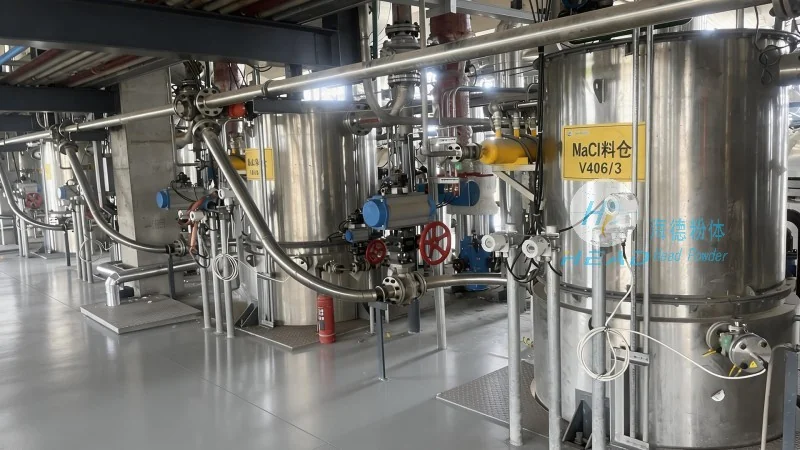
In a recent deployment by headpowder, a municipal water treatment facility processing 50,000 m³/day switched from dilute-phase to dense-phase conveying for its calcium hydroxide powder feed. The original system suffered from frequent blockages, high dust emissions, and annual pipe replacement costs of $18,000. After replacing the system with a dense-phase solution featuring a pressure vessel feeder, ceramic-lined bends, and adaptive pulse control, the plant achieved 99.2% system availability (up from 87%), reduced energy consumption by 32%, and eliminated dust leaks. The payback period was 18 months, and the plant successfully met upcoming local emission standards. This case illustrates how a well-designed pneumatic conveying system not only resolves operational pain points but also delivers measurable financial and environmental benefits.
Looking ahead, several advancements will shape calcium hydroxide powder conveying. The integration of Industrial Internet of Things (IIoT) sensors will enable predictive maintenance by tracking pipe wear, filter pressure drop, and air consumption in real time. Machine learning algorithms will optimize conveying parameters automatically, adapting to material batch variations without human intervention. Furthermore, modular, skid-mounted conveying units are gaining popularity for their ease of installation and scalability. headpowder is actively developing a next-generation smart conveying platform that includes self-diagnostic capabilities and remote monitoring dashboards, allowing operators to manage multiple sites from a central location. Sustainability also drives innovation: low-energy blowers (e.g., screw compressors with variable speed) and energy recovery systems that capture and reuse compressed air expander power are becoming cost-effective as electricity prices rise.
Calcium hydroxide powder conveying via pneumatic systems is a mature yet evolving technology. The choice between dilute-phase and dense-phase architectures hinges on a thorough evaluation of material characteristics, throughput requirements, regulatory constraints, and long-term operational goals. By prioritizing robust component selection, moisture control, and adaptive control logic, plant engineers can achieve reliable, efficient, and safe transport of this challenging powder. The investment in a properly designed system pays dividends through reduced downtime, lower maintenance, consistent product quality, and compliance with increasingly stringent environmental standards. For professionals seeking expert guidance or customized solutions, collaborating with an experienced provider like headpowder ensures that every detail—from pipe sizing to filter selection—is optimized for the specific application. As the industry moves toward smarter, greener, and more resilient systems, staying informed and proactive will be the key to maintaining a competitive edge in the production and utilization of calcium hydroxide powder.

 Shandong headpowder Engineering Co., Ltd.
 156-6277-7102(Manager Zhang)
  0531-83386006
  Jinan City, Shandong Province, China
服务热线
微信咨询
回到顶部