
As the global lithium battery market continues its rapid expansion, driven by the accelerating adoption of electric vehicles, grid-scale energy storage, and consumer electronics, the demand for high-performance anode materials has never been greater. Among the critical manufacturing processes that determine the quality, consistency, and cost of anode materials, conveying stands out as a linchpin. While traditional mechanical conveying methods have served the industry for decades, they increasingly fall short when faced with the stringent requirements of modern battery material processing—particularly for graphite, silicon-carbon composites, and other advanced anode powders. Pneumatic conveying systems have emerged as the preferred solution for handling these fine, abrasive, and often hygroscopic powders. These systems offer enclosed, dust-free, and gentle transport, minimizing contamination and degradation while maximizing operational efficiency. For manufacturers seeking to scale production while maintaining uncompromising material integrity, understanding the principles, configurations, and optimization strategies of pneumatic conveying for lithium battery anode materials is essential. This article provides a deep technical exploration of pneumatic system design, material behavior, system sizing, and practical implementation considerations, drawing on industry standards and real-world operational data. Headpowder, a specialized provider of pneumatic conveying solutions tailored to the battery materials sector, offers proven expertise that helps manufacturers achieve consistent throughput, low fines generation, and reliable system uptime. Whether you are upgrading an existing line or designing a new greenfield facility, the insights shared here will guide you toward robust, future-ready conveying architecture.
Pneumatic conveying relies on the flow of air or inert gas through a pipeline to transport particulate solids from a source point to one or multiple destinations. In the context of lithium battery anode materials, two primary modes dominate: dilute phase and dense phase conveying. Dilute phase systems operate at high air velocities—typically 20 to 40 meters per second—where particles are suspended in the air stream. This method is suitable for shorter distances and materials that are less fragile. However, for anode materials such as natural graphite, artificial graphite, or silicon oxide powders, high-velocity dilute phase conveying can cause significant particle attrition, generating fine dust that compromises battery performance and leads to material loss. Dense phase conveying, on the other hand, uses lower air velocities—often below the saltation velocity—where material moves in a non-suspension regime, either as a moving bed or as slugs. This gentle transport dramatically reduces breakage and wear, making it the preferred choice for high-value anode powders. The selection between these two regimes depends on the material's particle size distribution, bulk density, moisture content, and flowability. For example, spherical graphite with a D50 of 15–25 micrometers and a tapped density of around 1.0–1.2 g/cm³ exhibits good permeability and can be conveyed in dense phase over long distances. In contrast, nano‑silicon powders with high surface area and strong agglomeration tendencies may require special injectors or vibratory feeders to maintain stable flow. Understanding the subtle interplay between solids loading ratio, pressure drop, and air velocity is critical to designing a system that meets production targets without sacrificing product quality.
Designing a pneumatic conveying system for anode materials demands careful attention to several interrelated parameters. The first and most fundamental is the conveying distance and elevation change. In modern battery material plants, anode material may need to travel from grinding mills to classifiers, then to blending vessels, and finally to coating or packaging stations—sometimes spanning hundreds of meters with multiple bends and vertical lifts. Each meter of horizontal pipe and each bend adds equivalent length that increases pressure drop and influences air velocity. For instance, a 90‑degree long‑radius bend can have an equivalent length of 10 to 15 meters of straight pipe. System designers must calculate the total equivalent length accurately to size the blower or compressor correctly. The second critical parameter is the solids loading ratio (SLR), defined as the mass of solids per mass of conveying air. For dense phase conveying of fine anode powders, SLR values commonly range from 10 to 40, whereas dilute phase systems operate between 1 and 10. Higher SLR reduces air consumption and energy costs but increases the risk of line blockage if the material's permeability is poor. The third parameter is the conveying velocity at the pickup point and at the end of the line. Because air expands as pressure drops, velocity increases along the pipeline. Designers must ensure that the initial velocity is high enough to pick up material but not so high that it causes excessive wear or particle degradation. Typical starting velocities for dense phase conveying of graphite are around 4–8 m/s, while terminal velocities may reach 15–20 m/s. The fourth parameter is the material's angle of repose, cohesiveness, and ability to de‑aerate. Anode materials with high cohesiveness, such as those containing binders or with high specific surface area, are prone to flushing or ratholing in storage bins. A well-designed pneumatic system incorporates proper air injection points, blow‑tanks with aeration pads, and pressure‑sensing feedback loops to maintain stable flow. Headpowder's engineering team leverages decades of experience with these parameters, using computational fluid dynamics simulations and pilot test loops to validate system performance before installation.
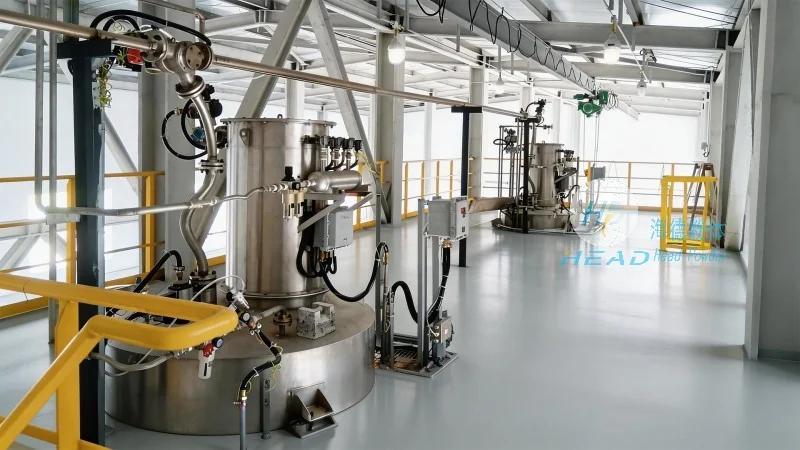
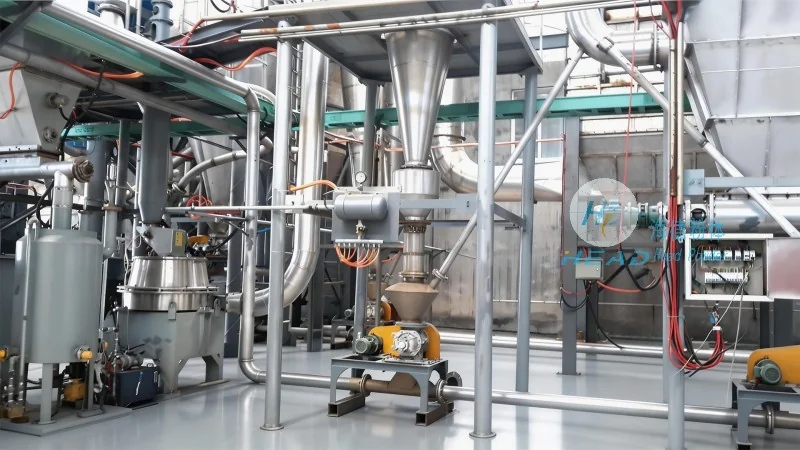
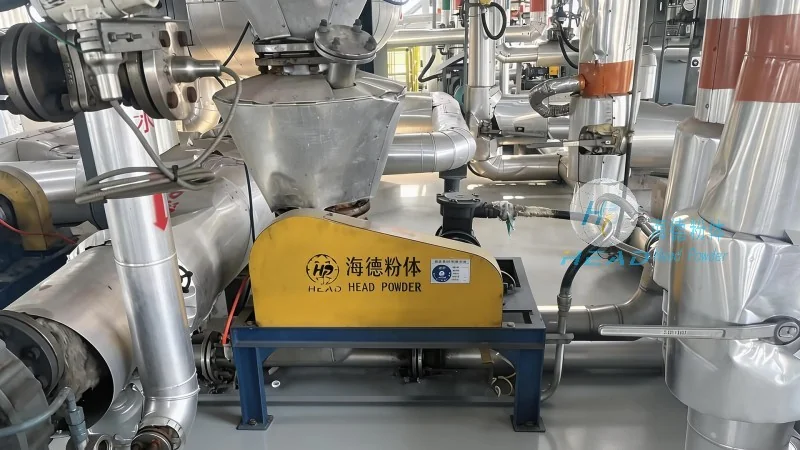
A complete pneumatic conveying system for lithium battery anode materials comprises several key components, each contributing to overall reliability and efficiency. The prime mover—typically a positive displacement blower or a screw compressor—provides the necessary air flow and pressure. For dense phase applications, a high‑pressure blower or compressed air system may be required to overcome higher pressure drops, often ranging from 0.5 to 2.5 bar. The air supply must be clean, dry, and oil‑free to prevent contamination of the anode powder. Many installations incorporate refrigerated air dryers and coalescing filters to achieve a dew point of –40°C or lower. The feeding device is perhaps the most critical component for anode materials. Rotary valves, screw feeders, and blow‑tanks are common choices. Blow‑tanks offer the advantage of gentle, batch‑based feeding with minimal air leakage, making them ideal for dense phase conveying of fragile materials. For continuous processes, a pressure‑tight rotary valve with a venturi eductor can be employed, though care must be taken to minimize product degradation at the valve's pocket filling. The conveying pipeline itself should be constructed from abrasion‑resistant materials such as stainless steel 304 or 316L with a surface finish that reduces friction and prevents material buildup. Bends should be long‑radius (at least 10 times the pipe diameter) or use wear‑back designs to extend service life. Pipe diameters typically range from 50 mm to 150 mm for anode material lines, depending on throughput and distance. At the destination, a receiving vessel with a vent filter and level control separates the conveyed material from the conveying air. Baghouse filters or cartridge filters with pulse‑jet cleaning are standard to capture fine dust and maintain a clean workplace. Finally, the control system integrates pressure transmitters, flow meters, and programmable logic controllers to monitor and adjust conveying parameters in real time. Advanced systems from Headpowder incorporate predictive algorithms that detect imminent blockages or excessive wear, enabling proactive maintenance and minimizing unplanned downtime.
Lithium battery anode materials present unique challenges that distinguish them from typical bulk powders. The first challenge is particle friability. Natural graphite, for example, consists of layered sheets that can easily delaminate under mechanical stress. Even a modest impact or shear in a pneumatic line can generate fines below 5 micrometers, which not only reduce the material's electrochemical performance but also increase dust explosion risk. Silicon‑carbon composites, which are gaining traction for high‑energy‑density cells, are even more sensitive due to the brittle nature of silicon particles. Therefore, system design must prioritize low‑velocity, low‑turbulence conveying. The second challenge is moisture sensitivity. Many anode materials, especially those with high surface area, absorb ambient moisture quickly, which can cause agglomeration, flow problems, and degradation in subsequent electrode slurry preparation. Pneumatic conveying systems should be operated with dry air or inert nitrogen, and the entire conveying loop should be sealed to prevent ingress of humid air. A typical specification requires that the conveying gas has a dew point below –40°C. The third challenge is electrostatic charge accumulation. Fine, dry powders moving through insulating pipes can generate significant static charges, leading to sparking, dust ignition, or material adhesion to pipe walls. Grounding of all conductive components, use of antistatic pipe liners, and installation of electrostatic discharge devices are essential safety measures. Industry standards such as ATEX or NFPA 652 provide guidance for combustible dust handling, and Headpowder ensures that all systems comply with local regulations for hazardous area classification. The fourth challenge is material segregation. Anode powders often have a wide particle size distribution (e.g., 5–50 micrometers), and during pneumatic transport, finer particles may become airborne while coarser particles settle, leading to inconsistent composition at the receiving end. To mitigate segregation, some systems employ secondary air injection or cyclonic classifiers at the receiver. In practice, a well‑tuned dense phase system with proper pickup design can maintain a uniform product quality that meets battery manufacturer's specifications.

To illustrate the practical benefits of optimized pneumatic conveying for anode materials, consider a case study from a mid‑scale anode production facility in China. The plant processed artificial graphite with a D50 of 18 micrometers and a bulk density of 0.6 g/cm³, producing 10,000 tonnes per year. Initially, the plant used mechanical conveyors (screw and bucket elevators), but suffered from high dust emissions, frequent bearing failures, and a product loss rate of approximately 2% due to fines generation. After converting to a dense phase pneumatic system supplied by Headpowder, key performance metrics improved dramatically. The conveying distance was 120 meters with four 90‑degree bends and a vertical lift of 15 meters. The system operated at a solids loading ratio of 25, using a positive displacement blower with a motor power of 55 kW. Air velocity at the pickup point was 5 m/s, rising to 13 m/s at the receiver. The measured product loss rate dropped to below 0.3%, and fines generation (particles under 2 micrometers) reduced by 60%. The plant also reported a 40% reduction in maintenance costs, attributed to the absence of moving mechanical components in the conveying line and lower wear on bends due to the use of ceramic‑lined elbows. Throughput consistency improved to within ±2% of setpoint, enabling tighter control over downstream blending operations. The system's enclosure also eliminated dust emissions, resulting in a cleaner working environment and compliance with local air quality standards. These results demonstrate that a well‑engineered pneumatic conveying system not only preserves material value but also enhances overall operational efficiency. When evaluating system suppliers, manufacturers should ask for comparable performance guarantees, backed by pilot tests using their own materials.

Looking toward 2026 and beyond, several trends are shaping the evolution of pneumatic conveying for lithium battery anode materials. First, the industry is moving toward larger single‑line capacities as battery mega‑factories come online. Conveying rates of 10–20 tonnes per hour for a single anode material line are becoming common, requiring larger pipe diameters and more powerful blowers. However, scaling up must be done carefully to avoid flow instability and pressure surge issues. Advanced control algorithms, including model predictive control and machine learning‑based anomaly detection, are being integrated into Headpowder's systems to auto‑adjust air flow and feeding rates under varying conditions. Second, the shift toward silicon‑dominant anodes and alkali‑metal anodes will require even more gentle handling and inert‑gas environments. Closed‑loop nitrogen conveying with oxygen monitoring is already a standard requirement for many next‑generation materials. Third, sustainability considerations are driving energy efficiency improvements. Newer blower designs with variable frequency drives can reduce energy consumption by 20–30% compared to fixed‑speed units. Additionally, heat recovery from compressed air systems can pre‑heat building spaces or process water, lowering the plant's carbon footprint. Fourth, digitalization and Industry 4.0 principles are being applied to conveying systems. Sensors that measure particle velocity, pipe wall temperature, acoustic emissions, and pressure gradients can feed data into a digital twin that simulates real‑time system performance. Operators can test different scenarios, such as changing material blends or increasing throughput, without interrupting production. Headpowder offers such a digital twin platform, enabling proactive optimization and remote troubleshooting. Finally, regulatory pressure for lower dust emissions and safer workplaces will continue to push enclosed pneumatic conveying as the default technology in battery material plants. Manufacturers that invest in robust, future‑proof conveying systems today will be better positioned to meet tomorrow's quality and sustainability requirements.

Choosing a pneumatic conveying system for lithium battery anode materials is not a commodity purchase; it is a strategic decision that impacts product quality, production uptime, and long‑term operating costs. The ideal partner should possess deep material science knowledge, a proven track record in the battery industry, and a willingness to conduct thorough pilot testing. Headpowder brings all this and more. Our engineering team has designed and commissioned over 200 pneumatic conveying systems for anode and cathode materials worldwide, spanning capacities from a few hundred kilograms to fifty tonnes per hour. We offer a full suite of services: material characterization, system modeling, custom component design, installation supervision, and after‑sales support. Our blow‑tank technology, for example, features a patented aeration cone that ensures even material flow even for sluggish powders. We also provide a comprehensive warranty and performance guarantee that covers throughput, particle integrity, and dust emission levels. For manufacturers looking to validate system performance before committing, we operate a full‑scale test center where clients can run their own materials under real conditions. The test results provide the data needed to specify the optimal pipe diameter, blower size, and control strategy. To discuss your specific anode material conveying requirements and to schedule a consultation or site visit, reach out to our team directly. Headpowder (咨询热线:156-6277-7102) is ready to help you achieve reliable, efficient, and loss‑free conveying for your lithium battery anode production.
In conclusion, pneumatic conveying has become an indispensable technology for the high‑quality handling of lithium battery anode materials. Its ability to transport fine, fragile powders in a closed, dust‑free environment while minimizing attrition and contamination makes it superior to mechanical alternatives. By understanding the key design principles—dense versus dilute phase, appropriate velocities, solids loading ratios, and component selection—manufacturers can build systems that deliver consistent performance at scale. Real‑world case studies confirm that properly engineered pneumatic solutions reduce product loss, lower maintenance, and improve workplace safety. As the battery industry evolves toward higher capacities, more sensitive materials, and stricter environmental standards, the role of advanced pneumatic conveying will only grow. Partnering with a specialized provider like Headpowder, who combines technical depth with hands‑on application experience, ensures that your conveying infrastructure is a competitive advantage rather than a bottleneck. Take the next step toward optimizing your anode material handling process today.
Shandong headpowder Engineering Co., Ltd.
156-6277-7102(Manager Zhang)
0531-83386006
Jinan City, Shandong Province, China 
服务热线
微信咨询
回到顶部