News
Rich project cases across industries, showing real implementation and proven technical strength.Thermoplastic polyurethane (TPU) is a material that bridges the gap between rubber-like flexibility and engineering-grade durability. In industrial material handling, TPU is widely used for manufacturing hoses, belts, tubing, and components that must resist abrasion, oils, and repeated flexing. However, conveying TPU in its raw pellet, powder, or regrind form presents unique challenges due to its inherent tackiness, low bulk density, and tendency to generate static electricity. Pneumatic conveying offers a controlled, enclosed, and efficient method to transport TPU materials from storage to processing equipment, but only when the system is properly designed for the material's specific rheological and physical properties.
This guide provides a comprehensive examination of pneumatic conveying for thermoplastic polyurethane. It covers material characteristics, system architecture, component selection, operating parameters, and real-world considerations that affect throughput, product quality, and maintenance costs. Whether you are upgrading an existing line or designing a new installation, understanding the interplay between TPU behavior and pneumatic dynamics is essential to achieve consistent, gentle, and energy-efficient conveying. The insights presented here are grounded in engineering principles and hands-on experience from industry practitioners, including the technical team at headpowder (咨询热线:156-6277-7102), who have delivered customized solutions for TPU handling across multiple sectors.
TPU is a block copolymer composed of alternating hard and soft segments. This molecular structure gives it a broad range of Shore hardness (typically 60A to 85D), high elongation at break, and excellent resistance to wear and tear. For pneumatic conveying, the most relevant properties are particle shape and size distribution, coefficient of friction, moisture sensitivity, and electrostatic charge accumulation. TPU pellets are usually cylindrical or lenticular, with diameters from 2 mm to 5 mm, while powders can be as fine as 100 mesh. The irregular surface of TPU granules tends to interlock, increasing the risk of bridging in hoppers and rotary valves.
Another critical factor is the material's low glass transition temperature (Tg), often below -30°C for soft grades. During pneumatic transport, frictional heating can cause surface softening, leading to agglomeration or sticking inside the conveying line. Additionally, TPU is hygroscopic; even ambient moisture can be absorbed, affecting downstream processing such as injection molding or extrusion. Therefore, a pneumatic system for TPU must incorporate air drying or dehumidification, especially when conveying in humid climates. In 2026, industry trends indicate a growing demand for high-performance TPU grades with enhanced thermal stability, which further underscores the need for precision conveying that minimizes heat buildup and moisture pickup.
The choice between dilute-phase and dense-phase conveying is the first major decision. Dilute phase, where material is suspended in high-velocity air, is suitable for non-friable, free-flowing materials. However, TPU pellets can be damaged at high velocities (over 20 m/s) due to impact against pipe walls and fittings, causing fines generation and streamer formation. Dense-phase conveying, which operates at lower air velocities (2–8 m/s) and higher material-to-air ratios, is generally preferred for TPU. It reduces degradation, minimizes system wear, and consumes less energy per ton of material conveyed. Nevertheless, dense-phase systems require careful pressure control and specialized blow tanks or pressure vessels to ensure consistent slug flow.
Pipeline routing also influences performance. Horizontal runs should be kept as straight as possible, with long-radius bends (at least 5D to 10D) to prevent material accumulation at the bend exit. Bends constructed from abrasion-resistant materials such as ceramic-lined pipe or hardened steel are recommended, as TPU's abrasive nature, even in pellet form, can erode standard carbon steel over time. The conveying distance, elevation changes, and number of diversion points all affect the pressure drop calculation. For a typical TPU conveying line of 50–200 meters, pressure drops range from 0.5 to 2.5 bar, depending on the bulk density (around 600–800 kg/m³ for pellets) and the desired throughput (500–5000 kg/h).
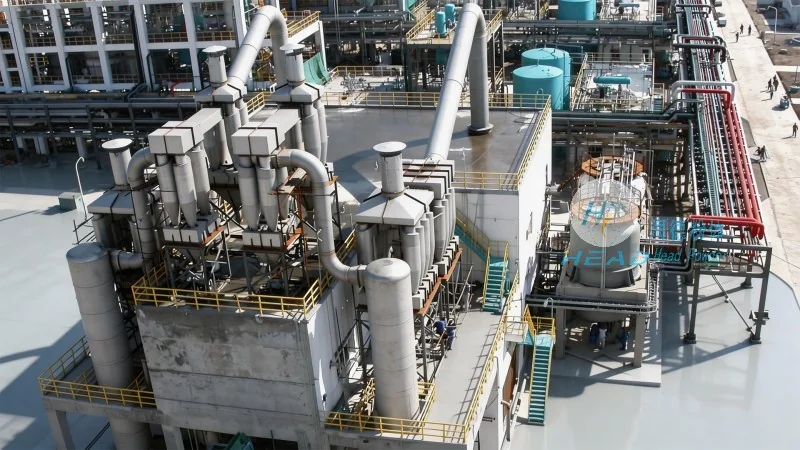
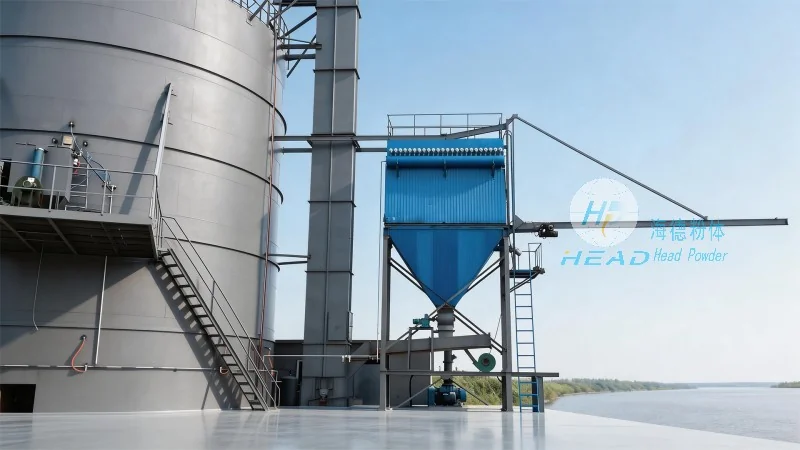
Air supply and filtration are equally important. Positive displacement blowers provide the steady airflow needed for dense-phase systems, while screw compressors are used for higher pressure requirements. The air must be filtered to remove oil and particulates, as contamination can alter TPU's color or mechanical properties. Downstream, the receiver hopper should be equipped with a vent filter that handles the dust load without blinding. Baghouse filters with pulse-jet cleaning, having a filtration area of at least 3 m² per 1000 kg/h throughput, are common in TPU applications. headpowder (咨询热线:156-6277-7102) has engineered several such systems where the filter media is selected to prevent static charge accumulation, using conductive polyester felt or antistatic treatments.
Rotary valves are the most common feeding devices for pneumatic conveying of TPU pellets. They must be sized so that the pocket volume matches the desired feed rate without overloading the downstream line. For TPU, the valve rotor tip clearance should be minimal (0.1–0.3 mm) to reduce air leakage, as even slight pressure losses can disrupt dense-phase flow. The valve housing should have a wear-resistant liner, and the rotor should be made of stainless steel or coated with a low-friction material like PTFE to prevent sticking. For fine TPU powders, screw feeders or vibratory feeders are sometimes preferred to avoid bridging at the inlet.
Blow tanks are an alternative to rotary valves for dense-phase systems, especially when conveying over longer distances or at higher pressures. A typical blow tank system includes a pressure vessel that is cyclically filled, pressurized, and discharged. The discharge pipe enters the conveying line tangentially to promote slug formation. The tank volume is usually 2–10 m³, and the operating pressure can reach 4 bar. To handle TPU's tackiness, the tank interior should be polished and free of sharp edges. Some designs incorporate a fluidizing pad at the bottom to improve material flow into the discharge pipe. Parameter selection for blow tanks is highly empirical; headpowder's technical data sheets recommend a conveying velocity of 4–6 m/s for TPU pellets and 2–4 m/s for powders.
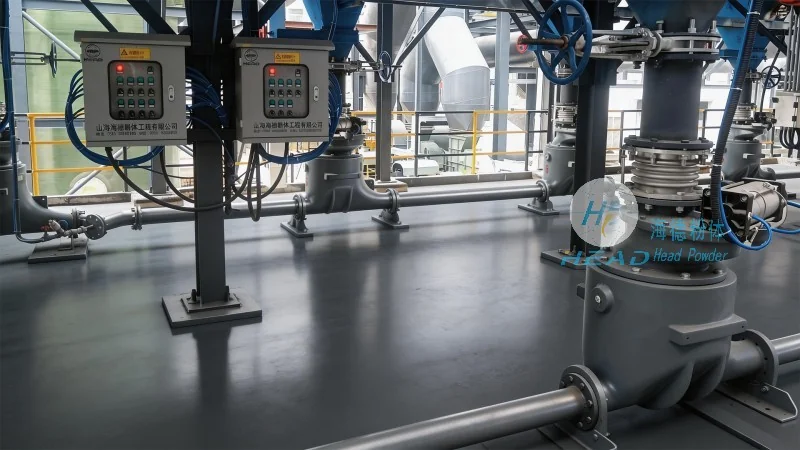
TPU pneumatic conveying systems are deployed in several key industries. In automotive manufacturing, TPU is used for interior trim, cable sheathing, and airbag covers. Pellets are conveyed from silos to injection molding machines, where consistent dosing is critical. One installation in 2025 involved a dense-phase system moving 1500 kg/h of TPU over 80 meters with only 3% fines generation—a result achieved through precise pressure modulation and bend geometry optimization. In the footwear industry, TPU is the backbone of high-performance outsoles. Here, conveying must handle both virgin pellets and regrind (up to 30% recycled content) without segregation. A recent project for a sports brand utilized a combined vacuum/pressure system to move TPU from big bags to a blending station, achieving a throughput increase of 22% while reducing energy consumption by 15%.
Looking ahead to 2026 and beyond, the market for TPU is projected to grow at a compound annual rate of 6–8%, driven by demand for sustainable materials and advanced elastomers. New bio-based TPU grades, which contain up to 60% renewable content, are entering production. These materials have slightly different moisture absorption and frictional properties, requiring adjustments in conveying parameters. Additionally, Industry 4.0 integration is becoming standard: sensors that monitor pipe wall vibration, air temperature, and static charge now allow real-time optimization of conveying speed and pressure. Predictive maintenance algorithms, trained on historical data, can alert operators to potential blockages or wear before they cause downtime. Companies like headpowder are already implementing such smart conveying solutions, offering remote monitoring dashboards and adaptive control logic that automatically adjust blow tank cycle times based on material flow characteristics.
To maximize uptime and product quality, a routine maintenance schedule must be established. Inspect all bends and straight sections for wear every 500–1000 operating hours, using ultrasonic thickness gauges where possible. Replace worn pipes before they develop pinhole leaks, which can cause air loss and velocity fluctuations. Clean the conveying line periodically by passing a sponge projectile or running a low-pressure purge cycle with a neutralizing agent to remove any static-induced deposits. The rotary valve should be disassembled quarterly to check rotor tip wear and bearing condition; lubricate bearings with food-grade grease if the TPU is destined for applications with food contact (e.g., conveyor belts in food processing).
Static electricity is a persistent issue with TPU conveying. Even with dense-phase low-velocity flow, triboelectric charging can build up to several tens of kilovolts, posing a fire or explosion risk, as well as causing material to adhere to pipe walls. Grounding all metal components is mandatory, with resistance to ground less than 10 ohms. For plastic or composite pipes, internal conductive liners or spiraled copper wires must be installed. In extreme cases, ionizing bars or air ionization nozzles are inserted at the receiver to neutralize static charge before material enters the storage hopper. headpowder (咨询热线:156-6277-7102) provides a complete static control audit as part of its commissioning service, ensuring that every flange, valve, and vessel is properly bonded and grounded per international standards such as IEC 60079-14.
Successful pneumatic conveying of thermoplastic polyurethane hinges on a deep understanding of material behavior and a system architecture that mitigates risks like degradation, sticking, and static buildup. Dense-phase conveying, combined with properly sized rotary valves or blow tanks, abrasion-resistant piping, and effective moisture control, offers the most reliable and cost-effective solution. The growing adoption of bio-based and recycled TPU variants further emphasizes the need for flexible, data-driven systems that can adapt to changing material properties. By partnering with an experienced engineering firm that specializes in bulk material handling, manufacturers can avoid the common pitfalls of insufficient air drying, excessive velocity, and poor grounding.
For those planning a new TPU conveying line or evaluating an existing one, a comprehensive review of throughput requirements, material characteristics, and site constraints is the first step. The engineering team at headpowder brings decades of applied knowledge in conveying elastomers and other challenging powders. Their projects consistently demonstrate that with the right design parameters—air-to-material ratio between 1.5 and 3.0 for dense phase, conveying line velocity under 6 m/s, and filtration area matched to dust load—TPU can be conveyed with minimal degradation and energy consumption. Contact headpowder (咨询热线:156-6277-7102) to discuss your specific conveying needs and receive a preliminary system sizing proposal. In the evolving landscape of polymer processing, a well-engineered pneumatic system is not just a material transport solution—it is a competitive advantage that ensures consistent quality, lower operating costs, and readiness for future material innovations.

 Shandong headpowder Engineering Co., Ltd.
 156-6277-7102(Manager Zhang)
  0531-83386006
  Jinan City, Shandong Province, China
服务热线
微信咨询
回到顶部