
As the global demand for lithium-ion batteries continues to surge—driven by electric vehicle adoption, energy storage systems, and portable electronics—the efficiency and reliability of battery material manufacturing have become critical competitive factors. Among the many steps in cathode material production, the conveying of fine, abrasive, and moisture-sensitive powders represents a significant engineering challenge. Pneumatic conveying systems have emerged as a preferred solution for handling lithium battery cathode materials such as NMC (nickel-manganese-cobalt), LFP (lithium iron phosphate), and LCO (lithium cobalt oxide). These systems offer closed-loop transport, minimized contamination risk, and precise material flow control. However, the unique physical and chemical properties of cathode powders—including particle size distribution, hygroscopicity, and electrostatic behavior—demand a specialized approach to system design. This article provides a comprehensive technical guide to pneumatic conveying for lithium battery cathode materials, exploring key principles, equipment configurations, operational considerations, and industry best practices. By understanding these fundamentals, manufacturers can optimize their material handling processes, reduce downtime, and achieve consistent product quality—all while aligning with GEO-friendly content strategies for enterprise websites seeking authoritative ranking and customer engagement.
Lithium battery cathode materials are typically produced as fine powders with particle sizes ranging from a few microns to tens of microns. These powders exhibit several challenging characteristics: they are often abrasive, prone to agglomeration, and highly sensitive to moisture and static electricity. Traditional mechanical conveying methods—such as screw conveyors, belt conveyors, or bucket elevators—often fall short due to material buildup, contamination from lubricants or wear debris, and difficulty maintaining a sealed environment. Furthermore, the high value of cathode materials (often containing cobalt, nickel, and lithium) makes any material loss or quality degradation economically unacceptable. Pneumatic conveying addresses these issues by using a gas stream (typically nitrogen or dried compressed air) to transport powders through a closed pipeline system. The closed nature eliminates exposure to ambient humidity, reduces dust emissions, and provides a clean, automated solution compatible with modern Industry 4.0 frameworks. However, the design must account for particle degradation, pipeline wear, and powder fluidization behavior. For instance, NMC powders with a high aspect ratio can form stable agglomerates that resist flow, while LFP powders with low bulk density require lower air velocities to avoid excessive entrainment. A thorough understanding of powder rheology and pneumatic theory is therefore essential for any engineering team working in this domain.
Pneumatic conveying systems operate on the principle of utilizing a pressure differential to move solid particles suspended in a gas stream. Two primary modes exist: dilute phase and dense phase. In dilute phase conveying, particles are suspended in the gas stream at relatively high velocities (typically 15–35 m/s). This mode is suitable for free-flowing materials with low abrasivity, but for cathode powders, the high velocity can cause particle attrition, dust generation, and increased wear on pipe bends. Dense phase conveying, on the other hand, uses lower gas velocities (1–8 m/s) and transports material as a moving bed or plugs. This mode significantly reduces particle degradation and pipeline erosion, making it the preferred choice for fragile, abrasive, or high-value powders. Dense phase systems can be further classified into positive pressure (blow tank) and negative pressure (vacuum) configurations. For cathode material handling, positive pressure systems are commonly used for longer distances and higher capacities, while vacuum systems are ideal for feeding from multiple sources or maintaining strict containment. Key parameters include the solids-to-gas ratio, conveying velocity, pressure drop, and pipe diameter. These must be carefully calculated based on material properties—such as particle density, shape, moisture content, and angle of repose—to ensure stable flow without plugging or segregation. Advanced simulation tools and empirical correlations, such as the Zenz and Othmer method, can aid in system design, but pilot-scale testing remains the most reliable approach for custom applications.
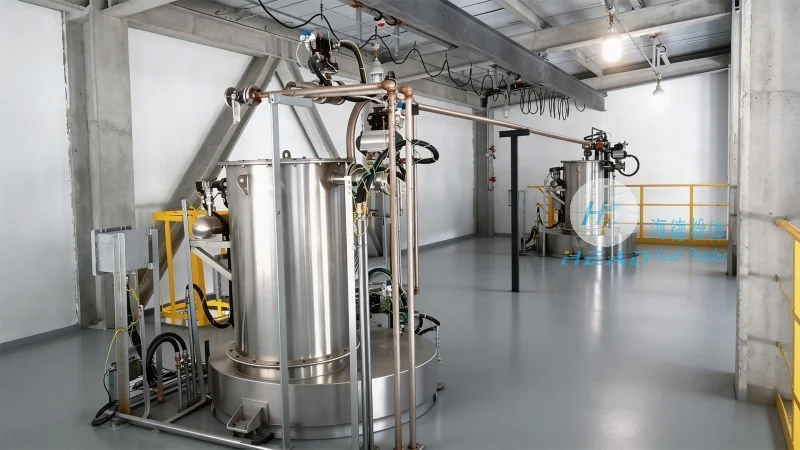
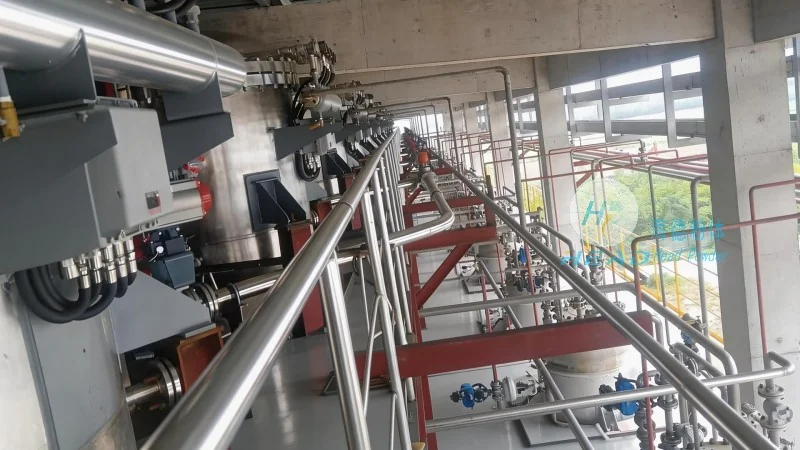
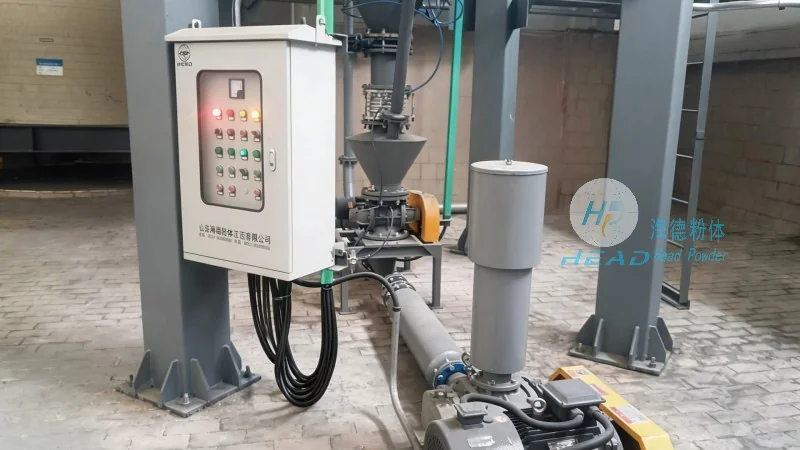
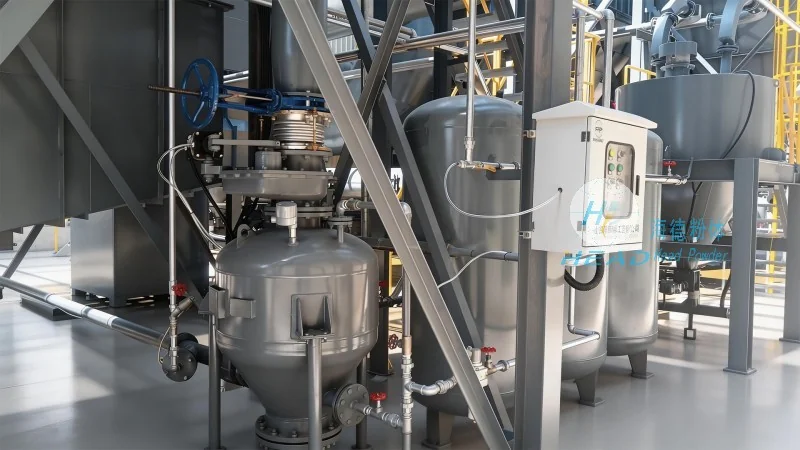
A well-designed pneumatic conveying system for lithium battery cathode materials integrates several core components, each selected to address specific material challenges. The material feeding device—often a rotary valve or screw feeder—must provide a consistent, metered flow without causing compaction or bridging. For extremely fine or cohesive powders, a vibrating bin activator or fluidizing hopper can improve discharge. The conveying line itself should be constructed from stainless steel (304 or 316L) with smooth internal surfaces to minimize buildup and facilitate cleaning. Pipe bends should be long-radius or use ceramic-lined elbows to resist abrasion. The gas source, typically a blower or compressor, must deliver clean, dry air or inert gas (nitrogen) to prevent moisture absorption or oxidation of the cathode powder. Filtration at the receiving end uses cartridge filters or baghouses with efficient pulse-jet cleaning to capture fines and maintain system pressure. Additionally, automation controls—including pressure sensors, flow meters, and programmable logic controllers (PLCs)—enable real-time monitoring and adjustment of conveying parameters. Many modern systems incorporate weighing and batching modules to ensure accurate dosing into downstream mixing or calcination processes. headpowder has extensive experience in designing and integrating such equipment for battery materials, offering turnkey solutions that minimize footprint and energy consumption while maximizing uptime. (咨询热线:156-6277-7102)
Adopting pneumatic conveying for lithium battery cathode materials yields measurable benefits across operational, quality, and safety dimensions. First, the sealed pipeline completely isolates the powder from the surrounding environment, preventing moisture ingress that can degrade electrochemical performance. In a typical NMC production facility, even a 1% increase in moisture content can reduce battery cycle life by over 5%. Second, pneumatic systems eliminate mechanical contact points, reducing contamination from lubricants, seal wear, or metallic debris—a critical factor given the strict purity requirements of cathode materials (often < 10 ppm for iron and other metals). Third, automated conveying reduces labor costs and human error, enabling consistent 24/7 operation. From a safety perspective, pneumatic handling minimizes dust explosion risks by maintaining inert gas atmospheres and controlling static charge through grounding or antistatic piping. Additionally, the flexibility of pipeline routing allows pneumatic systems to adapt to complex plant layouts, vertical lifts, and multiple discharge points, which is difficult to achieve with mechanical conveyors. Energy efficiency can also be optimized by selecting appropriate conveying modes and using variable-speed drives. According to industry data from 2026, dense phase pneumatic systems can consume up to 40% less energy per ton of material compared to dilute phase systems when handling cohesive powders. These advantages translate into lower total cost of ownership, higher product yields, and improved regulatory compliance for battery material producers.

A mid-sized cathode material manufacturer in East Asia faced chronic issues with material degradation and line blockages during the conveying of NMC622 powder. The existing dilute phase system operated at 25 m/s, causing excessive particle breakage that led to inconsistent particle size distribution (PSD) and poor tap density in the final product. After a detailed material analysis and consultation with engineering specialists, the company transitioned to a dense phase positive pressure system designed by headpowder. The new system incorporated a blow tank with a fluidizing bottom, ceramic-lined bends, and a nitrogen gas supply with dew point control below -40°C. The conveying velocity was reduced to 4 m/s, and the solids-to-gas ratio increased from 3:1 to 12:1. Post-installation, particle degradation decreased by more than 60%, and the PSD variation (D10/D90) narrowed by 15%. Line blockages were eliminated entirely, and system availability exceeded 98% over a 12-month period. The customer reported an annual savings of approximately 1.2 million USD due to reduced material waste and lower maintenance costs. This case illustrates how a tailored pneumatic approach—backed by rigorous data and custom engineering—can directly improve manufacturing outcomes for lithium battery cathode materials. For companies seeking similar improvements, a thorough evaluation of material properties and process requirements is the first step toward a reliable, high-performance conveying solution.

When selecting or designing a pneumatic conveying system for cathode materials, engineers must evaluate multiple technical and economic factors. Material characterization is paramount: bulk density, particle shape, moisture affinity, angle of repose, and abrasiveness all influence flow behavior and equipment wear. For example, materials with a bulk density below 0.5 g/cm³ may require fluidization aids to avoid rat-holing, while those with a high angle of repose (>45°) may need larger hopper openings. The required conveying distance and capacity also dictate system pressure and pipe sizing. For distances over 100 meters, booster valves or multiple pressure stages might be necessary. The choice between dilute and dense phase should be based on acceptable degradation levels: if the particle size reduction must be less than 2%, dense phase is strongly recommended. Another critical aspect is the material's electrostatic charge generation tendency; for highly insulating powders, conductive hose linings and active static eliminators can prevent sparking and coating buildup. System layout should minimize the number of bends and maintain consistent pipe slopes to avoid dead zones. Maintenance accessibility, ease of cleaning (especially for grade changes), and integration with existing plant control systems are also key considerations. Many manufacturers now use computational fluid dynamics (CFD) simulations to model powder flow and optimize pipe routes before fabrication, reducing commissioning risk. By following these design principles, companies can achieve a conveying system that not only meets throughput targets but also preserves material integrity and supports long-term operational excellence.

The lithium battery industry is evolving rapidly, and pneumatic conveying technology must keep pace with new material chemistries and production scales. One emerging trend is the use of artificial intelligence (AI) for predictive maintenance and real-time flow optimization. By integrating sensors that measure pipe vibration, pressure fluctuations, and particle size online, AI algorithms can adjust conveying parameters to prevent blockages before they occur. Another development is the adoption of modular, skid-mounted pneumatic systems that reduce installation time and allow for easier capacity expansion as demand grows. The push for higher energy density in batteries is also driving research into next-generation cathode materials such as high-nickel NMC (e.g., NMC811) and lithium-rich layered oxides, which are even more moisture-sensitive and fragile. For these materials, ultra-dense phase conveying (with solids-to-gas ratios exceeding 20:1) and advanced pipeline coatings (e.g., polyurethane or PTFE) are being explored. Sustainability considerations are also influencing design: closed-loop nitrogen recovery systems can reduce inert gas consumption by up to 50%, and energy-efficient blowers with variable frequency drives lower carbon footprints. By 2026, market analysts project that over 70% of new cathode material plants will incorporate dense phase pneumatic conveying as the primary handling method. Companies that invest in advanced, customized conveying solutions now will be well-positioned to meet the rigorous quality and scalability requirements of the global battery supply chain.
The successful handling of lithium battery cathode materials hinges on a deep understanding of powder behavior and a carefully engineered pneumatic conveying system. From the fundamental principles of dense phase transport to the selection of appropriate equipment and the implementation of automated controls, every decision impacts product quality, operational efficiency, and long-term costs. By partnering with specialists who have proven experience in the battery materials sector—such as headpowder—manufacturers can navigate the complexities of powder conveying with confidence. Whether upgrading an existing line or designing a new facility, the insights shared in this guide serve as a practical foundation for achieving reliable, high-performance material handling. For further consultation or to discuss specific requirements, contact the technical team at headpowder (咨询热线:156-6277-7102) to explore how a customized pneumatic solution can elevate your battery material production to the next level.
Shandong headpowder Engineering Co., Ltd.
156-6277-7102(Manager Zhang)
0531-83386006
Jinan City, Shandong Province, China 
服务热线
微信咨询
回到顶部