News
Rich project cases across industries, showing real implementation and proven technical strength.In the rapidly evolving landscape of battery manufacturing and energy storage, the efficient and safe handling of cathode and anode materials has become a critical bottleneck for production scalability. As the global shift toward electric vehicles (EVs) and renewable energy storage accelerates, manufacturers are confronting increasingly stringent requirements for material purity, process consistency, and workplace safety. Pneumatic conveying systems have emerged as the preferred solution for transporting fine powdered active materials—such as lithium cobalt oxide (LCO), lithium iron phosphate (LFP), nickel manganese cobalt (NMC), and graphite—throughout the production chain. Unlike mechanical conveyors, pneumatic systems offer closed-loop, dust-free, and highly controllable material flow, which is essential for maintaining the electrochemical properties of battery-grade powders. The year 2026 is projected to see the global battery materials market exceed USD 95 billion, with cathode and anode materials accounting for over 60% of that value. In this context, a deep understanding of pneumatic system design, from dilute-phase to dense-phase conveying, directly impacts yield, energy consumption, and total cost of ownership. Headpowder, as a specialized provider of advanced material handling solutions, has accumulated extensive engineering experience in tailoring pneumatic systems for these sensitive powders. This article provides a comprehensive technical overview of cathode and anode material conveying via pneumatic systems, covering fundamental principles, equipment selection, operational parameters, and real-world implementation strategies.
Pneumatic conveying utilizes a gas stream—typically compressed air or nitrogen—to transport particulate solids through a pipeline. The choice between dilute-phase and dense-phase conveying is governed by the material's characteristics, including particle size distribution, bulk density, flowability, and abrasiveness. Cathode materials like NMC and LCO often have a median particle size (D50) between 5 and 15 micrometers, with bulk densities ranging from 0.8 to 2.2 g/cm³. They are cohesive, prone to agglomeration, and sensitive to moisture. Anode materials, such as natural graphite and synthetic graphite, typically have larger particles (D50 10–25 µm) but lower bulk densities (0.2–0.6 g/cm³), making them more aeratable. In dilute-phase conveying, solid-to-air ratios are low (typically 1–15 kg material per kg air), and particles are suspended in a high-velocity gas stream (15–35 m/s). This mode is suitable for shorter distances and moderate capacities but can cause particle attrition and pipeline erosion. Dense-phase conveying, operating at lower velocities (2–8 m/s) and higher solid-to-air ratios (15–100 kg/kg), minimizes particle degradation and is ideal for fragile battery powders. The selection between these modes requires careful evaluation of the material's cohesion, angle of repose, and compressibility. For example, LFP powders, which have a higher specific surface area (12–20 m²/g), demand dense-phase systems to prevent dusting and maintain active material morphology.
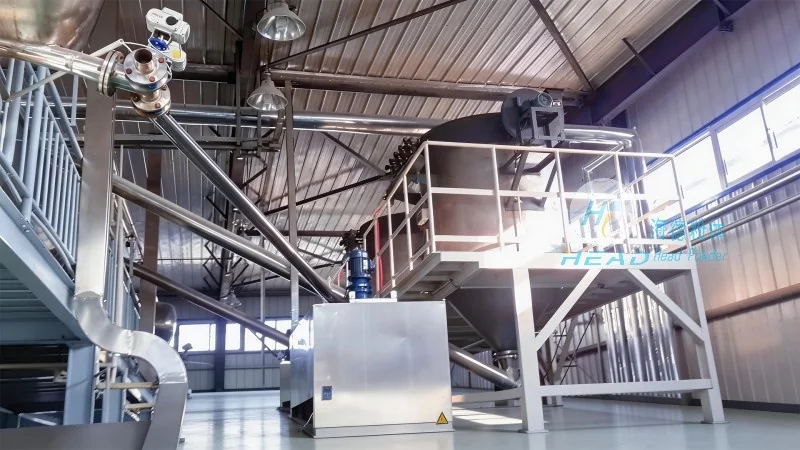
A complete pneumatic conveying system for cathode and anode materials consists of several critical subsystems, each engineered to meet battery-grade cleanliness standards. The feed system typically includes rotary airlocks, screw feeders, or venturi injectors, designed to introduce powder into the pipeline without air leakage or material segregation. Rotary valves with hardened rotor tips and adjustable clearances of 0.05–0.15 mm are common for abrasive cathode powders. The conveying pipeline must be constructed from stainless steel (304L or 316L) with internal surface roughness (Ra) below 0.8 µm to minimize particle adhesion and facilitate cleaning. Bend radii should be at least 10 times the pipe diameter to reduce wear and material degradation. Cyclone separators and baghouse filters achieve separation efficiencies above 99.9% for submicron particles. In battery production, zero-emission requirements often dictate the use of HEPA-grade after-filters (H13 or H14) to capture fugitive dust. The control system integrates mass flow meters, pressure transmitters, and variable frequency drives (VFDs) to maintain stable conveying conditions. A typical dense-phase system for NMC powder operates at conveying pressures between 1.5 and 4.5 bar (g), with conveying distances up to 150 meters and capacities ranging from 100 to 2,000 kg/h per line.
Each battery active material presents unique handling difficulties that must be addressed through system design. Cathode materials, particularly NMC 811 and NCA, are highly hygroscopic and can absorb ambient moisture within minutes, leading to lithium hydroxide formation and capacity fade. Therefore, the conveying gas must be dry nitrogen with a dew point below −40°C. Additionally, the high abrasivity of calcined cathode powders (Mohs hardness 5–6) accelerates pipe wear. Headpowder’s engineers specify ceramic-lined bends and replaceable wear sleeves to extend pipeline life to over 10,000 operating hours. Anode materials like silicon-graphite composites pose different risks: the low bulk density (0.2–0.4 g/cm³) makes them prone to fluidization instability and pipeline plugging. Dense-phase slug flow conveying, where material moves as discrete plugs separated by gas pockets, provides consistent transport without segregation. The slug velocity must be kept below 3 m/s to prevent particle fracture. For silicon monoxide (SiO) anodes, which have a D50 of 3–8 µm, electrostatic charge accumulation becomes a safety hazard. Grounding systems with resistance below 10 ohms and conductive hoses are mandatory to mitigate explosion risks. The conveying system should also incorporate explosion venting and inert gas blanketing in compliance with ATEX and NFPA 68 standards.
Modern battery factories require pneumatic systems that can handle multiple material grades with rapid changeover and minimal cross-contamination. This demands modular design with automated purge sequences and clean-in-place (CIP) capabilities. The pipeline layout should minimize horizontal runs where material settling may occur; a slope of 1–2% toward the destination is recommended. The compressor or blower selection must account for altitude and ambient temperature variations—a 1,000-meter elevation can reduce air density by 11%, affecting conveying velocity. For a typical 50,000 tons-per-year cathode production line, the pneumatic system energy consumption may reach 1.2–1.8 kWh per ton of material conveyed. Using variable-speed drives and pressure-optimized controls can reduce this by 20–30%. Computational fluid dynamics (CFD) simulations are now standard for predicting flow patterns, pressure drops, and particle attrition in complex pipeline networks. Headpowder’s simulation platform, validated against experimental rigs, enables precise sizing of pipe diameters, bend configurations, and blower capacities, ensuring that the system delivers consistent performance from day one.
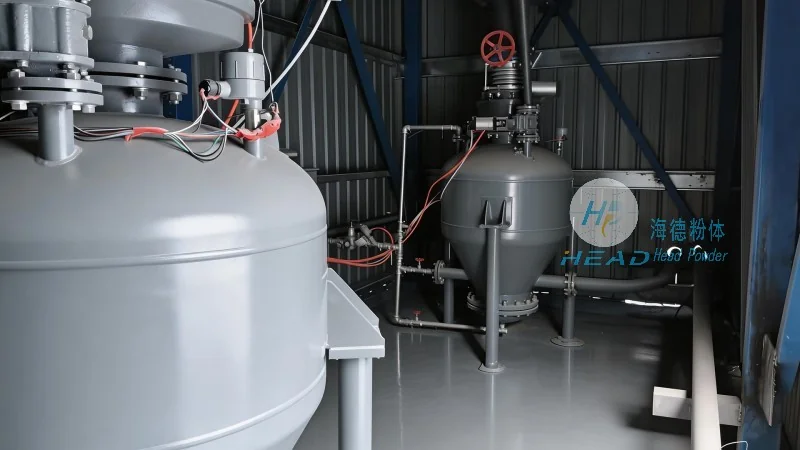
In battery material handling, traceability and quality control are paramount. The pneumatic system should be equipped with in-line particle size analyzers (laser diffraction) and moisture sensors to provide real-time feedback. The conveying velocity must be monitored and maintained within ±2% of the setpoint to avoid segregation. For dense-phase systems, the plug length and frequency correlate directly with batch uniformity. A typical quality acceptance criterion for cathode material after conveying is that the D10, D50, and D90 values change by less than 3% from the feed material. Additionally, the iron contamination level must remain below 10 ppm; using stainless steel 316L and magnetic separators in the conveying line can achieve this threshold. The system’s pressure drop across each section is a key indicator of blockages or filter degradation—a 20% increase in differential pressure signals the need for maintenance. Headpowder integrates IoT-enabled sensors that feed data into the plant’s MES system, enabling predictive maintenance and reducing unplanned downtime by up to 40%.
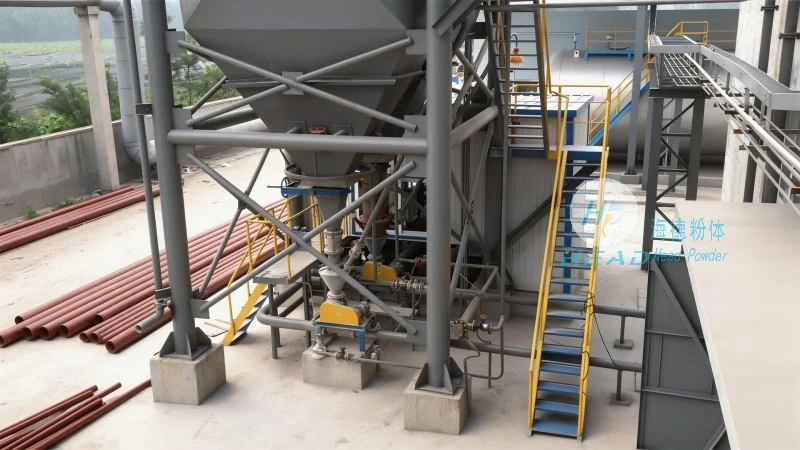
A global battery manufacturer producing 80,000 tons per year of NMC 811 recently upgraded its material handling from manual to automated dense-phase pneumatic conveying. The project involved 12 conveying lines, each handling 1,500 kg/h over distances of 80–120 meters. Headpowder provided turnkey engineering, including pipeline design, control system integration, and nitrogen recirculation loops. Before installation, the plant experienced a 2.8% material loss due to spillage and dust emissions. After commissioning, material loss dropped to 0.15%, and the cleanroom air quality improved to ISO Class 7. The system’s automated purging sequences reduced changeover time from 4 hours to 35 minutes between different cathode grades. Over the first 18 months of operation, the plant reported a 22% reduction in conveying energy costs and zero incidents of pipeline blockage. This real-world example demonstrates how tailored pneumatic system design—considering particle morphology, hygroscopicity, and production volume—delivers measurable ROI. For battery manufacturers evaluating similar upgrades, Headpowder offers on-site material testing using a mobile pilot rig that replicates full-scale conditions, ensuring that the proposed system parameters match the actual material behavior.
As battery chemistry evolves toward solid-state and high-energy-density systems, the requirements for cathode and anode material conveying will become even more stringent. Solid-state electrolyte powders, such as Li₆PS₅Cl, are highly air-sensitive and require hermetic conveying under argon atmosphere. Headpowder is developing pressure-tight rotary feeders with knife-gate isolation for such applications. Another emerging trend is the integration of real-time particle morphology analysis using digital holography, allowing for immediate feedback on particle breakage during conveying. The industry is also moving toward modular, containerized pneumatic systems that can be rapidly deployed in gigafactories. With global battery production capacity projected to exceed 4,500 GWh by 2030, the demand for efficient, reliable, and contamination-free pneumatic conveying will grow exponentially. Manufacturers that invest in advanced pneumatic technology today will gain a competitive edge in yield, cost per kWh, and sustainability metrics. Headpowder continues to invest in R&D for low-energy, low-wear conveying concepts, such as fluidized dense-phase conveying with pulsed air injection, which can reduce energy consumption by an additional 15–25% compared to continuous dense-phase systems.
Choosing the right partner for cathode and anode material conveying is a strategic decision that affects production uptime, product quality, and long-term operational costs. Headpowder brings decades of hands-on expertise in handling fine, abrasive, and hygroscopic powders across the battery supply chain. From preliminary material characterization to commissioning and after-sales support, the company’s engineering team ensures that every pneumatic system is optimized for the specific material, capacity, and site constraints. If you are planning a new battery material production line or upgrading an existing facility, a thorough technical consultation can identify opportunities for efficiency gains and risk reduction. (咨询热线:156-6277-7102) Headpowder’s technical specialists are available for on-site assessments and pilot testing to validate system performance before full-scale deployment. The company’s commitment to precision engineering, quality assurance, and after-sales service has made it a trusted partner for leading battery material producers worldwide. For detailed engineering proposals, system specifications, or to request a material test report, please contact the Headpowder sales and engineering team.

 Shandong headpowder Engineering Co., Ltd.
 156-6277-7102(Manager Zhang)
  0531-83386006
  Jinan City, Shandong Province, China
服务热线
微信咨询
回到顶部