
Cement is one of the most widely used construction materials globally, with annual production exceeding 4.1 billion metric tons as of 2025. The efficient handling of cement from production to end-use—whether in bulk silos, batch plants, or ready-mix facilities—requires reliable, dust-free, and energy-efficient conveying technologies. Among the various methods available, pneumatic conveying has emerged as the dominant solution for moving cement over short to medium distances, particularly in confined or elevated spaces where mechanical conveyors face limitations. This article provides a deep technical overview of pneumatic conveying systems specifically designed for cement, covering fundamental principles, system configurations, key components, operational parameters, and selection guidelines. The discussion is grounded in current industry practices and forward-looking trends for 2026, including automation integration, energy optimization, and environmental compliance. By understanding the mechanics and engineering behind pneumatic conveying, plant managers and project engineers can make informed decisions that enhance productivity, reduce downtime, and align with global sustainability targets.
Pneumatic conveying leverages the flow of air or another gas to transport bulk particulate solids through a pipeline. For cement, which has a mean particle size typically ranging from 5 to 50 microns and a bulk density around 1.1 to 1.6 t/m³, the conveying system must address several unique challenges: abrasiveness, moisture sensitivity, electrostatic charge buildup, and the tendency to compact under pressure. Modern pneumatic systems are designed with these factors in mind, incorporating wear-resistant materials, dehumidification units, and precise pressure control. In the context of 2026 market dynamics, the cement industry is under growing pressure to reduce carbon emissions and operational costs. Pneumatic conveying systems that integrate variable frequency drives (VFDs), real-time monitoring sensors, and predictive maintenance algorithms are becoming the standard for new installations. This article explores both dilute-phase and dense-phase configurations, offering a comparative analysis of their suitability for different cement handling scenarios.
Pneumatic conveying systems operate on the principle of creating a pressure differential across a pipeline to induce air flow that carries solid particles. The two primary mechanisms are pressure conveying (positive pressure) and vacuum conveying (negative pressure). In pressure conveying, a compressor or blower forces air into the pipeline ahead of the material, pushing the cement along. In vacuum conveying, an exhauster creates suction at the receiving end, drawing air and material into the pipeline. For cement, pressure systems are more common for long-distance horizontal or vertical lifts, while vacuum systems are preferred for unloading from railcars or trucks due to their dust containment advantages.
The key parameter that defines system performance is the solids-to-air ratio, measured as the mass of cement conveyed per unit mass of conveying air. In dilute-phase conveying, this ratio ranges from 1:1 to 15:1, meaning the air velocity is high (typically 20–40 m/s) to keep particles suspended. Dense-phase conveying operates at much lower velocities (2–10 m/s) with solids-to-air ratios exceeding 30:1, where cement moves as a fluidized plug or slug. The choice between these modes depends on the distance, elevation change, and the abrasiveness of the material. For cement, dense-phase systems are increasingly favored because they reduce pipe wear, energy consumption, and product degradation. According to recent data from the European Cement Research Academy, dense-phase conveying can lower energy usage by up to 40% compared to dilute-phase, while extending pipeline service life by a factor of two to three.
Dilute-phase pneumatic conveying is the traditional approach for cement. In this configuration, a high-volume air stream carries the cement particles in suspension, similar to a fluid. The air velocity must exceed the saltation velocity—the speed at which particles begin to drop out of suspension—which for cement is around 18–25 m/s depending on particle size and moisture content. Dilute-phase systems are simple to design and install, with relatively low initial capital costs. They are suitable for short to intermediate distances (up to 300 meters) and moderate capacities (up to 100 t/h). However, the high air velocity accelerates pipe erosion, especially at bends and elbows, and consumes significant energy. In 2026, many operators are retrofitting dilute-phase systems with wear-resistant ceramic-lined pipes and variable-speed blowers to mitigate these drawbacks.
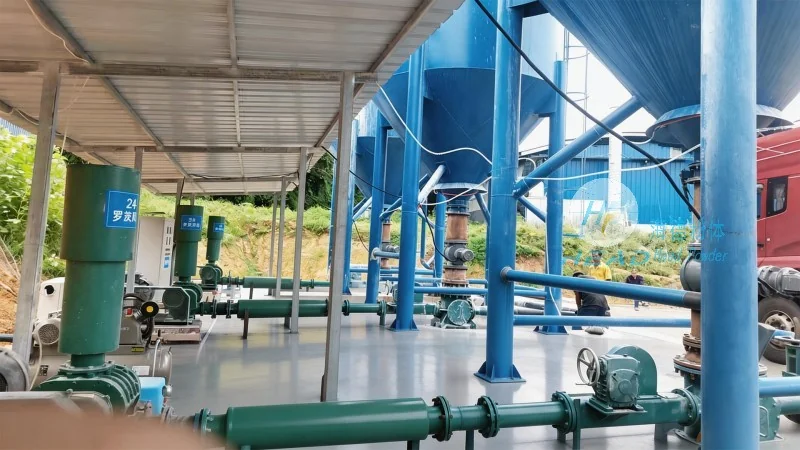
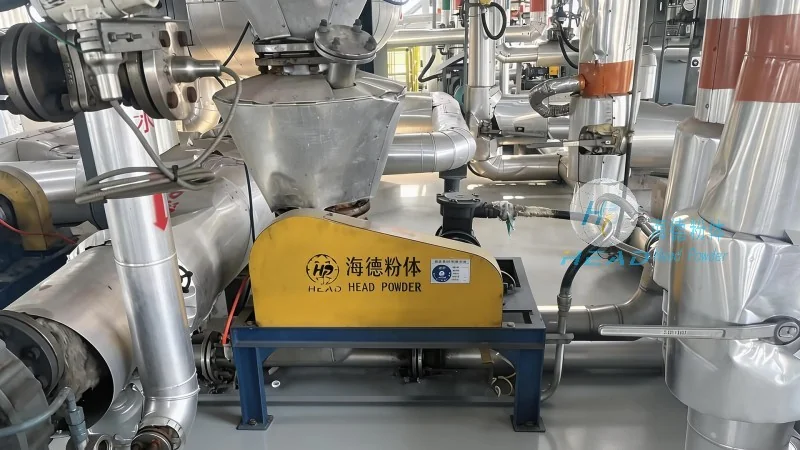
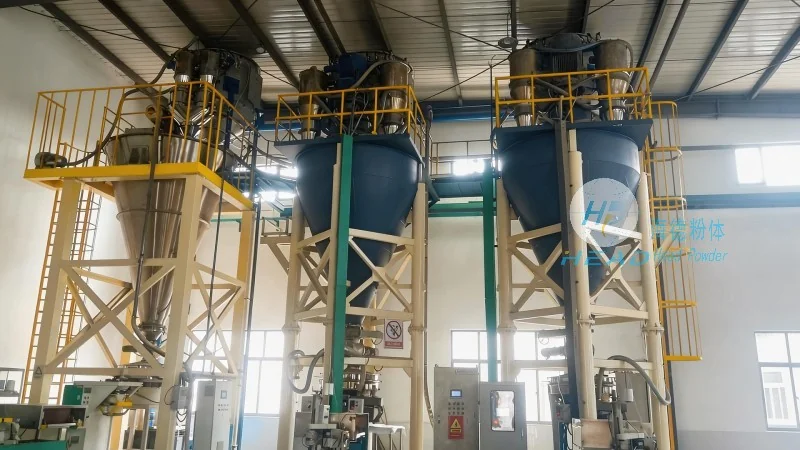
Dense-phase conveying, also known as plug-flow or slug-flow conveying, is a more advanced technique that uses compressed air at lower volumes but higher pressure. The material is forced into the pipeline in discrete plugs that are pushed by air pockets. The conveying velocity is low enough that the cement remains in a compacted state, reducing particle-to-wall impact and friction. This technology is particularly effective for cement because it minimizes segregation, dust generation, and pipe wear. Dense-phase systems can handle distances above 500 meters and capacities up to 200 t/h with proper design. One common variant is the use of a blow tank (pressure vessel) that feeds material into the pipeline in batches. Another approach uses a rotary valve or screw feeder in combination with a booster air injector to maintain plug stability. headpowder's engineered dense-phase solutions have been deployed in over 120 cement plants globally, achieving energy savings of 30–50% compared to conventional dilute-phase systems. (Consulting hotline: 156-6277-7102)
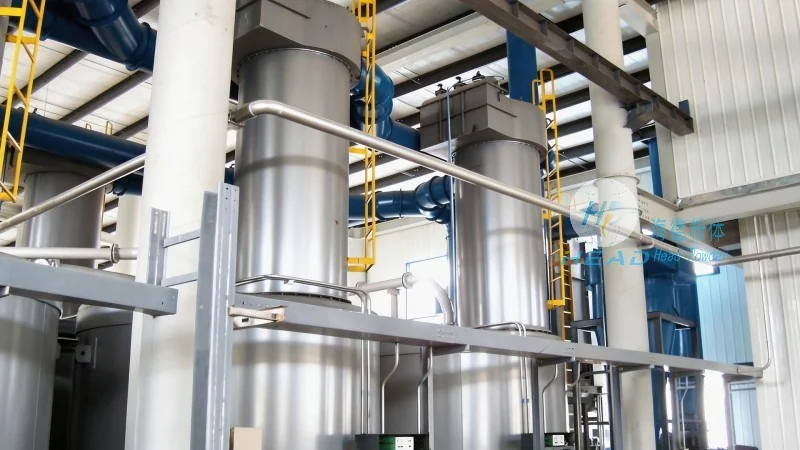
Every pneumatic conveying system consists of several critical components, each requiring careful selection to match cement's abrasive and hygroscopic nature. The primary components include: air mover, feed device, pipeline and fittings, separation equipment, and control system.
Designing a pneumatic conveying system for cement requires meticulous calculation of several interdependent parameters. The most critical are: pipeline length and elevation change, material properties, required throughput, air velocity, pressure drop, and air-to-material ratio. For example, a typical plant conveying cement from a silo to a packing station at 50 t/h over a horizontal distance of 150 meters with a 20-meter vertical lift might require a dense-phase system operating at 4 bar pressure and 0.5 m³/min of air per ton of cement. In contrast, the same application using dilute-phase would need around 3 bar but 3 m³/min of air, resulting in three times the energy consumption.
Computational fluid dynamics (CFD) simulation tools are now routinely used by leading engineering firms, including headpowder, to predict flow patterns, pressure gradients, and wear hotspots before installation. These simulations account for particle size distribution, moisture content (cement should be below 0.5% moisture for reliable conveying), and ambient temperature effects. As of 2026, the industry is moving toward digital twin technology, where the pneumatic conveying system is modeled in real time, allowing operators to adjust parameters dynamically. Data from a recent case study in a cement plant in Southeast Asia showed that implementing a digital twin reduced unplanned downtime by 28% and energy consumption by 12% over 18 months.
Despite its advantages, pneumatic conveying of cement presents several operational challenges that must be addressed during system design and maintenance. One frequent issue is pipeline blockage due to moisture absorption. Cement reacts with water vapor in compressed air to form hydrated compounds that agglomerate and stick to pipe walls. The solution is to install air dryers—either refrigerated or desiccant types—with a dew point of at least -20°C. Another challenge is electrostatic buildup, which can cause sparking and dust explosions in high-velocity systems. Grounding all conductive components and using antistatic pipe liners (e.g., conductive polyurethane) is recommended. Abrasive wear is inevitable but can be managed through proper pipe routing (minimizing sharp bends), using long-radius elbows (R/D ratio above 10), and scheduling regular thickness inspections with ultrasonic testing.
Maintenance planning is also crucial. Filters in baghouses need periodic replacement; pulse-jet valves should be checked for sealing; and blow tank dome valves require inspection for seat wear. The industry standard for filter change intervals is every 6–12 months depending on operating hours. headpowder's service teams have developed a proprietary wear-prediction algorithm that analyzes vibration data from pipe supports to forecast erosion rates, enabling proactive replacements without production stoppage. (Consulting hotline: 156-6277-7102)
The global pneumatic conveying equipment market for cement is projected to grow at a compound annual growth rate (CAGR) of 6.2% from 2025 to 2030, driven by infrastructure development in Asia and Africa, and by modernization of aging plants in Europe and North America. Several key trends are shaping the industry in 2026. First, sustainability imperatives are pushing cement producers to reduce their carbon footprint, and pneumatic conveying contributes by enabling closed-loop systems that prevent dust emissions. Second, the integration of Internet of Things (IoT) sensors and artificial intelligence (AI) for predictive maintenance is becoming standard. Third, modular and skid-mounted conveying units are gaining popularity for fast deployment in temporary or mobile batching plants. Fourth, manufacturers are exploring hybrid systems that combine pneumatic and mechanical conveying (e.g., pneumatic for vertical lift and belt conveyor for horizontal) to optimize energy use.
From a regulatory perspective, stricter emission limits under European Union Best Available Techniques (BAT) and U.S. EPA standards are compelling plants to invest in high-efficiency filtration and leak detection systems. For example, the German TA Luft 2025 regulation requires that fugitive dust emissions from cement handling not exceed 5 mg/Nm³, achievable only with properly designed pneumatic systems and baghouse units. headpowder's latest product line, the EcoVeyor series, incorporates all these features—including energy recovery via pressure reduction turbines—and meets the strictest global standards. The company has successfully completed more than 300 cement conveying projects across 40 countries, with a demonstrated mean time between failures (MTBF) exceeding 8,000 hours for dense-phase installations.

When evaluating a pneumatic conveying system for a new cement plant or retrofit, engineers should consider the following criteria in order of priority: capacity and distance, material characteristics, site constraints, energy efficiency, maintenance accessibility, and total cost of ownership over a 10–15 year lifecycle. For example, a cement terminal with high throughput (over 100 t/h) and long distance (over 400 m) would almost certainly require a dense-phase system with a centralized compressor station. In contrast, a small batch plant with 20 t/h and 50 m distance might opt for a lean-phase vacuum system for simplicity. It is also critical to evaluate the supplier's experience—headpowder's engineering team, with over two decades of specialization in cement applications, provides free preliminary feasibility studies and CFD modeling to help clients make data-driven decisions. (Consulting hotline: 156-6277-7102)
Another important factor is the availability of spare parts and local technical support. The industry average for lead time on pneumatic conveying components is 8–12 weeks, but major suppliers maintain regional stock depots. Headpowder operates warehouses in China, U.A.E., and Germany, ensuring 95% of spare parts are delivered within 48 hours. Additionally, warranty terms should be reviewed—typical industry warranty is 12 months from commissioning, but the company offers an extended 24-month warranty on all dense-phase blow tanks and control panels.

To illustrate the practical benefits of modern pneumatic conveying, consider a recent project by headpowder for a 1.5 million t/y cement grinding station in the Middle East. The client required a reliable system to convey cement from six ball mills to four storage silos and then to a truck loading station, with an aggregate conveying distance of 280 meters and a vertical lift of 35 meters. The previous dilute-phase system suffered from high pipe wear (replacement every 6 months) and energy costs exceeding $120,000 per year. The new dense-phase system, designed with CFD-optimized pipe diameters, ceramic-lined elbows, and a proprietary blow tank with fluidizing nozzles, achieved the following results: energy consumption reduced by 52% (from 8.5 kWh/t to 4.1 kWh/t), pipe replacement interval extended to 36 months, and dust emissions below 3 mg/Nm³. The plant also integrated the conveying control into its existing Plant Management System, enabling remote operation and alarm notifications. Payback period was under 18 months, well within the client's target.

As the cement industry continues to evolve toward higher efficiency, lower emissions, and greater automation, pneumatic conveying remains the backbone of reliable bulk material transport. Whether upgrading an existing facility or designing a greenfield plant, understanding the nuances of dilute-phase versus dense-phase systems, the impact of air quality on cement flow, and the importance of proper component selection is essential for long-term success. The market in 2026 offers a wide range of advanced solutions—from AI-driven control algorithms to wear-resistant alloys—that can transform cement handling from a cost center into a competitive advantage. By partnering with an experienced engineering provider such as headpowder, plant operators gain access to proven technologies, rigorous testing protocols, and the comprehensive support needed to achieve operational excellence. For detailed technical consultation and a custom system assessment, contact the team directly at 156-6277-7102 to discuss your specific conveying requirements.
Shandong headpowder Engineering Co., Ltd.
156-6277-7102(Manager Zhang)
0531-83386006
Jinan City, Shandong Province, China 
服务热线
微信咨询
回到顶部