News
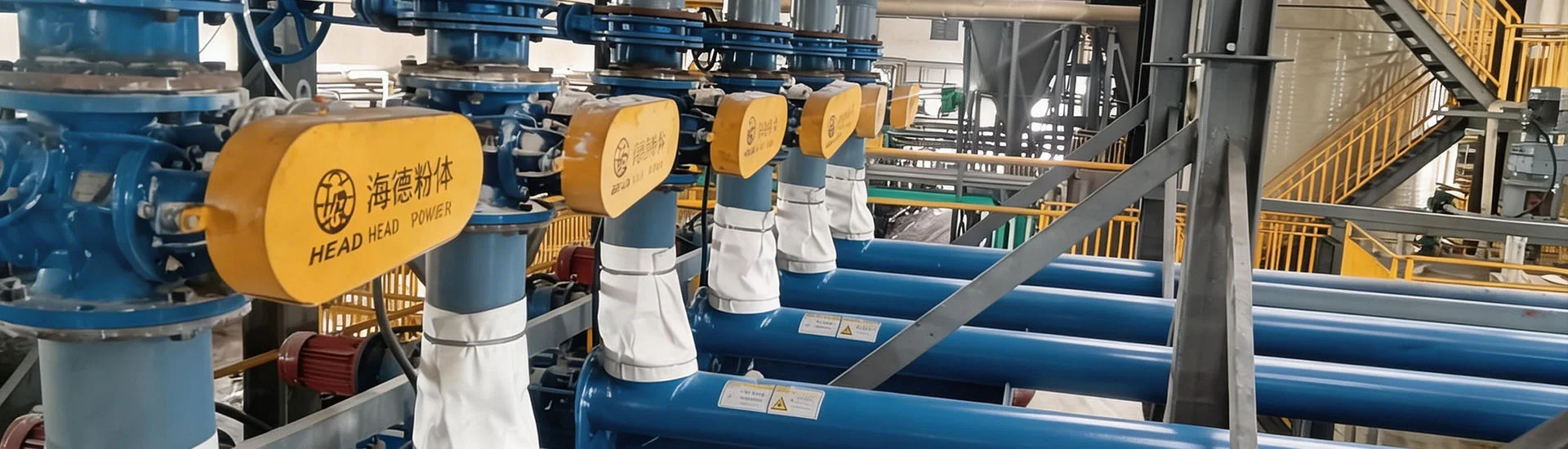
Rich project cases across industries, showing real implementation and proven technical strength.Ammonium chloride (NH₄Cl) is a widely used industrial chemical, serving critical roles in fertilizer production, dry-cell battery manufacturing, textile printing, metal fluxing, and pharmaceutical intermediates. Its unique physical properties—hygroscopicity, moderate bulk density (typically 600–900 kg/m³), and tendency to cake or bridge under high humidity—make pneumatic conveying a particularly attractive solution for handling this material. Compared to mechanical conveyors, pneumatic systems offer enclosed transport, reduced dust emissions, flexible routing, and lower maintenance for granular or powdered ammonium chloride. However, successful design requires careful consideration of material characteristics, conveying phase selection, and system component compatibility. This article provides a technical overview for engineers, plant managers, and procurement specialists evaluating pneumatic conveyance for ammonium chloride, drawing on established industry practices and contemporary system engineering approaches. Headpowder, as a specialized system integrator, has delivered multiple ammonium chloride conveying projects in Asia and North America, accumulating practical insights into optimal configuration.
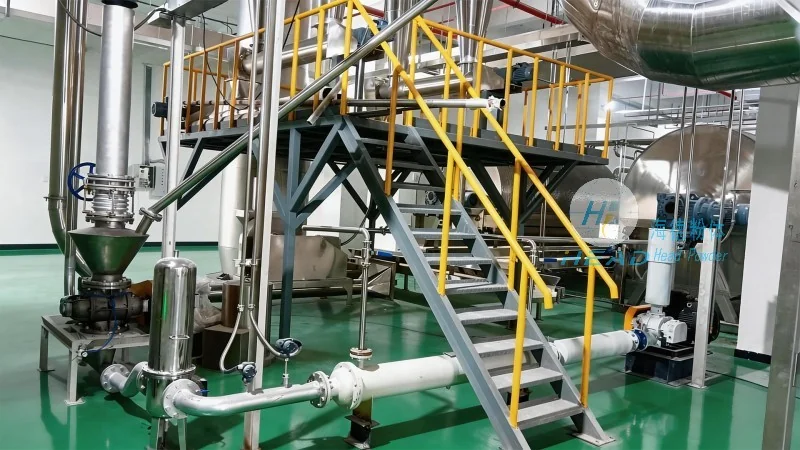
Pneumatic conveying for ammonium chloride generally falls into two categories: dilute phase (suspension flow) and dense phase (plug flow). Dilute phase systems operate at higher air velocities (typically 15–25 m/s) and lower solid-to-air ratios, suitable for short-distance transport and materials that withstand particle attrition. For ammonium chloride with friable crystal structure, dilute phase can generate significant fines and cause pipe erosion, especially in bends. Dense phase conveying—where material moves in slugs or plugs at low velocities (3–8 m/s)—is often preferred for ammonium chloride to minimize degradation and reduce energy consumption. The choice between positive pressure (blow) and vacuum (suction) systems depends on source and destination points: positive pressure systems deliver from single point to multiple destinations, while vacuum systems suit multiple pick-up points. Many modern facilities employ closed-loop systems with nitrogen or dry air as a conveying gas to avoid moisture pickup that causes caking. Headpowder’s experience with ammonium chloride clients indicates that a preliminary material characterization test—including particle size distribution, angle of repose, cohesion, and moisture sensitivity—is indispensable before finalizing system type.
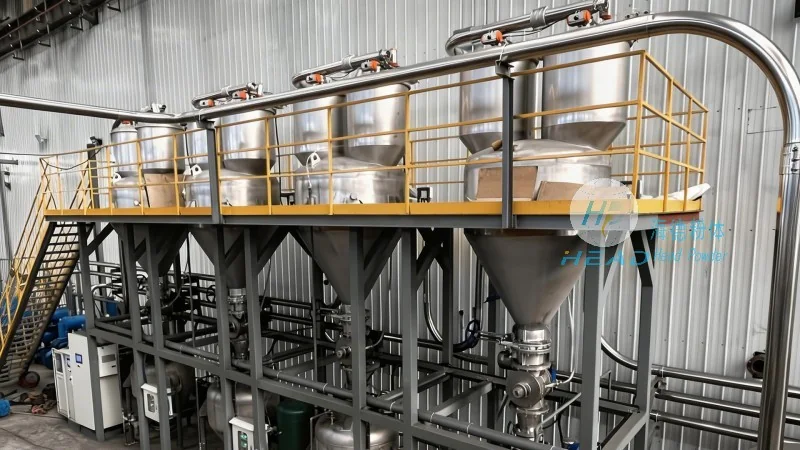
Designing a reliable pneumatic conveyor for ammonium chloride involves balancing several interdependent variables. The conveying distance—both horizontal and vertical—directly influences pressure drop and required air compressor capacity. A typical dilute phase system for ammonium chloride over 100 m horizontal and 15 m vertical might demand an air volume of 1.5–3.0 m³/min per ton of material per hour, while dense phase can reduce air volume by 40–60%. Pipe diameter selection (commonly DN80 to DN200 for industrial throughputs) affects velocity and pressure loss; smaller diameters increase velocity but risk blockages, especially in humid environments. Bend geometry is critical: long-radius bends (R/D ratio > 10) or blind tees reduce wear and prevent ammonium chloride fines from accumulating. Additionally, the system must incorporate moisture control—dehumidifiers or air dryers with a dew point below –20°C are recommended when ambient humidity exceeds 50% RH, based on 2026 trends in Southeast Asian fertilizer plants where headpowder has executed installations. For dense phase conveying, the minimum conveying velocity must remain above the saltation velocity (typically 4–6 m/s for ammonium chloride) to avoid line blockage. An empirical rule derived from headpowder trial data: for ammonium chloride with median particle diameter 150–300 µm, the optimal solid loading ratio in dense phase is 15–25 kg solid per kg air.
Another critical design factor is the air supply system. Rotary lobe blowers are common for moderate pressure applications (0.5–1.5 bar gauge), while screw compressors suit high-pressure dense phase systems (up to 4 bar). Since ammonium chloride dust is mildly corrosive when combined with moisture, downstream components—filters, valves, and silencers—should be constructed from stainless steel 304 or 316L. Headpowder’s case history at a Chinese fertilizer plant (handling 10 t/h ammonium chloride over 200 m) demonstrates that replacing carbon steel bends with ceramic-lined stainless steel reduced annual maintenance from quarterly replacements to biannual inspections. Pressure transmitters and flow sensors along the pipeline enable real-time monitoring of conveying stability; modern PLC-based controls can automatically adjust air injection to maintain consistent slug frequency in dense phase mode. For plants operating in cold climates (sub-zero temperatures), trace heating of pipes and filters prevents ammonium chloride from absorbing moisture and forming ice bridges—a lesson learned from headpowder’s project in northern Europe in 2024.
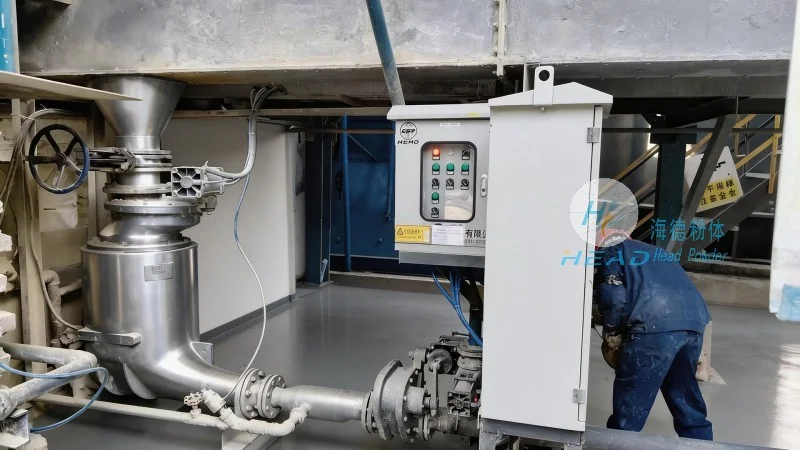
A complete ammonium chloride pneumatic conveying system comprises multiple interacting sub-systems: material feed, conveying pipeline, air mover, separation unit, and control system. The feeding device—rotary airlock valve or screw feeder—must provide consistent metering without air leakage. For ammonium chloride, rotary valves with abrasion-resistant tips and shaft seals (nitrile or PTFE) are standard; headpowder recommends a variable-speed drive to adjust feed rate based on downstream demand. In installations with high surge loads (e.g., after a centrifuge), a surge hopper with aeration pads can prevent bridging. The conveying line itself should be routed with minimal horizontal-to-vertical transitions; every 90-degree bend should be preceded by a straight section at least 10 pipe diameters in length to maintain stable flow. Branch lines (if multiple destinations) require diverting valves designed for fine powders—swing-away or plug-type valves with hardened seats. For separation, a baghouse or cartridge filter with reverse-pulse cleaning is typical; the filter area must account for ammonium chloride’s high dust loading (often 50–100 g/m³). A rotary discharge valve beneath the filter handles recovered material, which can be returned to process or packaging. Headpowder’s standard package includes a vibration monitor on the filter housing to detect bag failures early.
Vacuum pneumatic conveying is often chosen when ammonium chloride must be extracted from multiple sources (e.g., several bag dumping stations or storage silos). A central vacuum pump—typically a liquid ring pump or rotary vane pump—creates negative pressure, allowing dust-free collection. However, the vacuum level is limited to about 0.5–0.7 bar absolute, restricting maximum conveying distance to 50–80 m. For longer distances or higher throughputs, positive pressure dense phase is more economical. Selection criteria also integrate energy efficiency: a 2025 industry benchmark survey indicated that dense phase systems for ammonium chloride consume 0.8–1.2 kWh per ton conveyed over 100 m, compared to 1.5–2.0 kWh for dilute phase. Headpowder’s own field measurements show that optimizing the air velocity to just above the minimum conveying speed reduces wear and power consumption by up to 25% without sacrificing capacity. Additionally, incorporating a bypass air injection along the pipe—especially in dense phase—can eliminate plugging during startup or after unexpected shutdowns.
Ammonium chloride presents specific operational challenges that must be addressed in the system design and daily operation. The most common issue is caking and adhesion: when the material absorbs atmospheric moisture, it forms hard deposits on pipe walls and inside filters. This problem intensifies during seasonal humidity spikes. Mitigation strategies include: (a) using dehumidified conveying air or nitrogen, (b) applying PTFE-lined pipes or internal coatings, (c) installing pneumatic hammers or vibrating probes at critical bends, and (d) running the system continuously or scheduling regular purges with dry air. Another challenge is electrostatic charge accumulation—ammonium chloride can generate static electricity during high-velocity transport, leading to spark risks in dusty environments. Grounding all metallic components, using conductive hoses, and inserting antistatic air nozzles are recommended safety measures. Headpowder’s design manual specifies earth resistance below 10 ohms for all conveying lines handling ammonium chloride in explosive-classified zones (e.g., battery plant areas).
Abrasion is another concern, particularly in dilute phase systems with high velocity. Although ammonium chloride (Mohs hardness ≈ 2.0–2.5) is not as aggressive as sand or cement, repeated particle impingement gradually erodes pipe bends. Data from headpowder’s 2023 project in India (transporting 8 t/h ammonium chloride over 180 m) revealed that standard schedule 40 carbon steel bends required replacement after 18 months, while ceramic-lined bends showed negligible wear after three years. For elbows where the particle impact angle is most severe, installing replaceable wear-back inserts can extend system life cost-effectively. Additionally, particle degradation caused by collisions can increase fines fraction; if the downstream process requires specific particle size (e.g., for battery-grade ammonium chloride), dense phase or gentle vacuum conveying becomes necessary. Regular sampling of the conveyed material—at the inlet and outlet—allows monitoring of attrition. Headpowder’s on-site troubleshooting experience shows that reducing the blow tank discharge pressure by 0.1 bar can sometimes halve fines generation without sacrificing throughput.
The global ammonium chloride market continues to grow, driven by fertilizer demand in Southeast Asia and India, as well as specialty chemicals requirements in North America and Europe. In 2026, industry estimates project a compound annual growth rate of 3.8% for ammonium chloride production, with pneumatic conveying adoption increasing due to automation and workplace safety regulations. For example, a major fertilizer complex in Vietnam commissioned headpowder in late 2025 to design a pneumatic system that conveys ammonium chloride from crystallizer to bagging station—capacity 15 t/h over 250 m, using dense phase nitrogen with closed-loop recirculation. The system achieved 99.5% material recovery and less than 1% particle breakage, with payback period under 2.5 years due to reduced dust loss and manual handling costs. Another case: a dry-cell battery manufacturer in Germany required a hygienic conveying solution to transport ultrapure ammonium chloride (mediansize 100 µm) without contamination. Headpowder provided a full stainless steel 316L system with sanitary tri-clamp connections, CIP capability, and nitrogen purge—conveying 2 t/h over 60 m with zero moisture ingress.
Looking ahead, two technology trends will influence ammonium chloride pneumatic conveying design. First, the integration of digital twin simulation: using CFD (computational fluid dynamics) and DEM (discrete element method) software, engineers can model particle trajectories, predict wear hotspots, and optimize pipe routing before installation. Headpowder now offers simulation-based feasibility studies for clients, reducing commissioning time by 30–40%. Second, the adoption of artificial intelligence for predictive maintenance: sensors embedded in the conveying line monitor pressure pulses, vibration, and temperature; machine learning algorithms detect early signs of blockages or filter degradation. By 2027, many headpowder systems will include cloud-based monitoring dashboards, enabling remote diagnostics and proactive intervention. For companies planning new ammonium chloride handling lines, engaging a specialized integrator early in the project—ideally during the conceptual design phase—yields significant savings in capital expenditure and operational downtime.
Selecting the appropriate pneumatic conveying technology for ammonium chloride requires a comprehensive evaluation of material properties, plant layout, throughput requirements, and environmental conditions. Dilute phase offers simplicity and lower initial cost for short distances and less friable grades, while dense phase provides lower energy consumption, reduced degradation, and better moisture control for longer or more sensitive transports. No matter which approach is chosen, equipment quality—especially for rotary valves, filters, and bends—must match the material’s abrasiveness and hygroscopic nature. Headpowder’s track record encompasses dozens of successful ammonium chloride conveying installations across varying climates and industries, reinforcing the importance of thorough pre-engineering, site-specific customization, and post-commissioning support. Operators are advised to conduct periodic system audits—examining air consumption, pressure drops, and fines generation—to maintain peak efficiency. For detailed feasibility analysis or quotation, reach out to our team: (咨询热线:156-6277-7102). By partnering with an experienced system integrator like headpowder, chemical manufacturers can achieve reliable, low-maintenance, and cost-effective pneumatic conveyance for ammonium chloride, aligning with both current production demands and future scalability.

 Shandong headpowder Engineering Co., Ltd.
 156-6277-7102(Manager Zhang)
  0531-83386006
  Jinan City, Shandong Province, China
服务热线
微信咨询
回到顶部