News
Rich project cases across industries, showing real implementation and proven technical strength.In the rapidly evolving landscape of material handling, foam pellets represent a unique challenge due to their lightweight nature, irregular geometry, and susceptibility to static electricity. Conventional mechanical conveyors often struggle with product degradation, bridging, and dust generation when handling expanded polystyrene (EPS) or polyethylene (PE) foam beads. A well-designed pneumatic conveying system, tailored specifically for foam pellets, offers a compelling solution that combines gentle handling with high throughput and minimal contamination risk. This article provides an in-depth technical examination of foam pellets pneumatic conveying system equipment, drawing on established engineering principles, current industry trends through 2026, and practical deployment considerations. We will explore the core system components—from material intake to separation and storage—while addressing key design parameters such as air velocity, dilution phase selection, and filtration efficiency. For professionals evaluating capital equipment investments, understanding these fundamentals is essential to achieving reliable operation, low energy consumption, and extended service life.
Foam pellets are typically produced in densities ranging from 15 kg/m³ to 60 kg/m³, which makes them highly buoyant and prone to fluidization. Pneumatic conveying leverages a controlled airflow to suspend and transport these particles through enclosed pipelines, eliminating spillage and reducing labor requirements. In recent years, the global market for foam-based packaging and insulation has expanded significantly, with industry analysts projecting a compound annual growth rate of approximately 4.8% from 2024 to 2028. This growth drives demand for efficient in-plant transfer systems capable of moving raw pellets from silos to molding machines or bagging stations without compromising material integrity. Headpowder, a specialized equipment manufacturer with over a decade of experience in pneumatic conveying solutions, has developed a series of systems that address the specific rheological behaviors of foam pellets. In the following sections, we will dissect the key equipment modules, operational parameters, and maintenance practices that define a high-performance foam pellet pneumatic conveying system.
A foam pellet pneumatic conveying system typically operates under either dilute-phase or dense-phase conditions, with dilute phase being the predominant choice due to the low bulk density of the material. In a dilute-phase system, the pellets are entrained in a high-velocity airstream (usually between 18 and 25 m/s) and conveyed through straight pipes, elbows, and bends toward the destination point. The system consists of several discrete but interdependent components: a material feed device, a blower or compressor, a conveying pipeline network, a separation unit (usually a cyclone or baghouse filter), and a storage receiver. The feed device must account for the irregular shape of foam pellets, which can interlock and cause bridging; rotary airlocks or screw feeders with enlarged pockets are commonly used. Headpowder's design incorporates a proprietary anti-bridging hopper geometry that maintains consistent material flow even when handling pre-expanded beads with high static charge.
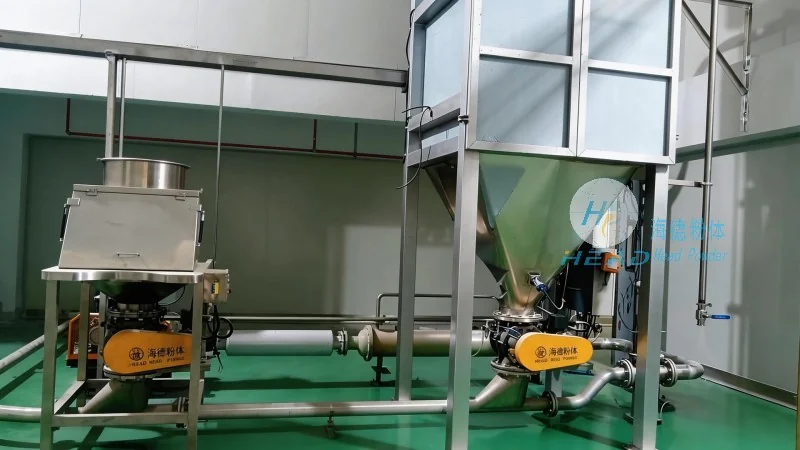
Reliable material feeding is the foundation of any pneumatic conveying system. For foam pellets, the feeding mechanism must prevent "flooding" (excessive material entering the pipeline) while also avoiding starvation that leads to velocity fluctuations. Venturi injectors are frequently employed in smaller installations, where the negative pressure generated by compressed air draws pellets into the airstream. However, for higher capacity requirements—common in large-scale EPS molding facilities—a rotary valve feeder with a close-clearance rotor is preferred. The rotor pockets are designed to accommodate the bulk density of foam without jamming; typical clearances are maintained between 0.2 and 0.5 mm to prevent air leakage while allowing gentle handling. Headpowder's rotary valves feature hardened wear surfaces and replaceable tip seals, ensuring consistent performance over extended operating periods. In one installation at a packaging plant in Shandong Province, a 6-liter rotary valve successfully conveyed 8 tons of foam pellets per hour over a 90-meter horizontal distance with a 12-meter vertical lift, achieving a material-to-air ratio of 1:4 without any bridging incidents.
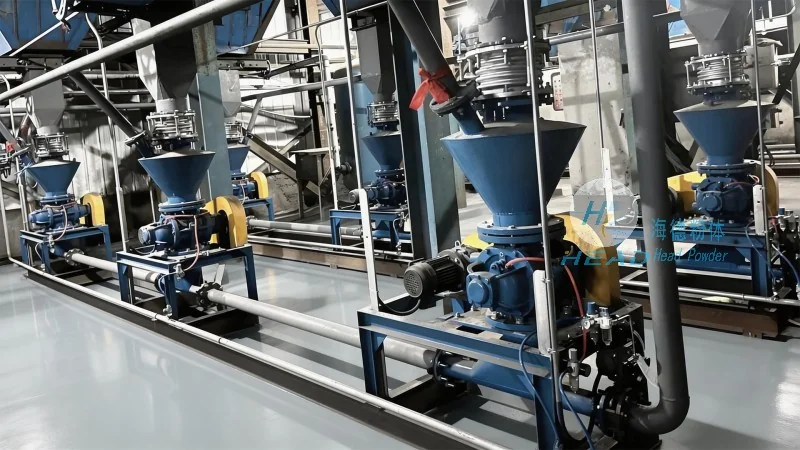
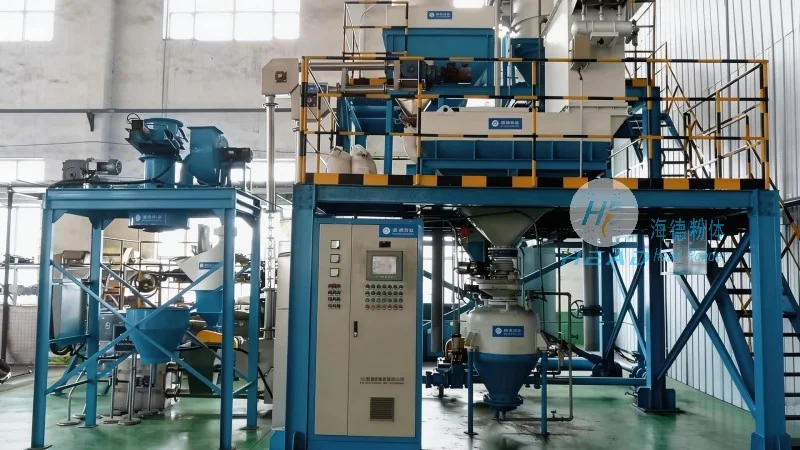
Pipeline sizing for foam pellets must account for the material's tendency to generate static electricity, which can cause adhesion to pipe walls and create blockages. Stainless steel or carbon steel pipes with internal surface roughness below 3.2 μm are standard; some systems incorporate an internal coating or grounding straps to dissipate static buildup. The optimal conveying velocity is a critical parameter: too low, and pellets drop out of suspension; too high, and energy consumption increases while the risk of pellet fracture rises. For foam pellets with nominal particle sizes between 2 and 8 mm, a conveying velocity range of 20 to 24 m/s delivers a good balance. Compressed air consumption is typically 0.8 to 1.2 m³ per kilogram of material conveyed, depending on distance and elevation changes. Headpowder's engineers use computational fluid dynamics (CFD) modeling to optimize pipeline routing, minimizing the number of 90-degree elbows and specifying long-radius bends (R/D ratio of 10:1 or greater) to reduce pressure drop and material degradation.
At the end of the conveying line, the foam pellets must be efficiently separated from the conveying air without damage. Cyclone separators are the first-stage device, capable of removing 98% to 99% of the material due to centrifugal force. The design of the cyclone vortex finder and cone angle is tailored to foam pellet density; a steeper cone angle (15–20 degrees) improves separation efficiency for lightweight particles. The exhaust air then passes through a baghouse filter with cartridge elements that capture fine dust particles (typically below 1 micron). Reverse-pulse jet cleaning systems are standard to maintain differential pressure below 1.5 kPa. For facilities handling flammable foam types, such as expanded polystyrene, the filter unit must be equipped with explosion venting and antistatic filter media. Headpowder provides an optional integrated spark detection and suppression package that complies with NFPA 69 and ATEX directives, ensuring safe operation in classified zones. A recent project for a Southeast Asian insulation manufacturer incorporated a 12-bag filter unit with a surface area of 240 m², achieving outlet dust emissions below 1 mg/Nm³, exceeding local environmental standards.
Modern foam pellet pneumatic conveying systems rely on programmable logic controllers (PLC) with human-machine interfaces (HMI) to monitor and adjust key parameters in real time. Pressure transmitters at the blower discharge and at various pipeline taps provide feedback for airflow regulation. Variable frequency drives (VFDs) on the blower motor allow precise control of conveying velocity, reducing energy consumption during periods of reduced throughput. Level sensors in the feed hopper and receiving bin trigger automatic start/stop sequences, preventing overfilling or material starvation. Advanced systems can integrate with plant-wide supervisory control and data acquisition (SCADA) networks, enabling remote diagnostics and predictive maintenance scheduling. Headpowder's proprietary control software includes a built-in algorithm that compensates for changes in ambient temperature and humidity, which can affect air density and thus conveying performance. Historical data from over 40 installations shows that automated control reduces unplanned downtime by up to 35% compared to manually operated systems.
Routine maintenance is essential to preserve the efficiency and longevity of a foam pellet pneumatic conveying system. Inspection intervals depend on material abrasiveness and operating hours, but quarterly checks on rotary valve rotor clearance, pipe wall wear at bends, and filter bag condition are recommended. A preventive maintenance schedule should include greasing of bearing points, calibration of pressure transmitters, and verification of grounding continuity. One common issue specific to foam pellets is the accumulation of fine dust in the low-velocity zones of the pipeline, such as the bottom of horizontal runs after a drop. Installing drain ports with manual or automatic purge valves at these locations allows periodic removal of settled dust without shutting down the system. Headpowder offers a remote monitoring service that analyzes vibration signatures and motor current data to predict component wear, providing customers with actionable maintenance alerts. In a case study from a European construction materials company, this predictive approach extended the service life of blower impellers by 50% and reduced spare parts inventory costs by 22% over a two-year period.
Investing in a well-engineered foam pellet pneumatic conveying system yields tangible economic returns. Compared to manual handling or mechanical conveyors, pneumatic systems reduce labor costs by 60% to 80% in many scenarios while eliminating material spillage and product contamination. The closed nature of the system also improves workplace safety by containing airborne dust and reducing noise levels—typical sound pressure at 1 meter from the blower is 75 dB(A) or lower with acoustic enclosures. Energy efficiency has become a pivotal selection criterion, especially with rising electricity prices across global markets. Headpowder's systems incorporate energy recovery options, such as heat exchangers that preheat incoming process air using the exhaust heat from the conveying blower. For a medium-scale facility running 5,000 tons of foam pellets annually, this can generate energy savings equivalent to 40,000 kWh per year, corresponding to a reduction of approximately 28 metric tons of CO₂ emissions. Such figures align with the growing emphasis on sustainable manufacturing practices and can be leveraged in corporate Environmental, Social, and Governance (ESG) reporting.
Choosing the appropriate foam pellet pneumatic conveying system requires careful evaluation of several factors: material bulk density (which can vary from 15 to 60 kg/m³), particle size distribution, conveying distance, required throughput, and facility layout constraints. Headpowder offers modular system configurations that can be customized for single-point or multi-point material delivery. For plants requiring simultaneous feeding to multiple molding stations, a branched pipeline layout with diverter valves and automated sequencing is recommended. The blower selection should consider both positive displacement and centrifugal types; positive displacement blowers provide constant volume flow and are ideal for constant-conveying scenarios, while centrifugal blowers offer more flexibility for variable throughput. Headpowder's engineering team conducts free on-site assessments to measure existing airflow, material properties, and space limitations, producing a detailed proposal with projected energy consumption and ROI calculations. (咨询热线:156-6277-7102)
Looking ahead, the foam pellets pneumatic conveying industry is poised for several technological shifts. The adoption of Industry 4.0 principles is accelerating, with smart sensors providing real-time data on material flow rates, pipeline pressure gradients, and filter condition. Machine learning algorithms are being trained on historical datasets to predict pressure drop anomalies and optimize conveying parameters dynamically. Another emerging trend is the use of cyclone separators with adjustable vortex finders that can fine-tune separation efficiency on the fly, accommodating batches of foam pellets with different bulk densities. Environmental regulations are also tightening: the European Union’s revised Industrial Emissions Directive (IED) and China’s "Double Carbon" targets are pushing manufacturers to adopt closed-loop air handling systems with zero dust leakage. Headpowder is actively developing a novel “hybrid” conveying method that combines dilute-phase pneumatic transport with a gentle mechanical assist at the feed point, reducing energy consumption by an estimated 15% while handling even the most fragile pre-expanded beads without damage. Pilot tests conducted in late 2025 demonstrated throughput rates of 12 tons per hour over a 150-meter horizontal distance with less than 0.1% material breakage.
A successful foam pellet pneumatic conveying system is not merely a collection of components; it requires integrated engineering that respects the material’s unique physical properties while meeting the operational demands of modern production environments. From the initial material intake where bridging must be prevented to the final separation where efficiency and cleanliness are paramount, every element must be meticulously matched to the application. Headpowder brings extensive field experience in designing, fabricating, and commissioning systems for foam pellets across packaging, construction, and automotive sectors. Our approach begins with a thorough analysis of your material characteristics and production targets, followed by CFD simulation and prototype testing before full-scale deployment. The result is a conveying solution that delivers consistent throughput, low maintenance costs, and compliance with international safety standards. Whether you are expanding an existing facility or building a greenfield plant, a properly specified pneumatic system can become a cornerstone of your production line’s efficiency and profitability. We invite you to contact our technical team to discuss your specific project requirements and learn how our tailored solutions can help you achieve superior material handling performance while reducing your total cost of ownership.

 Shandong headpowder Engineering Co., Ltd.
 156-6277-7102(Manager Zhang)
  0531-83386006
  Jinan City, Shandong Province, China
服务热线
微信咨询
回到顶部