News
Rich project cases across industries, showing real implementation and proven technical strength.In the modern fertilizer production chain, the efficient and reliable transfer of granular materials from one processing stage to another is a critical determinant of overall plant productivity. Among the various conveying methodologies, pneumatic conveying systems have emerged as a preferred solution for handling fertilizer pellets due to their enclosed nature, flexibility in routing, and ability to maintain product integrity. This article provides a comprehensive technical overview of a fertilizer pellets pneumatic conveying system, outlining the core design principles, key components, system configurations, and operational considerations that ensure optimal performance in industrial settings. As the global fertilizer market continues to expand, with an estimated annual growth rate of 3.5% through 2026, the demand for robust and energy-efficient conveying solutions becomes ever more pressing. Headpowder, as a specialist in pneumatic conveying technology, has developed a mature technical framework that addresses the unique challenges posed by fertilizer pellets, including abrasion, moisture sensitivity, and particle degradation. This article serves as a technical reference for plant engineers, project managers, and decision-makers seeking to upgrade or install a conveying system that aligns with both current operational needs and future scalability.
Pneumatic conveying relies on the flow of air or an inert gas through a closed pipeline to transport bulk solid materials. For fertilizer pellets, which typically range in size from 2 mm to 5 mm and have bulk densities between 800 kg/m³ and 1,200 kg/m³, two primary modes are applicable: dilute phase and dense phase. Dilute phase conveying suspends particles in a high-velocity airstream, suitable for shorter distances and lower throughput requirements. Dense phase conveying moves material in a non-suspended, slug-flow pattern at lower velocities, significantly reducing particle attrition and pipeline wear. Headpowder’s technical solution integrates both modes where appropriate, leveraging dense-phase technology for fragile or coated urea pellets and dilute phase for robust ammonium sulfate granules. The selection between these modes depends on factors such as material hardness, friability, moisture content, and conveying distance—parameters that must be precisely evaluated during the system design stage.
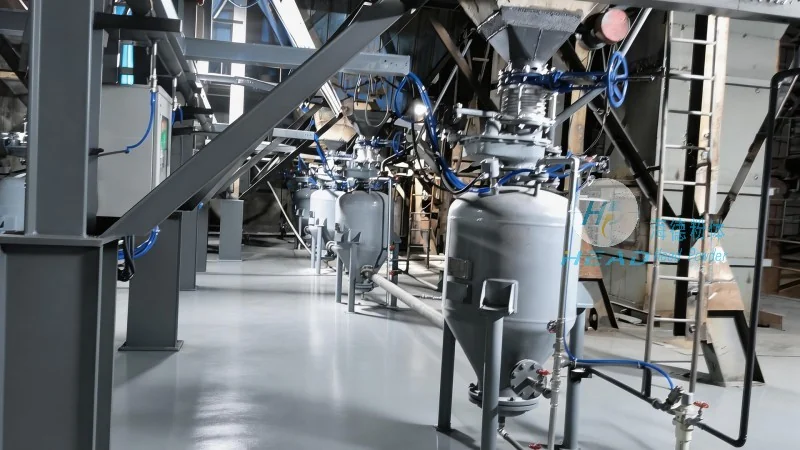
A fully functional fertilizer pellets pneumatic conveying system comprises several interconnected components, each engineered to withstand the abrasive and corrosive nature of fertilizer materials. The feeding device, typically a rotary airlock valve or a screw feeder, meters the pellets into the conveying line at a controlled rate. Headpowder’s rotary valves feature hardened steel rotors and adjustable tip clearance to minimize leakage and ensure consistent feed rates of up to 60 tonnes per hour. The pipeline itself is constructed from carbon steel with a minimum wall thickness of 6 mm, often lined with ceramic or basalt to extend service life by up to 300% in high-wear sections. The air-moving equipment, usually a positive displacement blower for dense phase or a centrifugal fan for dilute phase, must deliver the required pressure and volume. For a typical installation conveying pellets over 150 meters with a vertical lift of 20 meters, a blower rated at 50 kW to 75 kW with a pressure capability of 1.5 bar is standard. Downstream, the receiving hopper incorporates a cyclone separator or a filter receiver to disengage the pellets from the transport air, with bag filters achieving particulate collection efficiency above 99.9% to meet environmental emission standards.
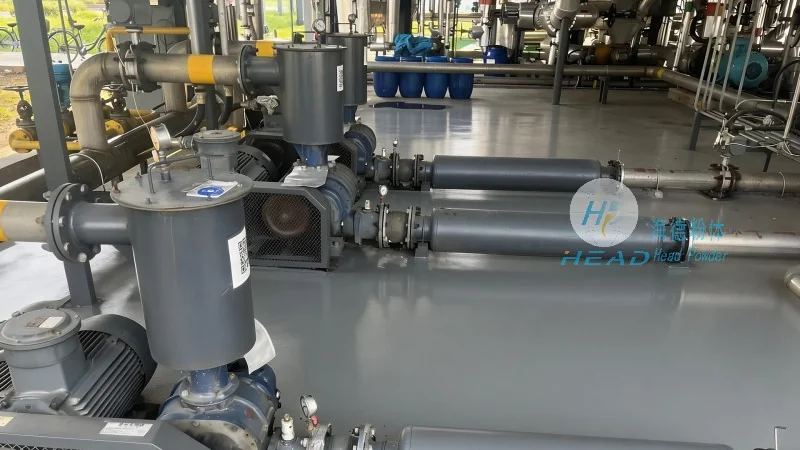
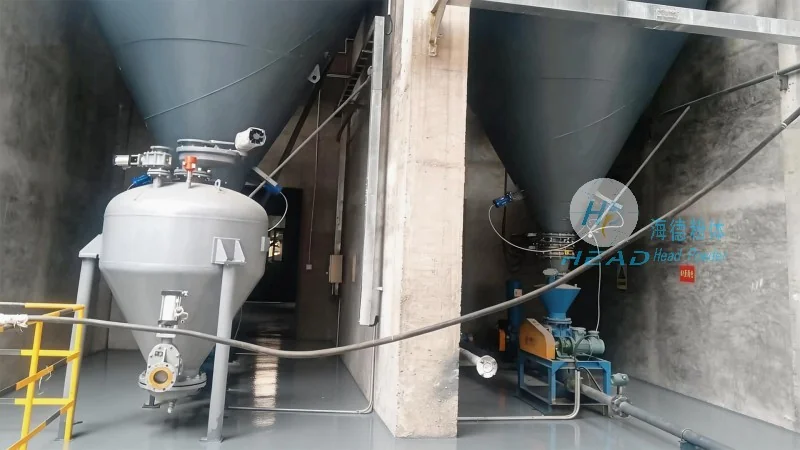
Designing a pneumatic conveying system for fertilizer pellets requires careful calculation of several interdependent variables. The conveying velocity is perhaps the most critical: too high and pellets suffer from chipping and dust generation; too low and blockages occur. For dense phase conveying, velocities as low as 3 m/s to 6 m/s are achievable, while dilute phase typically operates between 15 m/s and 25 m/s. The solid-to-air ratio, expressed in kg of material per kg of air, directly influences energy consumption and system capacity. Headpowder’s design methodology employs computational fluid dynamics (CFD) simulations to optimize this ratio, often achieving values of 30:1 or higher in dense phase applications, compared to the industry average of 10:1 to 15:1. Pipeline routing must minimize bends and vertical sections that increase pressure drop; each 90-degree bend can add the equivalent of 10 to 15 meters of straight pipe resistance. By using long-radius bends with a bend radius-to-pipe diameter ratio of 10:1 or more, Headpowder reduces wear and pressure loss, maintaining system efficiency above 85% over the equipment’s lifecycle.
Fertilizer pellets are not uniform: coated slow-release products, compound NPK granules, and prilled urea each exhibit different mechanical properties. Coated pellets require gentle handling to prevent shell rupture, while hygroscopic materials like ammonium nitrate demand airtight systems with dry air or nitrogen as the conveying medium. Headpowder’s technical solution incorporates moisture control modules, including inline desiccant dryers that reduce transport air dew point to -40°C, preventing caking and dissolution during transfer. Particle breakage tests conducted per ASTM D6940 show that a well-designed dense phase system can keep degradation rates below 1.5% by weight, compared to 5% or higher in conventional dilute phase designs. For cases where pellets are prone to static charge accumulation, grounding straps and anti-static piping materials are integrated to avoid spark hazards—a crucial safety consideration given that dust from fertilizers can be explosive at concentrations above 60 g/m³.
Modern pneumatic conveying systems rely on programmable logic controllers (PLCs) and distributed control systems (DCS) to manage start-up sequences, material flow rates, and emergency shutdowns. Headpowder’s automation framework uses pressure sensors at 5-meter intervals along the pipeline to detect incipient blockages, with response times under 200 milliseconds. Variable frequency drives on blowers allow real-time velocity adjustments based on load conditions, reducing energy consumption by up to 25% compared to fixed-speed operation. The control interface provides operators with a graphical overview of material mass flow, air consumption, and component status, with historical data logging for performance auditing. Integration with plant-wide manufacturing execution systems (MES) enables predictive maintenance alerts: for example, when rotary airlock leakage exceeds 2% of design flow, the system flags a seal replacement order. This level of automation not only ensures consistent conveying quality but also aligns with Industry 4.0 best practices that are increasingly adopted in fertilizer plants worldwide.
Energy consumption constitutes a significant portion of a conveying system’s total cost of ownership. A typical 50-tonne-per-hour system runs for 6,000 hours annually, consuming approximately 350,000 kWh of electricity in dilute phase operation. Headpowder’s optimized dense phase systems reduce this figure to below 200,000 kWh for the same throughput by lowering required air volume and pressure. Additionally, the use of wear-resistant materials extends component replacement intervals: ceramic-lined elbows last 18 to 24 months versus 6 months for standard steel in abrasive pellet transfer. The net effect is a reduction in both energy and maintenance costs by 30% to 40% over a five-year period. Plant managers evaluating return on investment should consider not only the initial capital expenditure but also these recurring operational savings. Headpowder provides a detailed total cost of ownership analysis as part of the project proposal, backed by field data from over 200 installations across Asia and Europe.
In 2023, Headpowder delivered a turnkey pneumatic conveying system for a 500,000-tonne-per-annum urea production facility in Indonesia. The challenge was to convey prilled urea over a distance of 180 meters with a vertical lift of 25 meters, while maintaining pellet integrity for export-grade specifications. The solution employed a dense phase system with a single positive displacement blower delivering 1.8 bar, feeding via four rotary airlocks in a cascading arrangement to handle peak loads of 80 t/h. Ceramic-lined pipelines with 100 mm diameter reduced wear, and a nitrogen injection system maintained an inert atmosphere to prevent moisture absorption. Commissioning data showed an average particle degradation rate of 0.9%, well below the contract limit of 2%. The system has operated for over 10,000 hours without a major blockage, achieving an availability factor of 98.7%. This installation exemplifies how a properly engineered pneumatic conveying system can meet the rigorous demands of large-scale fertilizer production while preserving product quality.
Scheduled maintenance is essential to prevent unplanned downtime in continuous fertilizer operations. Headpowder recommends a three-tier maintenance approach: daily visual inspections of rotary airlock seals and filter bags, monthly measurement of pipeline wear at critical bends using ultrasonic thickness gauges, and annual overhaul of blower bearings and drive components. Spare parts inventory should include spare rotary airlock rotors, a set of flange gaskets, and filter cartridges—items with the highest failure probability. For facilities operating in corrosive environments (e.g., ammonium chloride production), stainless steel pipeline sections are advised at points of high humidity exposure. Headpowder also offers remote monitoring services, where vibration and temperature data from blowers and fans are analyzed to detect bearing degradation 4 to 6 weeks before failure, allowing maintenance to be scheduled during non-peak periods. This proactive strategy reduces annual maintenance costs by an average of 18% across the installed base.
Looking ahead to 2026 and beyond, the fertilizer industry is likely to see greater adoption of hybrid conveying systems that combine pneumatic and mechanical elements, such as pneumatic elevators for vertical lift sections and belt conveyors for long horizontal runs, to further optimize energy use. Advances in sensor technology, including real-time moisture and particle size analyzers mounted in the conveying line, will enable closed-loop control that automatically adjusts airflow to maintain product quality. Additionally, the push toward carbon-neutral operations will drive interest in electric-driven blowers powered by renewable energy, reducing the carbon footprint of material handling. Headpowder is actively developing a next-generation system that integrates a hydrogen-ready air supply module, anticipating future requirements in regions with strict emission regulations. These innovations ensure that pneumatic conveying remains a competitive and sustainable choice for fertilizer pellet transfer.
Selecting the right pneumatic conveying system for fertilizer pellets is a decision that impacts not only daily production efficiency but also long-term operational costs and product marketability. The technical considerations outlined here—from material compatibility and velocity optimization to automation and maintenance planning—provide a framework for evaluating potential solutions. Headpowder brings to this process over a decade of domain expertise, a proven track record in complex installations, and a commitment to continuous improvement through R&D investments. Every system is designed with customer-specific parameters, backed by simulation tools that predict performance before installation, and supported by after-sales service that minimizes downtime. For plant engineers seeking a reliable partner to address their conveying challenges, a direct consultation can provide tailored insights and a preliminary feasibility assessment. Headpowder (咨询热线:156-6277-7102) welcomes inquiries from fertilizer producers aiming to enhance their material handling infrastructure, ensuring that every pellet reaches its destination in optimal condition.

 Shandong headpowder Engineering Co., Ltd.
 156-6277-7102(Manager Zhang)
  0531-83386006
  Jinan City, Shandong Province, China
服务热线
微信咨询
回到顶部