News
Rich project cases across industries, showing real implementation and proven technical strength.The efficient handling of activated carbon powder presents unique challenges across industries such as water treatment, food and beverage, pharmaceutical manufacturing, and air purification. As environmental regulations tighten globally and the demand for higher purity processing grows, the need for reliable, enclosed, and automated material transfer solutions has never been more critical. By 2026, the global market for pneumatic conveying systems is projected to exceed USD 8.5 billion, driven largely by the expansion of the activated carbon sector, which itself is expected to grow at a compound annual growth rate (CAGR) of 8.3% through the end of the decade. Activated carbon powder, characterized by its fine particle size (typically 10–100 microns), high porosity, low bulk density (ranging from 0.3 to 0.6 g/cm³), and abrasive nature, requires a specially engineered pneumatic conveying approach to prevent degradation, segregation, and dust emissions. A standard dilute-phase or dense-phase system designed for granular materials often fails when handling such cohesive and lightweight powders, leading to pipeline blockages, high energy consumption, and product loss. This is where a tailored activated carbon powder pneumatic conveying system equipment solution becomes indispensable. Headpowder has developed a comprehensive range of conveying equipment and integration services that address these specific material characteristics, combining decades of field experience with advanced computational modeling to deliver reliable, low-maintenance, and energy-efficient systems. The following article provides an in-depth technical overview of the key design principles, equipment components, selection parameters, and operational best practices for activated carbon powder pneumatic conveying, drawing on real-world installation data and industry benchmarks.
Activated carbon powder is not a homogeneous material; its physical and chemical properties vary significantly depending on the raw material source (coal, coconut shell, wood, or peat) and the activation method (steam or chemical). For pneumatic system design, the most critical properties include particle size distribution, bulk density, angle of repose, moisture content, and abrasivity. Typical activated carbon powder has a mean particle diameter between 15 and 150 microns, with a significant fraction below 10 microns. This fine fraction contributes to high dustiness and poor flowability. The bulk density can vary from 0.25 to 0.55 g/cm³, making it one of the lightest industrial powders to convey. The angle of repose often exceeds 45 degrees, indicating cohesive behavior that can lead to arching in hoppers and erratic feeding. Moisture content above 5% dramatically increases cohesiveness and can cause caking in pipelines. Additionally, activated carbon particles are highly abrasive due to their irregular, porous structure, which accelerates wear on pipe bends, diverter valves, and rotary valves. A system designed without accounting for these factors will suffer from frequent blockages, high maintenance costs, and inconsistent throughput. Headpowder recommends conducting a full material characterization test in a laboratory — including shear cell testing, permeability measurement, and particle friability assessment — before finalizing any conveying layout. This data-driven approach ensures that the conveying velocity, air-to-material ratio, pipe diameter, and component materials are optimally matched to the powder's behavior.
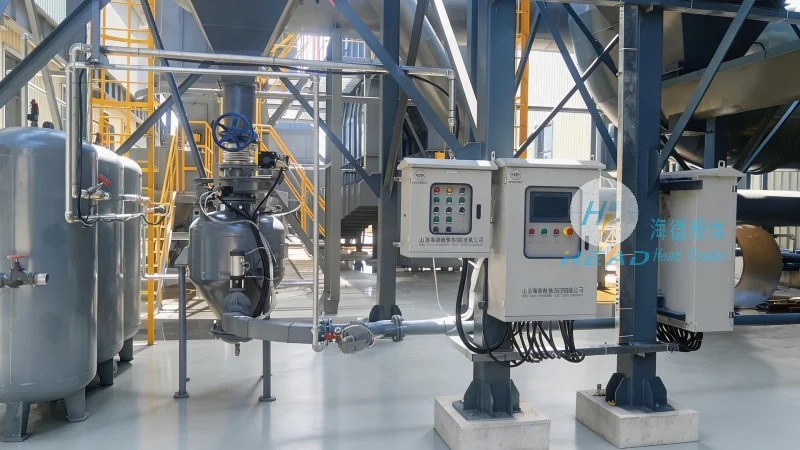
A robust activated carbon conveying system integrates several carefully selected components, each playing a specific role in maintaining gentle yet efficient material flow. The typical equipment chain includes:
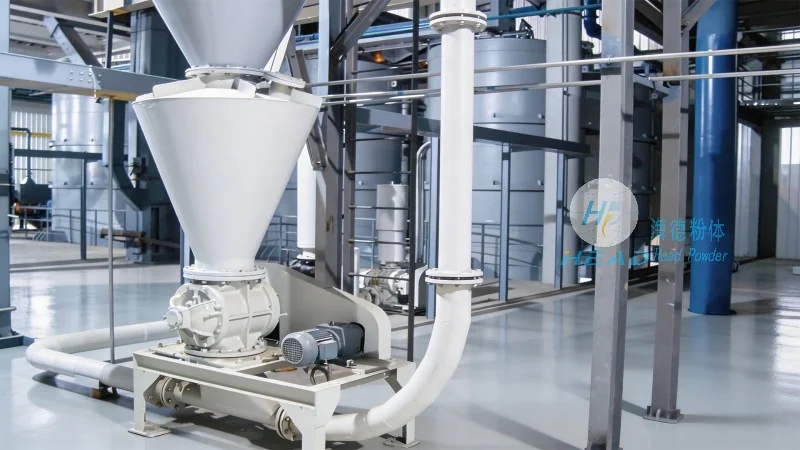
The choice between dilute-phase and dense-phase conveying for activated carbon powder hinges on throughput requirements, material degradation tolerance, and pipeline length. Dilute phase, operating at air velocities of 18–28 m/s and low pressure (0.5–1.5 bar), is the most common method for distances up to 300 meters and capacities below 15 metric tons per hour. It offers simplicity, lower initial cost, and easier component replacement. However, the high velocity can cause particle attrition (breaking of porous structures) and wear on pipe walls, which may be unacceptable for applications where the carbon's adsorption capacity must be preserved. Dense-phase conveying, with air velocities of 3–10 m/s and pressures of 2–7 bar, moves material in slugs or plugs at a much lower velocity, reducing attrition and wear by up to 60% compared to dilute phase. It is ideal for longer distances (up to 1,500 meters) and for materials that are friable or highly abrasive. For activated carbon powder, dense phase is increasingly preferred in carbon-in-pulp (CIP) and carbon-in-leach (CIL) gold recovery processes, where maintaining particle integrity is critical. Headpowder has developed a proprietary dense-phase system that uses a combination of bottom-discharge blow tanks and controlled air injection to create stable plug flow even with low bulk density powders. Field data from an operational plant in Southeast Asia showed that the dense-phase system reduced fine generation from 12% to 4.2% compared to a previous dilute-phase installation, while cutting power consumption by 35%.
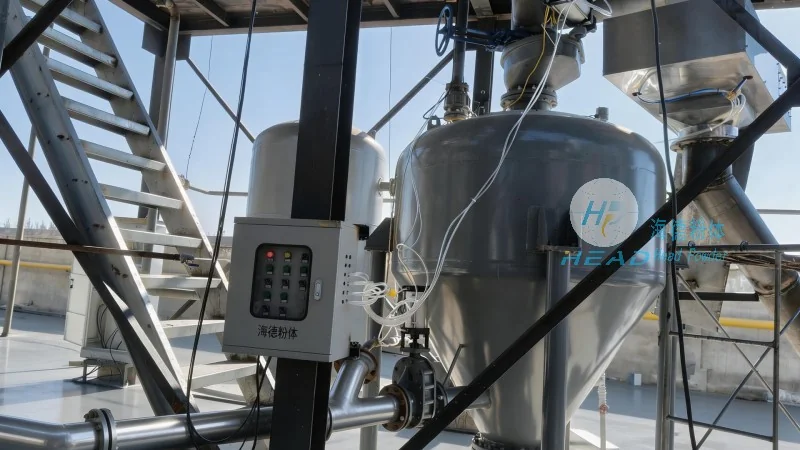
When specifying equipment for an activated carbon powder pneumatic conveying system, engineers must evaluate several quantitative parameters to ensure reliable performance. Below are the typical ranges and recommended values based on Headpowder's experience across more than 200 installations worldwide:
Activated carbon powder is classified as a combustible dust (Kst value typically between 120 and 250 bar·m/s) and requires strict explosion prevention measures. A complete system solution must integrate explosion venting, suppression, or isolation devices in accordance with EN 14460 or NFPA 68 standards. Headpowder designs all conveying systems with the following safety features: explosion-relief panels on the receiver hopper and baghouse, passive isolation valves (e.g., flap valves or chemical suppression barriers) at the rotary feeder inlet, and grounding of all conductive components to prevent electrostatic discharge. Additionally, because activated carbon can adsorb volatile organic compounds (VOCs) and moisture from the air, the conveying air should be pre-filtered and dehumidified when the ambient relative humidity exceeds 70%. The control system automatically adjusts the air flow and blower speed based on real-time pressure and flow feedback, maintaining optimal conveying conditions while minimizing energy use. A modern system also integrates with the plant's distributed control system (DCS) via industrial ethernet protocols such as Modbus TCP or PROFINET, allowing centralized monitoring of conveying rates, filter differential pressure, and equipment health. Headpowder offers a cloud-based analytics module that tracks historical trends and alerts operators to potential blockages or wear before they cause downtime.
Headpowder has supplied activated carbon powder pneumatic conveying systems to numerous clients in diverse industries. One notable project involved a major water treatment facility in the Middle East that required conveying 8 t/h of coconut shell–based activated carbon over a distance of 180 meters to 24 dosing points. The original system used mechanical screw conveyors, which suffered from high maintenance and dust leakage. Headpowder replaced it with a dilute-phase negative pressure system combined with a venturi eductor at each dosing point. The result was a 40% reduction in maintenance labor, a drop in dust emissions to below 2 mg/m³ in the working area, and a consistent dosing accuracy of ±0.5%. In another case, a pharmaceutical manufacturer needed to transfer 500 kg/h of highly friable activated carbon from a storage silo to a blending vessel 50 meters away, with strict particle size retention requirements. Headpowder installed a dense-phase system using a blow tank with a specially designed porous cone that fluidizes the powder evenly. Post-installation testing confirmed that the particle size distribution before and after conveying remained identical within measurement error, and the system operated at a power cost of only 3.2 kWh per ton — 60% less than the client's previous vacuum system. These case studies demonstrate that a properly engineered pneumatic conveying solution not only improves operational efficiency but also preserves product quality and reduces total cost of ownership. Headpowder (contact: 156-6277-7102) offers free material testing and feasibility studies to help clients determine the optimal system configuration for their specific activated carbon grade and application.
To maximize the service life and reliability of an activated carbon powder pneumatic conveying system, a structured maintenance program is essential. Headpowder recommends the following schedule and practices:
By adhering to these practices, operators can achieve upwards of 95% conveying availability and extend component life by 30–50% compared to reactive maintenance approaches.
The selection and implementation of an activated carbon powder pneumatic conveying system is a complex engineering challenge that demands deep understanding of material behavior, pneumatic principles, and operational constraints. A generic, off-the-shelf system will almost certainly fail to meet performance, safety, and efficiency targets when dealing with this challenging powder. Headpowder's approach — combining thorough material characterization, computational fluid dynamics (CFD) modeling, and a modular equipment platform — delivers systems that achieve consistent throughput, low degradation, minimal maintenance, and full regulatory compliance. With the global push toward stricter emission controls and the increasing use of activated carbon in emerging applications such as carbon capture and battery materials recycling, the need for reliable powder handling will only grow. Companies that invest in a well-designed pneumatic conveying solution today will gain a competitive edge through reduced operating costs, higher product quality, and greater process flexibility. For organizations evaluating a new system or seeking to upgrade an existing one, consulting with an experienced engineering partner like Headpowder is the first step toward a successful, long-term solution. By leveraging proprietary design tools, a proven track record in more than 200 installations, and a commitment to continuous innovation, Headpowder ensures that your activated carbon powder conveying system performs as intended — day after day, ton after ton.

 Shandong headpowder Engineering Co., Ltd.
 156-6277-7102(Manager Zhang)
  0531-83386006
  Jinan City, Shandong Province, China
服务热线
微信咨询
回到顶部