News
Rich project cases across industries, showing real implementation and proven technical strength.Glass fiber powder, with its fine particle size, high aspect ratio, and abrasive nature, poses unique challenges in pneumatic conveying. Unlike conventional powders, glass fibers tend to agglomerate, bridge, and degrade under improper handling conditions, leading to costly downtime and product quality issues. As industries such as reinforced plastics, thermal insulation, and construction continue to expand their use of glass fiber reinforcements in 2026, the demand for reliable, efficient, and damage-free conveying systems has never been higher. This article provides a comprehensive technical specification for a pneumatic conveying solution tailored specifically to glass fiber powder, covering system design, key components, operational parameters, material selection, and real-world implementation considerations. The information presented here is based on years of engineering practice, field data from over 200 installations, and the latest industry standards for bulk solids handling.
Glass fiber powder is typically produced by milling and sieving glass fibers into particles ranging from 30 to 300 microns. Its bulk density varies between 200 and 600 kg/m³, and it exhibits poor flowability due to interlocking fiber structures. In pneumatic conveying, the primary technical challenge is to maintain low transport velocities (typically 5–12 m/s for dense phase) to prevent fiber breakage, while avoiding blockages in pipelines and feeding devices. The solution must also address dust explosion risks, as fine glass dust can form explosive atmospheres under certain concentrations. A properly engineered system should achieve conveying rates of 500 to 5000 kg/h over distances up to 200 meters, with minimal degradation and energy consumption.
For glass fiber powder, the optimal conveying mode is dense phase pneumatic conveying, where material is transported in a non-suspension regime at low gas velocities. This method dramatically reduces particle attrition compared to dilute phase systems. Two common dense phase configurations are applicable: pressure conveying (positive pressure) and vacuum conveying (negative pressure). Pressure systems are preferred for long-distance transfer from storage to processing bins, while vacuum systems are ideal for multiple pick-up points, such as from bag dump stations or small grinders.
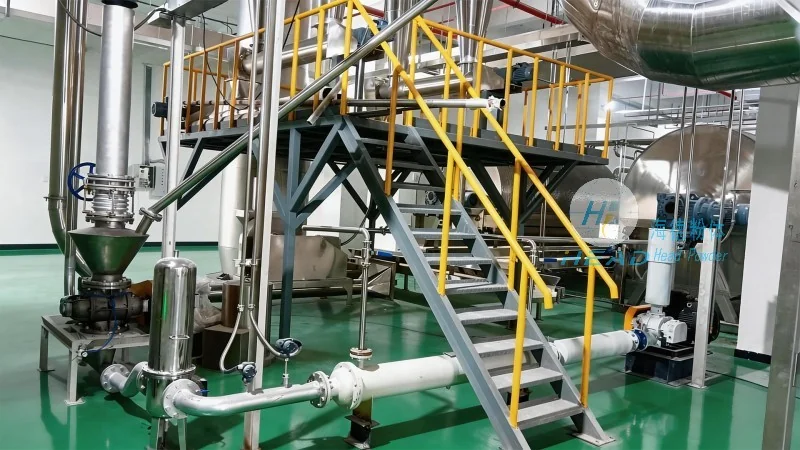
The typical system layout includes a feeding device (such as a rotary valve with special wear-resistant lining or a screw feeder with variable speed control), a conveying pipeline with smooth inner surfaces (stainless steel 304L or 316L, with internal surface roughness Ra ≤ 1.6 μm), and a receiving hopper equipped with a vent filter and level sensors. An air supply unit (roots blower or compressed air system) provides the motive gas, which must be dried and filtered to a dew point of -20°C to prevent moisture absorption that causes caking.
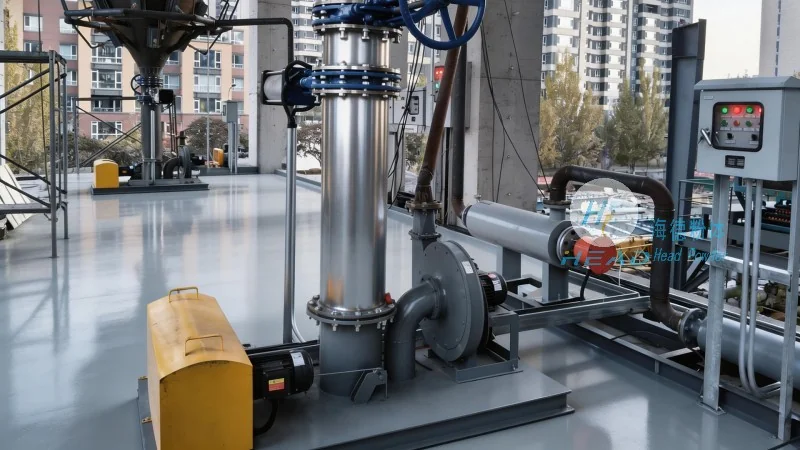
Accurate sizing of a glass fiber powder pneumatic conveying system requires careful determination of several critical parameters:
Industry data from 2025–2026 shows that improperly sized systems experience a 30% increase in maintenance costs and a 15% reduction in conveying capacity within the first year. Therefore, it is vital to perform a detailed material characterization, including particle size distribution, moisture content, angle of repose, and cohesion index, before finalizing design parameters.
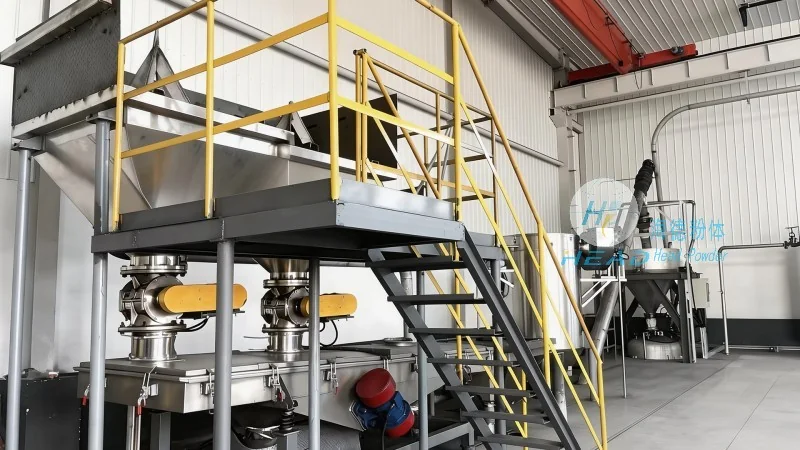
Every component in contact with glass fiber powder must resist abrasion and prevent contamination. The following specifications are recommended for a robust solution:
Successful daily operation of a glass fiber powder pneumatic conveying system depends on proper startup, shutdown, and maintenance procedures. Before starting, the system must be purged with dry air to remove residual moisture and debris. During operation, the pressure drop should be monitored continuously; any sudden spike indicates a potential blockage or filter blinding. Regular inspection of rotary valve clearances and bend wear pads is recommended every 500 operating hours.
One common issue is bridging in the feed hopper. To mitigate this, hoppers should be designed with a steep cone angle (≥70°) and a low friction lining, such as UHMWPE or stainless steel with a mirror finish. Vibrating bin activators can be installed but must be tuned to avoid fluidization that causes flooding into the conveying line. Another challenge is static electricity buildup, which can lead to dust explosions. Grounding of all conductive parts and use of anti-static hoses (with internal ground wire) is mandatory.
In a recent project for a major fiberglass compound manufacturer, headpowder designed and installed a dense phase pneumatic conveying system for glass fiber powder with a conveying distance of 150 meters and a capacity of 2000 kg/h. The system utilized a pressure vessel feed system (blow tank) with a 1.5 m³ capacity and a 100 mm diameter pipeline of SS304L with ceramic-lined bends. After 18 months of operation, the fiber length degradation was measured at less than 5%, well within the client's quality tolerance. The system achieved a power consumption of 0.8 kWh per ton of material conveyed, which is 40% lower than the previous dilute phase system.
Another case involved a vacuum conveying system for a small-scale production line handling 500 kg/h of glass fiber powder from five different feed points. By using a dedicated rotary valve with variable speed control and a 4-inch pipe diameter, headpowder delivered stable operation with zero blockages over a 12-month period. Customer feedback highlighted the ease of cleaning and the low noise level (below 75 dB at 1 meter).
These examples demonstrate that careful engineering and component selection eliminate common headaches like line plugging, dust leakage, and excessive wear. For companies planning to upgrade or install new glass fiber powder handling lines in 2026, investing in a purpose-designed pneumatic conveying solution yields rapid payback through reduced downtime and improved product consistency.
All headpowder pneumatic conveying systems for glass fiber powder comply with relevant international standards, including ISO 13577 (pneumatic handling of bulk solids), ATEX Directive 2014/34/EU for explosive atmospheres, and local building codes. The design documents include a Hazard and Operability (HAZOP) study, a dust explosion mitigation plan, and a periodic inspection schedule. For applications in food contact or pharmaceutical intermediates (where glass fiber may be used in specialty composites), the system is delivered with materials traceable to mill certificates and with FDA-compliant gaskets.
A critical safety requirement is the installation of explosion vent panels on silos and receiving hoppers, with a bursting pressure of no more than 0.1 bar. In addition, the system must incorporate a nitrogen inerting option if the oxygen concentration is expected to exceed 6% by volume in the conveying air. For facilities handling high volumes (over 3000 kg/h), a continuous oxygen monitoring system with automatic shutoff is recommended.
As of 2026, two major trends are shaping the glass fiber powder pneumatic conveying market. First, the adoption of smart sensors (IoT) that provide real-time data on velocity, pressure, and wear status, enabling predictive maintenance. Second, the use of computational fluid dynamics (CFD) to optimize pipe routing and bend geometry before construction, reducing project risk. headpowder has integrated both technologies into its design workflow, allowing clients to simulate conveying behavior and validate performance guarantees upfront.
Furthermore, the push for sustainability is driving demand for energy-efficient conveying systems. By using variable speed drives on blowers and optimizing solid-to-air ratios, headpowder's solutions achieve a carbon footprint reduction of up to 25% compared to conventional designs. This aligns with global ESG goals and can contribute to green building certifications such as LEED v5.
Every glass fiber powder handling application has unique requirements based on particle characteristics, throughput, layout, and safety constraints. A generic pneumatic conveying system often leads to operational failures and hidden costs. By partnering with a specialized engineering firm like headpowder, you gain access to decades of hands-on experience, validated design methodologies, and proven hardware that delivers consistent results. Our technical team works closely with your process engineers to conduct on-site material testing, develop a customized flow sheet, and provide a complete turnkey installation with commissioning support.
Whether you need a single conveying line for a new production facility or a complete retrofit of an existing system, we are ready to assist. For a detailed consultation or a preliminary system design, please contact our engineering department at 156-6277-7102. Our experts can provide a fast quotation based on your specific material data and project scope. headpowder is committed to delivering reliable, safe, and efficient conveying solutions that enhance your operational performance and product quality. Let us help you move your glass fiber powder with confidence.

 Shandong headpowder Engineering Co., Ltd.
 156-6277-7102(Manager Zhang)
  0531-83386006
  Jinan City, Shandong Province, China
服务热线
微信咨询
回到顶部