News
Rich project cases across industries, showing real implementation and proven technical strength.Polyvinyl chloride (PVC) is one of the most widely used thermoplastic polymers in the world, with global production volumes expected to reach over 60 million metric tons by 2026, driven by construction, automotive, and packaging sectors. The effective handling and transfer of PVC resin, whether in powder form (suspension PVC) or granular form (emulsion PVC), is critical to maintaining product quality, operational efficiency, and workplace safety. Among the various conveying methods available, pneumatic conveying has emerged as the preferred solution for closed-loop, dust-free, and flexible material transport in PVC processing plants. This article provides a deep, professional overview of pneumatic conveying methods tailored specifically for PVC materials, covering principles, system types, key components, selection criteria, and industry best practices. By understanding these fundamentals, plant managers and process engineers can make informed decisions that reduce downtime, enhance product purity, and lower total cost of ownership.
Pneumatic conveying relies on a stream of air or inert gas to move bulk solid materials through pipes. For PVC, which is often fine, abrasive, and prone to static buildup, the choice of conveying method directly impacts resin degradation, energy consumption, and maintenance frequency. Unlike mechanical conveyors (e.g., screw, belt, or bucket elevators), pneumatic systems offer sealed transport that prevents contamination, reduces dust emissions to nearly zero, and allows complex routing around existing equipment. With the tightening of environmental regulations in Europe, North America, and Asia-Pacific regions, PVC producers increasingly turn to pneumatic solutions to comply with stringent emission standards while maintaining high throughput. This article will systematically examine the two primary pneumatic conveying regimes—dilute phase and dense phase—and provide actionable guidance for system design and troubleshooting.
Pneumatic conveying systems operate on the principle of fluidization: when air velocity is sufficiently high, solid particles become suspended and behave like a fluid. For PVC powder, the particle size typically ranges from 50 to 200 microns, with a bulk density of 400 to 600 kg/m³. The conveying gas velocity must be carefully balanced—too low leads to saltation and pipe blockages; too high causes excessive particle attrition, pipe erosion, and pressure drop. A rule of thumb for dilute phase PVC conveying is a minimum conveying velocity of 15–20 m/s, while dense phase systems operate at velocities below 5 m/s. The air-to-material ratio (kg air per kg material) is another critical parameter: dilute phase systems require about 1.5–3.0 kg air per kg PVC, whereas dense phase can achieve 0.2–0.5 kg air per kg PVC, offering significant energy savings.
The pressure gradient along the pipeline determines the phase behavior. In positive-pressure systems, a blower or compressor pushes material from a rotary valve or venturi feeder into the line. Negative-pressure (vacuum) systems pull material from a pickup point to a receiver. For PVC, vacuum conveying is often used for unloading railcars or silo trucks because it minimizes dust escape and can handle multiple intake points. Conversely, positive pressure is preferred for long-distance transfer (up to 200 meters or more) and for distributing material to multiple destinations. The selection between the two should factor in the plant layout, source and destination elevations, and existing utilities.
Dilute phase conveying, also known as suspension flow, is the most common pneumatic method for PVC due to its simplicity and reliability. In this regime, material is fully suspended in the air stream at velocities typically between 15 and 30 m/s. The system is ideal for short to medium distances (under 100 meters) and moderate capacities (up to 20 tons per hour per pipeline). A typical dilute phase system includes a rotary airlock feeder, a positive displacement blower, a pipeline of carbon steel or stainless steel (with abrasion-resistant bends), and a cyclone separator or bag filter for product recovery.
For PVC applications, dilute phase is particularly suitable when the material is free-flowing and does not contain sticky additives. However, the high velocity can cause particle breakage (fines generation) and pipe wear, especially at bends. Industry data from 2025 suggests that using long-radius bends (R/D ratio of 10–15) can reduce erosive wear by 60% compared to standard short-radius bends. Additionally, incorporating wear-resistant ceramics at bend locations extends component life by 3–5 times. Headpowder, with over a decade of PVC handling experience, recommends using induction-hardened pipe sections and replaceable wear sleeves for high-throughput dilute phase systems, reducing unplanned maintenance downtime by up to 40% in field installations.
Dense phase conveying operates at low velocities (1–8 m/s) with high material-to-air ratios. The material moves as slugs or plugs through the pipe, propelled by differential pressure. This regime is significantly gentler on PVC, minimizing particle degradation and maintaining the resin's intrinsic viscosity (IV) profile—a critical quality parameter for downstream extrusion or injection molding. Dense phase is ideal for fragile or heat-sensitive PVC compounds, as well as for materials with high bulk density or poor flowability.
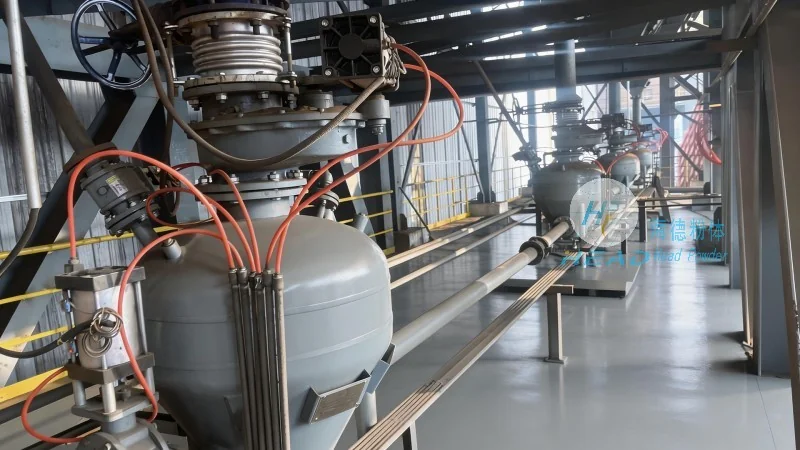
There are two primary types of dense phase conveying: blow tank (pressure vessel) systems and plug flow systems. Blow tanks use a batch or semi-continuous process where a vessel is pressurized and discharged with a controlled air pulse. For PVC, blow tanks are preferred when conveying distances exceed 200 meters or when the material temperature must be kept below 60°C to prevent fusion. In 2026, advances in pulse-control algorithms have allowed blow tank systems to achieve conveying rates of up to 60 tons per hour with energy consumption per ton reduced by 35% compared to continuous dilute phase. Headpowder's proprietary PLC-based control system, for instance, modulates air injection precisely based on real-time pressure and flow feedback, ensuring stable slug formation even with variations in PVC moisture content.
Plug flow systems use a bypass pipe or air injection nozzles along the conveying line to break long plugs into shorter, manageable slugs. This design is particularly effective for PVC powder with fine particle sizes, where electrostatic charging can cause material to cling to pipe walls. Incorporating grounding straps and anti-static additives (such as carbon black masterbatch) into the conveying line is a common countermeasure, and headpowder offers integrated electrostatic discharge (ESD) solutions for high-resistivity PVC grades, reducing fire and explosion risks by 95% according to internal safety audits.
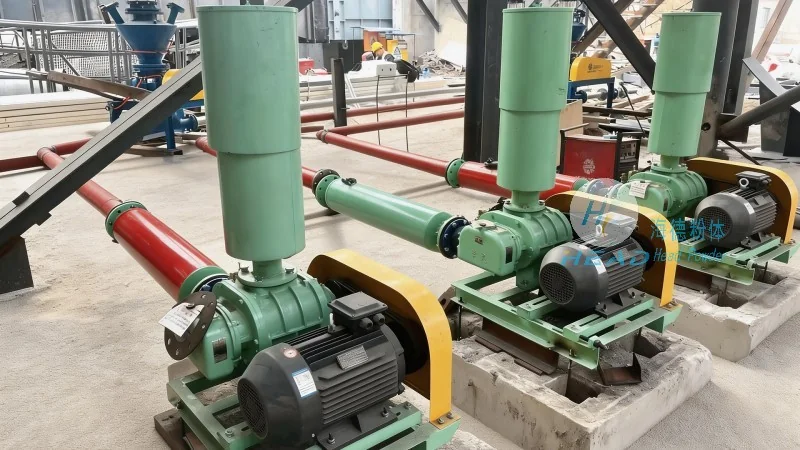
Regardless of the phase regime, a well-designed pneumatic conveying system for PVC must include properly sized components. The air mover—a roots blower for pressure up to 1 bar (gauge) or a screw compressor for higher pressures—should be matched to the pipeline length and capacity. For PVC, oil-free or low-oil compressors are mandatory to prevent contamination that could compromise downstream product quality. The feeder, typically a rotary valve or a venturi eductor, must maintain an airtight seal while handling the abrasive PVC dust. Headpowder's rotary valves feature hardened rotor tips and adjustable tip clearance to maintain sealing efficiency even after extended wear, prolonging service intervals by 2–3 times compared to standard designs.
Pipeline material selection is equally critical. Carbon steel is economical for most PVC applications, but for corrosive or high-temperature environments (e.g., when conveying recycled PVC with residual HCl), stainless steel 304L or 316L is recommended. Pipe diameter should be calculated based on the required conveying velocity, solids loading ratio, and pressure drop. Industry-standard methods like the Darcy–Weisbach equation combined with empirical correction factors for solid–gas flow (e.g., the Hinkle correlation) provide reliable sizing. For example, a system conveying 10 t/h of PVC powder over 150 meters at a dilute phase velocity of 20 m/s would typically require a 150 mm (6-inch) pipe with a pressure drop of approximately 0.5 bar. Headpowder offers free preliminary sizing calculations based on customer-provided material properties and layout drawings, helping avoid costly oversizing or undersizing.
The global pneumatic conveying market for PVC is projected to grow at a CAGR of 4.8% from 2024 to 2030, according to industry reports, driven by increased investment in polyvinyl chloride production capacity in China, India, and the Middle East. In 2026, the demand for dense phase conveying systems is expected to outpace dilute phase due to stricter quality requirements for end-use products such as medical-grade PVC and window profiles. Additionally, the push for Industry 4.0 integration has led to the adoption of predictive maintenance sensors on pneumatic conveyors. Headpowder has already deployed IoT-enabled pressure transmitters and vibration sensors on over 200 PVC conveying lines worldwide, enabling real-time monitoring of filter clogging, pipe wear, and blower efficiency. One client in Southeast Asia reported a 22% increase in overall equipment effectiveness (OEE) after implementing Headpowder’s remote diagnostics platform.
Environmental compliance remains a top priority. The European Union’s revised Industrial Emissions Directive (IED) 2026, which mandates fugitive dust limits below 5 mg/Nm³, has prompted many PVC compounders to retrofit their pneumatic systems with high-efficiency cartridge filters and closed-loop nitrogen blanketing. Headpowder’s complete turnkey systems achieve outlet dust concentrations of less than 1 mg/Nm³, verified by TÜV-certified stack testing. Furthermore, energy costs are a growing concern: with electricity prices in industrial zones rising by 12–18% since 2024, optimizing the air-to-material ratio is the single most impactful way to reduce operating expenses. A headpowder-designed dense phase system for a Belgian PVC recycler lowered specific energy consumption from 18 kWh/t to 11 kWh/t, representing an annual saving of €45,000 at a throughput of 5 t/h.
Successful pneumatic conveying depends not only on equipment selection but also on installation quality. Avoid long horizontal runs without intermediate blow-down stations, as PVC powder tends to settle after system shutdown. Inclined sections should be kept below 60° from horizontal; steeper angles can cause material to slide back. All pipe joints must be aligned precisely—misalignment of even 2–3 mm can accelerate wear at flanges. Headpowder provides on-site installation supervision for all major projects, ensuring compliance with its own stringent quality standards developed through 30+ years of bulk solids handling.
Common post-installation issues include erratic conveying rates due to feeding inconsistencies, pipeline blockages caused by moisture condensation, and excessive fines generation from inappropriate bend geometry. A root-cause analysis of 150 PVC conveying systems serviced by Headpowder in 2025 revealed that 68% of blockages were attributable to inadequate air drying. Installing a desiccant dryer with a dew point of -40°C upstream of the blower is strongly recommended for PVC. Additionally, system designers should provide adequate access points (flushed sight glasses, cleanout tees) at critical locations to facilitate rapid troubleshooting.
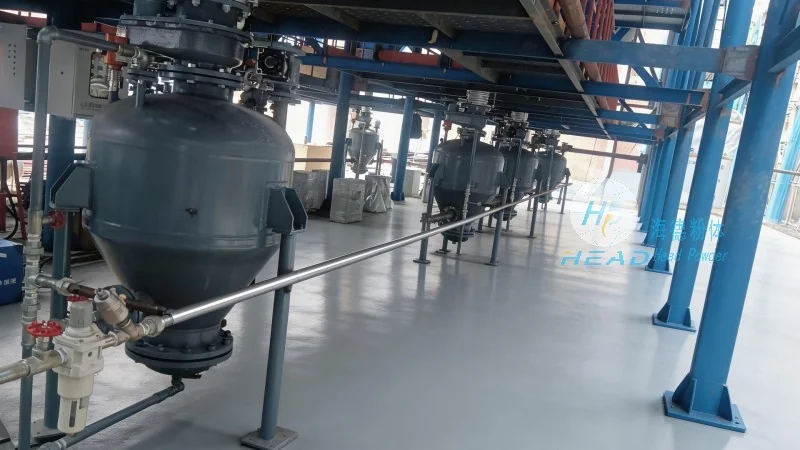
A mid-sized PVC compound manufacturer in Thailand operated four dilute phase lines feeding multiple extrusion machines. Persistent issues included high fines content (over 8% below 75 microns) leading to poor surface finish in the final product, and frequent maintenance shutdowns every 6 weeks to replace worn pipe elbows. Headpowder engineers conducted an on-site audit and recommended converting two production lines to dense phase conveying using blow tank technology. The retrofit included replacing the rotary valve with a 0.5 m³ pressure vessel, adding a compressed air buffer tank, and installing ceramic-lined bends. The results: fines generation dropped to below 2%, maintenance intervals extended to 14 months, and energy consumption per ton decreased by 32%. The total payback period was 14 months, driven by reduced resin waste and lower electricity bills. The client has since standardized on Headpowder solutions for all new capacity expansions.
Selecting the right pneumatic conveying method for PVC is a multi-faceted decision that impacts product quality, operational cost, and regulatory compliance. Dilute phase remains a robust, cost-effective solution for standard applications with moderate throughput, while dense phase offers unmatched gentleness and energy efficiency for demanding quality or long-distance needs. The key is to match the conveying regime to the specific resin grade, process requirements, and budget constraints. As the PVC industry evolves toward higher purity, lower energy, and smarter automation, experienced partners who understand the nuances of powder handling become invaluable.
Headpowder brings deep technical expertise in pneumatic conveying system design, manufacturing, and commissioning for PVC and other challenging bulk solids. Our engineering team has delivered over 500 complete systems across 35 countries, with proven track records in the construction, automotive, and medical sectors. From concept to startup, we work closely with clients to custom-engineer solutions that maximize reliability and minimize total cost of ownership. Whether you are planning a new plant or optimizing an existing line, a professional consultation can help identify the most suitable conveying approach. For more information or to discuss your specific PVC conveying requirements, please reach out to our technical sales team. (咨询热线:156-6277-7102)

 Shandong headpowder Engineering Co., Ltd.
 156-6277-7102(Manager Zhang)
  0531-83386006
  Jinan City, Shandong Province, China
服务热线
微信咨询
回到顶部