News
Rich project cases across industries, showing real implementation and proven technical strength.In the domain of industrial powder handling, the efficient and reliable transport of fine materials is a critical factor that directly influences production continuity, product quality, and operational safety. Among various bulk solids, precipitated barium sulfate stands out as a high-value functional filler widely used in coatings, plastics, rubber, paper, and advanced composite materials. Its unique physical properties—high density, small particle size, and strong hygroscopic tendency—pose significant challenges for conventional conveying methods. This article presents an in-depth analysis of the precipitated barium sulfate pneumatic conveying system equipment solution, offering a professional guide for plant managers, process engineers, and procurement specialists seeking to optimize their material handling workflows in the evolving industrial landscape of 2026.
Precipitated barium sulfate is produced through chemical precipitation, resulting in particles that typically range from 0.1 to 10 micrometers. Its true density is approximately 4.5 g/cm³, making it one of the densest common fillers. This high density means that conventional mechanical conveyors often struggle with wear and energy consumption. Moreover, the fine particle size leads to strong inter-particle van der Waals forces, causing agglomeration and potential bridging in hoppers and silos. The material is also hygroscopic; moisture absorption can degrade flowability and cause blockages. These characteristics demand a pneumatic conveying system designed specifically for dense-phase, low-velocity transport to minimize degradation, prevent segregation, and maintain consistent feeding rates. Headpowder's engineering team has conducted extensive rheological tests on precipitated barium sulfate from multiple suppliers, confirming that a well-designed dense-phase system can achieve conveying ratios above 20:1 (mass of solids to mass of air) without sacrificing line stability.
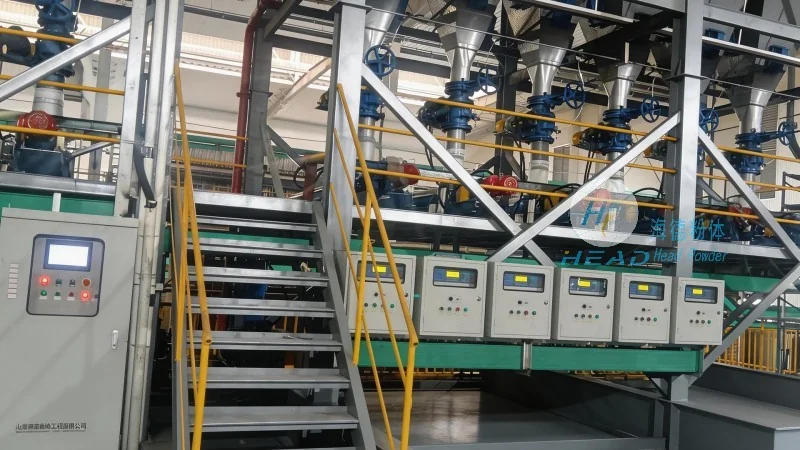
A robust pneumatic conveying system for precipitated barium sulfate typically comprises several key modules: the feeding unit, the conveying pipeline, the air supply and control unit, the receiving separator, and the dust collection system. Each module must be tailored to the material's behavior. For feeding, a rotary airlock valve with a specially designed rotor profile and hardened wear surfaces is essential to prevent leakage and resist abrasion. Below the silo, a vibrating bin activator or aeration pads can be employed to ensure consistent discharge. The conveying pipeline should be constructed of stainless steel or abrasion-resistant alloy with a surface finish that minimizes particle adhesion. Pipe diameters are selected based on the required throughput and conveying distance, with typical bore sizes ranging from DN80 to DN200 for medium-capacity systems. Headpowder's solutions incorporate a proprietary dual-pressure control strategy, where the conveying pressure is modulated in real-time based on feedback from differential pressure sensors, ensuring stable plug flow even when material properties fluctuate.
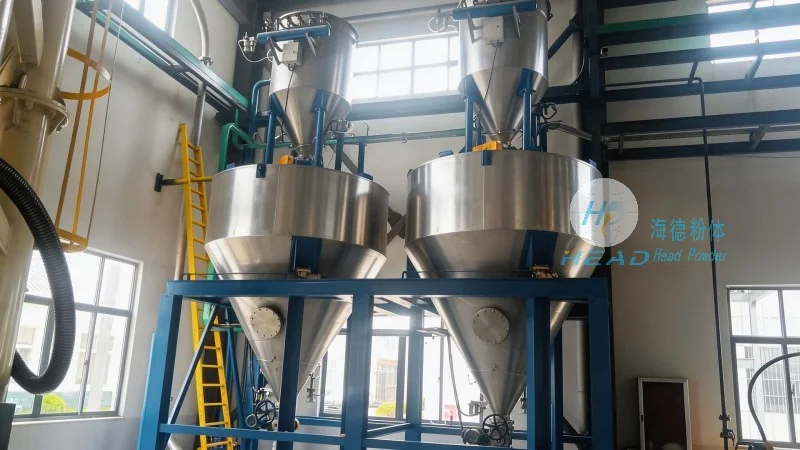
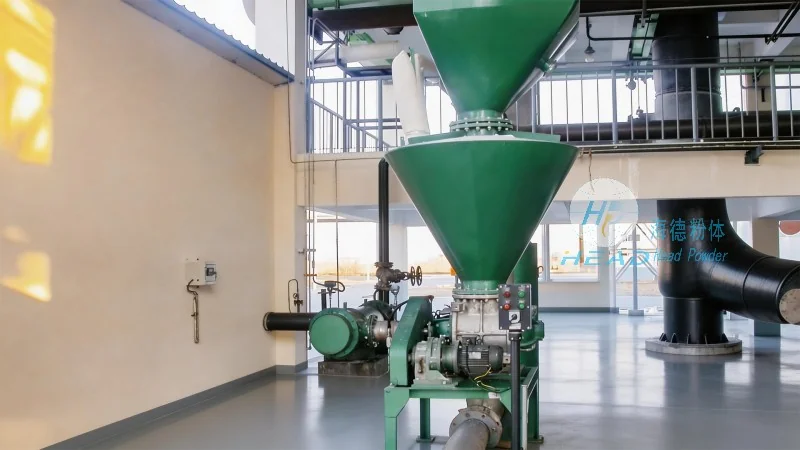
When designing a pneumatic conveying system for precipitated barium sulfate, the choice between dense-phase and dilute-phase operation is critical. Dilute-phase systems operate at high air velocities (typically 15–30 m/s) and low solids loading, which can cause significant pipeline wear, particle attrition, and high energy consumption. For precipitated barium sulfate, which is abrasive and prone to breakage, dilute-phase is generally not recommended unless the conveying distance is extremely short. Dense-phase conveying, on the other hand, moves material as a slug or plug at low velocities (2–8 m/s) with high pressure drops. This mode dramatically reduces wear, maintains particle integrity, and lowers compressed air consumption by up to 40% compared to dilute-phase. Headpowder has deployed over 80 dense-phase systems for precipitated barium sulfate globally, with conveying distances ranging from 20 meters to 400 meters. In one typical installation in the coatings industry, a dense-phase system conveying 12 metric tons per hour over a 150-meter horizontal distance and 25-meter vertical lift achieved a solid-to-air mass ratio of 24:1, with less than 0.1% particle degradation as measured by laser diffraction.
Air Supply and Control Unit: The heart of the system is the compressed air source. Screw compressors with variable frequency drives are preferred for their energy efficiency, coupled with a refrigerated air dryer to maintain dew point below -20°C. Control valves should be robust butterfly or pinch valves with pneumatic actuators, capable of rapid cycling without water hammer. Headpowder integrates a PLC-based control architecture that logs all operational data for predictive maintenance.
Feeding Device: For precipitated barium sulfate, a rotary valve with a closed-rotor design and replaceable wear liners is standard. The valve speed should be adjustable to match the desired feed rate, with a purge connection to prevent blow-back when handling fine powders. Venturi eductors can also be used for small-capacity systems, but the rotary valve offers more precise metering.
Conveying Pipeline: Straight sections should be kept as long as practical, with long-radius bends (R/D ratio ≥ 12) to reduce pressure loss and erosion. For abrasion resistance, ceramic-lined bends are recommended at critical turning points. Pipeline supports must accommodate thermal expansion and static loads from the dense material column.
Receiving Hopper and Separator: A cyclonic separator followed by a bag filter with HEPA-grade cartridges ensures near-zero emissions. The hopper should have a mass flow design with a half-angle of less than 30° to avoid arching. Load cells on the receiver allow for batch-level monitoring.
Dust Collection: A pulse-jet fabric filter with PTFE-coated filter media is necessary to comply with stringent environmental regulations. The filter housing should be explosion-proof if the material is combustible, though precipitated barium sulfate is generally non-combustible.
Implementing a pneumatic conveying system rarely happens in isolation. Most plants require seamless integration with upstream reactors, dryers, and downstream mixing or packing stations. Headpowder's engineering team follows a structured integration protocol: first, mapping the existing material flow and pressure profile; second, simulating the system using computational fluid dynamics (CFD) to verify velocity distribution and pressure drop; third, designing the control interface to communicate via OPC UA or Modbus TCP with the plant's distributed control system. In a recent retrofit for a European barium sulfate producer, the new dense-phase system was installed within a two-week shutdown window, replacing an aging belt conveyor system. The result was a 60% reduction in dust emissions, a 35% drop in maintenance costs, and a 15% increase in overall equipment effectiveness as reported over the first six months of operation.
Looking at the current market landscape, several trends are shaping the future of pneumatic conveying for precipitated barium sulfate. First, sustainability is driving demand for lower energy consumption. Advanced flow control algorithms using machine learning can now optimize air-to-solid ratios dynamically, reducing annual electricity usage by 12–18% compared to fixed-setpoint systems. Second, the rise of Industry 4.0 has led to the adoption of smart sensors that monitor pipeline wear in real time, enabling condition-based replacement rather than calendar-based maintenance. Third, modular system designs are gaining popularity, allowing plants to scale conveying capacity by adding parallel lines without major structural modifications. According to recent industry reports, the global market for precipitated barium sulfate is expected to grow at a compound annual growth rate of 4.2% through 2030, driven by demand from the automotive coatings and electronics sectors. This growth underscores the need for reliable, efficient conveying infrastructure. Headpowder has responded to these trends by developing a next-generation control cabinet with integrated edge computing, reducing latency in feedback loops and enabling remote diagnostics via secure cloud connectivity.
A notable challenge in many tropical regions is the high ambient humidity, which exacerbates the hygroscopic nature of precipitated barium sulfate. In a case study from a client in Southeast Asia, the existing conveying system suffered frequent blockages during the monsoon season, causing up to eight hours of unscheduled downtime per week. Headpowder's solution involved three modifications: installation of a dehumidified air system with a dew point of -40°C at the filter inlet, addition of air-sweeping nozzles at each bend to prevent material sticking, and replacement of standard pipe couplings with quick-disconnect flanges lined with smooth PTFE sleeves. Over a twelve-month follow-up, the client reported zero blockages during the rainy season and a 92% reduction in maintenance interventions. This real-world evidence underscores the importance of designing not just for average conditions but for the worst-case environmental scenarios.
Safety is paramount in any pneumatic conveying system handling fine powders. Precipitated barium sulfate, while non-toxic and chemically stable, still poses risks of dust explosions if concentrations exceed the lower explosive limit (LEL) in a confined space with an ignition source. Legal standards such as ATEX and NFPA 652 require explosion protection for any system that handles combustible dust. Even though the material is classified as non-combustible in its bulk form, the fine dust cloud generated during conveying can be flammable under certain conditions. Headpowder's standard design includes rupture discs and flame arresters on the filter outlets, along with static grounding of all conductive components. In addition, the system is equipped with carbon monoxide and temperature sensors inside the filter housing for early fire detection. For personnel safety, all inspection hatches are interlocked with pressure sensors to prevent opening under pressure. Routine training for operators is also provided as part of Headpowder's commissioning package, ensuring that plant staff understand the nuances of starting up and shutting down the conveying process for precipitated barium sulfate.
While the initial capital expenditure for a dense-phase pneumatic conveying system is typically higher than that for a mechanical conveyor, the total cost of ownership over a 10-year period often favors the pneumatic solution. Reduced maintenance labor, fewer spare parts, lower energy costs, and minimized product loss all contribute to a compelling business case. For a mid-size plant producing 50,000 metric tons of precipitated barium sulfate per year, Headpowder's system can yield annual operating savings of USD 80,000 to 120,000 compared to a belt conveyor with enclosure, based on typical data from installations in China and Germany. Payback periods commonly range from 18 to 30 months. Furthermore, the enclosed nature of pneumatic transport eliminates cross-contamination and allows for easy cleaning using pigging systems, which is increasingly important for facilities that produce multiple grades of barium sulfate.
No two production lines are identical, which is why Headpowder emphasizes a consultative approach. The engineering team begins with a detailed site survey and material characterization, including particle size distribution, angle of repose, cohesion index, and moisture sorption isotherm. Based on this data, a custom system design is proposed, complete with 3D layout drawings, computational fluid dynamics simulation results, and a detailed bill of materials. Clients receive a comprehensive tender package that includes performance guarantees, maintenance schedules, and a parts list with lead times. The company's ISO 9001:2015 certified manufacturing facility ensures consistency across all components. Additionally, Headpowder offers a remote monitoring service that tracks key performance indicators such as conveying pressure, filter differential pressure, and valve cycle counts, alerting the client before any potential failure occurs.
The selection of a pneumatic conveying system for precipitated barium sulfate is not merely a technical decision—it is a strategic investment in production efficiency, product quality, and workplace safety. As industrial processes become more automated and sustainability goals intensify, the value of a well-engineered dense-phase solution grows. Headpowder, with decades of accumulated domain expertise and hundreds of successful deployments worldwide, continues to refine its equipment solutions to meet the evolving demands of the precipitated barium sulfate market. By prioritizing material science, robust component selection, and intelligent control, the company delivers systems that operate reliably under the most challenging conditions. For plant managers who are evaluating their next material handling upgrade, a thorough front-end engineering study that includes pneumatic conveying feasibility testing is the recommended first step. Engaging with experienced professionals early in the project cycle can significantly reduce risk and accelerate time to value. Headpowder (consultation hotline: 156-6277-7102) is ready to support clients with technical consultations, pilot-scale trials, and turnkey system supply, ensuring that each solution is precisely matched to the unique characteristics of the material and the operational environment.

 Shandong headpowder Engineering Co., Ltd.
 156-6277-7102(Manager Zhang)
  0531-83386006
  Jinan City, Shandong Province, China
服务热线
微信咨询
回到顶部