
Glass fiber powder, a finely milled material derived from recycled or virgin glass fibers, plays an increasingly vital role in modern composite manufacturing, construction materials, automotive components, and thermal insulation products. Unlike conventional powders, glass fiber powder exhibits distinct physical characteristics—elongated particle shapes, high aspect ratios, moderate abrasiveness, and a tendency to generate static electricity—that pose significant engineering challenges for material handling systems. Pneumatic conveying, the process of transporting bulk solids through pipelines using a gas stream, has emerged as the preferred method for moving glass fiber powder across various production stages. However, designing a reliable and efficient pneumatic conveying system for this specific material demands a deep understanding of its rheological behavior, particle dynamics, and interaction with conveying air. Inadequate system design can lead to frequent blockages, excessive pipe wear, particle degradation, inconsistent feed rates, and ultimately production downtime. As the global composite materials market continues to expand—projected to reach over $140 billion by 2026 according to industry forecasts—manufacturers are increasingly seeking specialized conveying solutions that balance throughput, energy efficiency, and product integrity. headpowder, a technology-driven company with years of hands-on experience in pneumatic conveying systems for challenging powders, has developed tailored approaches that address the unique demands of glass fiber powder conveyance, combining robust engineering principles with field-proven innovations.
Glass fiber powder, typically produced through grinding or milling processes, has a particle size distribution ranging from 20 µm to 500 µm, with a mean particle diameter often between 50 µm and 150 µm depending on the application. The fibrous nature of the particles means they are not perfectly spherical; instead, they possess elongated shapes with length-to-diameter ratios that can exceed 10:1. This morphology creates several challenges during pneumatic transport. First, the high aspect ratio leads to increased inter-particle friction and mechanical interlocking, which can cause bridging and arching in hoppers and feeder outlets. Second, the sharp edges of broken glass fibers contribute to abrasion on pipe walls, especially at bends and elbows, reducing system longevity. Third, the low electrical conductivity of glass fibers promotes static charge accumulation during high-velocity conveying, leading to material cling and potential spark hazards in combustible environments. Additionally, glass fiber powder has a true density around 2.5–2.6 g/cm³, while its bulk density can vary from 0.3 to 0.8 g/cm³ depending on compaction, making it moderately cohesive. Moisture content, even at low levels, can drastically alter flowability, as absorbed water increases surface tension between particles. These properties collectively dictate that a one-size-fits-all conveying approach is insufficient; instead, engineers must carefully select conveying phase, air velocity, pressure levels, and pipeline geometry to maintain stable transport while minimizing wear and product degradation.
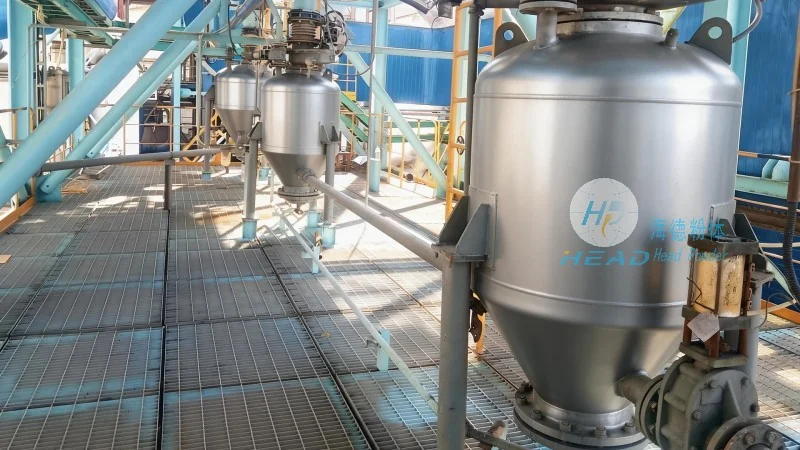
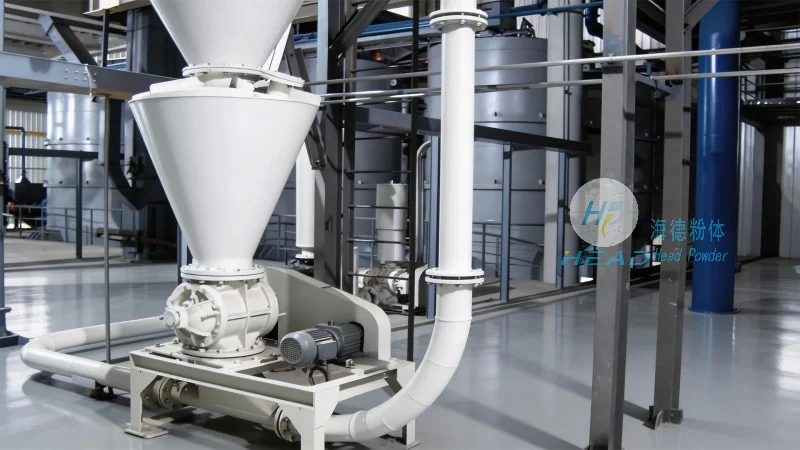
Pneumatic conveying systems are broadly classified into dilute phase (low pressure, high velocity) and dense phase (high pressure, low velocity) systems, each with distinct advantages and limitations when handling glass fiber powder. Dilute phase conveying, operating at air velocities ranging from 20 to 40 m/s and pressures under 1 bar(g), is the most common configuration for free-flowing powders. While it offers lower capital cost and simpler maintenance, the high velocities cause significant particle attrition and pipe erosion. For glass fiber powder, dilute phase is only suitable for short distances (under 50 m) and low conveying rates, as the fibrous particles become increasingly damaged during high-speed impacts. Dense phase conveying, on the other hand, operates at air velocities as low as 2 to 8 m/s, with positive displacement blowers or compressors generating pressures up to 6 bar(g). By moving the material in slugs or plugs rather than suspension, dense phase systems dramatically reduce wear and particle breakage, making them the recommended choice for fragile or abrasive powders like glass fiber. Within dense phase, two sub-types are prevalent: pneumatic transport in plug flow and in fluidized dense phase. For glass fiber powder, plug flow systems using a bypass pipe or pulse injection are particularly effective because they maintain a stable slug formation even for cohesive materials. Negative pressure (vacuum) conveying can also be employed for feeding from multiple points, but it is generally limited to shorter distances and smaller capacities. headpowder’s engineering team often recommends a combination of positive pressure dense phase for the main transport line and vacuum-assisted pickup for raw material unloading, ensuring both efficiency and gentle handling.
Designing a robust pneumatic conveying system for glass fiber powder requires precise calculation of several interdependent parameters. The most critical is the minimum conveying velocity—the lowest air speed at which the material remains airborne without settling. For glass fiber, this velocity is typically higher than for spherical powders of equivalent size due to the increased drag caused by particle shape. Standard empirical models, such as the Zenz correlation or the Rizk correlation, must be adjusted with safety margins of 20–30% to account for the irregular particle geometry. The solid-to-air loading ratio (mass of powder per mass of air) in dense phase systems for glass fiber usually falls between 15 and 40, depending on pipe diameter and conveying distance. Higher loading ratios improve energy efficiency but increase the risk of plugging if the material’s permeability is low. Pipe selection is equally important: carbon steel pipes suffer from rapid erosion at bends; thus, ceramic-lined elbows, hardened steel, or even rubber hoses in critical sections are recommended. Bend radius should be at least 1.5 to 2.5 times the pipe diameter to reduce impact forces. Air filtration must handle fine glass fiber dust, which has a tendency to clog standard filters; pulse-jet bag filters or cartridge filters with PTFE membranes are often specified. Air drying is also advisable because moisture condensation inside pipes can turn glass fiber powder into a cement-like paste, causing catastrophic blockages. In addition, grounding all conveying components—pipes, hoppers, filters—through dedicated bonding wires prevents static discharge, especially when conveying in dry, low-humidity environments. Properly sized rotary airlock feeders or screw feeders with variable speed drives ensure a consistent feed rate, while pressure transmitters and flow meters provide real-time feedback for automated control.
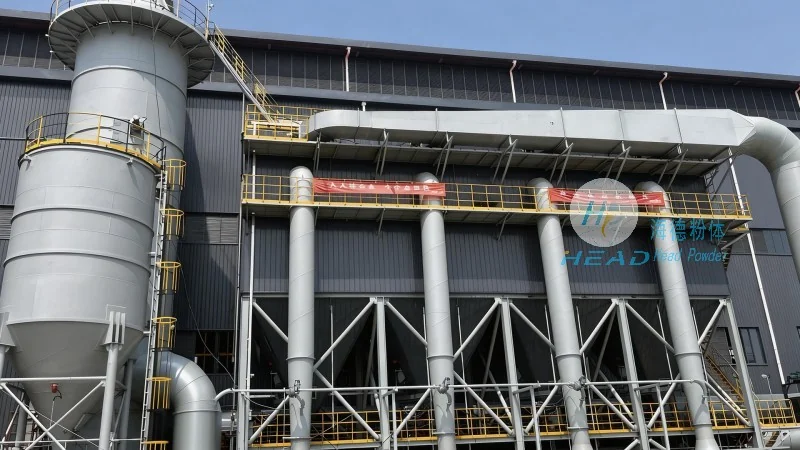
The selection of feeders, blowers, and separation equipment directly influences system reliability. For glass fiber powder, the feeder must handle the material’s cohesive nature without bridging. Rotary valves with adjustable tips and abrasion-resistant coatings work well, provided the rotor speed is tuned to avoid smearing the fibrous particles. Alternatively, venturi injector systems can be used in vacuum conveying, but they impose higher pressure drops. The air mover—whether a positive displacement blower (for low-pressure dense phase) or a screw compressor (for high-pressure systems)—should be sized with a 10–15% capacity margin above the theoretical requirement to accommodate filter loading and pipe aging. Cyclone separators, while effective for coarse particles, often fail to capture fine glass fiber dust below 10 µm, so a secondary filter is mandatory. Baghouse filters with polyester or ePTFE media, cleaned via reverse pulse jets, achieve >99.9% collection efficiency. Maintenance schedules should focus on inspecting pipe wear at bends using thickness gauges, replacing feeder seals every six months, and cleaning filter bags to prevent blinding. headpowder has documented cases where proactive maintenance reduced unplanned downtime by 40% in a glass fiber compounding plant. Additionally, system diagnostics using pressure drop trending and particle velocity sensors allow operators to predict blockages before they occur. For applications requiring high purity—such as glass fiber powder used in electronic grade composites—stainless steel pipeline construction and contaminant-free air filtration are non-negotiable.

The global demand for glass fiber powder is closely tied to the growth of composites, automotive lightweighting, and renewable energy sectors. According to a 2025 market analysis, the glass fiber powder market is expected to grow at a compound annual growth rate (CAGR) of 6.8% from 2024 to 2030, reaching approximately $2.3 billion by 2026. The Asia-Pacific region, particularly China and India, accounts for over 45% of consumption due to rapid industrialization and infrastructure development. In Europe and North America, stricter environmental regulations are driving the adoption of fiber-reinforced polymers, where glass fiber powder serves as a cost-effective filler. Concurrently, advances in pneumatic conveying technology—such as smart control systems with IoT connectivity, energy recovery from exhaust air, and modular skid-mounted designs—are enabling higher throughput while reducing operational costs. Manufacturers are increasingly demanding conveying systems that achieve less than 1% particle size degradation and maintain consistent bulk density, which directly impacts the quality of downstream products like injection molding compounds and putties. headpowder has been at the forefront of integrating these trends, deploying systems with real-time monitoring that adjust air velocity based on material moisture content, thereby avoiding energy waste and maintaining product integrity.

A practical example brings these concepts to life. A medium-sized compounder producing glass fiber-reinforced polypropylene masterbatch faced chronic issues with their existing dilute phase system: pipe blockages every 8 hours, fiber length reduction by 30% from feed to silo, and annual maintenance costs exceeding $50,000. After approaching headpowder for a solution, the engineering team conducted a thorough audit of the material’s flow characteristics using an annular shear cell and a laboratory-scale conveying test rig. Based on the data—which showed a cohesive index of 0.64 and a permeability value of 1.2×10⁻¹⁰ m²—the team designed a dense phase system operating at 3.5 bar(g) with a conveying velocity of 6 m/s and a loading ratio of 28. The pipeline was constructed with 4-inch Sch 40 carbon steel, but all 90-degree bends were replaced with ceramic-lined bends rated for a wear life of over 10,000 operating hours. A twin-screw feeder with a 10:1 turndown ratio was installed, and a pulse-jet bag filter with PTFE cartridges captured residual dust. The entire system was controlled by a PLC with touch-screen interface, allowing operators to adjust parameters on the fly. Results after six months of operation showed zero blockages, particle length retention above 95%, and a 35% reduction in energy consumption per ton conveyed. The project’s return on investment was achieved in less than 14 months, validating the design approach. This case underscores how deep material knowledge and customized engineering—exactly what headpowder delivers—can transform a problematic conveying operation into a high-performance asset. For inquiries about similar system design or upgrades, reach out directly (咨询热线:156-6277-7102).

As the glass fiber powder market matures, the need for reliable, efficient, and safe pneumatic conveying will only intensify. Emerging applications in 3D printing filaments, thermoplastic composites, and sustainable building materials will demand even tighter control over particle morphology and flow consistency. The integration of digital twin simulations using computational fluid dynamics (CFD) and discrete element method (DEM) is already enabling engineers to model conveying behavior before building physical systems, drastically reducing trial-and-error iterations. Regulatory pressure regarding worker exposure to respirable glass fibers also drives the adoption of fully enclosed conveying systems with negative pressure containment. headpowder continues to invest in research collaborations with material science institutes to develop predictive models specifically for non-spherical powders, furthering the industry’s ability to handle complex materials. For any organization involved in glass fiber powder processing—whether compounding, recycling, or end-product manufacturing—partnering with a specialized conveying expert is not just a convenience but a strategic advantage. Properly designed systems yield consistent product quality, lower operating costs, and extended equipment life, directly impacting competitiveness. The path forward involves continuous monitoring, incremental optimization, and a willingness to embrace new technologies. With the right engineering partner, the journey from raw glass fiber powder to high-value end product becomes smoother, safer, and more profitable.
Shandong headpowder Engineering Co., Ltd.
156-6277-7102(Manager Zhang)
0531-83386006
Jinan City, Shandong Province, China 
服务热线
微信咨询
回到顶部