
With over a decade of experience in the pneumatic conveying industry, our company specializes in a full range of pneumatic conveying system equipment.
您的当前位置:首页 >> News >> Technical FAQ

News

Rich project cases across industries, showing real implementation and proven technical strength.

Anode Material Pellet Conveying: Pneumatic System

2026-07-08

In the rapidly evolving landscape of battery material manufacturing, the efficiency and reliability of raw material handling directly impact production yield, cost, and safety. Among the critical unit operations, the conveying of anode material pellets stands out as a particularly demanding process due to the unique physical and chemical properties of these powders—high abrasiveness, low bulk density, electrostatic tendency, and strict purity requirements. Pneumatic conveying systems have emerged as the preferred solution for transporting anode material pellets from mixing or granulation stages to downstream processes such as pelletizing, sintering, and cell assembly. This article provides an in-depth analysis of pneumatic system design, operational parameters, material compatibility, and best practices for anode material pellet conveying, drawing on industry standards and real-world implementation insights. We will also examine how modern system architecture addresses common challenges like particle degradation, dust generation, and energy consumption, while aligning with the latest 2026 market trends toward higher throughput, closed-loop automation, and carbon footprint reduction. Whether you are a process engineer evaluating new equipment or a plant manager seeking to optimize existing lines, understanding the nuances of pneumatic conveying for anode materials is essential for achieving consistent quality and operational excellence.

Fundamentals of Pneumatic Conveying for Anode Material Pellets

Pneumatic conveying leverages air or inert gas flow to transport bulk solid materials through enclosed pipelines. For anode material pellets—typically composed of graphite, silicon, or lithium iron phosphate (LFP) variants—the system must handle particles ranging from 50 µm to several millimeters with careful control of velocity to avoid breakage or attrition. Two primary regimes are used in the industry: dilute phase and dense phase.

  • Dilute phase conveying suspends particles in a high-velocity gas stream (15–30 m/s). It is suitable for low-capacity, short-distance applications but risks particle degradation and pipe wear when handling abrasive anode pellets.
  • Dense phase conveying operates at low velocity (1–8 m/s) with high solids-to-gas ratios, moving material in slugs or plugs. This mode minimizes attrition, reduces dust generation, and lowers energy consumption per ton of material, making it increasingly favored for premium anode material processing.

Selection between these modes depends on pellet characteristics, throughput requirements, and plant layout. Recent 2026 data from industry reports indicate that dense phase systems account for over 65% of new installations in battery-grade anode material plants, driven by growing emphasis on particle integrity and cleanroom compatibility.

Critical Design Parameters for Anode Material Pellet Conveying

Designing a pneumatic system for anode pellets requires precise evaluation of several interdependent variables. Neglecting any can lead to line blockages, segregation, or excessive fines generation.

  • Particle size distribution (PSD): A wide PSD increases the risk of fines elutriation and hopper bridging. Systems must include classification or de-dusting stages upstream.
  • Material bulk density: Typical anode pellet bulk density ranges from 0.6 to 1.2 g/cm³. Lower density materials require higher air volumes or specialized feeder designs.
  • Moisture content: Even small amounts of moisture (above 0.5%) can cause agglomeration and adhesion to pipe walls, especially in humid climates. Drying or nitrogen purge is often integrated into the system.
  • Conveying distance and elevation: Longer distances or vertical lifts increase pressure drop. For a 100-meter horizontal run with 20-meter lift, a booster station or vacuum-to-pressure conversion may be necessary.
  • Pipeline material and surface finish: Stainless steel (304L or 316L) with electropolished inner surfaces reduces friction and prevents metal contamination. For abrasive pellets, ceramic-lined bends or wear-resistant elbows extend service life.

Industry standards such as ISO 10627 and DIN 15232 provide calculation frameworks for pressure drop and air velocity, but actual commissioning data from headpowder installations suggests that custom CFD modeling improves accuracy by up to 20% for complex geometries.

System Components and Their Role in Anode Material Handling

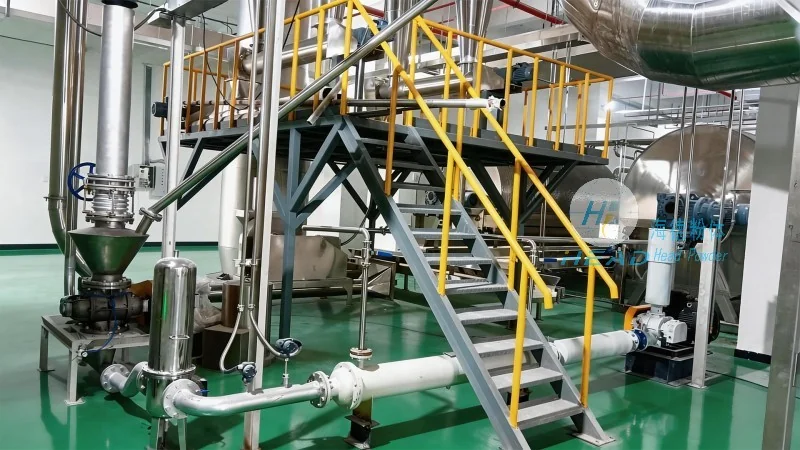
A complete pneumatic conveying system for anode pellets comprises several key modules, each requiring careful specification to maintain product quality and system reliability.

  • Feed system: Rotary valves, screw feeders, or pneumatic injectors meter pellets into the pipeline. For fragile silicon-based anodes, a venturi-type injector with gentle acceleration is recommended to avoid breakage.
  • Conveying line: Straight sections, bends, and diverters must be designed with minimum radius-to-diameter ratios of 6:1 to reduce wear and particle impact. Headpowder employs a modular flanged design that facilitates quick inspection and replacement.
  • Air mover: Positive displacement blowers are common for dense phase systems, while regenerative blowers suit dilute phase. Inert gas (nitrogen) systems are used for oxygen-sensitive materials to prevent oxidation or combustion.
  • Separation and filtration: Cyclone separators combined with bag filters or cartridge dust collectors achieve >99.9% collection efficiency. For anode fines, HEPA-grade final filters (H13) are increasingly mandated by battery manufacturers.
  • Control system: PLC-based automation with real-time pressure, flow, and temperature monitoring enables adaptive control. Advanced systems integrate mass flow meters and particle velocity sensors for closed-loop optimization.

Common Challenges and Mitigation Strategies in Anode Pellet Conveying

Even well-designed pneumatic systems encounter operational difficulties when handling anode materials. Understanding these challenges and implementing proactive solutions is critical for minimizing downtime.

  • Attrition and fines generation: High-velocity collisions degrade pellet quality, altering electrochemical performance. Mitigation includes reducing conveying velocity below critical erosion thresholds (typically < 10 m/s for graphite) and using impact-absorbing liners.
  • Electrostatic charging: Anode pellets, especially synthetic graphite, accumulate static charge during conveying. This can cause adhesion to pipe walls, sparking hazards in explosive atmospheres. Grounding straps, anti-static additives, or ionizing bars are standard remedies.
  • Blockage and bridging: Intermittent flow or moisture leads to plug formation. Proper aeration in hoppers, vibration aids, and stepped pipeline diameters help maintain consistent material movement.
  • Wear and corrosion: Abrasive particles erode elbows and valves. Scheduled inspection using ultrasonic thickness gauging and replacement of wear parts at 80% of expected life can prevent unexpected failures.

Industry Trends Shaping Anode Material Conveying in 2026

The global anode material market is projected to exceed 1.2 million metric tons by 2026, according to recently published research. Several technology trends are driving changes in pneumatic conveying design:

  • Larger-scale production lines: Single-line capacities now reach 20,000 tons per year, requiring conveying systems capable of 10–15 tons per hour with minimal footprint. Modular dense phase systems from headpowder are engineered to scale without sacrificing particle quality.
  • Inert gas recirculation systems to reduce nitrogen consumption by 40–60% are gaining adoption, lowering operational costs and environmental impact.
  • Digital twin and predictive maintenance: Sensor data combined with AI algorithms can forecast wear patterns and optimize cleaning cycles, reducing unplanned downtime by up to 30%.
  • Regulatory compliance: EU and US battery regulations (e.g., EU Battery Regulation 2023/1542) impose strict limits on dust emissions and worker exposure. Pneumatic systems must incorporate closed-loop filtration and real-time emission monitoring.

Case Study: Optimized Dense Phase Conveying for High-Capacity Anode Plant

A leading battery materials manufacturer in Asia approached headpowder to retrofit an existing dilute phase line that was producing excessive fines (over 8% below 10 µm) and suffering from frequent elbow replacements every three months. After a comprehensive audit of their anode pellet properties (bulk density 0.85 g/cm³, median particle size 180 µm), headpowder proposed a dense phase conveying system with the following specifications:

  • Conveying velocity: 4–6 m/s, controlled via variable frequency drive on the blower.
  • Pipeline: 6-inch Sch 10 stainless steel with ceramic-lined bends at 12-inch radius.
  • Feeder: Nitrogen-purged locking rotary valve with a soft-start torque profile.
  • Control: PLC with real-time pressure monitoring and automatic velocity adjustment based on material flow feedback.

Post-installation results showed fines generation reduced to 1.2%, energy consumption decreased by 35%, and pipe elbow life extended beyond 18 months. The system has been running continuously for over 14 months with zero blockages. For more information on how headpowder can design a tailored pneumatic conveying solution for your anode material line, contact our engineering team at 156-6277-7102.

Selection Criteria for Pneumatic System Suppliers

Choosing the right partner for anode pellet conveying is as important as the technology itself. Beyond equipment specifications, evaluate suppliers on the following dimensions:

  • Process expertise: Does the supplier demonstrate deep knowledge of anode material rheology and handling characteristics? Request references from similar battery material projects.
  • Testing and validation: Reputable suppliers offer pilot-scale testing with your actual material to confirm design parameters before full-scale fabrication. headpowder operates a dedicated test facility with throughput capacities from 100 kg/h to 10 t/h.
  • After-sales support: Spare parts availability, remote diagnostics, and on-site commissioning services directly affect lifecycle cost. Look for suppliers with regional service centers.
  • Compliance and certifications: ISO 9001, ATEX/IECEx for explosive environments, and CE marking are baseline requirements. For battery-grade applications, cleanroom compatibility (ISO Class 7 or better) may be necessary.

Maintenance Best Practices for Long-Term Reliability

Anode Material Pellet Conveying: Pneumatic System

Even the most robust pneumatic system requires routine maintenance to sustain performance. Implement a preventive program that includes:

  • Weekly inspection of filter bags for tears and pressure drop across baghouse.
  • Monthly wear measurement at critical elbows using laser scanning or coupon analysis.
  • Quarterly calibration of pressure transmitters and flow sensors.
  • Annual replacement of seals in rotary valves and diverter gates.
  • Continuous monitoring of motor current and vibration to detect bearing degradation early.

Data from headpowder's installed base indicates that facilities following a structured maintenance schedule experience 40% fewer unplanned shutdowns and 25% longer component life compared to reactive approaches.

Future Outlook: Pneumatic Conveying in Solid-State Battery Manufacturing

Anode Material Pellet Conveying: Pneumatic System

As solid-state battery technologies mature (targeting commercialization around 2028–2030), anode materials will shift toward sulfide-based or halide-based solid electrolytes. These materials are extremely moisture-sensitive and require entirely enclosed, inert-gas-purged conveying systems. Pneumatic solutions that can maintain dew points below -60°C and integrate with glovebox-class environments will be in high demand. Early-stage development work suggests that dense phase conveying with helium or argon as the carrier gas can meet these stringent requirements while maintaining gentle transport. headpowder is actively participating in collaborative R&D programs to adapt its conveying platforms for next-generation battery materials, ensuring that clients remain at the forefront of process innovation.

Conclusion: Achieving Operational Excellence in Anode Pellet Conveying

Anode Material Pellet Conveying: Pneumatic System

Pneumatic conveying remains the most efficient and hygienic method for transporting anode material pellets, but success hinges on careful system design that respects material-specific properties, operational constraints, and evolving industry standards. By selecting the correct conveying regime—typically dense phase for modern anode pellets—optimizing pipeline geometry, and integrating intelligent control systems, manufacturers can significantly reduce waste, lower energy costs, and improve product consistency. The 2026 market demands higher throughput, lower carbon footprint, and stricter quality assurance; pneumatic systems that address these requirements will become a competitive differentiator. Headpowder brings years of specialized experience in designing, manufacturing, and commissioning pneumatic conveying solutions for battery materials, with a track record of measurable performance improvements across global installations. For expert consultation or to request a feasibility study, please contact our team at 156-6277-7102. Let us help you build a conveying system that delivers precisely what your anode material process needs—reliability, purity, and scalability.

相关推荐

Shandong headpowder Engineering Co., Ltd. All rights reserved.

回到顶部