
With over a decade of experience in the pneumatic conveying industry, our company specializes in a full range of pneumatic conveying system equipment.
您的当前位置:首页 >> News >> Technical FAQ

News

Rich project cases across industries, showing real implementation and proven technical strength.

Baking Powder Conveying: Pneumatic Conveying Guide

2026-07-08
Baking powder is a chemically sensitive, hygroscopic, and often micro‑fine powder that demands meticulous handling throughout its production, packaging, and distribution. In the industrial baking powder manufacturing environment, any deviation in conveying method can lead to moisture absorption, chemical degradation, particle segregation, or even dust explosion hazards. Pneumatic conveying has emerged as the preferred technology for baking powder transport because it offers a closed, sanitary, and precisely controllable system that preserves product integrity while maximizing throughput. This guide provides a comprehensive technical examination of pneumatic conveying systems specifically for baking powder, covering system selection, design parameters, operational best practices, and industry‑proven solutions. Whether you are upgrading an existing line or designing a new facility, understanding the interplay of air velocity, material properties, and system geometry is essential to achieve reliable, efficient, and safe baking powder conveying.

The global baking powder market, valued at approximately USD 1.8 billion in 2025, continues to expand at a compound annual growth rate of 4.2% through 2030, driven by rising demand for convenience baked goods and clean‑label products. As production scales up, manufacturers face increasing pressure to optimize material handling without compromising the delicate chemical balance of baking powder — which typically contains sodium bicarbonate, one or more acid salts (such as sodium aluminium sulfate, monocalcium phosphate, or cream of tartar), and a starch‑based carrier. These components must remain uniformly blended and free from moisture or contamination. Pneumatic conveying offers a closed‑loop solution that meets these stringent requirements while enabling continuous, automated material flow. This guide draws on decades of field experience and engineering data to help operators, plant managers, and process engineers select, configure, and maintain the right pneumatic system for baking powder.

Understanding the Unique Properties of Baking Powder That Affect Pneumatic Conveying

Baking powder is not a simple free‑flowing powder. Its physical and chemical characteristics directly influence conveying behavior, energy consumption, and equipment wear. The bulk density of baking powder typically ranges from 0.6 to 0.9 g/cm³, but the actual value depends on the formulation, particle size distribution, and degree of aeration. The mean particle size often falls between 30 and 150 microns, with a significant fraction of fines below 20 microns. These fine particles create cohesive and electrostatic challenges during conveying. Additionally, baking powder is hygroscopic: even brief exposure to ambient humidity above 60% relative humidity can cause clumping, caking, or premature reaction between the acid and base components. Therefore, any pneumatic conveying system must operate with dry, conditioned air and maintain a sealed environment.

Another critical factor is the explosibility of baking powder dust. Although baking powder itself is not classified as a highly explosive dust under normal conditions, the starch carrier (often cornstarch or wheat starch) can create a combustible dust cloud if the concentration reaches the lower explosive limit. According to standard dust explosion testing (ASTM E1226), typical baking powder dust has a Kst value ranging from 50 to 120 bar·m/s, placing it in St1 to St2 categories. This means that proper design for static dissipation, explosion venting, and inerting is not optional — it is a safety imperative. A well‑designed pneumatic conveying system for baking powder must incorporate grounding, bonding, and pressure relief mechanisms to comply with international standards such as NFPA 69 and EN 14491.

System Type Selection: Dilute Phase vs. Dense Phase for Baking Powder

The two primary pneumatic conveying modes are dilute phase (suspension flow) and dense phase (non‑suspension flow). For baking powder, both have been used successfully, but the selection depends on the specific product characteristics, required throughput, and acceptable degradation level. In dilute phase conveying, the product is suspended in a high‑velocity airstream, typically above 15 m/s for fine powders. This method is simple, cost‑effective for short distances, and capable of handling multiple pick‑up points. However, the high velocity accelerates particle‑to‑wall and particle‑to‑particle collisions, which can cause attrition (breakage of starch granules) and generate additional fines. For baking powder, increased fines may worsen flowability and increase dust exposure. Dilute phase is generally acceptable for conveying over distances up to 80‑100 meters with moderate throughput, but care must be taken to avoid bends with small radii and sudden expansions.

Dense phase conveying, on the other hand, moves the material at low velocity (typically 2‑8 m/s) as a fluidized plug or continuous slug. This method drastically reduces degradation and minimizes dust generation, making it ideal for fragile or cohesive powders like baking powder. In dense phase systems, compressed air is used to push the material through the pipeline at high pressure — often 2‑6 bar(g). The product moves in a "plug flow" pattern, which is gentle on particles and maintains the blended homogeneity. However, dense phase systems require more careful sizing of the blow tank or pressure vessel, and they generally suit higher capacities and longer distances (over 100 meters). For baking powder that contains a high proportion of starch or is prone to caking, dense phase conveying provides a clear advantage in product quality preservation. headpowder has engineered dense phase solutions that reduce particle breakage by more than 60% compared to conventional dilute phase systems, while still achieving line rates of 5‑15 tonnes per hour.

Key Design Parameters for Baking Powder Pneumatic Conveying

Whether dilute or dense phase, several critical parameters must be accurately determined during the design phase. The first is conveying air velocity. Too low a velocity causes saltation or blockage; too high causes degradation and excessive wear. For baking powder, the saltation velocity (the minimum air speed to keep particles suspended) typically lies between 8 and 12 m/s for dilute phase at typical loading ratios. For dense phase, the air velocity can be as low as 2‑5 m/s, but the pressure drop across the system must be carefully modeled. Using empirical correlations such as Zenz or Dalla Valle, engineers can calculate the optimum velocity based on particle size, density, and pipe diameter. It is common practice to incorporate a 15‑20% safety margin above the calculated saltation velocity for dilute phase systems. Additionally, the conveying line pressure drop must account for straight pipe, bends, diverging/converging fittings, and the material lift height. For baking powder, a pressure drop of 20‑40 kPa per 100 meters of straight pipe is typical for dilute phase, while dense phase can reach 60‑120 kPa per 100 meters due to higher material concentration.

Another vital parameter is the solid‑to‑air ratio (loading ratio), expressed as kg of material per kg of air. For dilute phase, loading ratios are typically between 5 and 20. For dense phase, they can exceed 50. Higher loading ratios improve energy efficiency but increase the risk of pipeline plugging if the powder is cohesive. Baking powder, with its tendency to cling to pipe walls when moisture is present, requires a conservative approach — loading ratios of 15‑30 for dilute phase and 30‑50 for dense phase are generally safe. Pipe diameter selection also influences system performance. Common diameters for baking powder conveying range from DN80 to DN200, depending on throughput. A larger diameter reduces velocity and pressure drop, but also increases air consumption. The material of construction is also important: stainless steel (304 or 316) is standard for food‑grade applications, with internal surface roughness Ra < 0.8 µm to minimize particle adhesion. Using electro‑polished pipe further reduces the risk of product build‑up.

Moisture Control and Air Treatment Systems

Because baking powder is highly sensitive to moisture, the compressed air used for conveying must be thoroughly dried and filtered. Ambient air typically contains water vapor that, when cooled in the pipeline, can condense and cause premature reaction of the baking powder. The industry standard for baking powder conveying is to supply air with a dew point of at least -20°C (or lower), which corresponds to a moisture content of less than 0.6 g/m³. This is achieved through a combination of refrigeration dryers and desiccant dryers, often arranged in series. For facilities operating in humid climates, a heatless regenerative desiccant dryer is recommended to maintain consistent dew points. Oil removal filters to 0.01 ppm are also necessary to prevent contamination of the food product. Additionally, the entire conveying system should be kept under a slight positive pressure (0.1‑0.3 bar(g)) when idle to prevent the ingress of moist ambient air through seals or vents. headpowder integrates complete air treatment packages into its pneumatic conveying systems, ensuring that the air quality meets or exceeds the stringent requirements for baking powder handling.

System Components: Blowers, Feeders, and Piping Layout

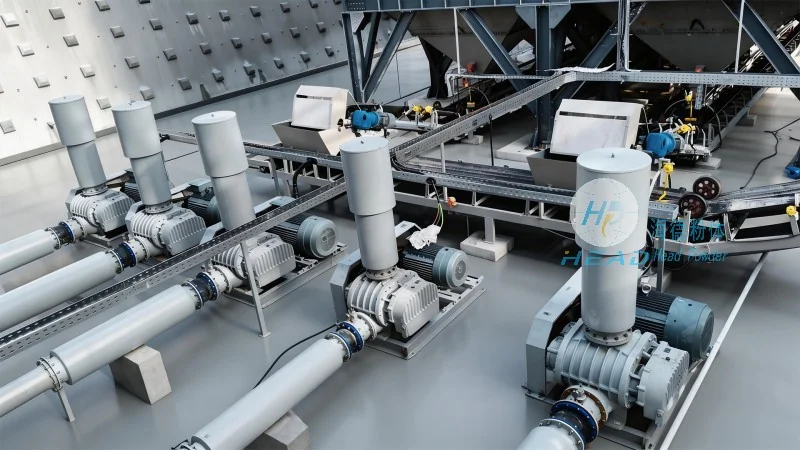
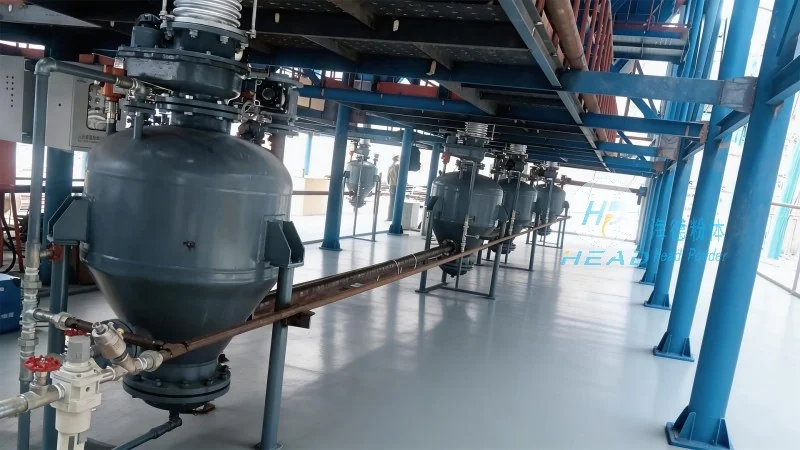
The heart of any pneumatic conveying system is the air mover — typically a positive displacement blower (Roots‑type) or a screw compressor for dense phase. For baking powder, a rotary lobe blower with a variable frequency drive (VFD) provides flexibility to adjust air volume and pressure according to changing line conditions. The blower should be sized to deliver the required air flow at the maximum pressure drop, with a margin of 10‑15%. The material feed point is equally critical. Rotary valves (airlocks) are the most common feeding device for dilute phase systems, but for baking powder they must be designed with special rotor tip clearances (0.05‑0.15 mm) to minimize air leakage and product degradation. For dense phase systems, a pressure vessel (blow tank) with a bottom discharge cone and aeration pad is standard. The aeration pad helps fluidize the baking powder before discharge, reducing the risk of bridging. The piping layout should minimize the number of bends — each bend adds pressure loss and potential for product accumulation. Long‑radius bends (R/D ratio of at least 6‑8) are recommended, and smooth interior welds are mandatory to avoid snagging or build‑up. Where possible, using T‑sections or sweep tees instead of standard 90° elbows can further reduce degradation. headpowder’s engineering team specializes in optimizing pipeline routing to achieve the shortest possible conveying path while maintaining system flexibility for future expansion.

Operational Best Practices and Maintenance

To ensure consistent baking powder quality and maximum system uptime, operators must follow a rigorous regimen of start‑up, operation, and shut‑down procedures. Before conveying, the entire line should be purged with dry air for at least 30 seconds to remove any residual moisture or foreign particles. The blower speed should be ramped up gradually to avoid a sudden surge of material that can block the line. During operation, continuous monitoring of pressure drop across key sections — such as the filter receiver, the conveying line, and the air dryer — provides early warning of potential problems. A pressure drop increase of more than 10% above baseline may indicate incipient plugging or filter blinding. Routine maintenance includes cleaning of the air filters and dryer elements every 200‑300 operating hours; inspection of rotary valve seals and rotor tips for wear; and checking of all grounding connections to ensure continuity below 10 ohms. For dense phase systems, the blow tank discharge valve and aeration pads should be inspected monthly. Keeping a log of conveying parameters for each product batch helps identify trends and optimize operating setpoints over time. headpowder provides comprehensive training and maintenance support to ensure that bakery powder producers can achieve reliable, long‑term performance from their pneumatic conveying investment.

Industry Standards and Safety Compliance

Baking powder pneumatic conveying systems must comply with multiple regulatory frameworks, including food safety (FDA, EU Regulation 1935/2004), dust explosion safety (ATEX, NFPA), and machinery safety (ISO 13849, EN 60204). The system should be designed to prevent cross‑contamination between different formulations — dedicated lines are recommended for different product types, or thorough cleaning‑in‑place (CIP) procedures should be implemented. For explosion protection, typical measures include: explosion‑proof electrical equipment in classified zones (Zone 20/21/22); passive venting panels on filter receivers and storage bins; active suppression systems; and isolation flap valves at critical locations. The maximum safe operating pressure for the conveying line (usually 3‑6 bar(g) for dense phase, 0.5‑1.5 bar(g) for dilute phase) must be clearly marked, and relief valves or rupture discs installed to protect the system from overpressure. headpowder designs all its baking powder conveying systems to meet or exceed these international safety standards, providing full documentation for plant audits and insurance compliance.

Application Case Study: Automated Baking Powder Transfer in a Modern Production Facility

Baking Powder Conveying: Pneumatic Conveying Guide

To illustrate the practical implementation of these principles, consider a recent installation by headpowder at a large‑scale baking powder manufacturing plant in the Midwest United States. The facility required transferring 12 tonnes of baking powder per hour from a central blending silo to four packaging lines located 85 meters away, with a vertical lift of 18 meters. The product had a bulk density of 0.72 g/cm³ and a moisture content of 1.2% (as‑received). After detailed analysis, a dense phase pneumatic conveying system was selected, utilizing a pressure vessel with a 1.5 m³ capacity, a 150 mm stainless steel pipeline with 10 long‑radius bends, and a desiccant dryer delivering air at -25°C dew point. The system was equipped with a VFD‑controlled screw compressor to adjust air flow dynamically based on product demand. During the first year of operation, the system achieved an average conveying rate of 12.3 tonnes per hour with a specific energy consumption of 2.8 kWh per tonne, while generating less than 0.5% fines — a 70% reduction compared to the previous dilute phase system. The closed‑loop design eliminated moisture exposure, and after‑sales monitoring showed zero product caking or rehydration incidents. This case demonstrates how a properly designed pneumatic conveying system can simultaneously improve throughput, product quality, and safety.

Future Trends and Technological Developments

Baking Powder Conveying: Pneumatic Conveying Guide

Looking ahead to 2026 and beyond, several trends are shaping the evolution of baking powder pneumatic conveying. The adoption of Industry 4.0 principles is driving the integration of real‑time sensors for pressure, flow, temperature, and humidity, coupled with machine learning algorithms that predict blockages or wear before they occur. Wireless monitoring of filter receiver pressure and hopper level sensors allows plant managers to optimize conveying schedules and reduce energy waste. Additionally, there is growing interest in vacuum‑assisted dense phase systems that combine the benefits of low‑velocity conveying with simplified dust collection. Another emerging area is the use of pneumatic conveying for traceability: by encoding batch information in the conveying sequence, manufacturers can precisely track which raw material lots are delivered to each packaging line. Sustainability pressures are also pushing for lower energy consumption; modern positive displacement blowers with high‑efficiency motors and smart control algorithms can reduce energy use by up to 30% compared to older systems. headpowder continuously invests in R&D to incorporate these advancements into its baking powder conveying solutions, ensuring customers benefit from the highest operational efficiency and lowest total cost of ownership.

Conclusion: Selecting the Right Partner for Your Baking Powder Conveying Needs

Baking Powder Conveying: Pneumatic Conveying Guide

Baking powder conveying is a technically demanding application that requires deep understanding of powder behavior, fluid dynamics, and regulatory compliance. A well‑engineered pneumatic system not only preserves the chemical and physical integrity of the product but also enhances plant safety, reduces waste, and improves overall equipment effectiveness. From the initial material characterization to the final commissioning and ongoing support, every decision — from conveying mode selection to pipe material, air treatment, and control strategy — directly impacts the success of the installation. As the market for baked goods continues to grow, manufacturers cannot afford to compromise on conveying reliability or product consistency. Investing in a system designed specifically for baking powder will pay dividends in reduced downtime, lower maintenance costs, and superior end‑product quality.

At headpowder, we bring more than a decade of focused experience in pneumatic conveying for the food powder industry. Our engineering team collaborates with your process engineers to develop a solution tailored to your specific formulations, throughput targets, and facility layout. We provide end‑to‑end service — from feasibility studies and system design through fabrication, installation, commissioning, and training. Every system is backed by rigorous testing in our pilot plant, which simulates real‑world conditions for baking powder and similar hygroscopic blends. We also offer a comprehensive performance guarantee: if the system does not meet the agreed conveying rate and product quality specifications, we will modify it at our cost. For more information on how headpowder can help you optimize your baking powder conveying process, contact us directly. (咨询热线:156-6277-7102) Our specialists are ready to discuss your specific requirements and provide a detailed proposal with technical data from comparable installations.

相关推荐

Shandong headpowder Engineering Co., Ltd. All rights reserved.

回到顶部