
Sintered lime, also known as quicklime or calcium oxide (CaO), is a high-temperature processed material widely used in steelmaking, flue gas desulfurization, water treatment, and construction. Its handling presents distinct challenges: it is hygroscopic, prone to dust generation, abrasive, and can react exothermically with moisture. Traditional mechanical conveyors such as screw feeders or bucket elevators often face issues with material degradation, seal leakage, dust escape, and maintenance downtime. Pneumatic conveying has emerged as the preferred technology for transporting sintered lime across many industrial facilities because it offers enclosed, flexible, and low-maintenance solutions. This article provides an in-depth analysis of pneumatic conveying systems designed specifically for sintered lime, covering system configurations, design parameters, operational considerations, and the latest market trends projected through 2026. Whether you are upgrading an existing plant or planning a new facility, understanding the engineering principles behind dense-phase and dilute-phase conveying will help you achieve higher efficiency, reduced energy consumption, and improved safety. The discussion draws from field-proven installations and references industry standards such as the ANSI/CEMA guidelines and the European standard EN 13463 for equipment in potentially explosive atmospheres. By the end of this technical overview, you will have a comprehensive framework to evaluate conveying solutions for your sintered lime application, and you will see why headpowder has become a trusted partner for many global operators seeking reliable pneumatic systems.
Before selecting a pneumatic conveying system, engineers must understand the physical and chemical characteristics of the material being handled. Sintered lime typically has a bulk density ranging from 800 to 1100 kg/m³, depending on the degree of sintering and particle size distribution. The particle shape is irregular with sharp edges, which contributes to abrasiveness. The material is also mildly cohesive when moist, but under controlled conditions it flows freely. One critical property is its high reactivity with water: even ambient humidity can cause slaking, generating heat and forming calcium hydroxide, which can plug pipelines and corrode equipment. Therefore, the conveying air must be dry, and the system must be designed to minimize moisture ingress. Additionally, sintered lime is classified as a nuisance dust, and fine particles below 10 microns can pose respiratory hazards. Depending on the process, the dust may also be combustible under certain concentrations, so explosion protection measures such as venting panels or inert gas purging may be required. These factors collectively dictate the choice between dilute-phase (high velocity, low pressure) and dense-phase (low velocity, high pressure) pneumatic conveying. Dilute-phase is simpler but generates more fines and abrasion due to higher velocities (20–30 m/s), whereas dense-phase operates at much lower velocities (2–8 m/s) and is gentler on the material, reducing degradation and pipe wear. For sintered lime, dense-phase conveying is often recommended when material integrity and low dust generation are priorities, but dilute-phase remains viable for short distances or when the lime is already in a coarser form. headpowder engineers routinely conduct material characterization tests including particle size analysis, angle of repose, and shear cell tests to determine the optimal conveying regime for each client's specific lime grade.
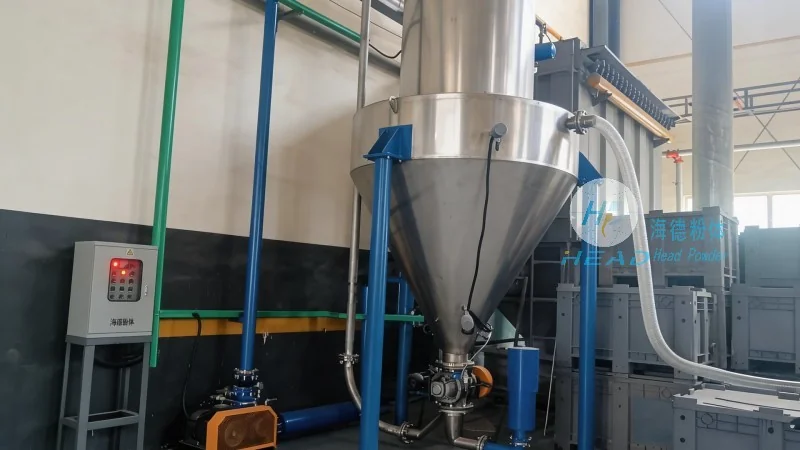
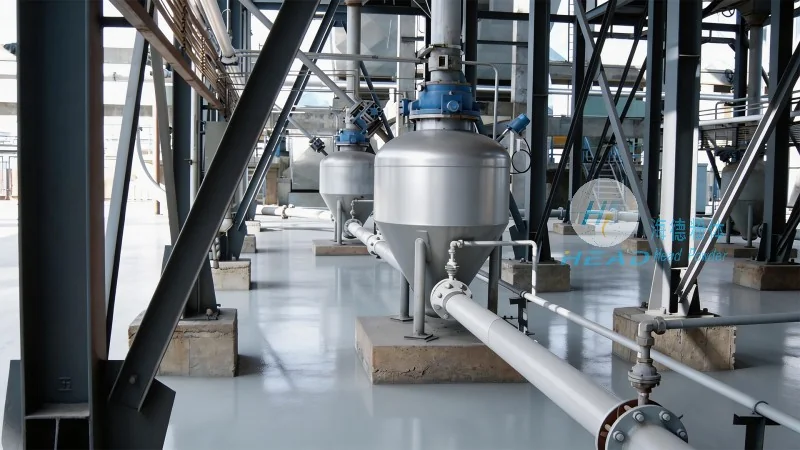
Pneumatic conveying systems for sintered lime can be broadly categorized into two main configurations: pressure systems (blowing) and vacuum systems (suction). Pressure systems are more common for long-distance transport and high capacities because they allow higher differential pressure across the pipeline. In a typical pressure dense-phase system, sintered lime is fed from a storage silo into a pressure vessel known as a blow tank. Compressed air (or nitrogen for inert atmosphere) is introduced at the bottom of the blow tank to fluidize the material and push it through the conveying pipeline. The air is supplied by positive displacement blowers or screw compressors, and the flow is controlled by a combination of air injection nozzles and control valves. For longer runs (over 300 meters) or complex routing with multiple bends, intermediate boosters may be installed to maintain the plug flow regime. Alternatively, dilute-phase pressure systems use rotary valves or venturi feeders to introduce material into a high-velocity airstream. These are simpler and cheaper but result in higher particle attrition and wear. Vacuum systems, on the other hand, draw material from multiple pickup points and deliver it to a single receiver, making them ideal for unloading railcars or trucks. The choice between pressure and vacuum often hinges on the number of source points and the layout of the plant. For example, a steel mill receiving sintered lime from multiple silos might use a pressure system for distribution to various furnace injection points, while a water treatment facility might use a vacuum system to unload bulk tankers. Regardless of the configuration, all components that contact the material—pipelines, elbows, valves, and silos—should be constructed from abrasion-resistant materials such as high-chrome white iron or ceramic-lined pipe. Sintered lime's abrasive nature can quickly erode standard carbon steel, leading to leaks and contamination. headpowder's standard design incorporates replaceable wear backs in elbows and flanged spool pieces, allowing easy maintenance without replacing entire pipe sections. This approach has been validated in dozens of installations where system availability exceeds 98% over a three-year period.
Designing a pneumatic conveying system for sintered lime requires careful calculation of several interdependent parameters: conveying distance (equivalent horizontal length including bends), vertical lift, material properties, desired throughput, air mass flow rate, and pressure drop. The most widely used method is based on the Darcy-Weisbach equation for fluid flow combined with empirical correlations for solid loading ratio (SLR). For dense-phase plug flow, the SLR can range from 10 to 40 kg of solids per kg of air, whereas dilute-phase typically operates at SLR below 5. The pressure drop across the system is composed of three components: straight pipe friction, bend losses, and lift. Each bend in a sintered lime line can cause a pressure loss equivalent to 2 to 5 meters of straight pipe, and more importantly, it accelerates wear. Therefore, the number of bends should be minimized, and long-radius bends (R ≥ 10D) are preferred. Another critical parameter is the minimum conveying velocity, which must be high enough to prevent saltation (settling of particles) but low enough to limit attrition. For sintered lime, the saltation velocity in horizontal pipes is typically between 3 and 7 m/s for dense-phase and 15 to 25 m/s for dilute-phase. These values are often verified through conveying trials using a test loop that mirrors the client's actual routing. Industry standards such as the Conveyor Equipment Manufacturers Association (CEMA) guidelines provide reference tables for pipe sizing based on material type and capacity. However, due to the variability in lime properties, it is strongly recommended to conduct a pilot test with the actual material and representative pipe geometry. headpowder operates a dedicated test facility where clients can evaluate system performance under controlled conditions. Data from these tests—including pressure profiles, velocity distribution, and particle size degradation—are used to fine-tune the design before fabrication. For example, a recent project for a lime calcining plant required conveying sintered lime over 450 meters with 12 bends and a vertical rise of 18 meters. With a target capacity of 20 t/h, the final design used a 6-inch diameter pipe, a blow tank pressure of 3.5 bar(g), and air consumption of 180 Nm³/h. The measured particle breakage was less than 2% by weight, far below the client's 5% specification. This level of predictability is only achievable when engineering firms invest in proper characterization and modeling rather than relying on generic rules of thumb.
Even with a well-designed system, pneumatic conveying of sintered lime presents several operational challenges that must be addressed through proper controls and maintenance protocols. The most common issue is pipeline blockage, often caused by moisture ingress leading to caking. A 1% increase in moisture content can cause the lime to become sticky and form a hard layer on the pipe wall, progressively narrowing the cross-section and eventually halting flow. To combat this, air dryers and filters must be installed upstream of the blower or compressor to achieve a dew point of at least -30°C. In humid climates, it is also advisable to add a small amount of desiccant or to preheat the conveying air. Another challenge is erosion of pipeline components, particularly at bends and at the material entry point. Predicted wear rates can be calculated using the Finnie model or the Archard equation, but real-world experience shows that installing ceramic tiles or using induction-hardened pipe in the first 20 meters after the blow tank can extend service life by a factor of three to five. Regular inspection schedules, such as ultrasonic thickness measurements every six months, help detect thinning before it leads to a rupture. Explosion safety is a further concern. Although sintered lime itself is not flammable, fine dust dispersed in air can explode at concentrations above the minimum explosive concentration (MEC) of around 30 g/m³. Many plant sites require the conveying system to be ATEX or NFPA compliant. Mitigation measures include using a nitrogen purge to keep oxygen levels below 8%, installing explosion venting panels on the receiver tank, and grounding all equipment to dissipate static charges. headpowder integrates these safety features as standard in systems destined for steel mills and chemical plants, and provides a comprehensive risk assessment report during commissioning. Finally, control system automation plays a major role in maintaining stable conveying. Modern programmable logic controllers (PLCs) monitor blow tank pressure, line pressure, air flow rate, and material level in real time. They adjust air injection timings and valve sequences to maintain consistent slug formation in dense-phase mode. Advanced systems can even predict imminent blockages by analyzing pressure fluctuations and automatically initiate purge cycles. These intelligent controls reduce operator intervention and improve overall system reliability.

The global market for pneumatic conveying systems is projected to grow at a compound annual growth rate of 5.8% from 2024 to 2028, driven by expansions in steel production and stricter environmental regulations on dust emissions, according to a recent report by MarketsandMarkets (2023). The sintered lime segment specifically benefits from the push toward cleaner steelmaking processes such as the electric arc furnace (EAF) route, which requires high-quality lime for slag conditioning. By 2026, we anticipate that more than 60% of new sintered lime conveying installations will adopt dense-phase technology because of its lower energy consumption (30–50% less air per ton of material) and reduced wear. Another emerging trend is the integration of digital twins—virtual replicas of the conveying system that use real-time sensor data to simulate performance and optimize parameters without interrupting production. Several large steel groups are already piloting such systems, and headpowder has developed a proprietary digital twin module that can predict remaining pipe life and identify optimal blow tank pressure settings. Furthermore, there is growing interest in carbon capture, utilization, and storage (CCUS) processes where sintered lime is used as a sorbent for CO₂. These applications demand extremely low dust emissions and high material purity, which further favors enclosed pneumatic conveying over open mechanical systems. The development of wear-resistant polymers and composite materials for pipe linings is also progressing. For example, ultra-high molecular weight polyethylene (UHMWPE) liners are being tested for lower abrasion applications, though they currently cannot withstand the high temperatures (above 80°C) that sometimes occur in lime conveying due to frictional heating. In response, manufacturers are introducing hybrid liners with ceramic inserts in high-wear zones. Finally, regulatory standards are becoming more stringent. The European Union's updated Machinery Regulation (2023/1230) requires enhanced documentation of safety functions for powder handling equipment. Companies that proactively comply with these standards—by providing detailed FMEA reports and conformity declarations—will gain market advantage. headpowder already aligns its design and documentation processes with ISO 12100 and the new EU framework, ensuring that its systems meet the highest safety and reliability benchmarks for sintered lime conveying.

To illustrate the real-world impact of well-engineered pneumatic conveying, consider a mid-sized steel plant in Southeast Asia that was using a fleet of dump trucks to move sintered lime from a nearby kiln to its EAF building. The process generated excessive dust, required frequent road cleaning, and caused inconsistent quality due to moisture pickup during transport. The plant decided to install an enclosed pneumatic conveying system with a capacity of 30 t/h over a distance of 380 meters. After evaluating proposals from three vendors, they selected headpowder because of the detailed test work and the proposed dense-phase design. The system comprised three blow tanks in a piggyback arrangement to allow continuous feeding, a 150 mm (6-inch) pipeline with ceramic-lined bends, and a nitrogen purge system for safety. Installation took eight weeks with minimal disruption to existing operations. During the first year of operation, the plant reported a 97% availability rate, with the only significant downtime occurring when a blockage caused by a batch of lime with unusually high moisture content required cleaning. In response, headpowder upgraded the air drying system and added a moisture sensor at the blow tank inlet. Subsequently, blockages dropped to near zero. The plant also measured a 15% reduction in lime consumption per ton of steel because the enclosed system eliminated spillage and improved consistency of the lime particle size. Total annual savings from reduced material loss, lower maintenance of trucks, and eliminated road cleaning exceeded USD 180,000. Furthermore, the enclosed system reduced dust emissions by more than 90%, helping the plant comply with local air quality regulations and avoid potential fines. This case demonstrates that upfront investment in a properly designed pneumatic conveying system for sintered lime yields rapid payback through operational efficiencies and compliance gains. It also underscores the importance of choosing a partner with deep domain knowledge—a core strength of headpowder. For any industrial operation handling sintered lime, the decision to adopt pneumatic conveying is not just a matter of material transport; it is a strategic move toward safer, cleaner, and more profitable production.

In summary, pneumatic conveying offers a proven, efficient, and safe method for transporting sintered lime across industrial facilities. The choice between dilute-phase and dense-phase depends on material properties, distance, capacity, and the acceptable level of degradation. Dense-phase systems, in particular, provide superior material integrity, lower energy consumption, and reduced pipe wear—making them the preferred option for most modern installations. However, the success of any system hinges on accurate design data, robust component selection, and comprehensive safety integration. Factors such as moisture control, abrasion protection, explosion mitigation, and automation must be addressed from the conceptual stage onward. As the industry moves toward 2026, trends like digital twins, advanced wear materials, and stricter regulatory compliance will continue to shape the market. Engineers and plant managers should seek suppliers who not only supply hardware but also bring extensive material handling experience, testing capabilities, and a track record of delivering custom solutions. headpowder has been at the forefront of sintered lime pneumatic conveying for over a decade, with hundreds of successful projects across steel, cement, mining, and environmental sectors. Our engineering team collaborates closely with clients to analyze site-specific challenges and propose optimized designs that balance capital cost with long-term operating cost. We also provide after-sales support including remote monitoring, spare parts management, and system audits. If you are evaluating a new conveying line or looking to upgrade an existing one, we invite you to discuss your requirements with us. (咨询热线:156-6277-7102) Our goal is to help you achieve a reliable, low-emission conveying solution that meets your production targets and sustainability goals. Ultimately, the right pneumatic system for sintered lime is one that integrates technical excellence with practical understanding of your process—exactly what we deliver at headpowder.
```
Shandong headpowder Engineering Co., Ltd.
156-6277-7102(Manager Zhang)
0531-83386006
Jinan City, Shandong Province, China 
服务热线
微信咨询
回到顶部