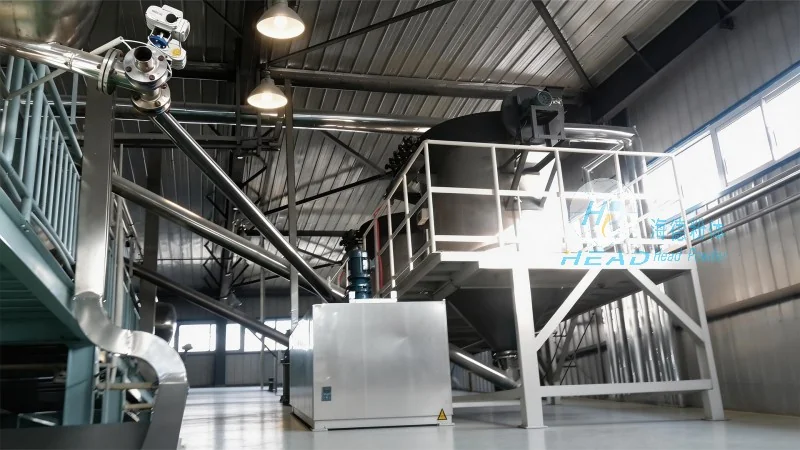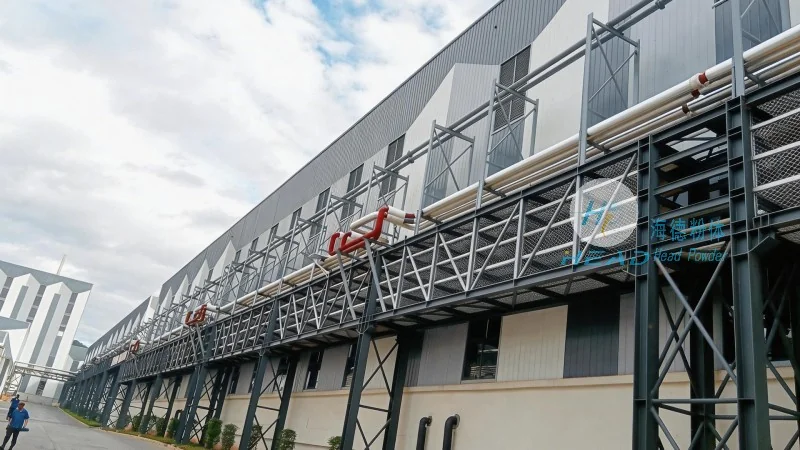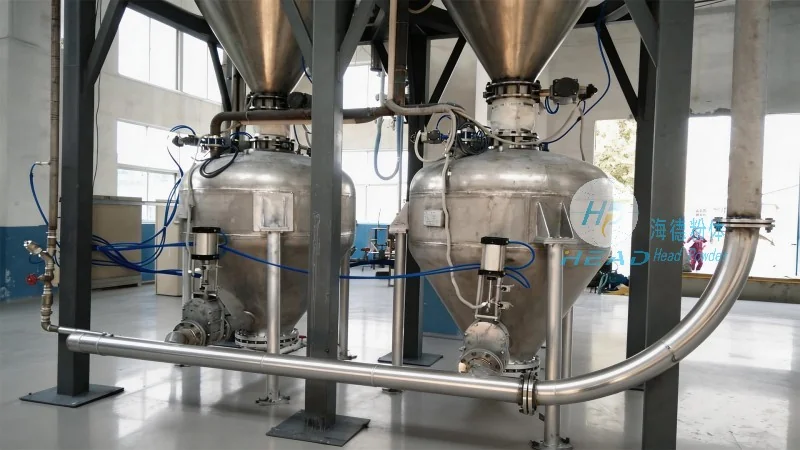

With over a decade of experience in the pneumatic conveying industry, our company specializes in a full range of pneumatic conveying system equipment.
您的当前位置:首页 >> News >> Technical FAQ

News

Rich project cases across industries, showing real implementation and proven technical strength.

Micropowder pneumatic conveying system technical introduction

2026-07-20

In the specialized field of powder handling, the micropowder pneumatic conveying system stands as a critical engineering solution for industries ranging from advanced ceramics and battery materials to fine chemicals and pharmaceuticals. As global manufacturing shifts toward higher precision and stricter environmental compliance by the year 2026, the demand for reliable, enclosed, and energy-efficient transport of micron- and sub-micron powders has never been greater. This article offers a comprehensive technical introduction to micropowder pneumatic conveying systems, examining core principles, component design, system classification, material considerations, and practical implementation strategies. The content is tailored to serve engineers, plant managers, and procurement professionals who seek in-depth knowledge for system selection and optimization, while also presenting the technical capabilities of headpowder as a dedicated partner in this domain.

Fundamental Principles of Pneumatic Conveying for Micropowder

Pneumatic conveying relies on the flow of air or an inert gas to transport particulate solids through a pipeline. For micropowders—typically defined as particles with a median diameter below 100 microns—the physics of fluidization, particle-particle interaction, and electrostatic behavior become significantly more complex compared to conventional granular materials. The system must maintain a stable suspension of fine particles within the gas stream to prevent settling, agglomeration, or pipe blockage. The key principle behind successful micropowder conveying is achieving a homogeneous dilute-phase or dense-phase flow regime that matches the specific powder characteristics. headpowder engineers have accumulated extensive data on critical velocity thresholds, saltation velocity, and pressure drop correlations for various micropowder grades, enabling system designs that balance throughput with energy consumption.

Micropowder pneumatic conveying system technical introduction

System Classification: Dilute Phase vs. Dense Phase

Choosing between dilute-phase and dense-phase conveying is the first technical decision in system design. Each approach presents distinct advantages and constraints when handling micropowders.

Micropowder pneumatic conveying system technical introduction
  • Dilute-phase conveying: In this mode, particles are fully suspended at high velocity (typically 20–40 m/s) with low solids-to-air ratios. It is suitable for friable materials that tolerate impact, but the high velocity can cause erosion of pipe bends and breakage of fragile micropowder agglomerates. For heat-sensitive or abrasive micropowders, dilute phase may introduce unwanted generation of fines or pipe wear.
  • Dense-phase conveying: Here, material moves at lower velocity (2–8 m/s) in a plug or fluidized bed form, with high solids loading. This method is preferred for cohesive, very fine, or abrasive micropowders because it reduces attrition and pipeline erosion. However, dense-phase systems require more precise pressure control and often use blow tanks or pressure vessels. headpowder has developed proprietary dense-phase control algorithms that maintain stable plug flow even for ultra-fine powders below 10 microns, addressing the common challenge of unstable conveying due to poor fluidization.

The selection ultimately depends on powder flowability, particle size distribution, moisture content, and system length. Industry data from 2025–2026 indicate that over 60% of new micropowder installations globally now adopt dense-phase or semi-dense configurations for better product quality preservation and reduced energy cost.

Micropowder pneumatic conveying system technical introduction

Key Components and Their Technical Specifications

A robust micropowder pneumatic conveying system comprises several engineered components, each requiring careful sizing and material selection. Below is a technical breakdown of essential elements:

  • Feed devices: Rotary airlocks, screw feeders, and venturi injectors are common. For micropowders, rotary airlocks must feature specialized rotor tip seals to prevent leakage and maintain pressure integrity. headpowder utilizes coated rotors with wear-resistant carbide surfaces to extend service life when handling abrasive materials like silica or alumina micropowders.
  • Pipeline design: The diameter, wall thickness, and bend geometry profoundly affect system performance. Long-radius bends (R/D ratio > 10) minimize particle impact and velocity change. For electrostatic-prone micropowders, headpowder specifies stainless steel or conductive polymer pipes to dissipate static charge, reducing explosion risks.
  • Blowers and compressors: Positive displacement blowers (Roots-type) are standard for dilute-phase, while screw compressors or high-pressure fans support dense-phase systems. Accurate flow and pressure regulation is achieved through variable frequency drives (VFDs), which also contribute to energy savings of 15–30% compared to fixed-speed solutions.
  • Separation and filtration: At the destination, cyclone separators and baghouse filters recover the product. For micropowders with respirable fractions, HEPA-grade filters with filtration efficiency of 99.97% at 0.3 microns are often required to meet occupational exposure limits. headpowder integrates pulse-jet cleaning systems that optimize filter cake release without damaging fragile filter media.
  • Control and automation: Modern systems employ PLC-based controllers with touchscreen HMI, offering real-time monitoring of pressure, flow, temperature, and material level. Advanced algorithms adjust conveying parameters automatically to maintain stable transport during raw material variations.

Material Properties Influencing System Design

Micropowders exhibit behaviors that deviate from bulk solid mechanics. Engineers must characterize the powder using standard tests before designing the conveying line. Key properties include:

  • Particle size and shape: Spherical particles fluidize more easily than irregular ones. Nanoparticle agglomerates often require deagglomeration before conveying.
  • Bulk density and compressibility: Very low bulk density (e.g., < 100 kg/m³) powders are prone to flooding; high compressibility can cause plugging in dense-phase systems.
  • Moisture content and hygroscopicity: Even 0.5% moisture can dramatically increase cohesion and reduce flowability. Dried air or nitrogen blanketing is a standard addition from headpowder for moisture-sensitive micropowders.
  • Electrostatic charge: Fine powders accumulate high static charges during conveying, leading to adhesion, sparking, or dust explosions. headpowder recommends antistatic additives, grounding systems, and controlled humidity for such applications.
  • Explosibility: Many organic and metallic micropowders have minimum ignition energies below 10 mJ. System design must incorporate explosion venting, suppression, and inert gas purging per ATEX or NFPA 68 standards.

Case Study: Successful Implementation of a Multi-Product Micropowder Line

To illustrate real-world application, consider a fine-chemical facility handling three types of micropowders: a cohesive silica fume (mean size 0.2 µm), a free-flowing ceramic additive (10 µm), and an explosive metallic flake (5 µm). The customer required a single conveying system capable of switching between products with minimal cross-contamination and no degradation. headpowder designed a dense-phase system with a modular blow tank, stainless steel pipes with polished internals, and a rapid-change filter receiver. The system incorporated pressure ramping profiles specific to each powder, achieving a conveying rate of 3 t/h for the ceramic additive and 1.2 t/h for the cohesive silica fume—all while maintaining particle breakage below 0.3% as measured by laser diffraction. The installation resulted in a 40% reduction in manual handling labor and eliminated ambient dust fugitive emissions, passing stringent OSHA PEL limits. (咨询热线:156-6277-7102)

Energy Efficiency and Sustainability Considerations for 2026

With global energy costs rising and carbon regulations tightening, micropowder pneumatic conveying systems must evolve toward higher sustainability. headpowder has focused on three key areas:

  • Optimized air management: By using variable-speed drives and intelligent pressure control, systems can reduce compressed air consumption by 25–40%. Real-time airflow sensors adjust the conveying air volume to match the actual solids loading, a technology headpowder calls Adaptive Flow Control™.
  • Waste reduction: Leakage at rotary airlocks and pipe joints can account for 5–10% of energy loss. Magnetic shaft seals and clamped couplings, standard in headpowder designs, maintain pressure integrity for thousands of operating hours.
  • Recycling of conveying gas: In closed-loop systems, the conveying gas is filtered and recirculated. This not only reduces energy by 50% compared to once-through systems but also prevents emission of toxic or valuable fines to the atmosphere.

Industry projections for 2026 show that plants adopting these technologies can achieve a 15% lower total cost of ownership over a decade, while also supporting ESG reporting goals.

Selection Criteria and Common Pitfalls to Avoid

Selecting a micropowder pneumatic conveying system requires a systematic evaluation. The following checklist helps decision-makers avoid typical errors:

  • Incomplete powder characterization: Never design a system based on a single sieve analysis. Rheology, shear cell testing, and moisture sensitivity tests are essential.
  • Oversizing or undersizing the blower: Too much air velocity causes product degradation; too little causes blockages. Computational fluid dynamics (CFD) modeling, regularly used by headpowder, predicts optimal velocities.
  • Ignoring bend wear: For abrasive micropowders, pipe bends should be lined with ceramic or use radiused sections with replaceable wear plates. headpowder has documented an example where replacing standard elbows with wear-resistant designs extended pipeline life from 6 months to 5 years.
  • Neglecting downstream dust control: Even a well-designed conveying system will generate some escape of sub-micron dust at the receiver. Secondary filtration with bag-in-bag-out filters is a recommended practice for toxic or potent powders.

Conclusion: Building a Future-Proof Micropowder Handling Solution

As industries push toward finer particle sizes and stricter purity requirements through 2026 and beyond, the role of well-engineered pneumatic conveying systems becomes increasingly strategic. A reliable system not only enhances production efficiency but also safeguards product quality and operator safety. The technical insights shared here outline the foundational knowledge required to evaluate and implement such systems effectively. headpowder continues to support clients with engineering assessments, pilot testing, and installation services, backed by over a decade of experience in micropowder applications ranging from battery material precursors to specialty coatings. To discuss specific powder characteristics or request a feasibility study, the team is available for technical consultation. (咨询热线:156-6277-7102)

相关推荐

Shandong headpowder Engineering Co., Ltd. All rights reserved.

回到顶部