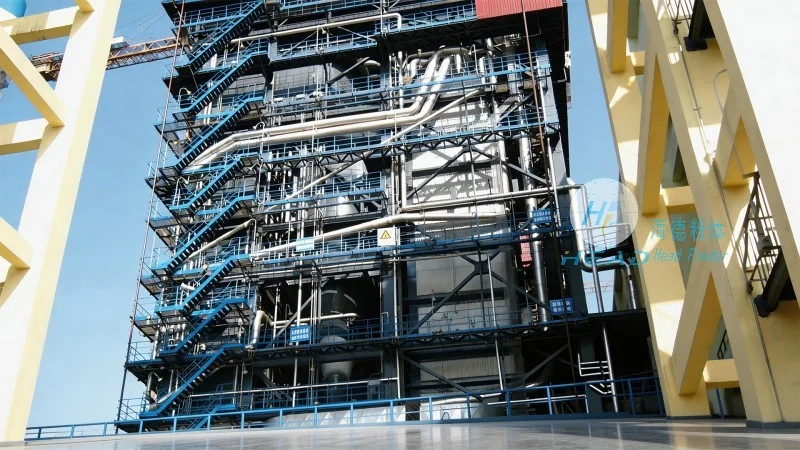

In the evolving landscape of industrial material handling, wood fiber processing has emerged as a sector demanding precision, efficiency, and reliability. As global industries push toward sustainable manufacturing and circular economy models, the need for advanced conveying systems that can handle fibrous, low-density, and abrasive materials without degradation or contamination has never been more critical. Wood fiber pneumatic conveying technical solution specification serves as a comprehensive reference for engineers, plant managers, and procurement specialists who seek to optimize their production lines. The technology behind pneumatic conveying for wood fiber addresses unique challenges—such as fiber entanglement, moisture sensitivity, and variable particle morphology—through carefully engineered airflow dynamics, pressure differentials, and material conditioning. This article delves into the core technical parameters, system architecture, selection criteria, and operational best practices that define a state-of-the-art wood fiber pneumatic conveying solution. By 2026, the global wood fiber market is projected to exceed USD 280 billion, driven by demand in construction composites, bioenergy, and packaging. Industries are increasingly turning to closed-loop, dust-free conveying systems to meet stringent environmental regulations and workplace safety standards. Headpowder, with over a decade of domain expertise, provides tailored pneumatic conveying solutions that align with these market trends, ensuring consistent throughput, minimal energy consumption, and extended equipment lifespan. This technical specification breaks down every critical component—from rotary valves and blow tanks to cyclone separators and filtration units—offering actionable insights for decision-makers.
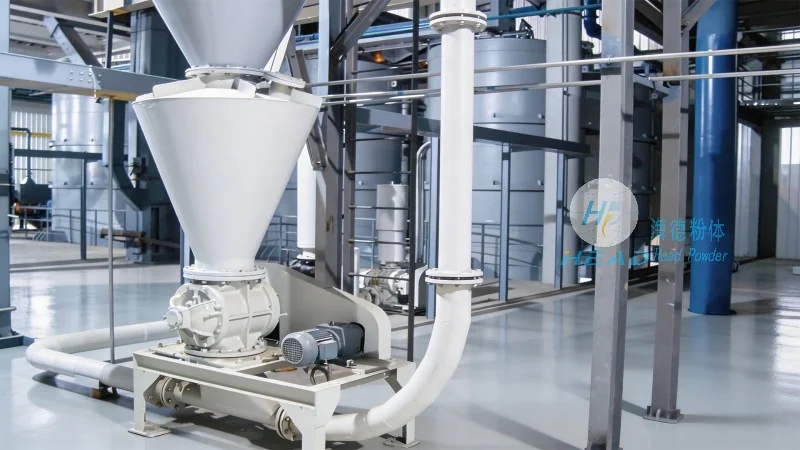
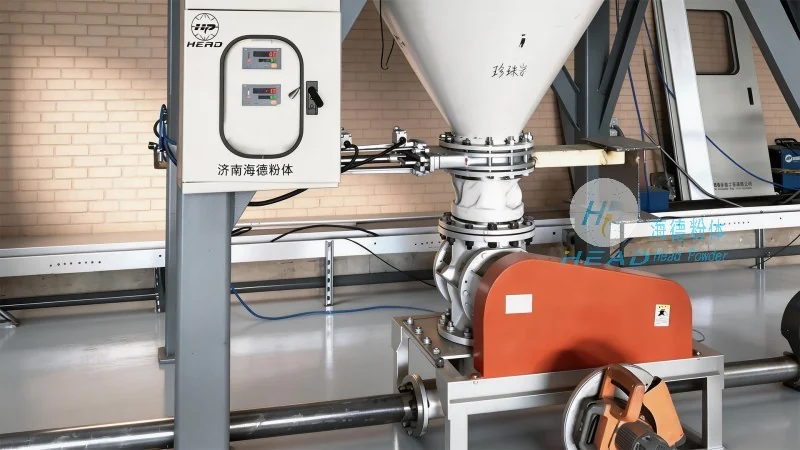
A well-designed wood fiber pneumatic conveying system integrates several interdependent modules to achieve reliable material transport. The fundamental architecture typically includes a material feed mechanism, a prime mover (positive displacement blower or compressor), a conveying pipeline, a separation device, and a dust collection unit. For wood fiber, the feed mechanism must accommodate the material’s tendency to bridge and clump. Rotary airlocks with oversized pockets and anti-bridging features are often recommended, especially when dealing with fibers longer than 10 mm. Alternatively, screw feeders with variable speed drives can provide controlled dosing to the conveying line. The choice between dilute-phase and dense-phase conveying depends on fiber bulk density (typically 80–200 kg/m³) and degradation sensitivity. Dilute-phase systems, operating at air velocities of 20–35 m/s, are suitable for short-distance transport where fiber breakage is acceptable. Dense-phase systems, operating at lower velocities (5–15 m/s) and higher material-to-air ratios, preserve fiber integrity and reduce pipe wear. Headpowder’s engineered blow tank designs incorporate fluidization pads and pulse-assisted discharge to prevent plugging, even with high-moisture wood fiber (up to 25% moisture content). Pressure drop calculations must account for fiber compressibility and wall friction coefficients, which differ significantly from granular materials. Using computational fluid dynamics (CFD) modeling, headpowder optimizes pipe routing to minimize bends and vertical lifts, as each 90-degree bend can increase pressure drop by 10–20% in wood fiber applications.

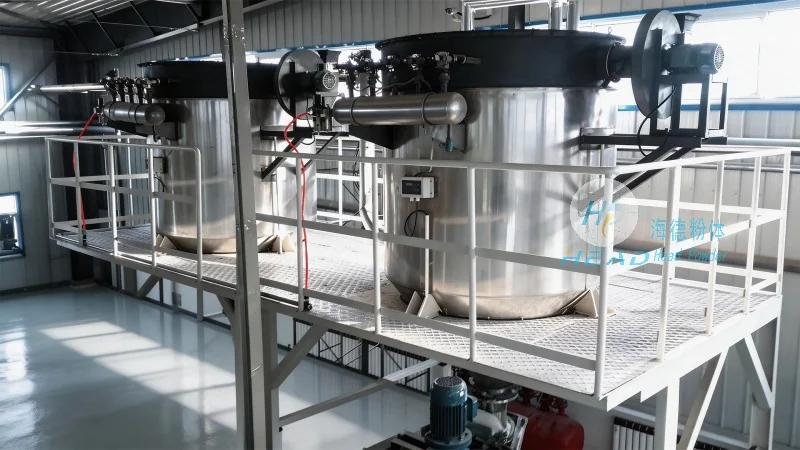
Selecting the right prime mover is paramount. For dilute-phase conveying of wood fiber, positive displacement blowers (roots type) are standard due to their constant air volume characteristics, typically requiring 0.8–1.5 bar of gauge pressure. For dense-phase applications, screw compressors or multi-stage centrifugal blowers are preferred to achieve pressures up to 3 bar. Velocity matching is critical: excessive velocity leads to fiber fibrillation and dust generation; insufficient velocity causes settling and line blockages. Industry guidelines suggest that wood fiber with an average length of 5–15 mm maintains stable suspension at air velocities between 22 and 28 m/s in horizontal runs. Rotary valves must feature hardened tips and replaceable wear liners because wood fiber contains silica and other abrasive contaminants. Headpowder utilizes high-chrome cast iron or ceramic-lined valve bodies, extending service life by 300% compared to standard carbon steel. The filtration system is another vital component. Wood fiber generates fine fugitive dust (PM2.5 and PM10) that must be captured to comply with OSHA and EU dust exposure limits. Cartridge filters with pleated polyester media and pulse-jet cleaning—offering filtration efficiency of 99.97% at 0.3 microns—are recommended. A properly sized filter ensures continuous operation without backpressure spikes. For environmental compliance and workplace safety, headpowder integrates explosion venting and static ground bonding per NFPA 61 and ATEX 137 standards, addressing the combustible dust risk inherent in wood fiber handling.


Wood fiber is not a homogeneous commodity; its physical and chemical properties vary with species, moisture content, processing method, and particle size distribution. Bulk density can range from 60 kg/m³ for dry, fluffy fiber to 220 kg/m³ for compressed or moist material. Angle of repose typically falls between 40 and 55 degrees, indicating a moderately cohesive powder. Moisture content is the most influential variable: every 5% increase in moisture raises the effective cohesion force by 15–25%, increasing the risk of arching and ratholing in hoppers. Headpowder’s solution specification always includes a material characterization phase at our test facility, analyzing parameters such as deaeration rate, permeability, and compressibility. These data feed into the system design via the modified K.J. Sim and F.A. Zenz correlations, which better predict pressure gradient for fibrous solids. For instance, a wood fiber with a bulk density of 120 kg/m³ and a moisture content of 12% requires a minimum pick-up velocity of 18 m/s—compared to 14 m/s for dry fiber at 5% moisture. Conveying velocity must be adjusted accordingly to avoid pipe plugging while minimizing energy consumption. Headpowder’s proprietary air management system automatically adjusts blower speed based on real-time pressure feedback, maintaining optimal velocity across varying throughput conditions from 2 to 30 tons per hour.
Pipe diameter is often the first parameter determined after establishing required capacity and conveying distance. For wood fiber, typical line diameters range from DN100 to DN300. At a given mass flow rate, smaller diameter yields higher velocity and greater particle attrition; larger diameter lowers velocity but increases capital cost. The optimal diameter balances specific energy consumption (kWh per ton) against fiber quality retention. Headpowder’s guidelines recommend maintaining an Froude number (Fr) between 60 and 150 in horizontal sections. For bends, long-radius elbows (R/D ratio ≥ 10) with replaceable wear backs are standard. Blind-T or vortex-type bends can reduce degradation by allowing fibers to slide rather than impact, cutting wear rate by 50–60%. Depending on system layout, vertical lifts require an increase in conveying velocity of 10–15% over horizontal, which translates to a corresponding rise in blower power. Headpowder’s engineering team uses 3D laser scanning of the site to design pipe routes that minimize unnecessary elevation changes and sharp turns, significantly reducing long-term maintenance costs. Real-world case studies in medium-density fiberboard (MDF) plants show that optimized bend geometry reduced fiber fines content from 8% to 3%, directly improving downstream product quality.
Modern wood fiber pneumatic conveying solutions depend heavily on intelligent control architecture. Programmable logic controllers (PLCs) with human-machine interface (HMI) touchscreens allow operators to monitor key parameters: line pressure, material flow rate, air velocity, and motor current. Headpowder integrates advanced algorithms that predict blockages by analyzing pressure trend deviations—a 15% rise over baseline triggers pre-emptive adjustments, such as a momentary air pulse or a slight reduction in feed rate. This predictive capability reduces unplanned downtime by up to 40% in documented installations. VFD (variable frequency drive) control on blowers and rotary valves further optimizes energy use, achieving system-level power savings of 18–25% compared to fixed-speed alternatives. Communication protocols such as Profibus, Modbus, or Ethernet/IP enable seamless integration with the plant’s overall SCADA system. For facilities handling multiple fiber types or moisture grades, headpowder offers recipe-based control that automatically adjusts conveyor parameters when switching material sources. This flexibility is especially valuable in composite panel manufacturing, where a single line must handle softwood, hardwood, and recycled fiber streams.
Long-term reliability of a wood fiber pneumatic conveying system depends on proactive maintenance planning. Wear parts—rotary valve tips, pipe elbows, filter cartridges, and blower seals—should be inspected at intervals set by cumulative tonnage rather than calendar days. Headpowder’s recommended maintenance schedule indicates that valve inspection occurs every 2,000 operating hours, while filter cartridges typically last 12–18 months depending on dust loading. Pipe wall thickness monitoring using ultrasonic sensors can detect erosion hotspots before leakage occurs. A cost-of-ownership analysis for a typical 15 tph wood fiber system over a 10-year lifespan shows that maintenance represents approximately 35% of total lifecycle cost, with energy consumption at 40% and initial capital at 25%. By selecting durable components and optimizing line routing, headpowder customers have achieved an average equipment availability of 97.5% over five years. Training programs for plant personnel cover risk-free purging procedures, emergency shutdown sequences, and standard troubleshooting of rope formations—a common issue where fibers accumulate and spin inside the pipe. Headpowder provides on-site commissioning and a three-year service warranty for turnkey solutions.
The adoption of Industry 4.0 principles is driving significant changes in wood fiber handling. Internet-of-things (IoT) sensors now continuously monitor vibration, temperature, and pressure at multiple points, feeding data into cloud-based analytics that recommend optimized conveying parameters. By 2026, it is estimated that 45% of new wood fiber conveying systems will incorporate edge computing for real-time anomaly detection. Another trend is the move toward hybrid conveying solutions: combining pneumatic transport with mechanical pre-separation to reduce energy consumption. For example, using a vibrating screen before the pneumatic line removes oversized particles and tramp metal, reducing wear and power draw. Additionally, sustainability directives in the European Union and North America require lower carbon footprints in manufacturing. Headpowder’s systems are designed with high-efficiency motors (IE4 or better) and energy recovery options, such as using exhaust air for drying pre-heat. Carbon footprint reductions of up to 30% have been achieved in recent projects. The push for closed-loop production also means that pneumatic conveying lines must handle wood fiber blended with additives like resin or wax without cross-contamination. Headpowder’s clean-in-place (CIP) designs allow rapid product changeovers with minimal waste.
A leading MDF manufacturer in Southeast Asia faced frequent blockages in their existing dilute-phase system when processing rubberwood fiber with 18% moisture. The original system used a 10-inch pipe with a single positive displacement blower, resulting in 6–8 unplanned stoppages per month. Headpowder conducted an on-site audit and proposed a dense-phase system with a 12-inch pipeline, a dual-blow tank arrangement, and a smart pressure control loop. The new system achieved 12 tph capacity with zero blockages over six months of operation. Fiber breakage decreased from 11% to 4%, and downstream press rejects dropped by 30%. The plant reported a payback period of 14 months from reduced maintenance and improved yield. This case illustrates how a deep understanding of wood fiber behavior, combined with robust component selection and advanced controls, delivers measurable operational benefits. Headpowder’s engineering team continues to document and refine such solutions, ensuring that each new installation incorporates lessons learned from prior projects.
Every wood fiber handling application presents unique constraints—limited space, existing infrastructure, or special material composition. Headpowder offers free preliminary feasibility assessment based on material samples provided by your facility. Our laboratory can test up to 50 kg of your wood fiber to determine optimal conveying mode, minimum velocity, and pressure requirements. We then deliver a detailed technical solution specification covering all system components, dimensional drawings, projected energy consumption, and maintenance schedules. For projects requiring integration with dust collection, drying, or storage silos, headpowder provides complete turnkey engineering procurement construction (EPC) services. Our team includes certified mechanical engineers and process specialists with experience across wood panel, pellet, and bioenergy industries. To discuss your specific requirements and receive a tailored proposal, contact our technical consultation department. (咨询热线:156-6277-7102) Headpowder remains committed to advancing pneumatic conveying technology for wood fiber and other challenging bulk solids, ensuring your operation runs efficiently, safely, and profitably.
Shandong headpowder Engineering Co., Ltd.
156-6277-7102(Manager Zhang)
0531-83386006
Jinan City, Shandong Province, China 
服务热线
微信咨询
回到顶部