

Operation Process and Working Principle of Quantitative Powder Feeding and Conveying
Shandong HeadPowder Engineering Co., Ltd., commonly referred to as headpowder, is a leading manufacturer specializing in quantitative powder feeding and conveying systems. These systems are essential in industries requiring precise control over bulk material handling, ensuring consistent and reliable delivery of powders for various applications. The following content outlines the operation process and working principle of such systems, integrating key technical aspects and operational details to provide a comprehensive understanding.


Overview of Quantitative Powder Feeding Systems
Quantitative powder feeding systems are engineered to deliver bulk materials in controlled, measurable quantities. They are widely used in sectors like pharmaceuticals, food processing, chemical manufacturing, and mining, where accuracy in material dosing is critical for product quality and process efficiency. The systems typically consist of a storage hopper, a feeder mechanism, a control system, and a conveying component. Each component plays a vital role in ensuring the system operates as intended, with the feeder being the core element responsible for metering the material at a precise rate.
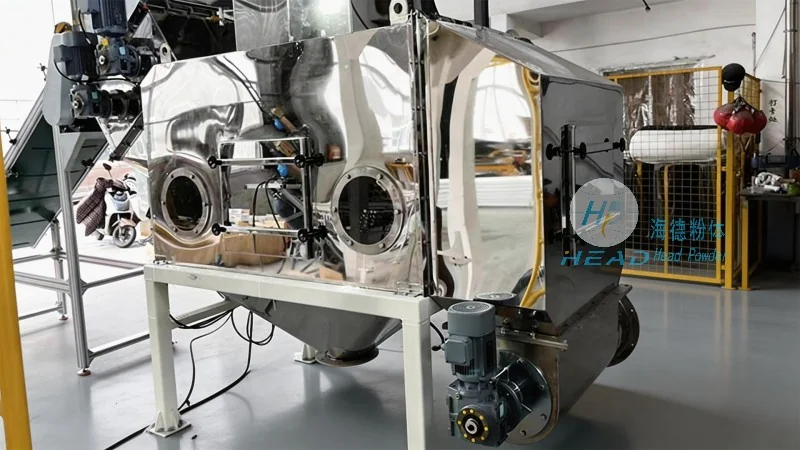
Operation Process of Quantitative Powder Feeding Systems
The operation process of a quantitative powder feeding system involves several sequential steps to achieve accurate material delivery. Initially, the bulk powder is stored in a hopper or silo, where it is maintained under controlled conditions to prevent issues like caking or segregation. The feeder, which can be a rotary valve, screw feeder, or loss-in-weight feeder, is then activated to draw the powder from the storage vessel. The feeder is equipped with a control mechanism that regulates the flow rate based on the desired output. This control can be manual or automated, with modern systems often utilizing sensors and feedback loops to maintain precise dosing. The powder is then conveyed through a pipeline or a conveyor system to the processing equipment, where it is utilized as per the production requirements. Throughout the process, the system continuously monitors parameters such as flow rate, pressure, and material level to ensure optimal performance and prevent disruptions. This monitoring helps in maintaining consistency and allows for quick adjustments if any deviations are detected.

Working Principle of Quantitative Powder Feeding and Conveying
The working principle of quantitative powder feeding systems is centered on precise control of material flow. Key components include the storage hopper, feeder mechanism, control system, and conveying equipment. The storage hopper provides a stable source of material, ensuring a consistent feed to the feeder. The feeder, often a rotary valve or a loss-in-weight feeder, is designed to meter the powder at a controlled rate. A rotary valve operates by using a rotating disc with slots that allow powder to pass through; the rotation speed determines the flow rate. Loss-in-weight feeders, conversely, measure the weight loss of the material in the hopper and adjust the feeder speed to maintain a constant weight, thus ensuring accurate dosing. The control system, which may include PLCs or advanced software, manages the operation of the feeder and monitors all critical parameters. Sensors such as level sensors, pressure transducers, and flow meters provide real-time data to the control system, enabling it to adjust the feeder speed or other parameters as needed. The conveying system, which can be pneumatic or mechanical, transports the metered powder to the processing point. Pneumatic conveying systems use air pressure to move the powder through pipes, while mechanical systems use belts or screws. The choice of conveying method depends on the material properties, such as particle size, moisture content, and flowability. Overall, the working principle focuses on achieving high accuracy in material delivery, minimizing variations, and ensuring the system operates efficiently and reliably.