

What is High-Pressure Dense-Phase Powder Pneumatic Conveying? And What Are Its Design Principles?
High-pressure dense-phase powder pneumatic conveying is a specialized method used for transporting bulk powders through a pipeline system using compressed air or other gas as the conveying medium. This technology is particularly effective for handling materials that are difficult to convey, such as fine powders, cohesive powders, or those prone to dusting and caking. The core principle involves operating at high pressure, typically ranging from 0.5 to 2.5 MPa, to ensure that the powder forms a dense, plug-like flow within the pipeline, minimizing particle separation and reducing the risk of material degradation or blockage.

Key Characteristics of High-Pressure Dense-Phase Conveying
Compared to traditional low-pressure or dilute-phase systems, high-pressure dense-phase conveying offers several distinct advantages. The most notable benefit is the ability to transport powders at a high concentration, often with a solids loading ratio of 20-30% by volume. This results in a more efficient use of the pipeline, as less gas is required to move the same amount of material. Additionally, the dense-phase flow helps to maintain the integrity of the powder, preventing segregation and ensuring consistent product quality throughout the conveying process. The system also provides better control over the material's velocity and pressure, which is crucial for applications requiring precise dosing or processing.
Design Principles for High-Pressure Dense-Phase Systems
The design of a high-pressure dense-phase powder conveying system involves several critical components and considerations. The primary elements include a high-pressure blower or compressor, a feeder system to introduce the powder into the pipeline, a pipeline network with appropriate diameter and length, and a control system to regulate pressure and flow. The selection of the blower or compressor is a key decision, as it must be capable of delivering the required pressure and flow rate while maintaining energy efficiency. The feeder, often a rotary valve or a pressure feeder, is designed to meter the powder accurately and introduce it into the pipeline at a controlled rate, preventing surges or blockages.
One of the most important design principles is the calculation of the required pressure drop and flow rate. Engineers must consider factors such as the powder's particle size, density, and flow properties, as well as the pipeline length and diameter. The pressure drop across the system is calculated using empirical formulas or computational fluid dynamics (CFD) simulations to ensure that the system operates within the optimal pressure range. The flow rate is determined based on the desired conveying capacity and the solids loading ratio, ensuring that the system can handle the intended throughput without excessive energy consumption or material degradation.
System Components and Their Roles
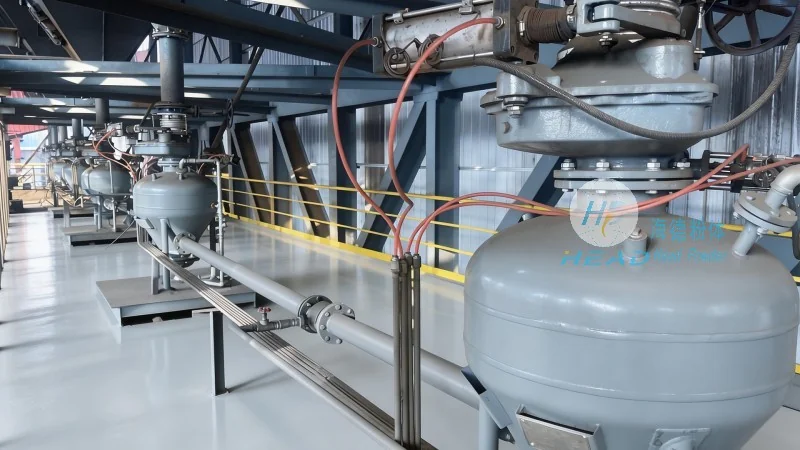
A typical high-pressure dense-phase conveying system consists of several interconnected components, each playing a vital role in the overall operation. The high-pressure blower or compressor is responsible for generating the necessary pressure to move the powder through the pipeline. It is typically a positive-displacement type, such as a roots blower or a screw compressor, which can maintain consistent pressure even at high loads. The feeder system, often a rotary valve or a pressure feeder, is designed to introduce the powder into the pipeline at a controlled rate. This component is critical for maintaining a stable flow and preventing surges or blockages, as it ensures that the powder is introduced at a consistent velocity and pressure.
The pipeline network is another key component, as it must be designed to withstand the high pressure and the abrasive nature of the powder. The diameter of the pipeline is selected based on the required flow rate and the solids loading ratio, while the length is determined by the distance between the source and the destination. The pipeline is typically made of materials such as stainless steel or PVC, which are resistant to corrosion and wear. Additionally, the system includes pressure relief valves and check valves to prevent overpressure and ensure unidirectional flow.
Advantages and Applications of High-Pressure Dense-Phase Conveying
High-pressure dense-phase powder pneumatic conveying offers numerous advantages over traditional methods, making it suitable for a wide range of industrial applications. The dense-phase flow minimizes particle separation and reduces the risk of material degradation, ensuring that the product quality is maintained throughout the conveying process. The system is also highly efficient, as it uses less gas and requires less energy compared to dilute-phase systems. Additionally, the high pressure allows for the transportation of powders over long distances, making it ideal for applications where the source and destination are far apart.
Common applications of high-pressure dense-phase conveying include the handling of fine powders in the pharmaceutical and food industries, the transport of cohesive powders in the chemical and mining sectors, and the conveying of abrasive materials in the cement and construction industries. The system is also used in the petrochemical industry for transporting catalysts and other powders, as well as in the agricultural sector for handling fertilizers and other bulk materials.

Design Considerations and Best Practices
When designing a high-pressure dense-phase powder conveying system, several factors must be considered to ensure optimal performance and longevity. First, the material properties of the powder must be thoroughly understood, including its particle size distribution, density, flowability, and cohesive properties. This information is crucial for selecting the appropriate feeder and pipeline diameter, as well as for determining the required pressure and flow rate. Second, the system must be designed to handle the potential for blockages and surges, which can occur due to changes in the powder's flow properties or the system's operation.
Engineers must also consider the energy efficiency of the system, as high-pressure conveying can be energy-intensive. The selection of the blower or compressor, as well as the optimization of the pipeline design, can help to reduce energy consumption. Additionally, regular maintenance and inspection of the system components are essential to prevent wear and tear and ensure consistent performance. Best practices include monitoring the pressure and flow rates, checking for leaks, and replacing worn parts as needed.
Conclusion
High-pressure dense-phase powder pneumatic conveying is a highly effective and efficient method for transporting bulk powders, offering numerous advantages over traditional low-pressure systems. The design principles, which involve careful consideration of the powder's properties, system components, and operational parameters, are critical to achieving optimal performance and maintaining product quality. As a leading provider in this field, Shandong HeadPowder Engineering Co., Ltd. specializes in the design, manufacturing, and installation of high-pressure dense-phase conveying systems, leveraging years of experience and expertise to deliver reliable and efficient solutions for a wide range of industrial applications.