
White clay, also referred to as kaolin or china clay, is a versatile industrial mineral with applications spanning ceramics, paper coating, rubber, plastics, paints, and cosmetics. As global demand for high-purity white clay surges—projected to reach a market value exceeding USD 6.8 billion by 2026, according to industry analyses—manufacturers face increasing pressure to optimize material handling processes. Pneumatic conveying stands out as the most efficient, hygienic, and reliable method for transporting white clay from storage to processing points, especially when dealing with fine, abrasive, or moisture-sensitive powders. This article provides a comprehensive specification for a white clay pneumatic conveying system, blending technical depth with practical implementation insights, tailored for plant managers, process engineers, and procurement professionals seeking a turnkey solution. Headpowder, with over a decade of experience in powder handling, offers a complete system design that aligns with industry best practices and regulatory standards. From system architecture to component selection, air velocity control, and filtration, every detail is calibrated to preserve material integrity while minimizing energy consumption and maintenance downtime. Whether your application involves dense-phase or dilute-phase conveying, the following specification will guide you toward a robust, scalable, and cost-effective installation.
To understand the specific challenges of conveying white clay, one must first examine its physical properties. White clay typically exhibits a bulk density ranging from 0.5 to 0.8 g/cm³, a particle size distribution from sub-micron to 50 microns, and a moisture content that can vary between 2% and 10% depending on drying stage. The material is mildly abrasive and has a tendency to agglomerate under pressure or humidity. These characteristics demand a pneumatic conveying system that can handle fine particles without segregation, prevent pipe wall buildup, and maintain consistent flow under varying load conditions. Headpowder’s engineering team evaluates these parameters at the outset, using laboratory-scale flowability tests and shear cell analysis to determine the optimal conveying regime—typically lean-phase (dilute) for high-capacity short-distance transfers or dense-phase for longer runs and reduced particle degradation. For white clay applications requiring minimal attrition, dense-phase conveying at low velocities (typically 4–8 m/s) is recommended, whereas dilute-phase systems operating at 15–25 m/s are preferred for high-throughput operations where fines generation is less critical. System pressure drop calculations must account for the clay’s compressibility and the risk of plugging in elbows; Headpowder employs computational fluid dynamics (CFD) simulations to predict flow patterns and optimize pipe routing, ensuring a pressure drop typically within 50–80 kPa for a 100-meter horizontal run.
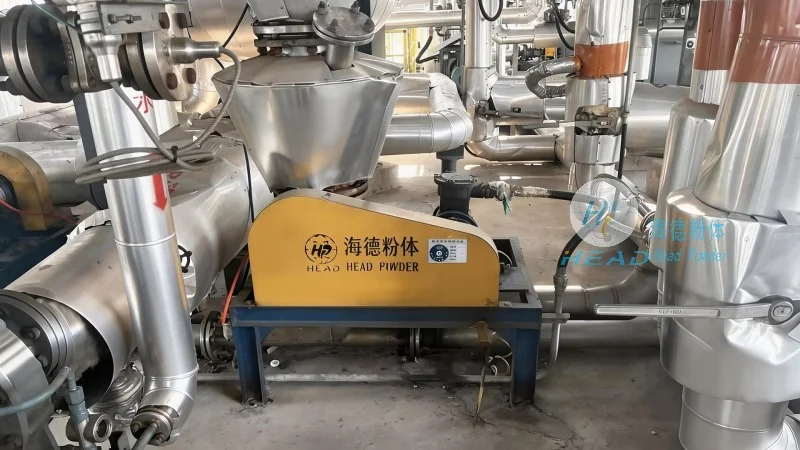
Beyond basic flow characteristics, the specification must address the conveying air source, which directly impacts energy efficiency and operational cost. Rotary positive displacement blowers are the standard choice for white clay systems due to their constant volume characteristics and ability to handle moderate pressure ranges (0.5–2.5 bar). For larger installations requiring up to 500 kW of blower power, Headpowder integrates variable frequency drives (VFDs) to match airflow to real-time demand, achieving energy savings of 20–35% compared to fixed-speed alternatives. The air intake should be equipped with high-efficiency particulate air (HEPA) filters to prevent contamination of the white clay, particularly for grades destined for food-contact or pharmaceutical applications. In humid climates, a compressed air dryer with a dew point of −40°C is essential to avoid moisture absorption during conveying, which would otherwise cause caking and pipeline blockages. Headpowder’s standard white clay solution also includes an inline air heater to raise the carrier air temperature to 60–80°C when conveying partially dried clay, further reducing the risk of condensation and ensuring a consistent material moisture profile at the destination point.
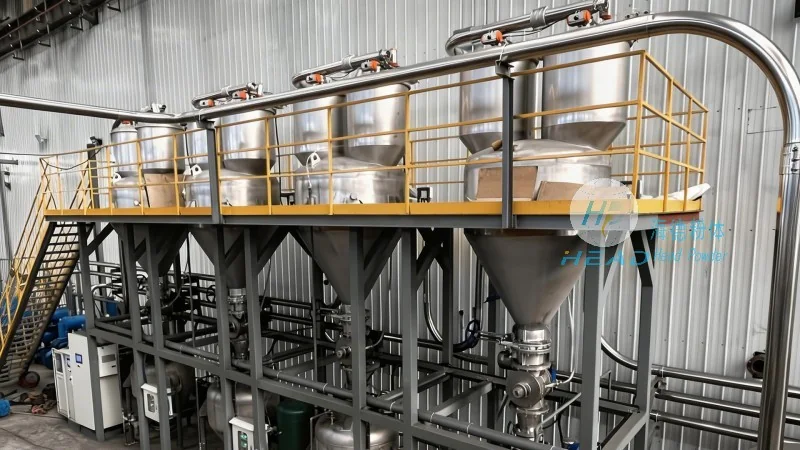
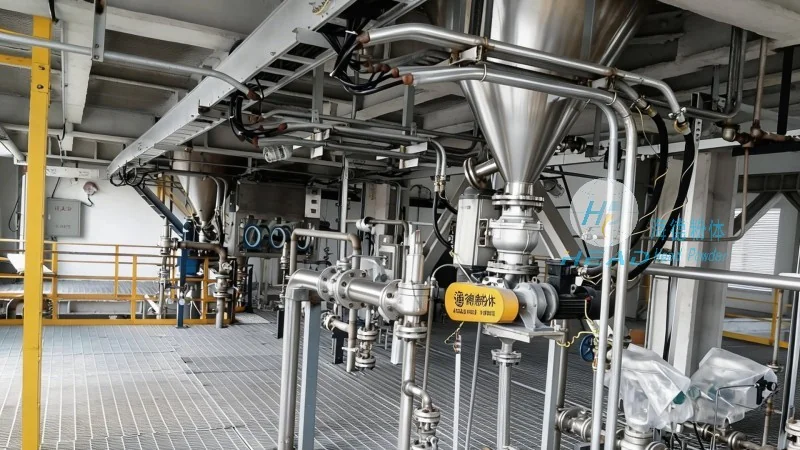
A white clay pneumatic conveying system comprises several integrated modules, each optimized for reliability and ease of maintenance. The feeding stage begins at a storage silo or bag dump station equipped with an aeration pad and a rotary airlock valve. The airlock must have an abrasion-resistant rotor and housing—typically cast iron with tungsten carbide coatings—to withstand the erosive nature of white clay. For applications with variable feed rates, Headpowder recommends a screw feeder with a variable-speed drive preceding the airlock, providing precise control over material infeed and preventing flooding of the conveying line. Downstream, the conveying pipeline is designed with long-radius bends (R ≥ 10D) or ceramic-lined elbows to reduce wear and particle breakage. Pipe materials for white clay handling should be either mild steel with a hardened internal surface or stainless steel (304L or 316L) when food-grade purity is required. The pipeline diameter is sized based on the required conveying capacity and air velocity—typical sizes range from DN80 to DN200 for throughputs of 5 to 50 tons per hour. Straight sections should be supported at intervals of 3–4 meters with adjustable brackets to allow for thermal expansion and easy sag correction.

The receiving end of the conveying system is usually a cyclone separator or a bag filter unit. For coarse white clay particles (>10 microns), a high-efficiency cyclone with a removal efficiency above 98% is adequate; however, for ultrafine grades (sub-micron), a reverse-jet pulse-jet bag filter is mandatory. Headpowder’s standard filter design features PTFE-coated polyester felt filter bags with a filtration velocity of 0.8–1.2 m/min, ensuring emissions below 10 mg/Nm³ to meet stringent environmental regulations. The filter housing is equipped with an explosion vent and a rotary discharge valve to transfer collected material back into the process. In multi-point conveying systems, diverter valves with ceramic inserts direct the flow to different silos or process machines. Each valve is actuated by a pneumatic cylinder with position feedback, integrated into the plant’s distributed control system (DCS) for seamless automation. Headpowder’s control architecture includes a programmable logic controller (PLC) with a human-machine interface (HMI) that displays real-time parameters such as air pressure, flow rate, material level, and filter differential pressure, enabling operators to diagnose issues before they cause downtime.

Adherence to recognized standards is critical for ensuring safety, reliability, and interoperability. The white clay pneumatic conveying system designed by Headpowder complies with ISO 9001:2015 quality management principles and ISO 14001 environmental guidelines. For installations in the European Union or markets requiring ATEX compliance, the system is equipped with explosion-proof electrical components and static grounding assemblies, as white clay dust can form explosive atmospheres when suspended in air. The maximum permissible dust concentration in the conveying line is maintained below 50 g/m³, and all metal parts are bonded and grounded to a resistance of less than 10 ohms. Headpowder also integrates continuous spark detection and suppression systems as an optional upgrade for high-risk applications. Performance benchmarks for a typical 30 tph white clay conveying system over a 150-meter horizontal distance include a specific energy consumption of 0.8–1.2 kWh per ton of material, a conveying velocity of 5–7 m/s (dense phase) or 18–22 m/s (dilute phase), and a filter cake thickness not exceeding 3 mm before pulsing. Field data from a recent installation at a major kaolin processing plant in Georgia, USA, showed a 12% reduction in annual maintenance costs and a 98.5% uptime over 18 months of operation, validating the design’s robustness.
Material selection for critical components extends beyond pipes and elbows. The rotary airlock’s tip clearance is set to 0.15–0.25 mm to minimize air leakage while preventing rotor contact. Headpowder uses finite element analysis (FEA) to optimize the rotor profile, achieving a volumetric efficiency of 85–90% even with sticky white clay. For the blow tank used in dense-phase systems, the discharge cone angle is designed to be at least 70° to promote mass flow and avoid rat-holing. Tank pressure vessels are manufactured to ASME Section VIII Division 1 or PED 2014/68/EU standards, with a design pressure of 4 bar gauge and a safety factor of 3.5. All welds are subjected to radiographic examination, and the entire system undergoes hydrostatic testing at 1.5 times the design pressure before shipment. Headpowder also provides a complete set of documentation, including material certificates, pressure test reports, and operation & maintenance manuals, to facilitate seamless integration with the client’s quality assurance protocols.

Reliable long-term operation of a white clay pneumatic conveying system hinges on proactive maintenance and process monitoring. Headpowder recommends a predictive maintenance schedule that includes weekly inspection of airlock rotor wear (measured with a feeler gauge at the tips), monthly calibration of pressure transmitters and flow meters, and quarterly cleaning of filter bags by off-line pulse-jet cleaning followed by visual inspection for pinhole leaks. The conveying line should be checked for internal buildup using an endoscope after every 2,000 operating hours—any deposits exceeding 5 mm in thickness require immediate cleaning via a compressed air flush or a mechanical pigging system. For white clay grades with a high alumina content, the abrasive nature accelerates wear; a typical elbow replacement interval is 12–18 months for standard cast iron, whereas ceramic-lined elbows can extend this to 3–5 years. Headpowder’s remote monitoring platform, accessible via a secure web portal, tracks vibration levels on blowers, motor current draw, and differential pressure trends, alerting the maintenance team via SMS or email when parameters drift outside predefined ranges. This data-driven approach has helped clients reduce unplanned downtime by over 40% and extend component life by 25%, as documented in internal case studies.
Another critical operational aspect is the management of conveying air exhaust. The filter’s compressed air consumption for pulse cleaning is typically 0.1–0.3 Nm³ per pulse, with pulse intervals of 10–30 seconds depending on dust load. Headpowder’s control algorithm automatically adjusts pulse frequency based on real-time differential pressure across the filter media, reducing compressed air usage by up to 30% compared to fixed-timer cleaning. The collected fines can be recycled back into the product stream—often blending them with the main conveying flow for applications where particle size distribution is not critical—or sent to a waste silo for landfilling. For customers aiming to achieve zero-waste operation, Headpowder offers a closed-loop system where the exhaust air is recirculated after passing through an ultra-fine filter (H14 grade HEPA), drastically reducing external emissions and recovering valuable heat energy from the conveying air.
White clay pneumatic conveying solutions are rarely one-size-fits-all. Headpowder’s engineering team customizes the system architecture based on factors such as the number of source points (bag dump, silo, or container feeder), the required number of destination silos or process machines, and the layout complexity (elevation changes, horizontal distances, and available floor space). For example, a ceramic tile manufacturer needing to transport 8 tph of kaolin from a railcar unloading pit to three blenders located 200 meters away might opt for a dilute-phase positive pressure system with a single blower and automated diverter valves. In contrast, a paper coating plant requiring ultra-fine white clay (<2 microns) might choose a negative-pressure (vacuum) system to avoid dust escape and maintain product cleanliness—Headpowder has successfully delivered vacuum conveying systems handling up to 15 tph over 80 meters. For expanding operations, the system is designed with modular scalability: adding a second blow tank or parallel pipeline can double capacity without redesigning the entire network. Headpowder also offers retrofitting services for existing systems, upgrading controls, replacing worn components with higher-wear-resistant materials, and improving energy efficiency by adding VFDs or optimizing conveying velocity.
Case in point: a leading paper mill in Jiangsu, China, approached Headpowder in early 2025 to replace their aged screw conveyor system with a pneumatic solution to eliminate dust and reduce maintenance. The project scope included a bag break station, a 50-meter dense-phase line with three 90-degree elbows, and a bag filter feeding two silos. Headpowder’s design achieved a conveying ratio (material-to-air) of 8:1, reducing air consumption by 28% compared to the client’s initial estimates. The system has been running for over 14 months with zero unplanned stops, and the mill reported a 15% improvement in worker safety due to the elimination of open powder handling. This real-world validation reinforces the importance of pairing robust equipment with application-specific engineering, a philosophy central to Headpowder’s service offering.
Choosing the right partner for your white clay pneumatic conveying project involves evaluating not just the hardware but also the depth of technical support and after-sales service. Headpowder provides a full-cycle guarantee: from concept validation through 3D laser scanning of existing facility layouts, to in-house fabrication, on-site commissioning, and operator training. Every system ships with a 24-month warranty on manufacturing defects, and ongoing technical support is available via phone, email, or on-site visits within 48 hours for most industrial regions. As white clay processors continue to face pressures from rising energy costs and stricter environmental regulations, a well-engineered pneumatic conveying system becomes a strategic asset—improving product consistency, reducing waste, and lowering the total cost of ownership. For a detailed quotation or a feasibility study tailored to your specific white clay handling needs, contact the Headpowder team directly. (咨询热线:156-6277-7102)
Shandong headpowder Engineering Co., Ltd.
156-6277-7102(Manager Zhang)
0531-83386006
Jinan City, Shandong Province, China 
服务热线
微信咨询
回到顶部