
With over a decade of experience in the pneumatic conveying industry, our company specializes in a full range of pneumatic conveying system equipment.
您的当前位置:首页 >> News >> Technical FAQ

News

Rich project cases across industries, showing real implementation and proven technical strength.

Aluminum sulfate pneumatic conveying solution technical introduction

2026-07-20

Understanding the Unique Challenges of Aluminum Sulfate in Pneumatic Conveying

Aluminum sulfate, commonly known as alum, is a widely used industrial chemical with applications ranging from water treatment and paper manufacturing to textile processing and construction. Its hygroscopic nature, tendency to cake under humidity, and abrasive crystalline structure present significant engineering challenges when designing a reliable bulk material handling system. Unlike free-flowing powders, aluminum sulfate exhibits cohesive behavior, which can lead to bridging in hoppers, blockages in pipelines, and inconsistent feed rates if the conveying solution is not tailored to its specific physical properties. Over the past decade, the global market for aluminum sulfate has grown steadily, driven by stricter environmental regulations and increasing demand for clean water. By 2026, industry projections indicate that the water treatment sector alone will account for over 60% of total aluminum sulfate consumption, with annual growth rates exceeding 4.5% in regions such as Asia-Pacific and the Middle East. This growth places greater emphasis on efficient, low-maintenance pneumatic conveying systems that can handle the material without degradation, dust emissions, or excessive energy consumption. A well-engineered solution must consider particle size distribution, moisture sensitivity, and flow characteristics to ensure continuous operation in 24/7 industrial environments. This technical introduction explores the core principles, system configurations, and advanced technologies that enable reliable pneumatic conveying of aluminum sulfate, with a focus on practical engineering parameters and real-world performance data.

Aluminum sulfate pneumatic conveying solution technical introduction

Fundamental System Configurations for Aluminum Sulfate Conveying

Pneumatic conveying systems for aluminum sulfate generally fall into two primary categories: dilute phase and dense phase. Each configuration offers distinct advantages depending on the material's moisture content, particle shape, and required conveying distance. Dilute phase systems operate at higher air velocities, typically 25–35 m/s, suspending the material in the airstream. While effective for short distances and simple layouts, dilute phase conveying can cause significant wear on pipeline elbows and generate dust due to particle attrition. For aluminum sulfate with a Mohs hardness of approximately 2.5–3, wear rates increase substantially when conveying at high velocities over extended periods. Dense phase systems, by contrast, move material at lower air velocities, often below 10 m/s, pushing plugs of product through the pipeline. This approach reduces particle breakage, minimizes dust generation, and lowers energy consumption by 20–40% compared to dilute phase. However, dense phase requires careful control of air pressure and material feed to prevent blockages, particularly when handling hygroscopic grades of aluminum sulfate that may absorb moisture from compressed air. Many modern installations combine both concepts, using a dilute phase pickup point followed by a dense phase transport segment, optimizing the trade-off between wear and capacity. The selection of conveying pressure also matters: positive pressure systems are common for distributing material from a single source to multiple destinations, while vacuum systems offer cleaner operation for unloading railcars or trucks directly into storage silos.

Aluminum sulfate pneumatic conveying solution technical introduction

Critical Equipment Components and Material Selection

The successful pneumatic conveying of aluminum sulfate hinges on the correct specification of every component in the material pathway. Rotary airlock valves at the feed point must withstand abrasion from crystalline particles while maintaining an effective air seal; hard-faced vanes or ceramic-lined rotors extend service life to over 10,000 hours in continuous operation. Pipeline material selection is equally important: schedule 40 carbon steel with a minimum wall thickness of 6 mm is standard, but for highly abrasive grades, the use of induction-hardened pipe or replaceable wear-back bends reduces maintenance frequency. The radius of pipe bends should be at least ten times the pipe diameter to minimize impact wear and product degradation. For example, a 100 mm diameter pipeline requires bends with a centerline radius of 1,000 mm or more. Air filtration and conditioning are non-negotiable when handling moisture-sensitive materials like aluminum sulfate. Compressed air dryers with a dew point of -40°C or lower prevent condensation within the conveying line, which could otherwise cause clumping and blockages. In humid coastal climates, additional insulation and trace heating on the pipeline may be required to maintain product flowability. Furthermore, storage silos must be equipped with fluidization pads that use low-pressure air to promote discharge, along with level indicators and vent filters to maintain pressure balance. The integration of these components into a coordinated control system, typically using PLC-based logic with pressure and flow sensors, allows automatic adjustment of air velocity and material feed rate to match real-time conditions.

Key Technical Parameters for System Design

Engineering a pneumatic conveying system for aluminum sulfate requires precise calculation of several interrelated parameters. The material's bulk density typically ranges from 800 to 1,200 kg/m³ depending on crystal structure and moisture content, while the particle size distribution often shows a mean diameter of 100–500 microns with up to 10% fines below 50 microns. These fines contribute to dust explosion risks if the conveying atmosphere contains sufficient oxygen; consequently, systems handling aluminum sulfate must include grounding and bonding per ATEX or NFPA standards, along with explosion venting on storage vessels. The conveying velocity must be carefully selected to stay above the saltation velocity (the speed at which particles begin to settle) but below the threshold where excessive wear occurs. For aluminum sulfate, the saltation velocity in a horizontal pipeline is approximately 12–16 m/s for dense phase and 20–28 m/s for dilute phase. The pressure drop across the system, typically 0.5–1.5 bar for distances up to 200 meters, must be calculated using modified Darcy-Weisbach equations that account for solid loading ratio. A solid loading ratio of 5–15 kg of material per kg of air is typical for dilute phase, while dense phase can achieve ratios of 30–60 kg/kg, dramatically reducing air consumption. Capacity requirements also influence pipe diameter: a 150 mm pipeline at 25 m/s conveying velocity can handle approximately 15–25 tons per hour of aluminum sulfate in dilute phase, whereas a dense phase system with the same pipe diameter can move 30–40 tons per hour when optimized with higher loading ratios. These values should be validated through pilot testing on representative material samples, as variations in production batches can significantly alter flow behavior.

Industry Trends and Technological Advancements for 2026 and Beyond

The pneumatic conveying industry continues to evolve, driven by demands for higher efficiency, lower carbon footprint, and greater automation. For aluminum sulfate applications, several emerging trends are shaping new installations and retrofits. First, the adoption of smart sensors and IoT-enabled monitoring systems allows operators to track real-time parameters such as pipeline pressure, air flow, and material moisture, enabling predictive maintenance that reduces unplanned downtime by up to 30%. Second, variable frequency drives (VFDs) on blowers and air compressors enable dynamic adjustment of conveying air velocity based on product demand, cutting energy consumption by 15–25% compared to fixed-speed systems. Third, the use of advanced computational fluid dynamics (CFD) simulation in the design phase has become standard practice, allowing engineers to predict wear patterns, pressure profiles, and segregation risks before a single pipe is installed. By 2026, it is estimated that over 70% of new pneumatic conveying systems will incorporate some form of digital twin technology for ongoing optimization. Additionally, environmental regulations are pushing for closed-loop systems that capture and recycle conveying air, minimizing dust emissions and reducing makeup air requirements. For aluminum sulfate producers and users, these technologies translate into lower total cost of ownership, improved workplace safety, and compliance with tightening emission standards. The shift toward modular, pre-engineered system designs also reduces installation lead times by 40–50%, enabling faster project execution for water treatment plants and chemical processors expanding their capacity.

Practical Implementation Case Study: Reliable Operation in a High-Humidity Environment

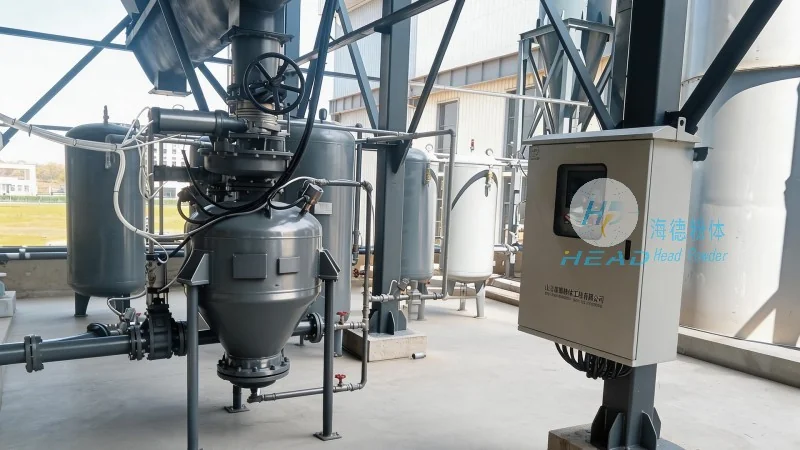
A recent application involved a major municipal water treatment facility in a coastal region with ambient humidity exceeding 85% for eight months of the year. The facility required a system to convey granular aluminum sulfate from bulk bag unloaders to a series of storage silos and then to dissolution tanks, with a total horizontal distance of 180 meters and a vertical lift of 15 meters. Initial attempts using a dilute phase design resulted in frequent blockages during humid weather, with caked material forming at low points and elbows. The solution implemented by headpowder involved a dense phase system operating at a solid loading ratio of 35:1, employing a pressure vessel feeder with a conical discharge and variable frequency drive control on the air supply. The pipeline was constructed from schedule 40 carbon steel with 1,200 mm radius bends, and each section was equipped with trace heating cables maintaining a surface temperature 5°C above the ambient dew point. Automated moisture sensors at the feed point triggered a reduction in conveying velocity if product moisture exceeded 2%, preventing agglomeration. Over 18 months of continuous operation, the system achieved 99.2% uptime, with only scheduled maintenance required every 6,000 hours for rotary valve inspection. Energy consumption averaged 0.8 kWh per ton of material conveyed, a 35% improvement over the previous dilute phase system. The facility reported zero dust emissions and a 40% reduction in manual cleaning labor. This case demonstrates that meticulous attention to material characteristics and environmental conditions, combined with robust equipment selection, yields a conveying solution that performs consistently even under challenging conditions.

Selecting a Partner for Your Aluminum Sulfate Conveying System

Choosing the right engineering partner for a pneumatic conveying project involves evaluating not only technical capability but also domain experience with specific materials like aluminum sulfate. A provider that understands the nuances of hygroscopic bulk solids, abrasive wear, and dust control will propose solutions that avoid costly redesigns and operational compromises. headpowder specializes in designing and manufacturing customized pneumatic conveying systems for challenging powders and granules, with over 15 years of experience across water treatment, chemical processing, and food industries. Our engineering team utilizes full-scale test facilities to validate system performance using customer material samples, ensuring that every design parameter is optimized before fabrication. We offer end-to-end support, from conceptual layout and CFD modeling to equipment supply, installation supervision, and commissioning. For clients seeking to upgrade existing systems or build new lines, our modular approach reduces project risk and accelerates timelines. To discuss your specific application requirements or request a technical consultation, you can reach us at (咨询热线:156-6277-7102). We invite you to explore how our proven technology and deep material handling expertise can deliver a reliable, cost-efficient aluminum sulfate conveying solution that meets your operational goals well into the next decade.

相关推荐

Shandong headpowder Engineering Co., Ltd. All rights reserved.

回到顶部