
With over a decade of experience in the pneumatic conveying industry, our company specializes in a full range of pneumatic conveying system equipment.
您的当前位置:首页 >> News >> Technical FAQ

News

Rich project cases across industries, showing real implementation and proven technical strength.

Algae powder pneumatic conveying technical solution specification

2026-07-20

In the rapidly evolving landscape of biomass processing and microalgae utilization, the selection of an efficient, hygienic, and reliable material handling system is paramount. Among the various technologies available, pneumatic conveying has emerged as the preferred method for transporting algae powder—a fine, cohesive, and often fragile material. This article, titled Algae powder pneumatic conveying technical solution specification, provides an in-depth examination of the technical parameters, system design considerations, and operational best practices for deploying a pneumatic conveying system specifically for algae powder. Drawing on extensive engineering experience and current industry data, we explore the unique challenges posed by algae powder—such as its low bulk density, high moisture sensitivity, and tendency to agglomerate—and present a robust technical framework for overcoming these hurdles. Whether you are involved in the production of algae-based biofuels, nutritional supplements, animal feed, or bioplastics, understanding the nuances of pneumatic conveying is critical to maintaining product quality, minimizing energy consumption, and ensuring continuous, trouble-free operation. This article serves as a comprehensive guide for plant managers, process engineers, and procurement specialists seeking to specify or upgrade their algae powder transfer systems.

Understanding the Material Characteristics of Algae Powder

Before delving into the technical solution design, it is necessary to analyze the physical and flow properties of algae powder. Typical algae powders used in industrial applications, such as Spirulina and Chlorella, exhibit a bulk density ranging from 0.3 to 0.6 g/cm³, depending on the drying process and particle size distribution. The particle size often falls between 50 and 200 microns, which classifies the powder as a Group A or Group C material under the Geldart classification for fluidization behavior. Group C materials are cohesive and difficult to fluidize, meaning that standard dilute-phase pneumatic conveying may lead to rat-holing, bridging, and line blockages. Additionally, algae powder has a high fat content—sometimes exceeding 10%—which can cause adhesion to pipe walls and accumulation in bends. Moisture regain is another critical factor; even a slight increase in relative humidity can cause caking and a dramatic reduction in flowability. Therefore, any pneumatic conveying solution must account for these challenges through careful engineering of gas velocities, pipeline geometry, and aeration systems. Industry data from 2026 indicates that the global algae powder market is projected to grow at a compound annual growth rate of 8.3%, reaching a valuation of approximately USD 6.2 billion. This growth drives the need for more sophisticated, scalable, and energy-efficient conveying technologies that can handle increasing throughput without compromising product integrity.

Algae powder pneumatic conveying technical solution specification

Core Technical Parameters for Pneumatic Conveying of Algae Powder

Designing a reliable pneumatic conveying system for algae powder requires precise definition of several key parameters. The conveying phase—dilute phase or dense phase—is the most fundamental decision. Dilute-phase conveying typically operates at high gas velocities (20–35 m/s) and low solids loading ratios, making it suitable for non-friable materials. However, for algae powder, the high velocity can cause particle degradation, dust explosion risks, and excessive wear on pipe elbows. In contrast, dense-phase conveying operates at low velocities (3–10 m/s) and high solids loading ratios, which minimizes product degradation and energy consumption. For algae powder, a dense-phase system is generally recommended, especially if the material is intended for high-value applications such as nutraceuticals or pharmaceuticals. The conveying pressure must be carefully controlled: positive pressure systems (blowers) are common for distances up to 200 meters, while vacuum systems (venturi or vacuum pumps) are preferred for short-distance, dust-free transfers. A critical parameter is the minimum conveying velocity, which for algae powder typically ranges from 4 to 8 m/s depending on moisture content and particle shape. Below this threshold, the material may deposit and cause plugging. Above this, energy waste and degradation increase. The solids-to-air ratio, expressed as mass of material per mass of air, usually falls between 5 and 15 for dense-phase conveying of fine powders. System design must also incorporate air filtration and moisture control. For example, a desiccant dryer or a dehumidifier integrated into the air supply can maintain relative humidity below 40% to prevent caking. Modern sensor-based controls allow real-time monitoring of pressure drop, flow rate, and material temperature, enabling predictive maintenance and automatic adjustments to changing material properties.

Algae powder pneumatic conveying technical solution specification

System Architecture and Key Components

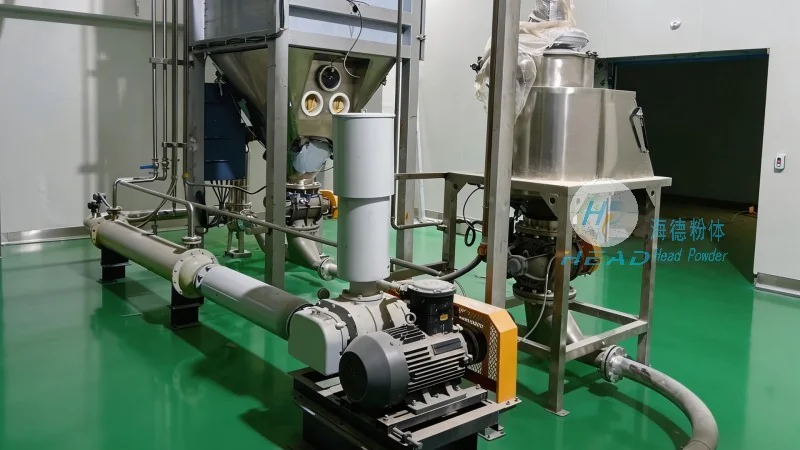
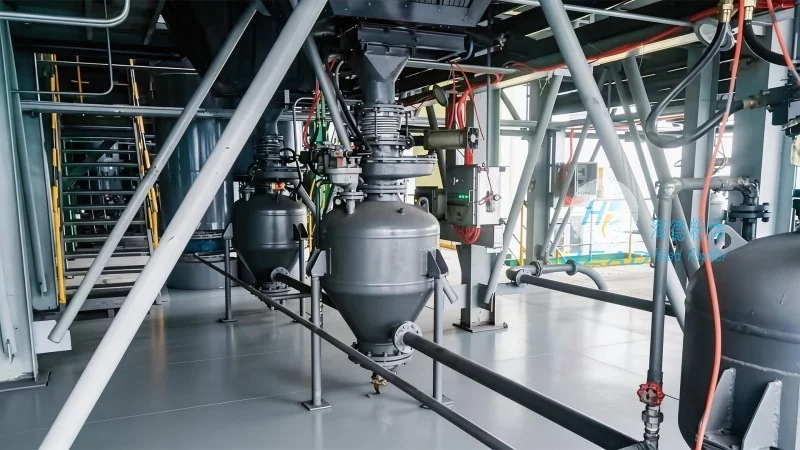
A typical pneumatic conveying system for algae powder comprises several interconnected modules: the feed hopper, a rotary valve or screw feeder, the conveying pipeline, a separation cyclone or bag filter, and a discharge station. The feed hopper should be designed with a steep cone angle (60–70 degrees) and a vibrating or fluidizing bottom to ensure consistent discharge of the cohesive powder. A rotary airlock is the most common feeding device, providing a positive seal between the hopper and the conveying line while metering the material. For algae powder, the rotor-tip clearance should be minimized (typically 0.1–0.3 mm) to prevent air leakage and material backflow. The pipeline itself should be constructed of stainless steel (304 or 316L) with a surface finish of Ra ≤ 0.8 µm to reduce friction and adhesion. Bends should be long-radius (R/D ≥ 10) or use blind-tee designs to minimize erosion and particle breakage. For longer distances, intermediate boosters may be incorporated to maintain pressure. At the receiving end, a high-efficiency cyclone (95% removal efficiency for particles >10 microns) followed by a pulse-jet bag filter ensures near-zero dust emissions. A rotary discharge valve at the bottom of the cyclone or filter enables direct transfer to downstream process equipment such as mixers, packaging machines, or storage silos. For applications requiring hygienic transfer—such as in food or pharmaceutical algae powder production—the entire system should be cleanable via CIP (Clean-in-Place) cycles, with 316L stainless steel, sanitary clamps, and no dead legs. The electrical and control panel should be rated for dust-explosion-hazardous zones (ATEX or NEC Class II, Division 2) since algae powder is combustible. The 2026 technical trend shows increasing adoption of IoT-enabled control systems that provide real-time data on energy consumption, conveying rate, and filter differential pressure, facilitating optimization and energy savings of up to 20% compared to conventional fixed-speed blowers.

Operational Challenges and Mitigation Strategies

Despite careful design, operational challenges are inevitable when handling algae powder. The most common issue is line blockage, often triggered by a sudden increase in moisture, a change in particle size distribution, or an incorrectly set air velocity. Preventive measures include installing pressure sensors at strategic intervals along the pipeline and integrating an automatic purge cycle that uses pulses of high-pressure air to clear accumulated material. Another challenge is product degradation—algae powder contains fragile cell walls that can rupture under high shear. This not only reduces the nutritional value but also generates fine dust that can worsen filter loading and explosion risks. Dense-phase conveying with gentle acceleration zones and low-velocity regimes is the best mitigation. Material bridging in the feed hopper can be addressed using aeration pads or mechanical agitators such as a bridge breaker. A third challenge is dust explosion risk. Algae powder has a minimum explosible concentration (MEC) of approximately 60–80 g/m³ and a minimum ignition energy (MIE) of less than 10 mJ, making it highly sensitive to static sparks. Grounding all metallic components, using conductive hoses, and bonding flanges are mandatory. Explosion venting or suppression systems should be installed on cyclones and filters. In 2026, regulatory bodies in the United States (OSHA) and the European Union (ATEX Directive 2014/34/EU) have tightened requirements for combustible dust handling, and compliance is non-negotiable for any industrial installation. Headpowder has extensive field experience in deploying explosion-proof conveying systems for algae powder plants, with over 20 successful installations worldwide. For example, in a recent project for a large-scale Spirulina production facility in Southeast Asia, we designed a dense-phase system that reduced material loss by 12% and cut energy costs by 18% compared to the client’s previous lean-phase setup. The system now operates 24/7 with over 99% uptime, handling 3 tonnes per hour with negligible particle degradation.

Design Optimization and Selection Criteria

Choosing the optimal pneumatic conveying solution for algae powder requires a systematic evaluation of several trade-offs. Throughput capacity is a primary driver: for rates below 1 t/h, a simple vacuum system may suffice; for higher throughputs (1–10 t/h), positive pressure dense-phase systems are more efficient. Conveying distance is another factor. For distances under 50 meters, a vacuum system offers lower installation cost and easier cleaning. For longer distances—up to 500 meters—a pressure system with intermediate boosters becomes necessary. Material condition also matters: if the algae powder has been spray-dried and is relatively free-flowing, a lean-phase system might be acceptable; but if it is oil-rich or high in moisture, dense-phase is strongly recommended. Capital investment and operating costs must be balanced. Dense-phase systems typically have higher initial cost due to more complex controls and larger compressors, but they consume 30–50% less energy per ton conveyed and produce less wear and tear. The payback period is often less than two years for high-volume operations. When evaluating suppliers, look for those that offer comprehensive pilot testing and computational fluid dynamics (CFD) simulations. A reputable engineering partner will validate the conveying characteristics of your specific algae powder in a test loop before finalizing the design. Headpowder’s in-house test facility is equipped with a 100-meter closed-loop conveying system capable of replicating all common conveying regimes, and we provide detailed reports that include optimal velocity, pressure drop, and air consumption data. This customized approach reduces risk and ensures that the final solution meets or exceeds performance guarantees. Our team holds certifications in process safety management and powder technology, and we adhere to standards such as ASME B31.3, ISO 9001, and the European Machinery Directive. When you work with us, you receive not only a piece of equipment but a complete engineered solution tailored to your algae powder formulation.

Installation, Commissioning, and Maintenance Best Practices

A successful algae powder pneumatic conveying project extends beyond design and component selection. Proper installation is critical: pipelines must be supported at intervals to prevent sagging and accumulation of material, and all joints should be sealed with gaskets suitable for food-grade contact if required. During commissioning, a step-by-step ramp-up procedure is recommended—starting with air-only tests, then low-rate material feeding, and gradually increasing to full design capacity while monitoring pressure and flow. Adjustment of air velocity and feeder speed may be needed based on real-time observations. A detailed standard operating procedure (SOP) should be developed for operators, covering start-up, shutdown, and emergency stop sequences. Preventive maintenance intervals depend on the abrasiveness and corrosiveness of the algae powder. For typical applications, weekly inspection of filters and rotary valves, monthly lubrication of bearings, and quarterly checking of pipe thickness at bends are advisable. Spare parts such as rotary valve blades, filter bags, and pressure sensors should be kept in stock to minimize downtime. Remote monitoring capabilities, offered as an optional upgrade by headpowder, allow the system to alert maintenance personnel via mobile notifications when a filter differential pressure exceeds a threshold or when the conveying rate deviates from setpoint. This predictive approach reduces unscheduled outages and extends equipment life. Our service team offers annual maintenance contracts that include on-site inspections, software updates, and performance optimization. In 2026, the industry is moving toward condition-based maintenance enabled by machine learning algorithms that analyze vibration data and pressure trends to predict component failure weeks in advance.

Case Study: Optimizing Algae Powder Transfer at a Nutraceutical Facility

A leading producer of organic Spirulina powder contacted headpowder to address frequent blockages and high product degradation in their existing dilute-phase conveying system. The facility processed 2.5 tonnes per day and needed to expand capacity to 5 tonnes per day without increasing floor space. After analyzing the material properties—bulk density 0.45 g/cm³, moisture 4.5%, particle D50 120 microns—our engineering team proposed a conversion to a dense-phase pressure system with a 75 mm diameter pipe and a conveying distance of 120 meters. A pilot test at our facility confirmed that a velocity of 6 m/s at a solids-to-air ratio of 12:1 yielded smooth flow with less than 0.5% particle breakage. The existing rotary valve was replaced with a low-speed, drop-through design with hardened steel rotor tips. We also installed a moisture control system that dried the compressed air to a dew point of -40°C, preventing moisture absorption. Within three months of commissioning, the new system achieved a throughput of 5.2 tonnes per day with 99.2% uptime. Energy consumption dropped by 34%, and the client reported a 15% improvement in final product quality, as measured by phycocyanin content retention. The total return on investment was realized in 14 months. This project demonstrates that a carefully engineered pneumatic conveying solution not only solves operational pain points but also unlocks production scalability and product value. For any inquiry regarding your specific algae powder conveying requirements, headpowder can provide a free feasibility assessment and a detailed technical proposal. (咨询热线:156-6277-7102)

Future Trends and Technological Advancements

The pneumatic conveying industry is witnessing rapid innovation, and algae powder handling is no exception. The integration of artificial intelligence and digital twins is becoming more common, allowing operators to simulate different conveying scenarios and optimize parameters without disrupting production. Advanced sensor technologies—such as acoustic emission sensors and electrostatic charge monitors—are enabling real-time detection of particle velocity, mass flow, and even moisture content inside the pipe. This data can feed into a closed-loop control system that adjusts air injection rates and feed speeds dynamically. Another emerging trend is the use of hybrid conveying systems that combine dense-phase with a small amount of dilute-phase at the entry point to improve material pickup. In 2026, sustainability demands are driving equipment manufacturers to develop energy recovery systems that capture waste pressure from the conveying line and reuse it for air compression. Headpowder is at the forefront of these trends, investing in R&D to reduce the carbon footprint of our systems. Our latest design incorporates a variable-frequency drive (VFD) blower that automatically matches air flow to the actual conveying demand, achieving energy savings of up to 25% compared to fixed-speed equivalents. Additionally, we offer modular and skid-mounted designs that reduce installation time and allow future capacity expansion with minimal disruption. As algae continues to gain traction as a sustainable source of protein, omega-3 fatty acids, and biopolymers, the demand for reliable, high-performance pneumatic conveying will only increase. By staying abreast of these developments and partnering with an experienced engineering firm like headpowder, producers can ensure their material handling infrastructure remains a competitive advantage rather than a bottleneck.

相关推荐

Shandong headpowder Engineering Co., Ltd. All rights reserved.

回到顶部