
With over a decade of experience in the pneumatic conveying industry, our company specializes in a full range of pneumatic conveying system equipment.
您的当前位置:首页 >> News >> Technical FAQ

News

Rich project cases across industries, showing real implementation and proven technical strength.

Sintered lime pneumatic conveying equipment system overview

2026-07-20

Efficient, reliable, and environmentally responsible material handling is a cornerstone of modern industrial operations. In sectors such as steelmaking, power generation, chemical processing, and waste treatment, sintered lime—a high-calcium quicklime product with enhanced reactivity—demands specialized pneumatic conveying solutions. Unlike conventional limestone or hydrated lime, sintered lime exhibits unique physical properties including higher density, irregular particle shapes, and a tendency to absorb moisture, which challenge standard conveying systems. As global industry moves toward stricter emission targets and higher production efficiency in 2026, selecting the right pneumatic conveying equipment for sintered lime is no longer a simple procurement decision. It is a strategic investment that directly impacts operational uptime, product quality, and total cost of ownership.

This article provides a comprehensive overview of sintered lime pneumatic conveying equipment systems, examining key design principles, system configurations, component selection criteria, industry trends, and practical operational considerations. Whether you are a plant engineer evaluating a greenfield project or a maintenance manager seeking to upgrade an existing system, the insights shared here will help you navigate the complexities of moving sintered lime safely and efficiently.

Understanding Sintered Lime and Its Pneumatic Conveying Challenges

Sintered lime, often produced by calcining limestone at temperatures exceeding 1200°C, differs significantly from ordinary quicklime. Its internal pore structure is partially closed during sintering, resulting in higher bulk density (typically 1.1–1.3 t/m³) and lower specific surface area. These characteristics create distinct conveying obstacles. First, sintered lime particles are abrasive—their angular shape wears down pipeline elbows and valves more rapidly than softer materials. Second, the material is hygroscopic; even minor moisture exposure can cause caking, bridging, or complete blockages in conveying lines. Third, sintered lime dust poses respiratory hazards, requiring enclosed systems with robust filtration. Finally, thermal sensitivity means that prolonged transport at high velocities can degrade product quality. Overcoming these challenges demands a thoughtfully engineered pneumatic system that balances pressure, velocity, and material conditioning.

Sintered lime pneumatic conveying equipment system overview

Core System Architectures: Pressure vs. Vacuum Conveying for Sintered Lime

Two primary pneumatic conveying modes are employed for sintered lime: dilute phase and dense phase. Within each, the choice between positive pressure (pressure conveying) and vacuum (suction conveying) depends on distance, capacity, and plant layout.

Sintered lime pneumatic conveying equipment system overview

Dilute Phase Pressure Conveying – This method suspends sintered lime in a high-velocity air stream (20–35 m/s) and pushes it through the pipeline. It is suitable for shorter distances (under 100 meters) and moderate capacities (1–10 t/h). However, the high velocity accelerates wear on bends and reduces energy efficiency. HeadPowder’s industrial experience shows that dilute phase systems are typically chosen for feeding small hoppers or for applications where multiple discharge points are not required.

Dense Phase Pressure Conveying – Operating at lower air velocities (3–10 m/s) and higher material-to-air ratios, dense phase systems move sintered lime in slugs or fluidized plugs. This approach significantly reduces particle attrition, pipeline wear, and energy consumption. For distances exceeding 100 meters or capacities above 10 t/h, dense phase is the preferred configuration. HeadPowder has deployed numerous dense phase systems in steel desulfurization plants, where sintered lime must travel 150–300 meters without degradation.

Vacuum Conveying Systems – Vacuum systems draw material from multiple pick-up points into a central receiver. They are ideal for safe unloading from bulk tankers or for reclaiming spillage. However, vacuum systems are limited in distance (typically under 80 meters) and require careful filter maintenance to prevent vacuum pump damage from fine lime dust.

In 2026, the industry trend is shifting toward hybrid systems that combine pressure and vacuum stages. For example, a vacuum pickup from storage silos followed by dense phase pressure transfer to remote use points offers both flexibility and reliability.

Sintered lime pneumatic conveying equipment system overview

Key Components of a Sintered Lime Pneumatic Conveying System

Every reliable system depends on correctly selected and integrated components. The following list outlines the critical elements for sintered lime service:

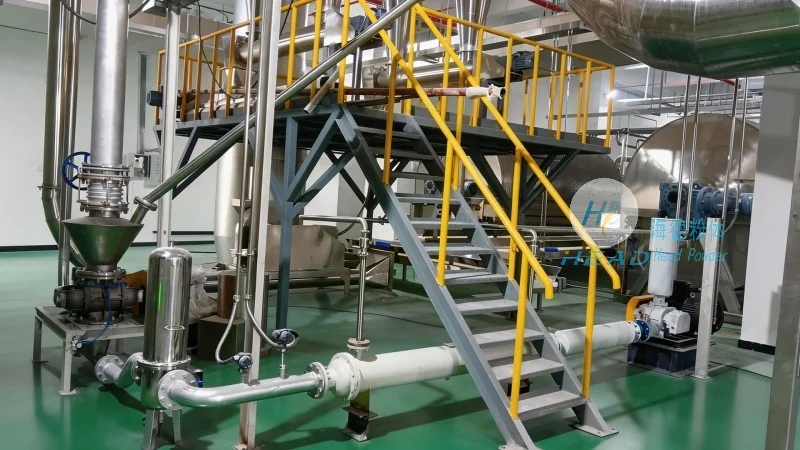
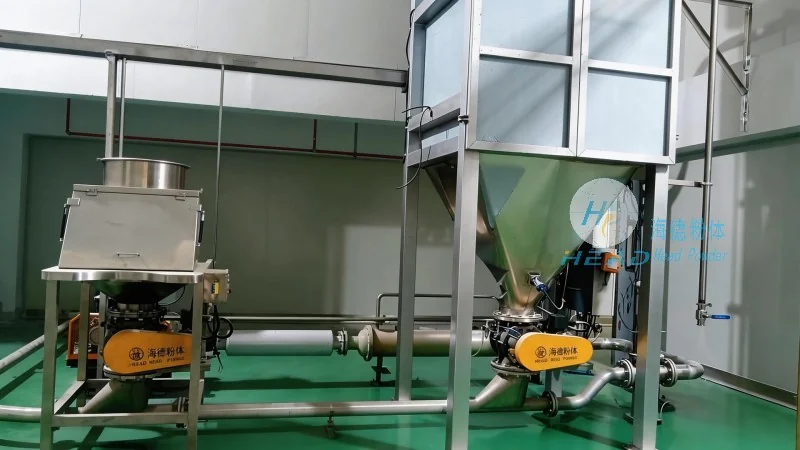
  • Rotary Airlock Valves – Must feature hardfaced tips and adjustable rotor-to-housing clearances to handle abrasive particles. A tapered rotor design reduces jamming caused by material compaction.
  • Blowers and Compressors – Positive displacement blowers (Roots type) are common for dilute phase; screw compressors or high-pressure boosters are preferred for dense phase due to their ability to maintain stable pressure at low flow.
  • Pipeline and Bends – Schedule 40 or thicker carbon steel is standard, but wear-resistant ceramic-lined bends or induction-hardened elbows extend life by 3–5 times. Long-radius bends (R/D ratio ≥ 10) reduce particle impact energy.
  • Diverters and Diverter Valves – For systems serving multiple destinations, flapper-type or plug-type diverters with purge ports prevent cross-contamination and clogging.
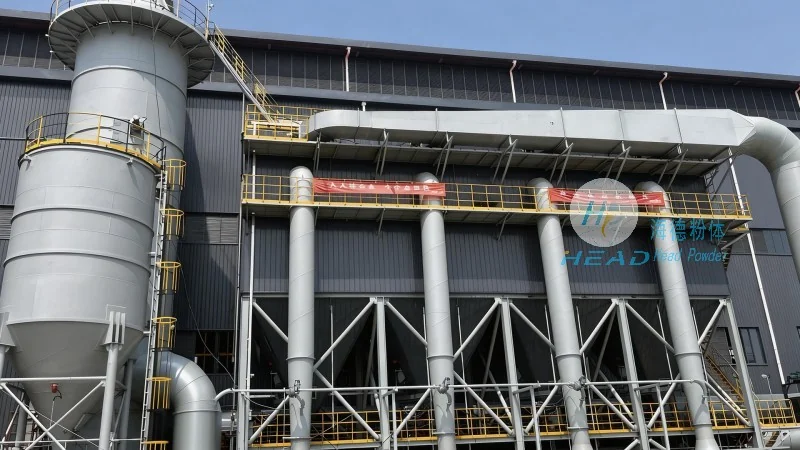
  • Receivers and Filters – Cyclone separators paired with pulse-jet cartridge filters achieve 99.9% dust collection. Filter media should be anti-static and moisture-resistant to handle sintered lime’s affinity for humidity.
  • Moisture Control Systems – Desiccant dryers or heated air blowers ensure compressed air dew point remains below -20°C, preventing lime hydration within the conveying line.
  • Instrumentation and Controls – Pressure transmitters, flow meters, and weight-based batching controllers enable precise material metering. HeadPowder’s smart control platforms integrate with plant DCS for real-time monitoring.

System Design Parameters and Performance Optimization

Designing a sintered lime pneumatic conveying system requires accurate material characterization. Key parameters include particle size distribution (typically 0–5 mm), bulk density, angle of repose, and abrasion index. Industry best practice recommends conducting a conveying test with representative material samples before finalizing pipe diameter, line length, and compressor sizing. Common design pitfalls to avoid:

  • Undersized pipeline diameter causing saltation (material settling) and frequent blockages.
  • Overusing booster air injectors—while they help restart slumped material, excessive boosters increase energy waste and wear.
  • Neglecting blow-down cycles when the system stops; residual lime can harden inside the line, requiring costly manual cleaning.

HeadPowder engineering teams apply computational fluid dynamics (CFD) modeling to simulate air-solids flow patterns, optimizing bend placement and velocity gradients. Data from over 200 installed systems shows that optimized dense phase designs reduce annual maintenance costs by 35–50% compared to standard dilute phase installations.

Market Trends and Technology Advancements in 2026

The global pneumatic conveying equipment market is projected to grow at a compound annual growth rate (CAGR) of 5.8% from 2024 to 2030, according to industry analysts. Within the lime sector, three trends dominate:

  • Digital Twin Integration – Predictive maintenance using digital twins allows operators to simulate wear patterns and schedule part replacements before failures occur. Several European steelmakers have reported 20% reduction in unplanned downtime after adopting digital twin systems for their lime conveying lines.
  • Low-Carbon Conveying – Energy-efficient screw compressors with variable frequency drives (VFD) cut electricity consumption by up to 30%. Combined with heat recovery from compressor cooling loops, these systems contribute to scope 2 emission reduction goals.
  • Autonomous Cleaning – Automated pigging systems that periodically send a cleaning projectile through the pipeline are gaining traction. They remove built-up lime deposits without requiring manual disassembly, supporting continuous operation in 24/7 plants.

HeadPowder has integrated these advancements into its latest product line, the HPDC-SL series, which includes built-in sensors for real-time wear monitoring and remote diagnostics capabilities.

Practical Case Study: Dense Phase Conveying for a Steel Desulfurization Plant

To illustrate real-world performance, consider a 1.5 million ton-per-year integrated steel mill that upgraded its desulfurization station in 2025. The facility required transferring sintered lime from a central storage silo to four injection hoppers located 180 meters away, with a capacity of 12 t/h per hopper. Initial dilute phase design proposals called for 8-inch lines with three booster air injectors, estimated annual energy cost of $85,000, and pipeline replacements every two years due to wall thinning. HeadPowder proposed a dense phase solution using 6-inch lines, a single rotary screw compressor (250 kW), and a proprietary pressure-control algorithm that maintains plug flow. Results after the first year of operation: energy consumption dropped to $52,000 annually; pipeline inspection showed less than 0.1 mm wall loss; unscheduled downtime reduced by 70%. The mill now plans to expand the system to serve three additional silos.

Installation, Commissioning, and Maintenance Best Practices

Proper installation is as critical as design. Key steps include:

  • Pre-cleaning all pipelines with compressed air and a foam projectile to remove construction debris.
  • Verifying that all flanges are aligned within 1 mm tolerance to avoid gasket leaks that can introduce moist air.
  • Calibrating pressure sensors at multiple points along the line to detect early signs of plugging.

Routine maintenance should focus on rotary valve tip clearances (check monthly), filter cartridge differential pressure (replace when exceed 200 Pa), and compressor oil quality. HeadPowder offers comprehensive commissioning services, including on-site operator training and a 24/7 remote monitoring platform. For plants operating in humid coastal regions, an additional recommendation is to install a desiccant dryer on the compressed air supply, even if the main plant air system seems sufficient.

Selecting the Right Partner for Sintered Lime Conveying Equipment

Not all pneumatic conveying manufacturers have deep experience with sintered lime. When evaluating suppliers, consider their track record in handling abrasive, hygroscopic, and high-temperature materials. Look for:

  • Proprietary material test data and in-house flowability testing labs.
  • References from similar industries (steel, cement, waste-to-energy).
  • Warranty terms that cover both components and system performance guarantees.

HeadPowder has dedicated more than a decade to refining sintered lime conveying technology. Our engineering team includes specialists with backgrounds in bulk solids handling and powder mechanics, ensuring that each system is tailored to the specific particle characteristics and operational constraints of the client. From concept design through installation and after-sales support, we deliver systems that maximize uptime and minimize total life-cycle cost. For inquiries regarding your specific project requirements, please contact us at (咨询热线:156-6277-7102).

Conclusion: Building a Reliable Conveying Foundation for Tomorrow

The demands placed on sintered lime pneumatic conveying equipment continue to evolve alongside stricter environmental regulations, rising energy costs, and the push for digitalization. A system that performs well today may become a bottleneck tomorrow if not designed with scalability and adaptability in mind. By prioritizing dense phase technology, selecting wear-resistant components, integrating smart monitoring, and partnering with an experienced specialist like HeadPowder, plant operators can achieve consistent material flow, reduced carbon footprint, and improved profitability. Whether your focus is on new installations or retrofitting existing lines, investing in a properly engineered sintered lime conveying system is an investment in long-term operational excellence.

相关推荐

Shandong headpowder Engineering Co., Ltd. All rights reserved.

回到顶部