
With over a decade of experience in the pneumatic conveying industry, our company specializes in a full range of pneumatic conveying system equipment.
您的当前位置:首页 >> News >> Technical FAQ

News

Rich project cases across industries, showing real implementation and proven technical strength.

Potassium hydroxide pneumatic conveying technical solution overview

2026-07-20

Potassium hydroxide (KOH) is a highly hygroscopic and corrosive alkali widely used in industries such as chemical manufacturing, fertilizer production, soap and detergent processing, and water treatment. The pneumatic conveying of potassium hydroxide presents unique challenges due to its tendency to absorb moisture, agglomerate, and react with equipment materials. A well-engineered pneumatic conveying technical solution is essential to ensure safe, efficient, and reliable handling while minimizing product degradation and operational downtime. This article provides a comprehensive technical overview of potassium hydroxide pneumatic conveying, covering system design principles, component selection, control strategies, safety considerations, and industry trends through 2026. Drawing on practical engineering experience and case studies, the discussion aims to help plant managers, process engineers, and procurement professionals make informed decisions when selecting a conveying system for their specific application.

Fundamental Properties of Potassium Hydroxide Relevant to Pneumatic Conveying

Understanding the physical and chemical properties of potassium hydroxide is the first step in designing an effective pneumatic conveying system. Potassium hydroxide is available in various forms, including flakes, pellets, and powders. The bulk density typically ranges from 0.9 to 1.2 g/cm³, while the particle size can vary from fine dust to granular material. Its high hygroscopicity means that even small exposure to ambient moisture can cause caking and bridging inside conveying lines, hoppers, and receiving vessels. Additionally, KOH generates significant heat when dissolved in water, and in the presence of moisture it can corrode carbon steel and many alloys. These characteristics demand that the pneumatic conveying system be completely sealed, moisture-free, and constructed from corrosion-resistant materials such as stainless steel 316L or specialized polymers. The conveying air must be dehumidified to a dew point below -40°C to prevent moisture absorption during transport. The system design must also account for the abrasive nature of KOH particles, which can wear out bends, diverter valves, and other high-impact areas over time.

Potassium hydroxide pneumatic conveying technical solution overview

System Type Selection: Dilute Phase vs. Dense Phase Conveying

The selection between dilute phase and dense phase pneumatic conveying depends on the material characteristics, required throughput, distance, and process constraints. For potassium hydroxide, dilute phase conveying—where particles are suspended in a high-velocity airstream—is generally suitable for short distances and moderate capacities below 10 tons per hour. However, the high velocity increases particle attrition and pipe wear, and the risk of moisture absorption is higher due to increased air contact. For longer distances, higher capacities, or when product integrity is critical, dense phase conveying is the preferred technical solution. In dense phase systems, material is pushed through the pipeline in slugs or plugs at lower air velocities, significantly reducing degradation, wear, and moisture-related issues. For potassium hydroxide handling, dense phase conveying also allows for better control of dust emissions and lower energy consumption per ton of material moved. Many modern installations integrate both modes in a single system using a combination of pressure vessels, rotary valves, and variable-speed air supply to adapt to changing process demands. headpowder’s engineering team has extensive experience designing custom dilute and dense phase systems for potassium hydroxide, and clients can contact them for specific technical feasibility studies. (咨询热线:156-6277-7102)

Potassium hydroxide pneumatic conveying technical solution overview

Key Components and Material Selection for KOH Pneumatic Conveying

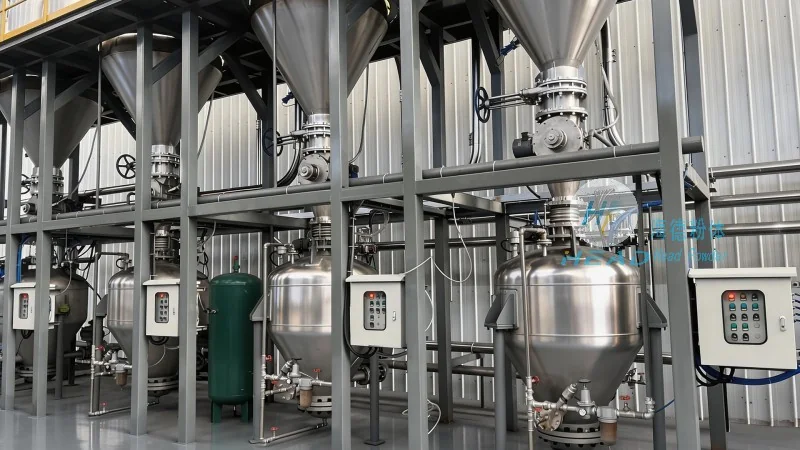
A robust pneumatic conveying system for potassium hydroxide must be built from carefully selected components. The following list highlights critical elements and their design considerations:

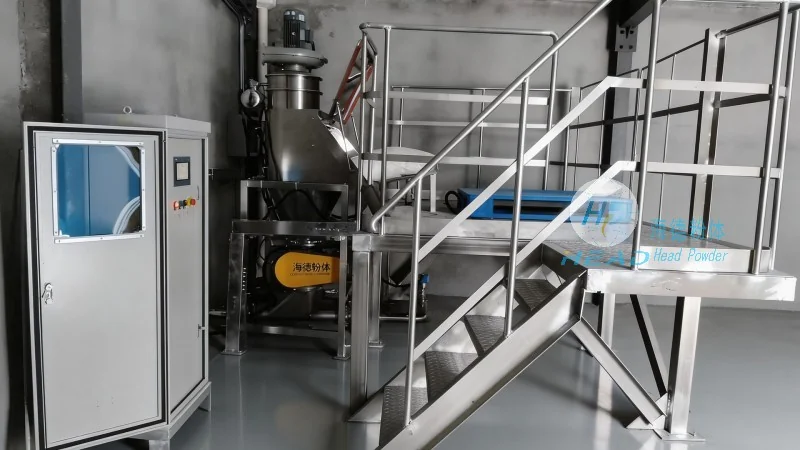
  • Feeding device: Rotary airlocks or screw feeders must be constructed from stainless steel 316L with hardened wear surfaces. The casing should include flushing ports for cleaning and inspection. For hygroscopic materials like KOH, nitrogen purging is recommended to maintain an inert atmosphere inside the feeder.
  • Conveying pipeline: Straight sections should be made of seamless stainless steel 316L or 904L, with wall thickness no less than 4 mm for standard diameters (DN80 to DN150). Bends must be long-radius with replaceable wear backings or ceramic-lined inserts to extend service life.
  • Air supply and drying: Compressed air must pass through a refrigeration dryer and a desiccant dryer to achieve a pressure dew point of -50°C or lower. Oil-free compressors are mandatory to prevent contamination. Air filters with 0.01 micron efficiency should be installed downstream of the dryers.
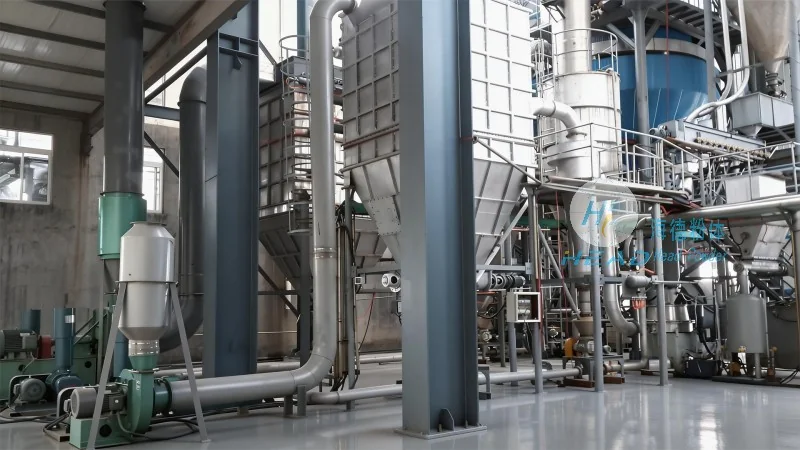
  • Receiving vessel (silo or hopper): The vessel must be equipped with a vent filter (reverse-jet type) to capture fine dust. The internal surface should be polished to an Ra of 0.8 µm or better to prevent material buildup. Level sensors and pressure transmitters provide feedback for automated control.
  • Diverter valves and couplings: Flap-type or rotary diverters with stainless steel bodies and PTFE seals are recommended. Quick-disconnect couplings should be used for routine maintenance without tools.
  • Control system: A programmable logic controller (PLC) with a human-machine interface (HMI) manages start/stop sequences, air pressure regulation, flow rate monitoring, and alarm handling. Integration with the plant’s distributed control system (DCS) is standard for large-scale operations.

Technical Parameters and Sizing Criteria for System Design

Accurate sizing of a potassium hydroxide pneumatic conveying system requires calculation of several key parameters. The conveying distance (horizontal and vertical), number of bends, material bulk density, particle size distribution, and required throughput all influence the design. For typical KOH flakes with a mean particle size of 1.5–3 mm and bulk density of 1.1 g/cm³, a dilute phase system might operate at an air velocity of 18–25 m/s and a solid-to-air ratio of 5–10 kg/kg. In contrast, a dense phase system would operate at 4–8 m/s with a solid-to-air ratio of 15–30 kg/kg. The conveying line diameter is selected based on the required capacity and acceptable pressure drop. For capacities up to 20 tons per hour over a distance of 100 meters, a DN100 pipeline with a pressure drop of 0.5–0.8 bar per 100 meters is common. The air supply pressure must be at least 1.5 times the system pressure drop to ensure stable flow. headpowder’s engineers use proprietary software and empirical data from over 200 installed systems to optimize these parameters, ensuring minimal energy consumption and maximum reliability.

Safety and Environmental Considerations in KOH Handling

Due to the corrosive and reactive nature of potassium hydroxide, safety is paramount in system design. All pipelines and vessels must be grounded to prevent static electricity buildup, which can ignite dust clouds. Explosion relief panels or suppression systems should be installed on receiving vessels, especially when handling fine KOH powders. The conveying system must be completely sealed with no leak points, as airborne KOH dust can cause severe respiratory and skin irritation. Emergency shut-off valves and purge systems allow for rapid isolation in case of a leak or blockage. In terms of environmental compliance, the system must include high-efficiency particulate air (HEPA) filters on exhaust vents to meet local emission standards. Wastewater from cleaning operations should be neutralized before discharge. As the industry moves toward stricter sustainability targets in 2026, many KOH processing facilities are adopting closed-loop pneumatic conveying systems that recycle conveying air and reduce overall energy usage by up to 30%. headpowder’s solutions are designed with these environmental considerations in mind, incorporating energy recovery options and low-maintenance filtration.

Common Operational Challenges and Troubleshooting

Even with proper design, operators may encounter issues that require systematic troubleshooting. One frequent problem is material bridging at the hopper discharge or feeder inlet. This is often caused by moisture ingress; solutions include installing heated hopper jackets, using vibratory bin activators, or replacing the feeding device with a live-bottom screw feeder. Another challenge is excessive pipe wear at bends, which can be mitigated by substituting standard bends with ceramic-lined or hardened steel bends. Blockages in the conveying line can occur if the air velocity drops below the saltation velocity; installing pressure sensors at regular intervals and adjusting the air supply or using boosters can resolve this. Dust leakage from rotary valves or diverter seals can be addressed by inspecting seal integrity and replacing worn components. headpowder provides comprehensive operation and maintenance manuals with each system, and their service team offers remote diagnostics and on-site support to minimize downtime.

Industry Applications and Real-World Case Studies

Potassium hydroxide pneumatic conveying systems are deployed across multiple sectors. In the chemical industry, they transport KOH from railcar unloading stations to storage silos and then to reactor feed systems. A notable case involved a global surfactant manufacturer that upgraded its conveying system from manual bag dumping to an automated dense phase solution designed by headpowder. The new system handles 15 tons per hour over a 120-meter distance with less than 0.2% product loss, compared to over 2% loss previously. In the soap and detergent sector, KOH flakes are conveyed to mixing vessels where they are dissolved in water. One soap producer reduced its labor costs by 60% after installing a fully enclosed pneumatic system that eliminated dust and sloshing. In water treatment plants, KOH is used for pH adjustment; a municipal facility in Southeast Asia adopted a custom dilute phase system that operates 24/7 with only two hours of scheduled maintenance per month. These examples highlight how a well-engineered solution not only improves safety and reliability but also drives measurable operational savings.

Market Trends and Technology Developments Through 2026

The global potassium hydroxide market is projected to grow at a compound annual growth rate of 5.1% from 2024 to 2026, driven by increasing demand for lithium-ion batteries (KOH is used in the manufacturing process) and agrochemicals. This growth places higher demands on material handling systems for higher capacity, lower energy consumption, and better automation. Industry trends include the adoption of smart sensors and IoT-enabled monitoring that provide real-time data on air pressure, material flow, and equipment health. Predictive maintenance algorithms can forecast component wear and schedule repairs before failure occurs. Additionally, the use of computational fluid dynamics (CFD) simulation in the design phase is becoming standard practice, allowing engineers to optimize air flow and minimize pressure drops before installation. Another emerging trend is the integration of pneumatic conveying with automated guided vehicles (AGVs) for flexible material routing. headpowder’s R&D team is actively incorporating these technologies into new system designs, ensuring clients receive future-proof solutions that meet evolving market needs.

Why Partner with headpowder for Potassium Hydroxide Pneumatic Conveying Solutions

Selecting the right engineering partner is critical for long-term success. headpowder has been delivering pneumatic conveying systems for alkali and hygroscopic materials since 2008, with over 300 installations worldwide. Our team of process engineers, mechanical designers, and automation specialists work collaboratively to develop solutions that address the specific challenges of potassium hydroxide handling. We conduct thorough material testing in our lab, including shear cell analysis, moisture sensitivity tests, and particle attrition studies, to validate design assumptions. Every system is built in our ISO 9001-certified facility and undergoes a full factory acceptance test before shipment. Post-installation, we provide commissioning support, operator training, and a two-year warranty on all major components. Our clients appreciate our transparent approach, competitive lead times, and responsive after-sales service. For detailed technical consultation or a feasibility study tailored to your facility, you can reach our team through the contact number provided earlier.

Conclusion: Building a Reliable and Efficient Potassium Hydroxide Conveying System

A successful potassium hydroxide pneumatic conveying technical solution balances material properties, process requirements, safety standards, and long-term operational economics. From careful material selection of equipment to precise control of air quality and velocity, every detail matters. The industry is evolving rapidly, with higher automation, better energy efficiency, and stricter environmental regulations shaping system design. Companies that invest in a robust, professionally engineered conveying system benefit from reduced product waste, lower maintenance costs, improved workplace safety, and higher production reliability. Whether you are planning a new facility or upgrading an existing system, partnering with an experienced supplier like headpowder ensures that your solution is optimized for both current and future needs. A comprehensive approach—combining technical expertise, real-world data, and continuous innovation—will deliver the performance that KOH processing demands.

相关推荐

Shandong headpowder Engineering Co., Ltd. All rights reserved.

回到顶部